I just started a new book. Reading, not writing. As with many written offerings, before I turned to the first page of the story I was presented by the author an epigraph. A short 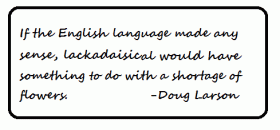 excerpt from I presume one of his favorite authors. I always read them. They often provide a glimpse into the authors mind at the time he or she was working on that piece. But it wasn’t until this time, this epigraph, that I really stopped to think about what I was reading. Not the metaphorical, the inside glimpse, etc., etc., etc. The actual. Why that the epigraph, those borrowed words, are indeed an epigraph.
Why “epigraph” and not “group of words?” Who decided this group would be an epigraph. And how did that person come to that conclusion. We have too many words in our language. Just reading this post you’ll read and at least unconsciously recognize five groups of words: title, sentence, paragraph, post, and epigraph. You could throw in phrase and incomplete sentence. And now that I think about it, question. It actually goes on and on. And on.
Where do they all come from? Not the words. Not in English at least. We know where they come from. They come from every other language on earth. The English language is said to have close to a million words in it. I’m not sure who counted that but the most complete, or as they would put it unabridged dictionary of the English language, the Oxford English Dictionary, has about 620,000 words. But language doesn’t equal vocabulary. And vocabulary doesn’t equal language. The average educated English speaking person knows around 20,000 words and uses but about 2,000 words in a week of talking and writing. )I know, sometimes it seems that I try to cram all 2,000 into a single post but that’s a different post for a different day.)
 So that brings me back, do we need all those words? If they made sense I’d be happy to learn all 600,000 words. But so many of them don’t make any sense. Look at two of the ones that I mentioned: epigraph and paragraph. Both have “graph” and both are similar in that they are a group of words. But when I think of graph I think of a picture.
Let’s concede that “graph” actually means “to write” and see how we’ve modified it with the prefixes “epi” and “para.” Neither really gives a clue as to what we are writing. “Epi” comes from ancient Greek meaning on or upon like the epidermis of your skin. “Para” is also borrowed from the old Greeks and means side by side, like the lines of a parallelogram. So an “epigraph” is actually a “picture on top” and when we call a group of words that come after each other “paragraphs” we are actually calling them “pictures that are side by side.”
 And if that’s not enough, then we have to use words that we know don’t fit a particular situation because that’s the in way to speak and Heaven forbid we aren’t trendy. For example good can’t be good. Since the time when I was torturing my parents with popular vocabulary “good” has been groovy, cool, bad, righteous, divine, outstanding (emphasis on the out), epic, excellent, rad, sick, and ridiculous. But what did they expect? They’re the generation that came up with cat’s pajamas and bee’s knees. Unfreakin’ believable.
No wonder I’ve been so misunderstood all my life.
That’s what I think. Really. How ’bout you?
 On the first round through the down clues I came across another present from the riddler until I started filling in those squares. That’s when I ran smack dab into my Pinterest picture holder so to speak and discovered that one of those gifts was more fit for a Trojan. I left that one and moved over a space and found a similar misread. Hmmm, perhaps my image wasn’t the perfect picture. (Stop it!) It wouldn’t be the first time I encountered a gimme that was anything but. After all, if crossword puzzles were easy nobody outside of the Pyrenees would know what an ibex is.
 changed. I got an incurable condition. I got cancer. I beat cancer. I still have an incurable condition. Through it all I see this every morning. I have to. It’s on the wall above my toilet tank. It’s a great place for a bit of inspiration. At first I misinterpreted it to mean that if we want to live life to its fullest we have to physically beat the odds. We have to literally skid in sideways. Not so! As long as we don’t give in we won’t give up. I sort of like that expression. Maybe I’ll hang that on the wall too.
 The Real Reality Show Blog