Rewriting the dictionary

Most of you know I have a passion for old movies. I likewise enjoy old books, not old classics, but old popular fiction of another day. Although it didn’t start when I decided to make a quest of reading the source material for the movies I watched, it took a good, strong hold then. I’m currently working my way through the works of Erle Stanley Gardner, mostly those written under his name and most of them of  the famous “Perry Mason” series, and most of his “Cool and Lam” detective series published as by A. A. Fair. I’ve also read all of Raymond Chandler, and Dashiell Hammett, and good deal of S. S. Van Dine, and Michael Arlen, writers reaching from the 1950s back to the 1910s. Some recognizable, others not quite household names, most standing up well to the ravages of time.

Believe it or not, that was a tangent I got in. What I really want to talk about is how language changed. Or more appropriately, the words. Not how we have added words to our vocabulary, but of how we just quite willy-hilly change the meaning of a word for seemingly no good reason other than that’s what someone wants.

Quite a few changes have had to do with sex and sexuality and are well known. When Hammett wrote of visiting a gay night club, it was a place where people went for a fun night out, perhaps dining with dancing or a floor show. If Chandler wrote that something was queer, he meant Phillip Marlow was puzzled over something. When Arlen had a character make love (and it was always one as he made love to her, not they made love together) he had a male character lavish a woman with flowers, gifts, and nights out, perhaps holding hands or sneaking a goodbye kiss on the front porch. As people became more comfortable discussing sex and sexuality, they did not become more comfortable using the words to describe sex and sexuality so they borrowed these seemingly innocent words and gave them their more blushing, new meanings.

Some words changed meaning because they evolved into their new meanings, somewhat related to what they previously represented. Prior to World War II, when one retired, one stopped work for the day and went to bed. After the war it took to meaning leaving a room at any time of day, and eventually to the now most familiar term describing one who has quit their life’s work and entered their post-employment phase of life.

Many words changed because of the burgeoning computer age. These words did not change as much as they took on new meanings. Cloud, footprint, and firehouse are among words that have added to their definitions to include computing actions or activities. It is likely that 100 years from now, people will still refer to a visible mass of particles of condensed vapor suspended in the atmosphere as a cloud and by then maybe even still to a remote, digital storage system.

While I’m talking about changes, I’m proposing no word changes but I am considering changing the blog name. I am consolidating some personal projects under one umbrella site, iammichaelross.net. I expect that to be live within the next 10 days. My next blog post made be delivered to you as you are used to, The Real Reality Show Blog by WordPress or via the new site, also hosted by WordPress. (If you’re wondering, this change won’t affect ROAMcare.org which is an arm of a separate not for profit education foundation that I just happen to be partnered with.)


Speaking of ROAMcare, and talking about words, we mentioned a word not usually mentioned around the dinner table, propinquity, whose meaning also changed over time. We mention when we talk about why some people work so well together, seeming to mesh effortlessly as we talk about strange forces at work (and at home too) in the latest Uplift!

7045BBA1-037B-48F8-93E4-A54FF8A9E031


All you need…

You certainly have noticed that at the end of each post I include a teaser to the current ROAMcare blog. From the ROAMcare website we explained how I and my co-founding partner are attempting to help people “bridge the gap from existing to living and refresh your enthusiasm for life!” We aren’t special any way.  We are ordinary people who have a desire to live what years we have in positivity and to invite others to join us in that endeavor. Our blog posts are drawn from our experiences.

Last week’s message resounded with me more deeply than any we had yet published. It is the essence of bridging the gap from existing to living. Like so many of the most profound concepts, it’s strength lies in its simplicity. If I was to write a teaser for this blog it would be,“As we begin February and almost everybody’s first thought is of love, let us consider those we love with all types of love, and tell them we love them.”

Today I’m going to do something I’ve never done.Instead of a teaser to the current post I am reprinting it in its entirety. I feel the message is so needed to be heard by as many people as possible. If you would like to share the message please do. If you should, I only ask that you attribute it to ROAMcare.org. The original post can be found at https://www.roamcare.org/post/three-little-words

Thank you!


Three Little Words

The Oxford English Dictionary lists over 750,000 words in the English language. There are about 171,000 words in common usage. According to a 2007 article in the journal Science, Mathias Mehl and others reported the average American adult speaks about 16,000 words a day. Of all those words, we don’t use many of them to convey our most important messages. Perhaps that is because we only have one word for the most important message of them all – love.

As we begin February, almost everybody’s first thought is of love. For as much that goes on during this, the shortest month of the year, Valentine’s Day holds a lot of attention. Valentine’s Day indeed is for lovers. But love is for so many more!

Humans are social beings. We relish, in fact we need to be with and interact with other humans. Our connections with each other are often born of need but grow because we want to explore and deepen those connections with other individuals, certain individuals. All of those connections are some form of love. The Greeks did it well. They coined seven different words for love, one for each type of love – Romantic, Affectionate, Familial, Selfless, Playful, Committed, and Self love, Eros, Philia, Storge. Agape, Ludus, Pragma, and Philautia respectively. Each type of love exhibits its own characteristics, but no one is more important, more special, more “loving” than any other. And yet, we seldom hear people verbally express their love for others except in the case of Romantic or sometimes Familial love. We are more likely to tell others we love our jobs, we love pizza, we love to travel, or we love swimming, than we are to tell our best friend, “I love you.”

Love is a source of motivation and strength for us as individuals. All types of love can induce the release of dopamine, adrenaline and norepinephrine, the so-called “feel-good chemicals.” But to affect that release, a relationship with a specific other person must be realized. Simplistically speaking, each form of love demonstrates a specific relationship. Eros involves a physical connection with others. Pragma is characterized by an emotional connection with another. Agape is known by its selfless, almost one-way flow of compassion and concern. But there is no pure form of each love. Some characteristics of each of the seven types of love can be found in all of the seven types of love. And thus, any love can improve a person’s self-worth, build trust, or strengthen family and social ties.

Another trait of humans is the need for physical contact. Reported by the National Institutes of Health is a 1995 study on the significance of physical contact that proposes four hugs per day as an antidote for depression, eight hugs per day to achieve mental stability and twelve hugs per day to possibly affect real psychological growth. We see people engaging more universally in hugging throughout the seven love spectrum. Family members hug each other, care givers hug their charges, friends hug their friends!

We suggest that hugging is an outward sign of love. People respond positively to hugs just as they would to any other indication they are loved, whether a kiss, a physical touch, a clasped hand-shake, a warm smile, or a verbal acknowledgement that they are loved – being told, “I love you!!”

As we begin February and almost everybody’s first thought is of love, let us consider those we love with all types of love, and tell them we love them. If we’re willing to say so to a large pizza it should be easy to admit it to our loving, living connections, no matter what type of love we feel for them. It’s just three little words out of so many you will say today.


0C23E9C8-F3DE-42D6-8418-2562CABD4E97


More words please

Once upon a time I wrote a post and I said, “The English language is said to have close to a million words in it. I’m not sure who counted that but the most complete, or as they would put it unabridged dictionary of the English language, the Oxford English Dictionary, has about 620,000 words. But language doesn’t equal vocabulary. And vocabulary doesn’t equal language. The average educated English speaking person knows around 20,000 words and uses but about 2,000 words in a week of talking and writing.” There are some things those 600,000+ words just aren’t up to task when it comes to describing them. As in them, the things that need describing, not the things that are described. See, right there, that’s where 620,000 words are just not enough. We need more words! And here are some examples.

Blog Art (24)Speaking of things that describe, we’ve been so busy lately so busy making up rules about pronouns to effectively represent people, that we’ve missed it completely that when it comes to things. When writing, or speaking or even texting (although I hesitate to include text message characters as representative of the English language), and reference is made to two objects introduced in the same sentence, in subsequent reference to one or both (or even more!) our current batch of pronouns is woefully inadequate. And we end up writing things like, “As in them, the things that need describing, not the things that are described.”  We need a good shorthand way to refer to thing one and thing two through the duration of the missive.

IMG_2448If I tell you to picture in your mind classic gray sweatpants, you know exactly what I mean. The picture in your mind is unambiguous. And you no doubt can fill in the rest of the catalog with several tops (long, short, and sans sleeves) and short versions of those pants. But what’s the stuff they are made of? We can describe it, but can we name it? Gray sweatsuit material is just too long. It’s usually cotton but to say, “it’s too warm today for long pants, I think I’ll exercise in my cotton shorts,” sounds like I’m headed to the gym in my underwear. Athletic wear is confused with athleisure which is just spandex you wear in the outside. Technically that gray stuff is a sort of flannel but if I say I plan to jog in my gray flannel suit, people will expect to see someone running down the street more formally attired than I’m comfortable running in. Nope, we need a new word for gray sweatsuit material and that’s that.
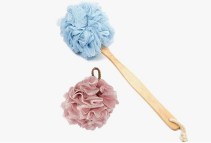
Body bathers, time for you to tell me what you call this: hmm, these:IMG_0027

While you’re wondering what kind of trick question this is, I’ll speak to the others for a moment. I figure there are three kind of showerers/bathers. There are those who use something like that picture, there are those who use a wash cloth, and there are those (usually very macho men who smell not much better apres shower) who stand under the water, make some squealing type sounds while lathering up with just the soap (usually bar soap) and slapping or rubbing it in with their bare hands. You’re going to say, “But what about loofah users? That makes 4 kinds.” I don’t think there are any loofah users left in the world. They’ve all died out from fungal skin infections from not properly washing their loofahs, which by the way, are not represented in that first picture. The things in that picture are puffs, body puffs or so they are called if you were to look for them on the internet. These are not to be confused with powder puffs, steel wool puffs, or crab puffs. Nor actual loofahs. The point is, there too many puffs. We can’t just call anything that is puffy a puff. We need at least 4 new words added to the army of 600,000.

Blog Art (23)

Actually, the real point is, I didn’t have anything to write about this week so I stretched things a bit. You might say, I published a piece of puff — but by no means, a puff piece!


Blog Art (22)Did you on June 29 Earth completed a full rotation on its axis 1.59 milliseconds ahead of schedule? Time flies! We talked about that last week at www.roamcare.org? Get over there now and read what we had to say.

While you’re there, check out the rest of our site, then share us with your friends and family!


Change of plans

Remember those best laid plans from a couple weeks ago? Earlier this week I saw a news blurb on one of the local stations about plans. It seems all the rage among the over 30 crowd is to not make plans. In fact, according a majority of 30-somethings interviewed, they are most happy when plans that have been made are cancelled. I know you may find this hard to believe, but I’m going to disagree with that. I remember life in my 30s. I was thrilled when something got cancelled because there was so much else going on, when something fell through, maybe I’d actually be able to do the things I had planned!

Perhaps we should better define “plan.” You likely “planned” to read my blog Thursday morning yet here you are, seeing it for the first time on Friday. Was that really a plan or more an anticipation or expectation (depending on how disappointed you were upon not finding it Thursday morning). I thought you would be reading this Thursday morning. Was that the plan? Or was that an intention? Likely you speak to someone early in the day and may be asked “So, do you have any plans for today?” And perhaps you do but more likely you have aspirations of doing things if other things don’t prevent that from happening. And lastly, if you have a desire to remove yourself from your day to day activities, take a break, perhaps two weeks in a tropical paradise you have never seen and may never see again and you don’t want to miss the plane or would like somewhere to stay besides in the open on the beach, you may request time off, purchase plane tickets, book a hotel room, maybe even make reservations for a local attraction or two for those weeks in the sometime future. This is a plan and one nobody will be “most happy” with if it is cancelled.

2 + 2 5 (1)

I think when the 30-somethings say they don’t make plans, they are speaking of the first three examples noted in the above paragraph. I am sure that somewhere, there is a 35 year old sitting with a couple tickets to Barbados, maybe pre-paid afternoon at the spa and reservations at the Salt Café in his (hers?, its?) phone’s wallet. It may think it a commitment (especially after the first few payments hit the Discover billing cycles) but it started out as a plan. Those other things like anticipating a blog post to hit your email or announcing a day’s probable agenda are possibly considered commitments by that unspecified 35 year old and it might not want to commit to lunch with the brother-in-law and then wash the car this Saturday afternoon and thus would prefer to “not make plans.”

I suppose it’s all in the words you use and even though the English  language gives us a bazillion from which to chose (over 600,000 per the Oxford English Dictionary, 39 for “plan”) we opt to use those that are most familiar to us and cause us to do the least amount of thinking to choose, while saying to everyone else “I know what I mean, figure it out yourself!”

I don’t know who decided that but I plan to look into it.

Speaking of Others

Trigger Alert!! Trigger Alert!! Arh-oooo-Gah!!! Warning! Warning! If you’re easily offended get the forlorn abyss of despair out of here. Proceed at your own risk. You have been warned! I’ll save you the trouble right now, the punch line is – Just be nice for Pete’s sake. (And who is this Pete?)

Now, on with the show!

Have we gone nuts? I’m speaking to the Americans now. You others might have also but I have no first hand knowledge of your nuttiness. Here, it’s a whole different story. Pretty close to a hole different story too if you ask me.

Exhibits 1 though 10: Penn State to ditch ‘male-specific’ student titles like freshmen.
That was the headline in one of the local papers on Tuesday. In my day (yeah yeah I know, that was back when “Leave it to Beaver” was considered high art and we saw how they bullied poor Lumpy and mistreated Mrs. Cleaver terribly, made her cook dinner in high heels and pearls!) …as I was saying, in my day we were too busy trying not to flunk out before freshman year was over to worry about what people were calling us. Of course, back in my day there weren’t majors in Surf Studies (as in Surfin’ USA, thank you Beach Boys) and Social Media Management (a whole different sort of surfin’), real honest to gosh Bachelor programs, Surf Studies is even a BS for Brian Wilson’s sake!

It doesn’t stop at Freshman for good old Penn State (who by the way ended up with over $100,000 of my money not terribly long ago – my money, not some student loan company government maybe you can get out of paying back money – so I feel I can call them out on their lunacy). In their eyes, technically in the eyes of the Faculty Senate (like the regular U.S. Senate isn’t filled with enough nut cases), the entire student reference is flawed. According to the Faculty Senate who drafted a comprehensive set of “inclusive and welcoming” recommendations, “Terms such as ‘junior’ and ‘senior’ are parallel to Western male father-son naming conventions,” No word on if sophomore is too sophomoric for sophomores to handle but that goes too. Instead, the classes will be First Year Students, Second Year Students, Third Year Students, Fourth Year Students, and for those in five-year programs, Fifth Year Students (currently known as fifth year seniors or, colloquially, Super Seniors – clearly that has to go).  I mean that’s not such a big deal except it’s going to be hard to fit “Fourth and Possibly Some Fifth Year Students’ Recognition Day” on the football tickets for the last home game.

Shall we continue? Upperclassmen will be no more. Where there are upperclassmen there are underclassmen and that is just so wrong on too many levels that the naming stress must be why so many underclassmen never pass their way to being upperclassmen. The First and Second Year Students will be referred to collectively as the Lower Division. The Third and Fourth Year Students will comprise the Upper Division.

Naturally they recommend doing away with he/him/his and she/her/hers, replacing those with they/them/theirs or non-gendered terms such as student, faculty member, staff member, and presumably coach although there was no mention if sports staff terminology will be an separate convention. (Coach Member may have been discussed and if it was, wouldn’t you have just loved to have been a fly on one of those wall?) I have always had an issue with they/them/theirs as a singular. Besides the fact that it/they are grammatically incorrect no matter what any easily coerced style manual may say, it appropriates the schizophrenics’ culture.

I’ve wondered this before. When somebody brings up the new “proper way” to refer to people so as to not offend, pronounly speaking, how do they feel about languages that have gender-based pronouns for inanimate objects? According to a survey cited in Wikipedia (well, it was handy and I wasn’t going to look up all those languages separately), of 256 languages surveyed, 44% had gender-based pronouns. I don’t know if that means much considering there are close to 7,000 known languages but it does mean that in at least 144 languages the computer I’m typing this on may be male or female and isn’t having any of the fun that goes with being one or the other being with the other or the one.

Hey, here’s a little aside. We’re always so busy “correcting” the male based words like Freshman, why hasn’t anybody been beating the drum to get rid of Girl Scouts, charwoman, showgirl, shopgirl, and Congresswoman. And why do we still have separate Best Actor and Best Actress awards – in California for Oscar’s sake!

I warned you that it wasn’t going to be pretty, so let’s pretty this up a little before we move on with our day. First, I’m not some ranting privileged old white dude, and although even I chuckled at a couple lines here and there, this is a serious problem. Not inclusivity – this pseudo inclusivity that is running more amok than usual, probably because if the pandemic starts to wind down what will people have to talk about. Do you want to include people? Do you want to welcome people? Then welcome them. I, poor little ole under-woke me, am for sure, for certain, know that if you went up to somebody and said “Hi! How are you? Would you like to have a sit and chat for a while? I’ll bring the donuts, you bring the coffee,” they wouldn’t give two rats’ gluteus maximuses if you said while wiping the jelly off your chin, “Boy oh boy that new donut lady at the bakery knows how to fill a donut!”

Maybe we should spend more time welcoming people into our lives than we do figuring what to call them while we keep everybody an arm’s length away. Perhaps it is time to revisit the Golden Rule, Modified: Speak of others as you would like them to speak of you. And do that treating part too while you are at it.

Continuing with my experiment on the WordPress/Anchor partnership, Don’t Believe Everything You Think is available on these platforms. 

Anchor   Spotify BreakerLogo PocketcastsLogo RadioPublicLogo

Please let me know what you think. So far I’m still mostly just recording the blog posts but eventually there will be more than that. We might even get into a discussion about how we all got into blogging. 

This post will begin to be available later today, after noon EDT. 

Trash Talk

We are already firmly into the fourth month of 2021. That itself is frightening, but more is that we still are filling our conversations with 2020 sound bite phrases (and some even older) which even in 2020 was depressing. So in the spirit of culture cancelling, let’s make a Second Quarter Resolution to, in no particular order, cancel these.

Eraser

Cancel Culture: Cancelling is becoming the new fad falling somewhere between hobby, and cottage industry. Old fogies like me tend to confuse cancel culture with “the mob” burning books or tearing down statues. It originated with some fashion or beauty type person who apparently was tight enough with the Kardashians to have amassed close to 2 Billion views on his YouTube channel lost over a million followers in a single day because of some spat he had with another YouTube beauty person. Seriously. You know I don’t make this stuff up. With origins that trite it’s time to cancel this bit of unculture.

Unprecedented Times: Many of last year’s news stories were unexpected, life-changing events. Of that there is no question. Were they unprecedented as the hyperbolic news media introduced every story. Consider this. To be unprecedented something must not have a precedent and a precedent is not merely the first of something, but the first of something to be used as an example for others to follow.  Let’s look at some of 2020’s “unprecedented” happenings. The pandemic was responsible for many of these events. First, there is the pandemic itself. Unprecedented, yes? Well, no, the WHO is currently tracking twenty different pandemics across the globe. Since 1900 there have been 12 worldwide pandemics, the most recent pre-CoViD were the 2013-2016 Ebola virus and the 2015-2016 Zika virus pandemics. Surely the vaccine response was unprecedent. Impressive yes, particularly in scope, unprecedented no. The 1947 smallpox vaccination drive in New York City claimed to have vaccinated 5 to 6 million people in less than a month. Verifiable data indicated 1.2 million doses were administered in the first week and a total of over 4.4 million administered during the 18 day campaign. Other “unprecedented” news stories from mass closures, to social unrest, to riots, to elections, even to the storming of the Capitol had precedents. The January attack on the Capitol was the sixth time the building had been breached and two other deadly incursions involving Capitol personnel occurred within its perimeter fencing.

Essential Worker – Clearly almost every worker can make an argument that a job is essential to somebody. Weather forecaster in San Diego might be stretching things but given that is only sunny there 362 days a year it could be essential for residents to know which three days to stay indoors. While I’m on this topic, there is no question of who qualifies as a Frontline Worker. If you have to ask, you aren’t one.

The New Normal – Do I have to say more?

Uncertain Times – A second cousin to Unprecedented Times, “Uncertain Times” is the nice little catch all to define any time that is uneasy or induces stress, real or imagined. Back when I was ineligible for AARP discounts, we called it a Get Out of Jail Card, AKA An Excuse to Get Out of Anything. You wanna know something, every time is uncertain. It if wasn’t it’s already past.

And finally, one to nip in the bud – Herd Immunity – Yes, it is a real thing, but unless you have a PhD in epidemiology or are a physician specializing in infectious diseases, you don’t know enough about it to carry on a Facebook level conversation let alone an intelligent one. Leave this to the experts. Hey, nightly news people, I’m talking to you, too.

There are a few hundred other choice words and phrases due for retirement: Blursday, Election Fraud, Super-Spreader, False Rumor (can a rumor actually be true?), and Remote [Anything]. Eliminate these and we have a good start on the return to intelligent life on this planet.

Genius

Say What?

Did you hear last week about one of the Trump young’ns (actually I think a youngster-in-law) misquoting Lincoln in his or her speech (the youth or relative youth, not the sixteenth Mr. President)? It doesn’t matter what he said or she said or she said that he said. What matters is how often people are getting wrong things that have been documented for over 150 years. But then, the quote was one attributed to one who was once a living, breathing, actual, real person and real people have a tendency of saying things more than once and not getting it exactly the same each time. (“Oh yes, you’re probably thinking he said “Ask not what your country can do for you,” but when great grand daddy and him were chatting out on the sailboat in the bay he said “don’t go asking what you can and can’t do.” That was the line I was referring to.) But when people misquote the words of fictional characters is when you know you’re dealing with a seasoned misquoter.


Think of the number of times have you heard some variation of “Play it again, Sam,” probably the most misquoted movie quote of all time made even worse because everybody knows that wasn’t the line yet still toss into some random discussion, “As Bogie would say, play it again Sam!” (Technically it was Rick who never said that but that’s a post for a different day.) Misquoting literary and movie characters is an everyday occurence and, now, “Here’s the thing” (as Adrian Monk so often said), those words are written down and no matter how many times you read the book or watch the movie, that fictional person says those same words. Over and over. Always the same. And still…


Sometimes, like Play it again Sam, the misquote just feels right, like the original needed a little spiffing up.


Just the facts ma’am

  • Sergeant Joe Friday probably would have approved this more succinct phrase to his actual more mundane direction to many a witness, “All we want are the facts.”


Damn it Jim, I’m a doctor, not a [fill in the blank]!

  • Dr. McCoy indeed was a doctor, a classy doctor with military bearing not seen much anymore. With all his class and proper southern upbringing he never would use “Damn it” but modern times called for a firmer rebuff than his rather bland “I’m a doctor, not a…”


We don’t need no stinking badges

  • In The Treasure of the Sierra Madre Fred C. Dobbs shouts down to the bandits who claim to be law enforcement officers to show his party their badges. Alfonso Bedoya playing the character identified only as Gold Hat replies with one of the best lines in cinematic history to be later bastardized to the often misquoted abbreviated version. The real line is, “Badges? We ain’t go no badges. We don’t need no badges. I don’t have to show you any stinkin’ badges!”


Hell hath no fury like a woman scorned

  • Another line unjustly shortened perhaps by one whose desire to appear literary is greater than his or her desire to read all five acts of The Mourning Bride to uncover Queen Zara’s lament early in Act III, “Heaven has no rage like love to hatred turned, nor hell a fury like a woman scorned.” Oddly it is from this William Congreve play, his only tragedy, that another famous misquote derives. “Music has charms to soothe a savage breast” so often is said to soothe savage beasts instead. Now that is tragic. 


Often truncated quotes appear to be just a desire to create something pithy out of really good dialogue that just won’t hold up under the fast pace of formal cocktail party rules discouraging soliloquies. Unfortunately sometimes when words are removed from the original lines the original meaning goes with them.


Now is the winter of our discontent 

  • That little piece of dialogue from Shakespeare’s Richard III would seem to imply that they were, or we are in the midst of a really miserable time. It is only when you hear or read Richard’s full sentence, “Now is the winter of our discontent made glorious summer by this son of York,” do you get the feeling that this is actually a great and happy time to be alive.


Money is the root of all evil

  • Another truncation that is more famous that the original line comes from what is said to be the best selling book of all time with over 5 billion copies in circulation, The Bible. You would think with that many opportunities to confirm it wouldn’t be misquoted. Probably shortened by dads confronted with teenagers wishing increases in their allowances, the abbreviated version is fair rebuttal. But in fairness to the author, the line from Paul’s letter to Timothy is “For the love of money is the root of all evils, and some people in their desire for it have strayed from the faith and have pierced themselves with many pains.” (1 Timothy 6:10)


Sometimes the quote we know just isn’t the quote at all. 


A man’s gotta do what a man’s gotta do

  • So often heard from the mouths of teenage boys ready to step onto the playground with shoulders full of chips or ready to defend the honor of mistreated young siblings and weak friends (or so it seemed in the dark ages when I was a teenage boy) the line might have been one said by any of John Wayne’s portrayals. Closest to that are what The Ringo Kid says in Stagecoach, “Well, there’s some things a man just can’t run away from,” and a little closer still from Hondo in Hondo, “A man ought’a do what he thinks is best.” But maybe we just wanted it to be by John Wayne and even got the attribution wrong. Out of all of moviedom the closest of the closest of the close lines was by Charlton Heston speaking as Captain Colt Saunders in the quickly forgotten Three Violent People, “A man must do what he must do.”


And that brings us back to the most famous quote that was never spoken, Play it again Sam, just about always said with Bogart’s unforgettable lisped snarl. Of course his line was really, “You played it for her, you can play it for me! … If she can stand it, I can. Play it!” But the line closest to Play it again, Sam came a few scenes and a montage earlier and is spoken not drunkenly by Rick but very smoothly by Ingrid Bergman in the role of Ilsa. “Play it once, Sam, for old time’s sake. … Play it Sam. Play ‘As Time Goes By’.”


Notwithstanding the most famous quote that isn’t a quote, Casablanca endowed us with some of the most memorable quotes we use so often, “Round up the usual suspects,” “I stick my neck out for no man,” “Of all the gin joints in all the world…,” “We’ll always have Paris,” and the wonderful “Here’s looking at you kid.”


None of them, not the real, not the misquoted, not even the most famous quote that was never said, stand up to my personal favorite quote, a line from my personal favorite movie of all time, the closing line from Casablanca (also often misquoted as This is the start of a beautiful friendship) when Rick walks off with Louis (properly pronounced “Louie”) planning some assumed adventure with the Free French battalion in Brazzaville and says, “I think this is the beginning of a beautiful friendship.”

Reach Out But Don’t Touch Someone

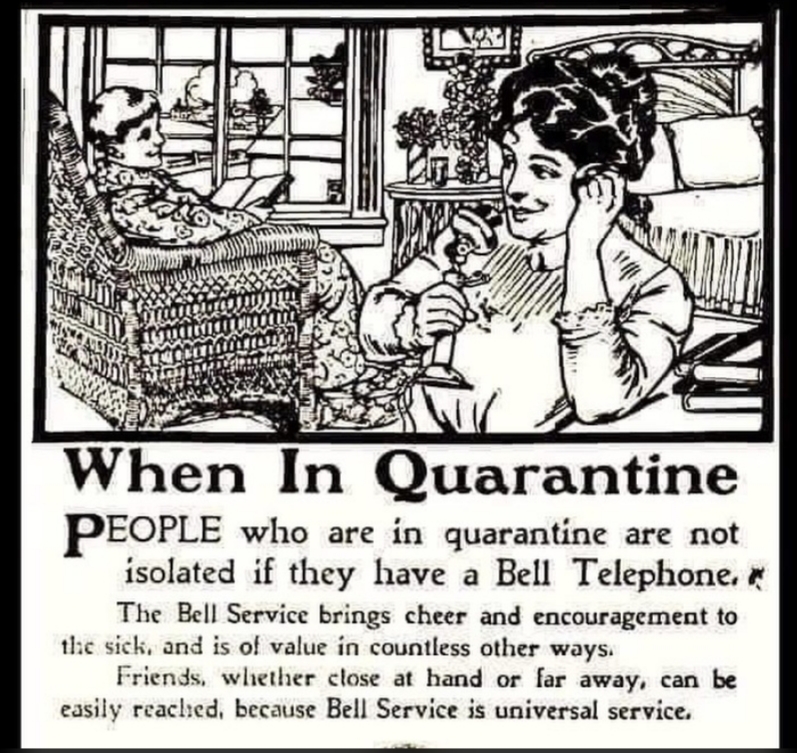
I saw this posted on Instagram last week and I was certain that had they had more than this in 1918 we would still be in the throes of the Spanish Flu pandemic although by now it would be epidemic because only in the U.S. would there still be people claiming “it’s going to go away.”
 20200718_192656
 
Imagine being able to share your opinions with only the closest of friends and family. It had to be with only those closest to you or you’d be broke long before your mask wore out. In 1918 when this ad was published*, although local service was only $1.50 a month, long distance was pricey, and long distance started not that far away. A cross country call ran about $5 per minute, cross state a little less than $2, and cross town, as much as 15 cents per minute. All in a time when the average 3 bedroom apartment was renting for $10 a month and a laborer was clearing $5 a day when a day’s work was available. 
 
There was no hue and cry over masks, isolation, soap shortages, or whether college football will be played this fall. Well, they may have been huing and/or crying but you kept it to yourself rather than passing yourself off as some sort of an expert because you read something in the Evening Star. (Although in fairness to this pandemic’s questionable coverage, that of 100 years ago was also often sparse, conjecture laden, contradictory, or all three.) (And then some.) (But then 1920 was also a Presidential election year so why should they have expected any less.) (Or more.)
 
There’s a particular hue being cried in our neck of the woods. A local amusement park is being sued because it is requiring all patrons to be masked at all times and on all rides, the exceptions being in their food venues while one is eating. The suit is brought by the parent of a child with sensory challenges and cannot wear a mask and the prohibition to entry without one violates to his rights. I don’t claim to be a Constitutional lawyer but my cursory review of the document didn’t reveal reference to the freedom of rollercoastering. Perhaps she’s hanging her mask on the line “life, liberty, and the pursuit of happiness” from the Declaration of Independence. The suit led by a mother who states she also has anxiety and cannot wear a mask had gathered the support of several other families and seeks compensatory and punitive damages for pain, suffering, anxiety, humiliation, emotional distress, and “the loss of the ordinary pleasures of life.” 
 
Silly me, I always thought the ordinary pleasures of life were music, reading, sitting under a tree on a sunny day, friends, food, and chasing dreams never meant to be caught. I suppose I should call my lawyer for further clarification. Fortunately it’s not long distance. 
 _____
*The person who originally posted this noted it was an actual ad from 1918 and I have no reason to doubt her, she not being one prone to hype, hysteria, or hyperbole**. However, that phone looks more like what was most common after 1920. But then on the other however, it is an ad from a telephone company so they would likely illustrate it with the most cutting edge equipment they have. You don’t see T-Mobile pushing iPhone 6’s.
 
**Okay, I have to ask this, what do you think about hype and hyperbole? In the dictionary, “hype” in the sense of extravagant promotion includes it first entered the English language in 1920 from the United States but with no etymological origin, or more often, “origin unknown.” I’m thinking it came about when fast patter was taking hold in informal speech and was most likely just a shortened version of hyperbole, which was convenient because it shortened the word dramatically and important because it shortened a word most people tend to either misspell or mispronounce. 
 
***You can stop looking for three asterisks in the post body, there isn’t one. Well, actually there is one asterisk but there isn’t one instance of 3. Anyway…speaking of misspellings, I had a heck of a time getting spellcheck to let me keep “throes” in the first paragraph. It insisted I really meant to type “throws” or “thrones” and would not take my word for it that not only did indeed I want “throes” I want it added to the dictionary. This from a program that has no problem adding words I legitimately misspelled and then have to go through Tartarus**** and back to remove. 
 
****That it knows!
 

Did So! Did Not!

I hate to be a wordsmith but…
 
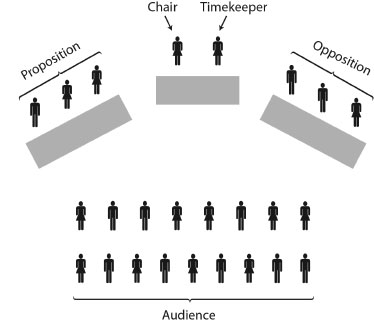
I wonder if this is just an American thing so please let me know if other cultures also decide they like a word so much they have to use it whether or not it is the right word to use. For example, debate. Debate: a formal discussion of a particular topic by persons of opposing views. Members of high school debate teams and university debating clubs must cringe every time somebody refers to the live attack ads laughingly billed as Presidential Debates as a “debate.”
 
Yes we all use “debate” less formally in daily life. We debate thin and crispy or thick and chewy for the ideal pizza crust, we debate Ford versus Chevy for muscle car king, or we debate boxers or briefs to liven up a dull party. But unless you hail from Naples (Italy, not Florida), none of these are of any particularly consequence. Even a Neopolitan will concede the world won’t come to an end if the heathens get their way and insist on calling that dreck Chicagoans churn out a pizza. 
 
Deciding who will be the standard bearer for a major political party should not be held in a forum more representative of a school yard “my dad can beat up your dad” stand off. Oh, sorry, inclusion you know. Make that “my mom can beat up your dad”….um, but not so inclusive as “my dad can beat up your mom.” That might be too much equality.
 
Without diving deep into the substance of the “debate,” mostly because it is dangerous to dive into shallow water, I have some comments that might make future Presidential Debates more entertaining since more informative seems to be out of the question.
 
Of the six candidates vying to be the nominee for the highest office their party will present, three were not always members of that party. That’s fine, neither is the sitting President and presumptive opponent of this group’s “winner” originally a member of the opposing party.
 
Although there is no mandatory retirement age for federal employees there are age limits for certain categories. Federal fire fighters, law enforcement officers, and air traffic controllers all have mandatory retirement ages of 57, 60, and 58 years respectively, probably because of the mental and physical burdens the jobs carry. Of the six candidates in last nights “debate” four would be excluded from these jobs just due to age. Under special circumstances the age limit may be raised to 65. Still those four would be ineligible. In fact, if it was raised to 70 those four, along with the current President, would still be ineligible. Now I admit I’d like to still be doing something when I’m 70 but I was thinking something more age appropriate, perhaps along the lines of volunteering as a docent at a historical site or a ticket taker at the local multiplex theater.
 
Of the six candidates on the “debate” stage last night, all but one have a net worth of greater than $1 million. In fact, there have been 30 declared candidates for President from both parties of which 9 are still active. Of those 30, only five cannot call themselves millionaires.
 
The Constitution stipulates a person must be 35 years of age to serve as President of the United States. No candidate has ever been than young. The youngest person to ever run for President is William Jennings Bryan who was 36 in 1896 when he lost to William McKinley. The youngest President was Theodore Roosevelt who was 42 when he assumed office upon McKinley’s death.
 
So there’s my take on the “debate.” I’ve presented my opening remarks and made my arguments. I suppose we could handle the question and answer period via comments. If you understood this then I’ll make it my closing statement and welcome you to the How Dare They Call That a Debate Club. 
.
db


Paradise Squashed

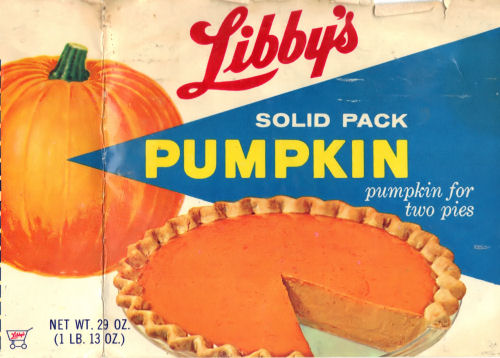
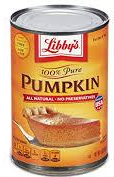
We are deep into the throes of PSL season although as previous rants of mine have shown, pumpkin flavoring goes far beyond latte, this year including potato chips. But I must admit, even though I detest almost everything else pumpkin, baked goods – pie, bread, rolls, cookies – made with real pumpkin is food heaven. But anybody who has made anything out of real pumpkin starting with that round, orange vegetable perched on the kitchen counter waiting to be dispatched by your biggest and strongest knife will tell you making those tasty tidbits is food hell! Thus the popularity of canned pumpkin. Well now, who else saw the breaking news earlier this week? Those cans touting 100% real pumpkin within typically contain 0% real pumpkin. Yes, canned pumpkin is not.

libbyssolidpackpumpkin

Americans should be used to foods not being what they seem to be. Euphemisms abound in the grocery store. Pigs become pork, cows are turned into beef, and I don’t even want to think about capon. The vegetable world makes soy beans tofu and wants to rename every chili when sold dried versus fresh. Maybe that’s where it all started, with those chili peppers we know weren’t called peppers until Chris Columbus and his crews landed in the Caribbean and called everything pepper.

The mysterious case of the missing pumpkin in canned pumpkin is kind of like Columbus and his peppers. It’s not simply a matter of masking the fact that those roosters were crowing soprano before they became a five star restaurant entree. It really is something else in that can but we’ve spent 200 years calling it pumpkin so there will be no stopping now.

The mystery substance is no mystery at all. According to Emma Crist of MyRecipes, that orange stuff “is made from a variety of winter squash (think butternut, Golden Delicious, Hubbard, and more). Libby’s, the brand that produces about 85% of the country’s canned “pumpkin” filling, has actually developed a certain variety of squash that they grow, package, and distribute to supermarkets” and because the FDA won’t quibble over what variety of squash is used “it’s perfectly legal to label a food product as ‘pumpkin’ when, in reality, it’s made from a different variety of squash.”

download

To clear that up, in a 1988 compliance guide the FDA states, “Since l938, we have consistently advised canners that we would not initiate regulatory action solely because of their using the designation “pumpkin” or “canned pumpkin” on labels for articles prepared from golden-fleshed, sweet squash, or mixtures of such squash with field pumpkins. The policy itself begins “In the labeling of articles prepared from golden-fleshed, sweet squash or mixtures of such squash and field pumpkin, we will consider the designation “pumpkin” to be in essential compliance with the “common or usual name” requirements.”

So there you have it. My only pumpkin refuge in a sea of pumpkin spiced latte is actually butternut squash pie. Oh well. Pass the whipped cream please. Umm, I mean the water, hydrogenated vegetable oil (including coconut and palm kernel oils), high fructose corn syrup, corn syrup, skim milk, light cream (less than 2%), sodium caseinate, and natural and artificial flavor.