Wordsmithing and the common man

Yesterday’s Uplift post at ROAMcare revolved around the word “common.” A comment had us thinking about how the meanings of words change. I thought about that a little more on my own and I was amazed at the number of words that once meant one thing now have little and sometimes no resemblance to their original meanings. I was also somewhat aghast at the temerity of humans to play willy nilly with established norms – although, at least with words, the norm established was established by humans so I guess humans can do what they want with them. It’s not like anybody is trying to change science. (People holding high government offices in Washington notwithstanding, given that I’m not so sure they are actually human anyway.)

Some words haven’t quite yet made that complete flip, or flop if you prefer, and carry two meanings opposite each other. Oversight can mean examining for inconsistencies from expectations or the inconsistency itself. These are called contranyms. My favorite contranym is Handicap. – An advantage provided to ensure equality (think golf), or a disadvantage that prevents equal achievement. (Why is this my favorite? Because I am. I have a handicap. Because of reasons too abstruse to go into here, I walk with a cane. It may look cool and all swaggerish, but every time I need to carry or hold something I am limited to only one-half of my carrying and/or holding appendages. People want to call all those with handicaps disabled but we are just as able as anyone else, perhaps more so due to our handicaps, whihch might make that a contranym within a contranym.)

Other common contranyms are model (an exemplary original or a scaled copy), puzzle (a problem or to solve one), and for out baseball fans, strike (to hit or to miss).

And then there are the antagonyms, words that have completely changed meanings over time. Awful is a classic example of a word today meaning the opposite of what it was meant to be. Five hundred years ago a bully was more of a heartthrob, one of outstanding physical prowess. Now it means fake president of a used to be major power. Prestigious, as in renown, has only been a positive example for the last hundred years or so. Before that, a prestigious someone was an imposter who gained wealth by way of trickery (sort of like…oh, never mind).

But back to “common.” I’m not sure where that fits in. everyone’s first definition is something generally met with and of nothing special. But its root is the same as community and it is used to described things shared, like a common border. Or as we wrote in that post, a common good, and even common sense, which most people want to ascribe to individuals but really is knowledge derived from shared experiences. Take a look at it. We think it is uncommonly good.

Not so famous last words

There are entire books of famous last words. Most of them are famous solely because they were said by famous people rather than being famous because they were profound. There are some that are a little of both. Benjamin Franklin’s last words were, “A dying man can do nothing easy.” The back story – that was in response to his daughter telling him to turn over in bed so he can breathe more easily. Sort of profound on its own. Now that you know the story behind it, it sounds like something I’d say!

Anyway, most last words will never be remembered by someone other than to whom they were spoken, except for last words you see and hear every day.

An exceptionally famous set of last words seldom seen today, was de rigueur in a different century, early in a different century, was “the end,” seen on the last page of every book and last card of every movie.

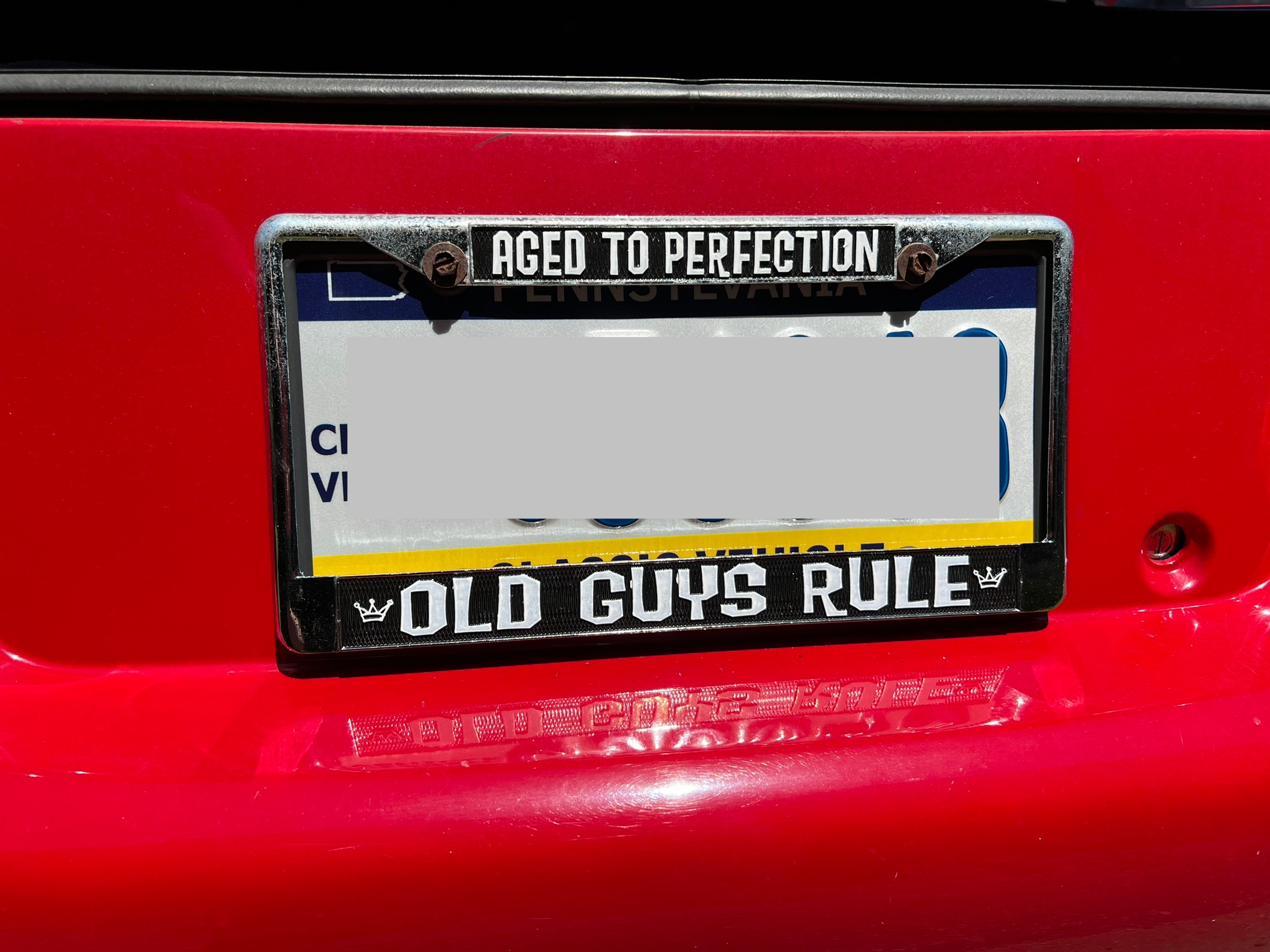
Other last words often more memorable are the last words you see when that car passes you on the highway and you get a look at their license plate, license plate frame, or bumper sticker. There are some pretty clever examples of two of the above specifies at the links noted. I’ve not yet succumbed to a vanity license plate although the frame I have around the classic plate on Rosemary the Little Red Car reads, “Aged to Perfection. Old Guys Rule!”

I saw an interesting sight just yesterday that I had heard of but never had seen in the wild with my own eyes. A Tesla car with its stylized “T” removed and replaced with a lightning bolt. Not quite a last word but a lasting impression.

A particular type of last word I have a difficult time with is the one to end a text message conversation. Not a quick message like “on my way.” That doesn’t even require an answer. But the conversations that go back and forth for a while, the things that have taken the place of phone calls. Phone calls were easy to end. The last word typically was a simple “bye” plus or minus a dear, hon, or second bye. An e-mail’s last words are like any other correspondence. But a text message. No good way out of that and when you usually decide on a last word, it’s more likely an emoji.

Now I’m not sure what kind of last words would be best to tack on the end of these words. I think I’ll steal Michael Landon’s last words. On his deathbed, his son said to him, “I think it’s time to move on.” Landon’s reply – “You’re right. It’s time. I love you all.” Actually, it’s his last, last words that mean the most. I love you all.

Not just the words

A show of hands please. How many have ever utter the words, “Yes dear.” Now an honest answer here. who envisioned a snarky retort when thinking of the last time you uttered that phrase. And yes, I am making an assumption that every one of us has been on the giving end of those words, and the receiving end too. 

But again, being honest about it, who hasn’t also said those words endearingly. You may have to think about when a little longer, but we’ve also all most probably given and received such a sentiment.

Words themselves mean little. They should mean little and rarely taken at face value. They are only there to convey feelings anyway. Sometimes, the feelings are strengthened by images. Sometimes, the images far exceed the feelings behind the word.

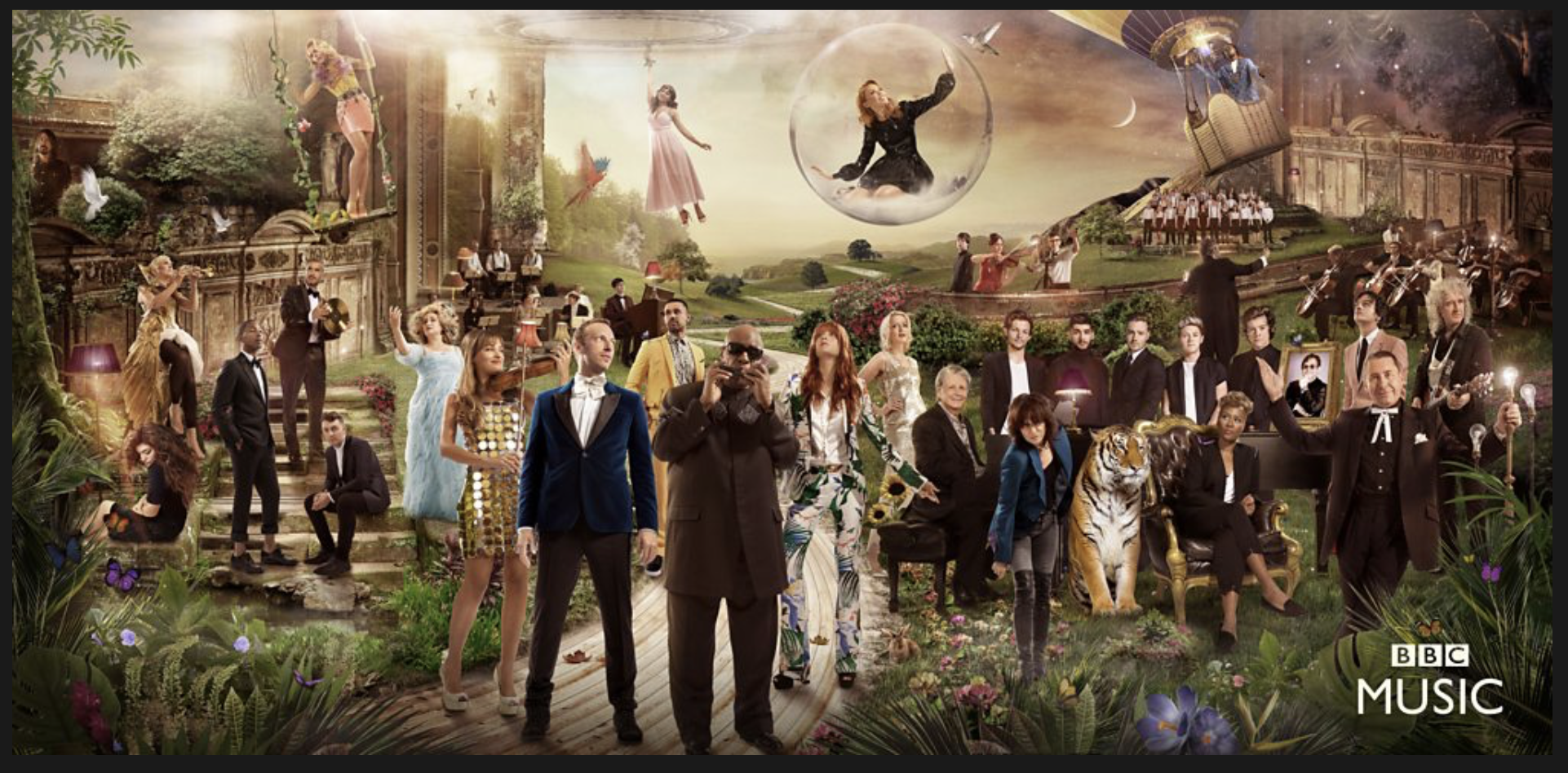
I discovered something like that a couple weeks ago. As I was preparing the New Year’s Day ROAMcare post when we associated 1960s ballads with daily resolution prompts to this year’s message, Live, Love, Share, I took a side trip to YouTube to refresh my memory of some of the music and lyrics. I ran across this version of “God Only Knows” put together by BBC Music from October of 2014. Although the song is a good one and the lyrics catchy, (and really do make a good daily living prompt because we really do know that God only knows what we’d do without each other, it’s the image of 32 artists and groups mingling their distinctive styles into a single beautiful performance that keeps playing over in my head.

I suppose I found a daily prompt for probably the rest of the year to encourage me to be a part of life and share my love. If the magic of the music doesn’t last, yesterday we suggested perhaps checking the obituaries for inspiration. Do whatever it takes to make it a year of love. God only knows what we’d do without it.


Isn’t it time to consider joining the ROAMcare community and subscribe to have Uplift delivered to your email as soon as it hits the website? In addition to an Uplift release every Wednesday, you will also receive weekly our Monday Moment of Motivation and the email exclusive Flashback Friday repost of one of our most loved publications every Friday. All free and available now at ROAMcare.org.


Screenshot 2025-01-09 at 9.15.41 AMhttps://youtu.be/XqLTe8h0-jo?si=O3n2ArCpZzexLg5T

Dreaming what to become

For the last couple weeks, I’ve been collecting some remarkable tidbits of wisdom (wisbits?) from of all places, the Internet. Someone said (and I’ll qualify this that it is a reputable somebody and was published somewhere reputable, but I’m comfortable in my chair and don’t feel like searching for the citation, but trust me, it’s a valid point) someone once said only 85% of what’s on the Internet is true, and nearly 100% of that is in legacy news sites, or traceable to same. Which if you’re even just decent at math means most of what we’re exposed to is crap. Or possibly plagiarized crap. But there is some interesting crap out there.

One of the non-cited things I saw, that I’m really tempted to believe, is that in the 1980s, A&W tried to compete with McDonald’s Quarter Pounder by releasing a 1/3 pound burger at a lower price, but it failed because people didn’t want the “smaller” burger, even if it was cheaper.

That might be what led Oxford University Press to declare “brain rot” as its 2024 word of the year. The term is defined as “mental decline caused by trivial material.” See, to me, that in itself is somewhat rotten. The mental decline isn’t caused by trivial material. That’s what we used to call recreation. “Let’s take time off and do something non-consequential, something trivial!” The mental decline we’re experiencing is caused by people accepting what they read as fact. But hold that thought.

A different word was selected word of the year for 2024 by that stalwart of unpublished publications, Dictionary.com. They named demure as this year’s word of the day. Of course demure took off this year when some Tik Tok celebrity (really?) started using it in a way that didn’t match the definition. Sort of like when someone wants to sound “educated” at a cocktail party (youngsters, ask your parents) and explain how the new red light at the corner will assuage traffic. Anyway, we now have a word of the day everyone thinks means very mindful when it means shy, modest often affectedly so, or coy, and its origin is a state of calmness at sea.

Remember that thought we held 2 paragraphs ago. That’s where I wrote that I read OUP selected Brain Rot as its word of the day. Plug in “brain rot” to your favorite search engine and it will say it’s the Oxford University Press 2024 word of the year. Now just for fun and giggles, do the same with “demure.” Yep, it will come back as the Oxford University Press 2024 word of the year. 85% right seems high. By the way, Merriam-Webster’s word of the year is polarization. That sounds right.

Leaving single words behind, here is a string of words from one of the Today Show social sites attributed to Michael J. Fox. “If you don’t think you have anything to be thankful for, keep looking. Because you don‘t just receive optimism. You can’t wait for things to be great then be grateful for that. You have to behave in a way that promotes that.” There’s an 85% chance he actually said that. Personally, I don’t care if that isn’t what he said, that’s a good thought.

I could end it with that but here’s something from a nondescript post that should be on all our walls. “We dream what we wish to become.” I wish we’d all become less brain rotted.

Blog Art 2


Not everyone can be exceptional and have the word of the year culled from one of your TicToc posts, but everyone can take pride in the exceptional qualities they possess. Even the most average of people have the most remarkable moments.

We took an above average swipe at those who feel being average is no better than having failed in the latest Uplift, Life on the Curve. You can read it on average in about 3 minutes.

But before you go look, have you still not thought about joining the ROAMcare community and have the weekly Uplift blog delivered to your email as soon as it hits the website? In addition to an Uplift release every Wednesday, you will also receive weekly a Monday Moment of Motivation, and our email exclusive Friday Flashback repost of one of our most loved publications. All free and available now at  ROAMcare.org.

Real life advice for real life

I would like to wish the fathers out there a belated Happy Father’s Day, those celebrating a Happy Juneteenth, and to everyone, the words of life advice from a father who has served many years of life.

I got this idea from last week’s post when I suggested one who serves food would be better received (and probably better tipped) if that one did not have a tattoo of a spider on the back of their hand. I realized then that I had a wealth of advice just waiting to spill forth from my brain and what better place for it to spill than on here? Just some morsels of common sense sprinkled over some of the nonsensical things I’ve lately noticed.

For example. If you own a bar, restaurant, bar and restaurant, diner, pizza parlor, sandwich shop, or similar, and you find yourself a little short staffed, don’t mount on the largest sign you can find “Servers, cooks, bartenders, dishwashers wanted” in the largest letters you can find and post said sign outside your main entrance door. You would be better served to post a sign that says “Please don’t come here to eat unless you enjoy waiting hours before being served.”

Likewise to the local auto repair shop owner with the sign “Mechanics needed” and is wondering why business has taken a sudden downturn.

I’m not sure anyone ever put “Spam Spreader” on their resume, but someone must write and distribute those aberrations to polite electronic mail correspondence. My advice to whomever it may be, don’t use flags, up arrow notations of urgency, or more than 4 emojis in the subject line. I can’t think of one legitimate email I’ve ever received that came with 🔈😮🔥🚨 as part of the subject that had me thinking “Oh my gosh, I better open this email before I do anything else or the world may end!”

While I’m thinking about resumes, if you should happen to think about applying for one of those open waitresses, cooks, or mechanics positions, leave “content creator” off yours. I’ve actually seen that on resumes and it didn’t impress me, and to honest, I’m usually quite impressionable.

Also apropos resumes, if you are employed as one who gets to send emails, text messages, or even real mail to potential job candidates and you start your spiel with “I found your resume on line and know you would be perfect for a position we are trying to fill,” please read the resume, or the next time someone wants to hire me as medical director at some hospital in a “world famous tourist location,” I may take you up on that, especially if you’re covering travel and expenses (including a plus one, naturally).

Finally, to those seeking a position in government like, I don’t know, maybe President, it’s in bad taste to put out TV, radio, internet, and mail ads suggesting your opponent is “dishonest” if you’ve just been found guilty of a few dozen felonies. Just my opinion.

Have a happy week everyone – and a happy federal holiday to those in states where it’s not illegal to celebrate it.


One way to survive in this crazy world is making the most of every hour. Not with a strict schedule and sticking to a to-do list. It’s implementing a to-don’t list. Yes, the secret to doing efficiently and effectively is knowing what not to do. We know  we said so in the latest Uplift!


Blog Art 2


Oh That Jack!

Not too long ago I was working on prompts for whatever I might want to prompt myself with and whenever I feel promptable. One of them is “Would I rather be a jack of all trades or a master of one.” My daughter say my list and said, “You know that’s not right.” I said, “Yes, but it’s closer that what most people think.”

You’ve probably said it or read it or heard it many times. “A jack of all trades, a master of none,” usually spoken derisively of someone more talented than the speaker. Obviously the speaker’s talents do not include reading. Buried between my prompt and the usual dismissal is the actual quote. Do you know what it is? I’ll let you think about that for a while and then we’ll come back to it.

That prompted us to think about sayings we get wrong, or those we pick or choose only a part of the actual quotation that is far more complex, but we stop short of the complete thought. For example, no, the customer is not always right. Harry Selfridge actually encouraged his employees to not question a customer’s taste, not the customer’s correctness with his whole message, “The customer is always right in the matters of taste.” An interesting side note to Mr. Selfridge. Many, many, many years before he founded the London-based retail empire that bears his name, he was born in Wisconsin and his first experience in selling was delivering newspapers after school (before he dropped out) in Jackson, Michigan. (And yes, I know somebody is going to say, no, that originated in France in the early 1900s about a restauranteur who said “no matter how ill-tempered is the diner, treat him with civility,” which is a completely different thought process.)

We all recognize that hell hath no fury like a woman scorned. Does heaven have a similar comparison? Why, yes, yes it does. When William Congreve wrote Act III of The Mourning Bride he wrote, “Heav’n has no Rage, like Love to Hatred turn’d, Nor Hell a Fury, like a Woman scorn’d.” Personally, I think love turning to hatred is more frightening than a ticked off lady. But then, I guess if she was really a lady, she’d not express her displeasure over much anyway.

One that doesn’t change the meaning at all is the complete quote that gave us ignorance is bliss, but it is so much more poetic. Hmm. Perhaps because it comes from a poem. Thomas Gray wrote in his Ode on a Distant Prospect of Eton College, “Since sorrow never comes too late ⁠and happiness too swiftly flies? Thought would destroy their Paradise. No more; —where ignorance is bliss, ’tis folly to be wise.”

Would you like me to make you an offer you can’t refuse. If you’re one of the billion or so people who claim to have been at the premiere of the Godfather, or one of the 400 who actually read the book, you would shake in your boots and beg for mercy thinking I intend to cause you bodily harm. It’s possible Mario Puzo remembered that line from the 1934 movie Burn ‘Em Up Barnes, about the owner of an apparently worthless piece of land. But rich oil speculators who know her land is worth more than a small fortune try to convince her to sell, sell, sell! John Drummond (played quite convincingly by Jason Robards’ father, Jason Robards (Sr.)) says, “I’ll make her an offer she can’t refuse,” literally meaning he would offer her so much she would be foolish not to sell the land to him. So you might want to check with whomever is making the offer if they are a vintage cinephile fan or a more modern movie goer.

A most familiar misquote, or incomplete quote, is one of many traced to the Bible. That is the one about money being the root of all evil. Although during the first century of the Common Era money was not as ubiquitous, or as necessary as today, it still was, if you’ll excuse the inherent redundancy, valuable, and used even by those mentioned in the Bible. The full verse in 1 Timothy (6:10) is, “For the love of money is the root of all of evil: which while some coveted after, they have erred from the faith, and pierced themselves through with many sorrows.” Not quite the same thing.

Speaking of not quite the same, let’s get back to jack, as in the jack of all trades. Do you know the full quote? Jack was given to us by the man who may be responsible for more common sayings than either Benjamin Franklin or the Bible. That would be William Shakespeare. Maybe. Some sources attribute it Shakespeare although not from any of his dramatic writings, but from his colloquial pieces. Others attribute it to fellow 16th Century author Robert Greene, speaking about Shakespeare. Still others have it going back to the ancient Greeks probably because you can make an argument that some ancient Greek said almost everything now noteworthy. Anyway, the full quote, which is not an insult is, “A jack of all trades is a master of none, but often times better than a master of one.”

Do you know of any others? Share them in the comments. Even if you aren’t sure of the origin or original meaning, we’ll get to the bottom of it.


Speaking of sayings, do you know the first instance of “Have a good day.” We do, and we even included it in the most recent Uplift, the one where we claim that telling someone to have a good day could be the smartest thing you do today. Have a good day!


Blog Art 2


The long and the short of it

I have noticed that my most recent posts are getting shorter.

And that’s all I have for today. Thank you for reading!


Seriously, these posts have been getting shorter. And believe it or not, that’s by design. Since November 2011 I have published 1,050-some of these and some of them were real monsters, one over 1800 words. The last several posts have seen more modest 400 to 500 word counts.

Why the big change? I don’t know. Maybe I realized I don’t have that much to say, and I don’t need 1,000 words to say not much. Or maybe I realized people don’t have time to devote untold minutes to reading my blog posts. Let’s face it, I am not dispensing indispensable information. Maybe a little smile-inducing, head-scratching, or even thought-provoking. Indispensable, imperative, can’t do without? Nah.

If you make the trip to the Uplift! blog at the ROAMcare site, you might have realized those posts with few exceptions fall in the 500-700 word range. By design. The goal is to produce a piece that can be read in two to three minutes. You might also have noticed they tend to ask more questions than they answer. Again, design. We want you to be able to read them in two or three minutes, but we’d like you to think about them for days on end. And hopefully, in a more thought provoking than head scratching way. You decide what is important for you. Taking the most recent post as an example, you probably didn’t find freshly laid goose eggs in your back yard, but it could get you thinking about what wonders you have recently experienced. (Yes, you have. Take a minute and think about it)

Another reason why I’ve taken pains to keep things brief (and yes, they are pains because I can talk and talk and talk and talk for hours and hours on end and beyond), is advice I once saw from one of the master story tellers of our time, Charles Osgood, and finally decided to give it a whirl. (Young people, you have a computer, look him up.) For forty-six years he presented “The Osgood Files” (“Reports and reflections on humankind”). He described his own style as “Short words, short sentences, short paragraphs,” and went on to say, “There’s nothing that can’t be improved by making it shorter.”

Oh boy, was he right! At least as far as my writing goes. Sometimes I think back when I was teaching and to fil the standard college hour (40-45 minutes). I routinely covered so much that my printed notes would fill pages in a notebook. Today, a 30 minute presentation reduced to writing might fill two printed pages. And be more informative. Not to mention more fun!

Sometimes I think as I write fewer words, I find more things to say. But then I read more of other people’s words, and I find I’m saying just enough. I hope you agree and are happy enough with the words I choose.


Are you still wondering about those goose eggs I mentioned? They really are a wonder. You can read about them at The Egg Hunt. What wonderful things might you find in your world?

a Veteran today! - 1


words matter

This week I was proof-reading the post that will be published this Wednesday, August 30 on Uplift! the ROAMcare blog. It’s about saying what you mean, meaning what you say, the joy you feel when you can, and the consequences when you don’t. As I started writing the first draft for this post, I had no inkling the two would intertwine. This post, like the previous two posts to this blog, was to be about words, though not necessarily the saying and meaning of them. In between the reading and the writing of these two blog posts, I was also reading some local news. There was an incident here in town involving a man barricaded in a house, and suddenly, I found an overlap.

  • The barricaded gentleman was the target of an order of eviction. Rather than accepting the paperwork, he fired on the sheriff deputies attempting to serve the order. And that began a 6+ hour standoff during which thousands of rounds of ammunition were fired. The county Sheriff reported that the suspect was pronounced dead at the scene. What does that have to do with words? One moment please. I did some further investigating. 
  • Checking the sports pages, a local college football booster donates $20 million to the college athletic department to enhance the school’s football program. The same donor previously founded a collective of like minded donors to set money aside for Name Image and Likeness payments for the school’s athletes. I know, one more time. What’s that have to do with words? Please hold.
  • A local Home Depot was reported to have been the victim of theft. “Thousands of dollars worth of equipment was stolen from a local Home Depot, police say,” the report begins, then it continues, “State troopers say two men and a woman were responsible for the thefts. Two microwaves, a stove, a gas grill and a John Deere riding mower were all stolen from the store.” The report goes on. “The thieves are also believed to have taken drinks. Overall, the stolen goods were worth $4,697.60.” One of these words is not like the other. Don’t go away. We’ll be right back. 
  • And an oldie but a goodie. Earlier this month a man was stopped by TSA agents at the local airport with a fully loaded 9mm handgun and 2 additional loaded magazines for a total of 22 rounds of ammunition. He forgot. Two words. Yeah, right.

Let’s look at the words used. 

Working backwards, yeah, right. Come on guy, just say you don’t trust women to recognize you’re happy to see them so you keep a gun in your pocket.

The report of the theft at the outsized home center knew exactly, what was stolen, the value of what was stolen, and who stole it, yet they aren’t quite sure about those couple drinks that are missing. Was the reporter on a word count and needed those eight words to satisfy the editor’s line budget?

Enhancements to the athletic department that also references the the NCAA NIL policy. Sounds like a personnel budget to me.

And the one that started me down this rabbit hole. One person inside a building. Thousands of shots from inside the building. And with all deference to the presumption of innocence, “the suspect?”

Isn’t it time we start saying what we mean?

Now, other than the common theory of say what you mean, mean what you say, this is nothing like the ROAMcare post will read. If you want to know how post that comes out, be one of the ones to read it as soon as that post comes out. You can subscribe to Uplift! here.


Speaking of words, the words “good enough” don’t conjure thoughts of expert performance, but is good enough ever good enough? We explore times when it might, and when it definitely isn’t, in the most recent Uplift! The approximate reading time is just 3 minutes


657DEE99-CF72-4E3C-B571-AC40C3B2C833


Hack no

After last week’s mini diatribe (would that be a monotribe?) I started thinking about word usage more than usual. As one who writes and speaks, words are my tools, and usage has to be precise if I expect to be understood. I decided if I could bump off any word, have it struck from all dictionaries, pulled from thesauri, and eliminated from internet searches, the one that stands out more than any other as offensive to my ears, more so than even the inappropriate use of weaponize, practicability, and disenfranchisement that will escalate over the next 15 months, that one word would be “hack” when used as a tip, hint, or suggestion. (A word I’d like you to consider not considering is “run-on” as in sentence.)

The word hack comes to us from Middle English, hakeney, a horse used for riding. It has been in common use as hackney, a horse of small stature appropriate for riding or pulling a small carriage (versus one used for plowing or pulling wagons) since the 1600s, perhaps earlier. Hack, the obviously shortened version, it along with its adjectival form hackneyed, almost immediately took on more sinister uses.

The hackney pulled carriages became a favorite for rides for hire throughout London, the horse and carriage combination commonly called a hack (which is why we still call taxis, cars for hire, hacks), and anything or anyone offering himself or his property out for hire, also was considered a hack. At this same time, the hackney pulled carriages became so prolific, hackneyed was coined to describe anything commonplace.

Hack continued to grace the pages of English dictionaries as a carriage or vehicle for hire or, in a pejorative way, one of common upbringing, skills, or expectations, and it continued without much controversy as such until Americans got involved. Through the early twentieth century, hacks here were also cabs and commoners but we expanded hack to refer to one who did the bare minimum to earn his pay in almost any field, whether a hack writer or a hack surgeon. And then, just about mid-century, something weird happened. Hack took its turn as a verb in American verbiage, as in, “That’s too much for me, I just can’t hack it anymore.” And that may (MAY) be its entry into computerese.

Mid-century computer programming was a long, difficult, and often trial and error experience. Those who were successful at programming proudly claimed they could hack it. And hack, hacker, and hacking became positive references to those proficient with the inner workings of computers and programming languages. About the time Matthew Broderick was changing grades for him and his high school sweetie, hacking with reference to computers, regained its negative connotation.

None of this explains why today, hack is synonymous with a handy dandy household hint. Etymologically there is no connection. Yet today there will be no less than 48 billion headlines in cyberspace addressing life hacks, kitchen hacks, productivity hacks, dating hacks, health and beauty hacks, and probably hacking hacks. Perhaps 48 billion is a tad hyperbolic. I’ll check for a writing hack on how to get large numbers across in dramatic fashion.

Perhaps it is as one Quorum user suggests, “It sounds edgier. “Tips” are merely interesting and useful. “Hacks” sounds as though you’ve been devious and insightful, perhaps even forbidden. “Hacker” used to be somebody with exceptional skill at computers. “Hacking in” to a computer system was something that required a lot of knowledge and cleverness. “Hacks” carries some of that sense of astuteness, along with some of that sense of having inside information that others don’t have. So it makes people feel important.” He goes on to say, “To me they just sound like a…” but I’ll stop there. This is a family blog. I’d had to get hacked and have my posting privileges revoked.


Etymologically, bias is assuming something. Cognitive biases, nobody listening or discussing, assumes outcomes based on past behavior and can have significant consequences. In the most recent Uplift!, we discuss how with respectful communication we can live, work, and play well together. Take 4 minutes to read it and see if you agree.


B1529247-670A-4E42-8322-870ACCA73E39


No more word smithing

I was building discussion points for a project in another part of my life and I got stuck for a word. I needed something to describe what someone who originates an idea does – or did. I thought “introduce” didn’t capture the work involved, “create” sounded too supernatural, “instigate” seemed somehow sinister, and “initiate” was much too formal. Well that exhausted the listings in my mental thesaurus. Time to dig up Mr. Roget’s best seller and see if I could find just the right set of letters to satisfy my word quest. I was actually out of the chair when I slapped myself in the forehead, fortunately not wearing a heavy ring, when I sat back down, keyed in o-r-i-g-i-n-a-t-e, hovered, and right-clicked on it.

  • Create (already eliminated that one)
  • Invent (no, not the feeling I’m after)
  • Initiate (again, I thought of that one without anybody’s help)
  • Instigate (still sounds sinister)
  • Make (dull)
  • Devise (wouldn’t have thought of that in a million years but that’s ok because I don’t like it anyway)
  • Patent (I’d argue that’s the same as originate but that’s just me)
  • Coin (ooh, good word – not the right word but a good one)
  • Begin (blah)
  • Derive (again, I argue that derive and originate are not synonymous)
  • [ ] (notice, they didn’t even come up with “introduce” like I did, not that it mattered)

In the end, or actually middle given that I’m still working on the project, I went with “originate” knowing I’ll never be completely satisfied that I did my best at creating an original set of discussion points. (See what I did there? Hmm?)

Although my mini-search hadn’t satisfied my curiosity for an appropriate substitute for “originate,” it raised my curiosity about words. I seem to end up with three of four posts about words and language each year. That’s a lot of words! I’ve gone back and forth to suggesting we need more words to we have too many words to we need better words. I know we need still need better words and I offer my ambivalence toward “originate” for proof. I’m not so sure we need more words, yet we keep inventing them. In one of those posts up yonder (or should I say heretofore mentioned), I wrote, “The English language is said to have close to a million words in it. I’m not sure who counted that but the most complete, or as they would put it unabridged dictionary of the English language, the Oxford English Dictionary, has about 620,000 words. But language doesn’t equal vocabulary. And vocabulary doesn’t equal language. The average educated English speaking person knows around 20,000 words and uses but about 2,000 words in a week.”

That was in 2017. Now things are even more confusing. The OED still contains over 620,000 listings, listings not words, many are duplicates because we use the same word for different uses. (See that. I did it again.) It lists (yep, again) 171,000 different words. But now those same sources say the average American English speaking person knows about 40,000 words. How did we double our word count in six years? For comparison, Classic Latin is composed of (comprised of?) 39,500 words.

There’s something not right here. I’m just not sure exactly how to express it.


Looking for your own perfect word? Practice your vocabulary. They say practice makes perfect, no? No! If no one can be perfect, why practice? Practice has to make something. What practice makes is a more positive you! Our most recent Uplift! digs into how that can be.

Go take a look for yourself. You can be there and back in about 3 minutes.


Untitled design-3