Is it just me . . .

I was going to end the title here with “…or is it chili in here?” in honor of National Chili Day (get it, is it chili in here? I crack myself up), but then I thought better of it and opted not to start a new Internet controversy. There are arguments enough on line that I don’t have to add fuel to the fire and start shouting matches between the bean camp and the no beaners, fights between the beef chunkers versus the ground beef crowd, or debates over whether vegetarian chili is or is not mutually exclusive. No, I’m not going to be the cause of any more strife along the world’s interwebs.

Instead I thought I’d pose a more calm inducing topic to the world today. Does anybody else think that snowboarding should be banned from the Olympics? Like forever. Plus an extra 20 years for good measure!

It has nothing to do with whether snowboarding is a “sport” and are snowboarders “athletes.” That would be no and no. But neither is the biathlon and I have nothing against that being in the Olympics. And before anybody gets too excited, curling is a sport and curlers are athletes and it without a doubt belongs in the Olympics. (Contrary to popular belief curling is not just shuffleboard on ice. If anything it more closely resembles bocce on ice and it is a travesty that lawn bowling is not an Olympic sport in the summer games yet beach volleyball is. But I digress. If you’re interested in finding out why bocce belongs in the Olympics you can read what I said about that here.)

SnowboardingIOC18So what do I have against snowboarding and snowboarders? Nothing personally. It can be entertaining and they are talented but it’s not a sport. It cannot be quantified. There is no time or distance measured to objectively determine the winner. If there was a downhill snowboard race and the winner determined by who gets there first, that would be a sport worthy of inclusion in the winter games.

Ah ha! you say. What then about skating? Sorry, that has to go too. It’s been around since the first winter Olympics but it should have never been allowed and it has to go. If the figure skaters and ice dancers (does anybody really know the difference?) want to compete for a medal on ice, let them try speed skating or hockey. Or curling even. Otherwise I’ll be happy to enjoy their contributions to a genteel society when they show up in town with Disney on Ice. While we’re at it, freestyle skiing is out also as is ski jumping unless they agree to ditch the style points and award medals only for distance. Not giving yourself a concussion on landing would be nice but not essential if the length is there.

The Olympics have hung around almost 2000 years to celebrate the fastest, the strongest, the highest. Not who can spin around in the air with a surfboard strapped to his feet the prettiest.

Thank you for your unwavering support and agreement.

And Happy Chili Day.

Ground. With beans.

And yes, it is.


For the Glory of Sport

The first of the 2018 Winter Olympic Games will be held today. And the opening ceremony for the 2018 Winter Olympic Games will be held tomorrow. Yes, I noticed that also.

Getting things twisted around like that is nothing new for the First Olympic Winter Games. You can go back to the first Winter Olympics in 1924 to confirm that.

OL1924In 1924 athletes from sixteen nations gathered in Chamonix France from January 25 to February 5 to compete in 16 events. On January 26, 1924 (the day after the opening ceremonies), Charles Jewtraw, an American from Lake Placid New York, finished the 500 meter speed skating event in 44.0 seconds to win the first gold medal of the games.
The other events held at Chamonix including Four Man Men’s Bobsleigh, 18km and 50km Men’s Cross Country Skiing, Men’s Curling, Men’s and Women’s Individual and Mixed Pair’s Figure Skating, Men’s Ice Hockey, Men’s Military Patrol (a sort of 4 man team biathlon), Men’s Individual Nordic Combined, Men’s Individual Ski Jumping, and Men’s 1000m, 1500m, 5000m, and Combined Speed Skating. Two hundred, fifty eight athletes participated in these sports; forty-nine medals were awarded.

The last medal awarded went to another American athlete. Anders Haugen was awarded the bronze medal in Men’s Individual Ski Jumping. He was awarded the medal on September 12, 1974. He was originally scored in fourth place but was advanced to third when fifty years later an error was noted in the original results. It’s interesting to note Mr. Haugen is the only American to have ever won an Olympic medal in a ski jumping event.

The 1924 games were opened on January 25 by French National Olympic and Sports Committee member Gaston Vidal. The opening was accompanied by a parade of athletes, each country led by its flag bearer who took the official oath on behalf of his team.

We swear. We will take part in the Olympic Games in a spirit of chivalry, for the honour of our country and for the glory of sport.

French skier and member of France’s Men’s Military Patrol team Camille Mandrillon delivered the oath to the public on behalf of all athletes assembled there. The games began the following day and medals were awarded at the closing ceremony on February 5. In his remarks at the closing, International Olympic Committee president Pierre de Coubertin stated:

Winter sports have about them a certain purity, and that is why I was inclined to support and nurture them in this Olympic environment.

So where were things twisted around? The Chamonix games of 1924 was in 1924 officially “a week of international winter sport.” In May 1925 at their annual congress,the IOC retroactively designated the 1924 games as the “First Olympic Winter Games.”

What’s that saying? Right. Better late than never.

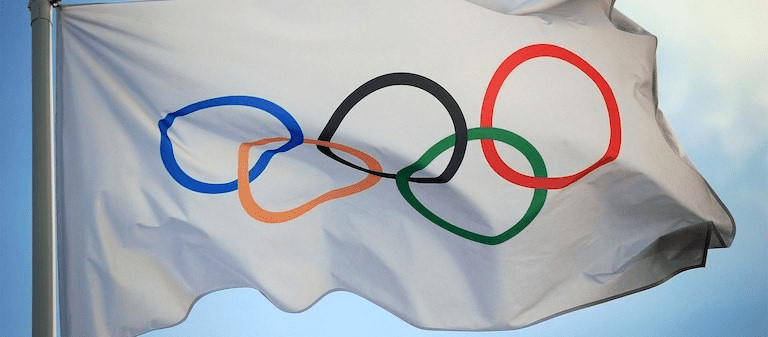
Olympic Flag

Photo: International Olympic Committee, Olympics.org


Our New Favorite Sport

For another four years the Olympics are over.  Well, four for the Winter Games.  The summer Olympiad will be around in just a couple.  One of the best things about the Olympics, winter or summer, is that we get to see sports that we’d never see anywhere else.  There are some sports we suspect that are designed specifically for the Olympics.

Some competitions you aren’t going to see anywhere else without doing some hard digging.  How often do you get to see curling, the biathlon, or the skeleton.  In the summer you could look for a while and not find competitive badminton, judo, or canoe slalom on a Saturday afternoon sports show.   Our favorite new sport (or new to us) is the Snowboard Cross.

You all know Snowboard Cross.  It’s Motocross without the trail bike.  Six Snowboarders come down the mountain at the same time, over bumps and lifts, around bends and turns, and try not to wipe out thus sending themselves and half of the remaining field into the side barricades.  That part always happens.  We didn’t see one heat, men or women, that saw the entire field make it to the finish line standing up.  Now that’s competition!

We’re not quite sure how this got added to the Olympics.  There are other snowboard events that seem to tie in very well with the “faster, stronger, higher” image of the games.  For example, the Parallel Slalom pits two snowboarders together in a snowboard version of the Super-G.  Very civilized as far as “falling off a mountain” event can be.  Then there are some events like the half-pipe that are reminiscent of the junior high school boy’s dream of winning the Olympics by being the best skateboarder in the neighborhood.  But the Snowboard Cross, that’s the right cross between mayhem and competition that makes you sit on the edge of your seat simultaneously wondering, “How do they do that?” and “You’ve got to be nuts to do that.”

One of the local sports commentators moaned on the opening day of the Winter Games that they should do something about the sports choices and put in more competitions that people care about like hockey and get rid of the ones that nobody wants to see like curling.  What he really was saying is that he has no imagination and no respect for anybody who dares like something that he doesn’t.  If he was a true sports “expert” he’d have been in front of his television every broadcast minute and drunk in the variety of competitions presented at the Olympics and no place else.

Perhaps your favorite new sport isn’t one of the Olympic events either.  But maybe it’s influenced by what’s happened over the past two weeks. The luge reminds us of an old fashioned snow shovel race.  Sort of.  And there are lots of things you can do with a snow shovel besides ride on one.  There could be competitive snow throwing – how far, how high, high flat, and/or how even can you make your driveway lining snow piles.  Or maybe you’re more influenced by the bob sled.  Dig out that old Flexible Flyer, find three of your closest friends, and see how fast you slide off your roof, over the front lawn, across the street, through the neighbor’s freshly made snowman, and into his garage.

It’s hard to imagine that with so many different sports at the same time that one cannot be fascinated with the sport itself.  Is it something completely new – or new to you?  Is it something that reminds you of your youth?  We know we’ve been moved by what we’ve watched during these competitions.  They gave us the opportunity to look at other parts of the world and see what those people think of when they think “faster, stronger, higher.”  We’re certain that with an open mind even Mr. Cynical Sports Show Host would have discovered a new favorite sport.  Maybe even Snowboard Cross.  After all, how often can you find a junior high school boy’s fantasy come true complete with real gold medals?

Now, that’s what we think. Really. How ‘bout you?


Misunderstood Olympics

The winter games of the Olympics are almost over and we realized something the other day that we hadn’t given much thought.  As we were watching the women’s bobsled competition we decided that we have no idea what the people in the bobsled actually do.  We’re certain that it takes skill, stamina, and strength, but that’s about it.  Does the brake man (or perhaps the brake person) have to do any braking along the way or is her job just to keep a low profile and stop the sled when it gets to the bottom.  Does the other person (and we don’t even know what to call the person who sits in the front) actually steer the sled or is it more like the sleds of old where one just torques one body and the sled goes in that general direction.  It all looks like fun – perhaps at half the speed they are travelling – and we enjoy watching it but we really aren’t certain of what we are watching.

There are other winter events that have us scratching our heads.  Take the various relays.  In the summer games, a relay has a clear handoff.  In track the hand off is quite literal as the runner of one leg passes the baton to the runner of the next leg.  In the pool, the swimmer must clearly touch the wall with everybody watching before the next swimmer is off for his or her leg.  But in winter there seems to be less formal transitions.  In the cross country skiing relay the skier finishing up a leg slaps the back of the next skier.  What if it’s a miss, not a hit?  And through all of the winter gear and bibs and what have you that they are wearing, are we even certain that the slappee feels the slapper’s slap?  The speed skating relays are just too chaotic to even think about.  It looks like every skater from every team, and maybe even a few extra, circle the track waiting for a push on the backside.  That’s when they know to get into gear and spend a couple laps figuring out who gets pushed next.

We understand snowboards and half-pipes.  We were a little confused when we saw the competitors on actual skis on the half-pipe.  Where were we when they invented that game?  We missed the memo or surely we would have commented on the relative dangers of flipping and twisting while wearing five foot long skies just waiting to get hung up on the rim on the way down.

We love the grace of anybody doing just about anything on ice.  Yet even though we hear the explanation every 4 years we still don’t know why there is pairs skating and ice dancing.  Something about lifts and turns and syncopated motions.  They are both beautiful but can you really take something seriously when it has a compulsory movement called the “Twizzle?”

Regardless if we understand them all or we don’t, we’re still watching and we’re still enjoying and we’re still rooting for our team.  Someday we’ll figure them all out.  It only took us 12 years to be able to watch curling with the confidence that we actually know what they are doing out there.  If we can mentally master curling we can certainly figure out a twizzle.

Now, that’s what we think. Really. How ‘bout you?