You’re Doing It Wrong

“You’re doing it wrong” is no longer a just a great line from the underrated 1983 John Hughes scripted film Mr. Mom. It has become the tagline of some 5 bazillion e-zine “articles” and YouTube videos. You know the ones: You’re using your oven drawer wrong. You’re storing you’re spices wrong. You’re cooking your eggs wrong. These “experts” have zeroed in on kitchen activities but then food is a fairly universal topic. And to be fair, I have seen s handful of articles telling me about what other things that I am screwing up in my life. You’re washing your car wrong. You’re wearing your seatbelts wrong. You’re cutting your grass wrong. You can find contradictory “expert” opinion on how to best accomplish just about anything. But that I add milk to my eggs before dumping them into a pan because I like my scrambled eggs creamy instead of fluffy is not wrong, just different. Nor is it wrong that someone else prefers water over cream although they are more likely pandering to the YouTube crowd rather than the “that’s a darn good tasting breakfast” crowd. (Please no nasty comments. The world is divided enough.)
.
Most activities have multiple means to reach their ends and how you get there is your choice depending on how you prefer to make the trip. None of these articles is wrong on how they present a way to do something. If that were so I’d have titled this “You’re Writing Those ‘You’re Doing It Wrong’ Articles Wrong.” If you are of a like mind with the person who wants to use water in scrambled eggs go right ahead. I’ll still splash some cow juice in mine and not feel at all slighted. But there is one expert process I can’t say presents a viable alternative to how I’ve been doing it for years. That is washing dishes. 
.
If you are of an a certain age, one that I passed an age ago, you’ll recall the days when there was but one way to wash dishes. Fill a basin with soap and water, grab a dish cloth, and commence wiping. There might once have been an alternate method but mothers put their collective feet down when they noticed the young’uns headed for the stream to pound the dishes against the rocks while doing the table linens in an early effort to multitask. Otherwise it was soap, water, and elbow grease and not terribly much of the third until you got to the pots and pans.
.
I saw the headline, “You’ve been washing your dishes wrong,” and the teaser, “Read this before you wash another dish by hand.” Being the well trained lackey who still routinely washes dishes by hand of course I did just that and read this (er, that) before I did another. What I read changed the way I think about hand washing forever. It won’t change how I do it but I’ll think about it now each time I plunge a scrunge into soapy water.
.
Apparently the faux pas is not of the order. It’s still glassware, table ware, serving utensils, eating vessels (plates etc.), cooking utensils, cooking vessels. (Whew!) Nor was it a definitive decision regarding the always controversial “bath v shower” methods of water used. (Double whew!) It was not even if you are better served with grease fighting detergents or scouring pads. No, the way those of us who are still washing our dishes by hand are washing our dishes wrong is that we are still washing our dishes by hand. (Read it a couple of times. It’s a legitimate sentence, really.) (I think.)
.
WaterHeaterThe “experts” claim to properly sanitize dishware the wash temperature must be a minimum of 140°F (60°C). Actually that’s not right. “Sanitizing” or the eradication of common kitchen pathogens doesn’t happen until 175°. That’s why modern dishwasher rinse cycles are set to heat the water internally to 180°. Anything less is just “cleaning.” However there are some pathogens killed at 140° so that temperature could be partial sterilization. Most domestic water heaters are capable of heating water to 140°. Why isn’t this good enough for hand washing and get at least part off them sanitized?
.
Just how hot is 140° anyway? If you’ve even been in a hot tub or sauna you’ve been in 100° water. (I used to keep mine set to 101° but that was because I liked the way the digital readout looked.) That morning hot shower is around 105°F. An electric blanket maxes out at 115° and a heating pad typically eases your sore muscles with 130-135° heat. Temperatures higher than that aren’t so well tolerated. That 140° we want to wash out dishes in will burn your skin in seconds. Third degree burn. In single digit seconds. Six seconds to be accurate. That is why even though water heaters can heat water to 140° they shouldn’t. The recommend maximum temperature for domestic hot water is 120°F (49°C). At 120° you would suffer those burns after exposing your skin for 5 minutes.  (Don’t think you can split the difference and set that heater for 130°. Third degree burns will happen at 30 seconds of continuous exposure to 130° water.
.
That would seem to validate the claim that handwashing is a somewhat futile exercise. Or is it? If you’re goal is complete sanitizing before you set those plates back on the table at the next meal it is indeed futile although no more futile washing in 140° water. And is there really such a thing as more or less futile? Futile is futile, right.
.
On the other hand, if you are happy with just for clean like we were so many ages ago, go ahead and use the sink. Trust me. You won’t be doing it wrong.
.
Water, Water Everywhere

There is something strange going on with water. More than usual strange. What. You don’t think water is strange? How else do explain that water can make the Grand Canyon but can’t wash peanut butter off a knife in the dishwasher? Strange!  But that’s not the kind of water strange (strange water?) I’m talking about. I have a whole different kind of strange going on.

I am a relatively sound sleeper. Years of rotating shifts, working very early hours, and being on call, while still having to function in a world that pays homage to 9-5 for basic business functions like banking and haircuts meant I had to be able to sleep through just about anything to get any kind of rejuvenating rest. Unless it was a child’s cry or a job’s beeper I slept through it. (Yes, beeper. You know the world didn’t always have cell phones. Back in the 70s if you had a job that required you to be reachable you carried a pager.) (Even if you weren’t an international drug smuggler.) It had to be the right pitch for a sound to get through to me while I was sleeping. Otherwise, I had been told, a bomb could go off next to the bed and I’d never hear it.

Well, let’s fast forward to today. The child is grown and she might still cry at night over some things but since she is about 12 miles away I won’t hear it. Usually. And the pages, whether through a beeper or later a cell phone, stopped about 3 months after I retired. (Some people were slow to get the message.) But my ability to sleep through anything is still functioning. Mostly. I can still tune out just about any external stimuli but I’m almost always awakened once during the night to….ah…..you know.

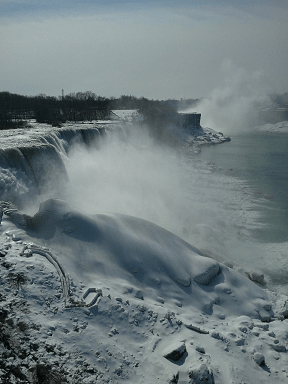
NiagraFallsEvery night I go to sleep with a bottle of water on my night stand. (You knew we’d get back to water eventually. Congratulations on hanging in there with me this far!)  I never remember drinking any of it but every morning when I get up it’s at least half empty. Not only do I never remember drinking any water, I don’t remember ever being awake during the night. (Um, unless I get up to…ah…, moving on.)

Am I a sleep drinker? Do I have such a water craving that I reach over, grab and uncap the bottle, glug away at a few ounces, replace the cap, and return the bottle to its place on the nightstand all without waking? If I didn’t have water next to me would I be sleep walking to the kitchen then sleep pouring a glass full so I could get my water fix during the night?

How does that happen? I have to figure it out. This is something I’m going to have to think on until I come up with a reasonable explanation about how I can drink and sleep at the same time. Unless it’s not me. I still haven’t solved the mystery of the open doors, drawers, and other front pieces. Perhaps with all their nocturnal activities the house fairies have now developed a need to wet their whistles.

I’d like to think I’m not so oblivious to my surroundings that I’m even missing the times that I am the one interacting with them when I quench a nighttime thirst. On the other hand, just in case it is the house fairies and they’re finally going to get around to actually working around here I want to keep them happy. If that means letting them drink my water, who am I to argue?

I certainly don’t want to make waves.


Shower Power

Yesterday I had more fun naked than I’ve had in years. I took a shower. Talk about good, clean fun!

To many of us, pretending to be the recipient of an automatic car wash might not seem to be epitome of carnal satisfaction. But I had just been released from an 8 day stay at one of the cleanest places on Earth, a hospital. And boy did I feel grungy.

I am not at all unfamiliar with America’s health care system. For almost 40 years it provided me my pocket change as I toiled on the provider side and for almost 4 years it provided me a place to hang out and spend said hard-earn pockrt change on the patient side. I am very aware, and very appreciated of the advances it has made. Technically, that is. Humanly, maybe not so much. Consider the following.

With modern imaging they can see tiny slivers of our insides down to the 32nd of an inch in detail almost better than lifelike. They can see with sound. My surgeon worked to delicately open my abdominal cavity, clean and repair the offending parts, and then put me back together using a camera through a couple of holes not much bigger than one made by a flu shot needle. Yet when all of that was done I was left to recover in a room with a TV the quality almost as good as a 1960 portable set with rabbit ears wrapped in aluminum foil. (Ask your granfather. He’ll explain.)

I was attached with the necessary wiring so my pulse, heart beat, breathing, and temperature could be monitored from a station 80 feet away. But the aforementioned television was controlled by a remote that contained only Power, Volume Up/Down, and Channel Up/Down buttons. This in a housing that also held the Nurse Call button and, for some reason, a button to set the room lights to three different brightness levels. All that looked much too alike.

And of course, unlike even the smallest movement towards improvement the silly remote has provided to the patient since I started my career those years ago, the one thing that hasn’t changed at all is the hospital gown. The famous see-through garment with non-sleeves that nobody can get their arms into, a neck fastener reminiscent of a backward bow tie, and all in an indecent package that only makes it 80% of the way around your body. And of course the remaining 20% is not on the side.

Yet given all this, on my return I was not overcome with the urge to finger my high tech remote, triggering the high def TV and the surround sound, grateful for work done to keep me going for another 4 to 40 years. It was to strip off those clothes that completely covered me and bask in joy of hundreds of gallon of hot water pouring over me, drenching every pore, soaking every personal nook and cranny. Thank all that is holy that one imorovement we’ve never had to endure is the restorative power of water.

It was enough to make me want a cigarette.

That’s what I think. Really. How ’bout you?

Water, Water Everywhere

I like to keep a bottle of water on my nightstand. Actually I’d like to keep a bottle of wine or fifth of bourbon but I used up my alcohol life allotment about 15 years ago and I’m trying to cut down. So I keep water there instead. I’d keep a glass of water on the nightstand but I know I’d knock the thing over more than I’d drink from it so that’s not a good option for me.

This water bottle doesn’t have to be filled with bottled water. I’m just as happy with tap water and I’ll do the unthinkable and re-use a bottled water bottle for a week or so. Thus a six pack of fresh mountain spring water might last me a couple of months. Now I don’t do this because I think it’s foolish to pay good money for water when you can get it free out of the tap. For one reason that water coming from the tap isn’t free.  But the biggest reason why I do this is because I’m basically lazy. I don’t want to add “water” on my weekly shopping list. It’s bulky, it’s heavy, and I have limited storage space.

Last week I did have “water” on my shopping list. I don’t care much what type of water I get; I’m more concerned with how sturdy the bottle is. Thus I have no brand loyalty when it comes to bottled water. And thus I found myself in the water aisle and suddenly realized how much water there is there. I suppose I always knew but this day was the day it finally hit me – there’s a lot of freaking water out there. I walked it off. I paced along 36 feet of shelving devoted to water. Each section held 6 shelves for over 200 linear feet of crystal clear, mountain spring, or factory generated, bottled water. And that’s just the plain water. My shopping list specified only “water” so I hadn’t included the vitamin water, sparkling water, soda water, flavored water, mineral water, or seltzer. Just water. Wow.

Someday I have to meet whoever first came up with a marketing plan for bottled water. That person is very good!

That’s what I think. Really. How ‘bout you?

Forgotten West Virginia

The post Hurricane Sandy news yesterday was that power would finally be restored to most of those in New York and New Jersey who had been without electricity for two weeks.  Nobody said anything about West Virginia.

At the height of the storm, whatever weather you were facing, wherever you were, was the most important news of the time.  As your weather crisis passed, whether it was weather, weather related, or just interesting, you turned your attention to the New Jersey New York Sandy Aftermath or whatever clever title your favorite news outlet wanted to give to the disaster.  The country was riveted to their televisions watching how New York City was recovering from the storm. Except some in West Virginia.

With all the sympathy and support, assistance and aid due the residents of New York and New Jersey, please don’t forget the already forgotten in West Virginia.  Thousands there are still without power, phone, water, and roads.  In West Virginia the storm story wasn’t water, it was snow.  Snow measured in feet was dumped on the Northeast counties of West Virginia in the mountains near the Pennsylvania border.  As the snow fell so did trees and electric poles and with them power. 

There the power wasn’t just for heating and cooling and refrigeration and lights.  There many of the houses’ water supplies are from wells and power is needed to run the pumps to bring water to the house for drinking, bathing, washing, and flushing.

As the snow and the trees and the poles fell on West Virginia, a lot of that fell on the roads.  Many are still impassable which is why many are still without and will continue to be without electricity, school, work, and trips to the store.   Local officials project it will take up to six months to clear the roads, the roads they were attempting to clear from a previous wind storm before Sandy hit.

Wherever disasters hit, decency follows.  Many of the residents were able to help themselves and their neighbors clearing roads with their own tractors and being able to get to those who needed the most help.  When those with the power (political, not electric) couldn’t get to those who needed to get to someplace warm, or to get to medical aid, or to get to their prescription refills, the neighbors did.  When electricity or natural gas wasn’t available with which to cook and heat, neighbors delivered propane tanks and stoves to those who then could and did.  

That some can dig their way out to help others is a remarkable story someone should tell.  If someone can get there.  While Homeland Security officials toured the devastated areas in New York and New Jersey, they attended a briefing in West Virginia’s capital a couple hundred miles away. 

Don’t take away from the efforts to restore normalcy to the coast.  And don’t forget to give to the efforts to do the same in the mountains.

Now, that’s what we think. Really. How ‘bout you?