Go to…where?

Oh you can just go to…where?

Before you start reading, please be warned this post contains some dramatic and often controversial concepts. Words like forgiveness, repentance, and hope are used, and not ironically.  We may even talk about politics and religion. Certainly, about the religious.

It has been a week and a day since Pope Francis was asked in an Italian television interview, how he imagined hell. He answered “It’s difficult to imagine it. What I would say is not a dogma of faith, but my personal thought: I like to think hell is empty; I hope it is.” It would seem, as Cindy Wooten wrote in an article for the Catholic News Service, to be an answer we should have expected. She wrote, “An emphasis on God’s mercy has so dominated Pope Francis’ pontificate that it should surprise no one that he said he hopes hell is empty.”

As of yesterday, social media is still buzzing. Perhaps people had to take a week to check out how their followers, connections, fellow former Twitterites, and “friends” felt about this, because we know that in the world of social media, we must all take a stand in every subject imaginable, especially after we find out what stand the loudest of the loud are taking. I won’t go into all of the ridiculous excuses people came up with to garner their 15 seconds of fame, suffice it to say that as with most issues from the Bill of Rights to the Las Vegas odds on the NFL playoffs, the loudest of the loud also demonstrated how easy it is to formulate an opinion before, and often instead of looking at obvious facts. The most often cited arguments against hoping hell has a lot of vacancies are what about Hitler (and other examples you don’t have to go back 80 years to find), what about serial killers, what about justice, and what about the devil himself.

“I like to think hell is empty; I hope it is.” None of those 11 words states nor even suggests there is no hell or there are no people bad enough to be worthy of hell, nor the existence of the devil if that is what you believe. The statement can be twisted into a more secular aspiration, “I like to think no newborn ever is sick enough to have to be admitted to a neonatal intensive care unit,” or “I like to think there will never be a car accident so bad the fire fighters have to cut an injured person out of a burning wreck.” It is a statement of hope, of desire, even of a challenge made to mankind to admit wrongdoing, confess and repent and rely on God’s mercy to save you from the sure damnation to the hell that we’d rather see empty.

I bring this up because it so reflects how far people will go to argue a point. It is not a matter of religion. We do this with statements from religious leaders, world leaders, celebrities, pretend celebrities, politicians, athletes, anybody we perceive as trying to “tell us what to do.” The arguments are universal. Much too often people don’t read, don’t listen, don’t know what’s been said before they start arguing a point, often the point they want to argue rather than whatever has been said, or to only parts of what had been said. (Note Pope Francis’ qualification “my personal thought.”) Just as big a concern are the people who have no stake in the discussion. Continuing with the Pope’s statement, there were many social media posts along the lines of “what does it matter, there is no Heaven or hell.” In that case, why even address the situation.

We do this with religion, with politics, and for too many even within our own families. It is easier to argue a point than defend it or to logically challenge it. Just look at the convoluted arguments surrounding the First and Second Amendments. People want to interpret to fit their expectations rather than read and understand what was intended.

Every religion believes in repentance, contrition, and mercy. Each has some dogma that says we can be forgiven for whatever wrongs we’ve done. Stepping outside religion, most societies also have systems of repentance and forgiveness. (“I’d like to think we are good enough to each other that prisons are empty.”) Every religion also has some prophetic personages. Ask most people of the role of the prophets and the response most probably is to foretell events. And although some prophets sometimes did, most carried messages to the people to repent. Now, ask most people what it means to repent, and the most common answer would be to express recognition of transgressions. Repentance also includes remorse and acceptance, and then recognize and correct the offensive action.

Without sounding like the street preachers of the 1960s, when you understand the process that has been created for us, the us who believe in Heaven and hell, who believe in God, a merciful God, we see it is possible to “repent and be saved,” and the Pope’s desire to see an empty hell is possible. It is improbable because there are too many people who believe themselves to be the center of all creation.

Likewise, it will be forever impossible if we never release our petty desires to always be right and if we can’t be right, do all we can to prove someone else wrong. It we can’t do that, we don’t have to worry about hell being empty. We will find ourselves already there.


You cannot make anybody like you, but you can make a place where they might. Read our take on how being honest, available, and caring can maintain healthy relationships in the most recent Uplift If You Insist.


B26A53B1-C4B1-46A3-BDD1-F8E733E0C9D9


words matter

This week I was proof-reading the post that will be published this Wednesday, August 30 on Uplift! the ROAMcare blog. It’s about saying what you mean, meaning what you say, the joy you feel when you can, and the consequences when you don’t. As I started writing the first draft for this post, I had no inkling the two would intertwine. This post, like the previous two posts to this blog, was to be about words, though not necessarily the saying and meaning of them. In between the reading and the writing of these two blog posts, I was also reading some local news. There was an incident here in town involving a man barricaded in a house, and suddenly, I found an overlap.

  • The barricaded gentleman was the target of an order of eviction. Rather than accepting the paperwork, he fired on the sheriff deputies attempting to serve the order. And that began a 6+ hour standoff during which thousands of rounds of ammunition were fired. The county Sheriff reported that the suspect was pronounced dead at the scene. What does that have to do with words? One moment please. I did some further investigating. 
  • Checking the sports pages, a local college football booster donates $20 million to the college athletic department to enhance the school’s football program. The same donor previously founded a collective of like minded donors to set money aside for Name Image and Likeness payments for the school’s athletes. I know, one more time. What’s that have to do with words? Please hold.
  • A local Home Depot was reported to have been the victim of theft. “Thousands of dollars worth of equipment was stolen from a local Home Depot, police say,” the report begins, then it continues, “State troopers say two men and a woman were responsible for the thefts. Two microwaves, a stove, a gas grill and a John Deere riding mower were all stolen from the store.” The report goes on. “The thieves are also believed to have taken drinks. Overall, the stolen goods were worth $4,697.60.” One of these words is not like the other. Don’t go away. We’ll be right back. 
  • And an oldie but a goodie. Earlier this month a man was stopped by TSA agents at the local airport with a fully loaded 9mm handgun and 2 additional loaded magazines for a total of 22 rounds of ammunition. He forgot. Two words. Yeah, right.

Let’s look at the words used. 

Working backwards, yeah, right. Come on guy, just say you don’t trust women to recognize you’re happy to see them so you keep a gun in your pocket.

The report of the theft at the outsized home center knew exactly, what was stolen, the value of what was stolen, and who stole it, yet they aren’t quite sure about those couple drinks that are missing. Was the reporter on a word count and needed those eight words to satisfy the editor’s line budget?

Enhancements to the athletic department that also references the the NCAA NIL policy. Sounds like a personnel budget to me.

And the one that started me down this rabbit hole. One person inside a building. Thousands of shots from inside the building. And with all deference to the presumption of innocence, “the suspect?”

Isn’t it time we start saying what we mean?

Now, other than the common theory of say what you mean, mean what you say, this is nothing like the ROAMcare post will read. If you want to know how post that comes out, be one of the ones to read it as soon as that post comes out. You can subscribe to Uplift! here.


Speaking of words, the words “good enough” don’t conjure thoughts of expert performance, but is good enough ever good enough? We explore times when it might, and when it definitely isn’t, in the most recent Uplift! The approximate reading time is just 3 minutes


657DEE99-CF72-4E3C-B571-AC40C3B2C833


Let the Better Love Win

If there was a movement started to celebrate those who believe in, actively participate in, and fought for human trafficking and slavery, would you support it? What about if there was a movement started to commemorate those who fought for their country bravely and without concern for their own personal safety because it meant preserving their family’s heritage and the only way of life that they knew?

What would you say if somebody you didn’t know said you had to change your name? Move? Forsake your parents and grandparents?

What would you do if somebody you trust, somebody whose opinion you value and word you accept unquestioningly, were to blatantly lie to you to make themselves look good in front of others.

Unfortunately, there’s a very good chance that you’re the one supporting the movements, doing the saying, or being the liar. Particularly if you’re an everyday, ordinary, middle of the road, try to do all the right things, unextreme American.

Those two movements I brought up. They are actually happening, right now, right here in the United States. The Civil War was fought because one side wanted to keep slaves and the other did not. It’s really just that simple. And it had been going on since before the signing of the Declaration of Independence almost 90 years previous when the southern colonies coerced the northern colonies to remove anti-slavery rhetoric from the document in exchange for their ratification of it. But those who fought the battles some 90 years later didn’t consider owning people unusual or even questionable. It’s what they and their families had down for as long as they had been Americans. All those monuments that have become this month’s flash point celebrate those who fought to continue slavery. They also celebrate somebody’s great grandfather’s younger brother who died from infections grown in wounds suffered when he was trampled by a regiment’s cavalry unit defending his family’s right to live the only life he ever knew.

In our efforts to “not offend” we have sanitized all heritages, all history, all family. Somebody, probably not someone whose roots are indigenous to this continent, decided those people will be called “Native Americans.” Someone, probably not somebody whose roots hail from the Far East, decided those people should be called “Asian Americans.” Somebody, probably not someone who never set foot on Africa, decided anybody with dark skin regardless of their country of origin should be called “African American.” If we are truly honest, and our parents or grandparents came to America from Italy, or Germany, or Poland, would we be happy calling ourselves “European Americans?” Why should a proud decedent of the Lakota, or The Navajo Nation, or Japan, or Cameroon not be allowed to celebrate their heritage and call themselves Americans and still respect their true heritage.

So many are calling Charlottesville a hastening of America’s downward spiral into unrestrained racism. Actually, that spiral began not last week in Charlottesville but last century in Selma, when a big chunk of our populace had to demonstrate to get the recognition of people, equal in all respects, that a civil war was fought for and a presidential proclamation declared them to be 98 years earlier. We passed laws and called them “equal rights” but actually fostered inequality and spent more time debating what constituted equal than time spent on living right.

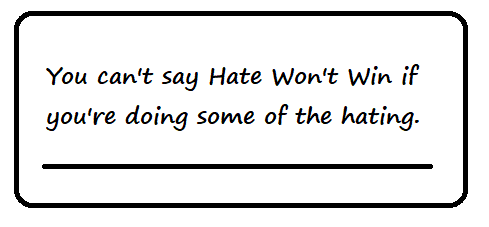
UnhateFacebook profile pictures are sporting “We will not let hate win” banners above posts that call those who don’t agree with them “bat shit crazy.” We openly claim support for tolerance yet openly refuse to make allowances for anybody who didn’t vote the same way regardless of which way that was. We justify our remarks by standing behind the First Amendment but tell others what is and isn’t allowed and don’t extend the courtesy to anyone whose speech is different.

St. Augustine said, “There are two loves, the love of God and the love of the world. If the love of the world takes possession of you there is no way for the love of God to enter you. Let the love of the world take the second place and let the love of God dwell in you. Let the better love take over.” This works regardless of what you call or believe your God to be: a heavenly being, a force of nature, a guiding spirit, omniscience personified. There is a greater force and there is an earthly force. You can believe in both, you can honor both, you can love both. You should love both. But the love of our guide should light our path. The love of the world should invite others to join us.

Unfortunately, we don’t seem to be expressing any love lately. You can’t say hate won’t win if you’re doing some of the hating.