We Tried

I wish I had a happier update to pass along but last Thursday we lost the kidney. We knew we were entering unfriendly waters, weren’t certain it was going to take and had the best team we could want, but the transplant was not meant to be. They all aren’t. Even something with a 97% chance of happening flawlessly has a 3% shot of not working at all. I suppose you could say the long shot came in. I can tell you what happened but people are still working on the why to go with it.

On the first implant, the donor kidney almost immediately picked up color indicating blood was flowing through it. By the following morning blood flow could not be detected and an ultrasound indicated a possible clot in the artery leading to new to me kidney. The decision was made to go back inside me, remove the kidney, clean things up, then return it. This is where we were at the most recent post.

For the next two days, various imaging tests indicated blood flow to be good, marginal, or inadequate – not consistently nor in that order any given time returning any of those results. But laboratory tests indicated an improved renal function. It raised questions. It can happen, in fact it’s not unusual that flow and function decrease or diverge in the first week after transplant. After a week though, results continued to show too much discrepancy between lab function and imaging. After much consultation and while considering risks versus benefits it was decided the only conclusive answer would be achieved by actually exploring the area and physically examining the kidney.

It was found that blood was flowing into the kidney but not through the kidney. The small veins inside the kidney were again clotted, turning the kidney into an anatomical water balloon. The danger of rupture resulting in peritonitis was too great and the kidney had to be removed.

Now that kidney is being examined by pathologists to try to determine the cause. Was there a defect in the kidney making it prone to clot, is there an undiscovered defect in my blood making it prone to clot, or was there a combination of immeasurable or unknown factors resulting in the clots.

The disappointment is huge but the potential is great. If there is something organically “wrong” with that kidney these events might have happened to it while it still resided in my sister potentially rupturing in her and causing her all sorts of untold problems. If there is a defect in my blood it could be that a potential life threatening condition might now be identified and treated. If there is a defect caused by the combination of my blood and her kidney it could that mean future donor and transplant candidates may undergo even more rigorous screening for compatibility.

Some consequences are more immediate. I continue to be hospitalized while I recover from these three operations. As an impatient I’ve received dialysis and my response here will aid in determining if upon discharge I return to dialysis at my pre-surgical order and schedule. My sister will continue her post-operative tests and appointments. I may not have been a successful recipient of her kidney but she was a quite successful donor and will now forever bear the scar of her sacrifice.

So the journey does not yet end. We’ve merely come to the inevitable fork in the road. It might be too early to tell which path to take or it might mean neither path is best but a whole new trail must be blazed. Something good will come from this. It might not be the result that we wanted but “good” and “want” are not guaranteed to overlap. Stay tuned.


Transplant Journey Posts

First Steps (Feb. 15, 2018)
The Next Step (March 15, 2018)
The Journey Continues (April 16, 2018)
More Steps (May 31, 2018)
Step 4: The List (July 12, 2018)
Step 1 Again…The Donor Perspective (Sept 6, 2018)
And The Wait Goes On (Oct. 18, 2018)
Caution: Rough Road Ahead (Nov. 19, 2018)
And The Wait Goes On (Jan. 24, 2019)
A Worldbeater of a Story (March 14, 2019)
Spare Part (May 22, 2019)

Close But No Cigar -Yet (June 2, 2019)

Other Related Posts

Walk This Way…or That (March 9, 2017)
Looking Good (May 18, 2017)
Technical Resistance (May 25, 2017)
Those Who Should Know Better (July 24, 2017)
Cramming for Finals (May 3, 2018)
Make Mine Rare. Or Not (Feb. 28, 2019)
Parts is Parts (May 6, 2019)

A Worldbeater of a Story

Because it is World Kidney Day, and only because it’s World Kidney Day, I’m going to talk about kidneys and then I’ll give you a few weeks without having to hear about my internal organs.

WKD

Since our last kidney transplant report I have lost one potential donor to high blood pressure. That leaves one who has now completed the evaluation and one with one test remaining and then of course the final review. That might bring up a couple questions for you. If it doesn’t, don’t worry, I’ll ask them. Does it seem to be taking a really long time and is it unusual to have a donor disqualified after such a long time into the process?

Honestly it is taking a bit longer than the average for these people to get through the evaluation process although not really by too much. I suppose if all the stars lined up and there was no waiting for appointments and if you had the most flexible schedule in the world and could be accommodating to the scheduling whims of a dozen different hospital departments you could breeze through the process in a couple months. But if you’re thinking the process is

…Step 1 hold sign up at hockey game looking for kidney,
…Step 2 sort through the 99,000 volunteers and pick the one with the best looking teeth,
…Step 3 meet in pre-op the following morning and plan to share a pitcher of beer later that day,

ummmm, no.

Under the best of circumstances it takes weeks and weeks because the process is a few more than 3 steps. And potential donors can be eliminated at any step, including the last.

The process pretty much follows the decreasing chance of elimination. That is, the step that would rule out most people as a donor is first, the second most common disqualifier then next, and so on.

A medical and family history is the first step along with a discussion of what is required for the evaluation, surgery, and recovery for a potential donor. At the same time, lab studies are drawn. Blood and tissue type compatibility is a must. If the donor candidate does not match the transplant candidate there are no further steps. In the spirit of the upcoming baseball season that means one strike and you’re out. There are no further reviews and no reconsiderations. If lab tests note suggestions of compromised renal function, unbalanced electrolytes, or heretofore unknown conditions such as diabetes, a committee will review the results and determine if the donor candidate can continue, be referred for treatment then reevaluated, or referred for treatment but disqualified.

Next are the cardiac and pulmonary functions. Will the donor’s heart and lungs get through the surgery and will they be strong enough to continue serving the donor well with the support of one remaining kidney? These steps include chest x-ray, EKG, stress test, and 24 hour blood pressure monitoring. At this point an abnormal return in one exam might require additional testing while the donor continues, additional testing while the donor holds, or disqualification. For example a slightly elevated blood pressure could require a second 24 hour test but the donor can proceed. A severely elevated blood pressure would hold the donor and refer him or her for new, modified, or additional treatment. A 24 hour blood pressure that remains within normal limits only with the use of more than one antihypertensive drug disqualifies the donor. In my particular set of donors there is one who was allowed to proceed pending a repeat 24 hour study ordered and then held and referred to cardiology for further review.

Next are renal function tests. You might think that if a person is considering donating a kidney the renal function tests would come sooner. People who know they have a renal impairment know not to begin the process. Nine out of 10 people with renal disease do not know it so why would this not be the first system reviewed?  Many of these people know they have a family history or it will be suggested by the earlier lab studies so they may not ever reach this step. A donor who does not initially pass the renal function tests will be reviewed by the transplant committee. Here they will be held until a determination is made that the test will be repeated, the results were expected because of other physical characteristics of the candidate, or the donor is disqualified. In my set of donor candidates, one was held for a repeat evaluation then further reviewed and determined to be allowed to proceed.

Then comes the psychological review. Usually. In some cases when a donor candidate has a history that includes psychological, emotional, or mental medical concerns with or without medication management, the psychological review may come after the initial history and lab studies. Most often it is held here when the potential donor is only two steps from being or not being further referred to as a candidate. In its simplest term, this is when it gets real. A candidate will either move on or withdraw.

To this point each step contains multiple tests any of which can hold or disqualify a candidate. After each test the transplant committee reviews the results and determines the next step: proceed, proceed but reschedule and repeat, hold and repeat, hold and review, or withdraw.

The penultimate step is an abdominal CT Scan. This step is the last physical exam for the donor candidate. This step explores the candidate’s kidneys and their physical appearance and position and is used to confirm the kidneys are normal in size and shape, which is the preferred kidney for harvest, and that all surrounding organs and tissue appear normal and regular. Here a donor will be approved for final review, held for further study due to an inconclusive finding regarding either or both kidneys, held and referred to appropriate specialist for inclusive finding regarding surrounding organs, or disqualified. Among my donor candidate pool, one was referred to a specialist when a nearby organ appeared other than normal.

At the final step the donor’s results and findings are reviewed by the transplant committee who will recommend the candidate to donor status or recommend withdrawal. In the case of multiple donor candidates specific for a single transplant candidate, a recommendation of one or more with consideration to potential acceptance and viability of the donated organ may be made.

HeartAndKidneySo now that it took you so long to read about the process you may better understand why it is taking so long to complete the process. Each of my donor candidates was stopped at some point in the evaluation. One proceeded all the way to the CT Scan when a shadow was noted on a neighboring organ. The transplant committee interrupted the process and referred her to a specialist who in turn determined the shadow was not clinically significant and recommended her to continue which the transplant committed approved. One was held at the renal function test when the IV mediated glomerular filtration rate returned a slightly elevated result. The committee referred the result to one of its own nephrologists who recalculated the result and determined due to her physical structure it was within normal limits for her height, weight, and age and recommended to continue. One potential donor returned elevated 24 hour blood pressure results. She was allowed to move on to the renal function tests but had to reschedule a repeat 24 hour blood pressure monitor. The second 24 hour blood pressure results also returned elevated and she was referred to her cardiologist. Pending his review and finding, even though by this time she had passed the renal function tests, she was held from further candidate progress. Ultimately her blood pressure could be maintained within the standards expected for a kidney donor only with the use of two medications thus she was removed from the candidate pool.

So now with one candidate at final review and one awaiting an upcoming CT Scan, you might be reading one of the last installments in my search for a kidney. And if that’s the case it means you might soon get to start on a new journey, one of a new transplant recipient.

—–

Transplant Journey Posts

First Steps (Feb. 15, 2018)
The Next Step (March 15, 2018)
The Journey Continues (April 16, 2018)
More Steps (May 31, 2018)
Step 4: The List (July 12, 2018)
Step 1 Again…The Donor Perspective (Sept 6, 2018)
And The Wait Goes On (Oct. 18, 2018)
Caution: Rough Road Ahead (Nov. 19, 2018)
And The Wait Goes On (Jan. 24, 2019)

Other Related Posts

Walk This Way…or That (March 9, 2017)
Looking Good (May 18, 2017)
Technical Resistance (May 25, 2017)
Those Who Should Know Better (July 24, 2017)
Cramming for Finals (May 3, 2018)
Make Mine Rare. Or Not (Feb. 28. 2019)
And The Wait Goes On

It’s time to bring you up to date with the kidney search. Okay, now you’re up to date.

Seriously, not much has happened since my last update other than the donor pool continues to march (swim?) (you know – pool, swim. okay, I’ll stop) toward completing all the required tests.

Actually, that is reportable. Three candidates are all moving along but are at different stages. One has completed all of the required steps and is waiting for the transplant group to review everything. One is awaiting a test date for the final step. One has one last test to complete before moving on to the final step.

So, everybody is through, near, or approaching the “final step.” What is it? It’s a CT Scan of the pelvic area including the kidneys and surrounding structure. If a candidate gets that far and nothing has derailed the process, the transplant surgeons will use the results of that scan to determine if the potential donated kidney exhibits any obvious defects that will disqualify the donor, which kidney would be harvested, and if the surgeon would need to consider any special procedures for retrieving the kidney.

So it’s been a while since they started the process and all are getting close to completing it without being disqualified. Yay! But it has been a long time, over five months, since that first phone interview. It’s not like in the movie where somebody holds up a sign at a hockey game that says “Need a kidney, Call me!” and the following scene they are being wheeled into the operating room.

What have I been doing while all this is going on? Other than my regular dialysis sessions, as I reported in my last Transplant Journey post I had a new fistula fashioned. Unfortunately, the central venous catheter that was placed so I could have dialysis until the fistula is healed, hopefully sometime next month, failed and I had to have a new one inserted the day after Christmas. I also hope to be able to report sometime next month that at least one potential donor has been cleared and we are awaiting a transplant date.

Until then we keep going on with our lives like nothing remarkable is going on. When you stop to think about it, other than I actually got basil to live indoors so far this winter, nothing remarkable has is going on. Yet.

——

Transplant Journey Posts

First Steps (Feb. 15, 2018)
The Next Step (March 15, 2018)
The Journey Continues (April 16, 2018)
More Steps (May 31, 2018)
Step 4: The List (July 12, 2018)
Step 1 Again…The Donor Perspective (Sept 6, 2018)
And The Wait Goes On (Oct. 18, 2018)
Caution: Rough Road Ahead (Nov. 19, 2018

Other Related Posts

Walk This Way…or That (March 9, 2017)
Looking Good (May 18, 2017)
Technical Resistance (May 25, 2017)
Those Who Should Know Better (July 24, 2017)
Cramming for Finals (May 3, 2018)


Caution: Rough Road Ahead

I don’t think I’ve ever started a post apologizing for not posting. As much as I find myself an interesting fellow I can’t imagine any of you (if there are any of you still reading) working yourself into a lather because I’ve deprived you of my drivel these many days. But that’s just it. It’s been many days. Many more than I’ve ever gone without posting unless I was unconscious in a hospital bed. That’s just plain rude so for that I apologize.

Technically though, I have been unconscious in a hospital bed but just for a couple of hours. And I’ve been awake on a hospital bed a few days but not any of them in a row. Let me start in the middle for you and maybe that will clear things up.

When we last left our kidney transplant journey there were potential donors being poked and prodded, tested and vetted. They still are but all are nearing their finish lines. Will any be found as able as they are willing? The best I can say is we’ll see.

Until then, dialysis continues to be the means by which my own, slightly overworked and underappreciated kidneys are given a hand doing what they used to do best. Smoothly is generally not a term used to describe how dialysis goes. And it isn’t. Three weeks ago at an anything but routine dialysis session (routine also not descriptive of the dialysis procedure) my fistula imploded. You remember my fistula. It’s a pair of blood vessels surgically connected then anchored just below the skin so the dialysis nurse can shove two needles about the size of ball point pen cartridges into the arm to get the blood to and from the dialysis machine. Repeated stabbings cause scarring and plaque to build up inside the fistula and about every six months the surgeon runs a catheter through my arm by which he can clean things up in there. There is a fairly descriptive description (which is truly the best kind of description you can have) along with a couple truly disgusting pictures (and when describing a fistula, disgusting is truly the best description you can make) in a post from earlier this year.

Even with careful maintenance, sometimes the fistula just fails. That’s what happened to mine on November 6 which just happened to be the day after the last day I posted anything. Coincidence? Umm, not really. After repeated attempts to get a needle seated properly in the fistula with nothing but resistance to show for it, the nurse declared my arm a no dialysis zone. Unfortunately that did not give me carte blanche to swap the dialysis recliner with a seat at the Chinese restaurant down the road although lunch would have been welcome since I rushed through breakfast in order to participate in the American election process. Instead I was able to swap that chair for a bed at the hospital outpatient surgery area and await an emergency clearing of the fistula.

To make a long story short (I realize I’ve already exceeded that marker but it sounds good and I rarely get to use that as an opening line), after two more attempts with equally poor results, everyone admitted that the fistula was no longer a viable and a temporary catheter was tunneled into the right external jugular vein. It was during that procedure I had my previously noted period of unconsciousness in a hospital bed. (I get to be awake during the cleaning procedure, known as a fistulagram, and can actually watch the progress. It’s fascinating stuff but I’d still rather see a Bond, James Bond movie any day of the week.)

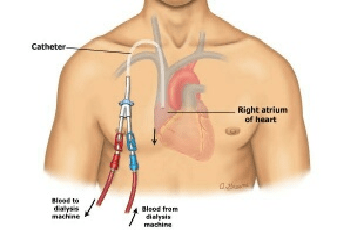
CVCThe unfortunate thing about dialysis catheters is that unlike say administration ports one might receive chemo through, they terminate outside the body and do so on a pair of tails. I’m posting a drawing so you can better see what I am trying to describe. (I could take a picture of my actual catheter but it’s not a selfie I’m anxious to snap and if you just type “dialysis catheter” into your favorite search engine you’ll get no end of new disgusting pictures to peruse at your leisure.) The part of the catheter inside floats and can actually be felt depending in where the tip resides at any particular moment. Reaching for anything higher than one’s shoulder, which given my modest height is anything off the counter, means moving the catheter around in there, also rather obviously noted. And because there is really no good way to anchor the outside tails, any movement or position change comes with a reminder that there is a part of you that isn’t really a part of you.

Fortunately I have the opportunity to be unconscious in a hospital bed again next Thursday when a new fistula will be fashioned into my other arm and I’ll get to have the catheter removed as soon as the new fistula completely heals and toughens enough for dialysis use. That shouldn’t be much after Ground Hog Day.

Just because I was having so much fun at the hospital, last Thursday when I was preparing to return to the world of blogging, I received a call from the dialysis center. The labs drawn earlier returned with a critically low calcium level endangering my health on any number of levels and I was instructed to return again to the hospital, this time to the emergency room where orders would be waiting to repeat the test and administer IV calcium if still returning a lower than normal level. It was, they did, and I got to recline on the sixth hospital bed (but conscious for five of them!) in 11 days.

And you thought getting on a transplant list was going to be boring between the listing and the planting.

Related Posts:

Transplant Journey Posts

First Steps (Feb. 15, 2018)
The Next Step (March 15, 2018)
The Journey Continues (April 16, 2018)
More Steps (May 31, 2018)
Step 4: The List (July 12, 2018)
Step 1 Again…The Donor Perspective (Sept 6, 2018)
And The Wait Goes On (Oct. 18, 2018)

Other Related Posts

Walk This Way…or That (March 9, 2017)
Looking Good (May 18, 2017)
Technical Resistance (May 25, 2017)
Those Who Should Know Better (July 24, 2017)
Cramming for Finals (May 3, 2018)


And The Wait Goes On

It’s been 6 months since I wrote the first post about the kidney transplant journey I’m on. Since then a lot of tests have been performed, a lot of blood and urine analyzed, a lot of x-rays and scans shot. Three months after that first post I reported I was officially placed in the list to await a transplant and if any willing and available volunteers could be evaluated for a potential live donor transplant.

Right now we’re still waiting for donor evaluations to be completed. It seems a long time but it really isn’t. Maybe to a chameleon but not to a human type person. Not even to a human type person waiting for a kidney transplant. With the possibility of waiting up to 5 years, 6 months is nothing, just 10% actually.

But it is long enough that now I’m thinking. Not good stuff all the time. Some of it is good. It’s amazing that of my 3 closest living relatives all three are willing to put themselves through this process. Then that gets me thinking would I for them? I’m sure. What about for a more distant relative…a cousin or cousin’s offspring,? How about a really, really close friend or child of a friend? What about a not so close friend? An acquaintance? A fellow church member or coworker? Stranger? Some people have said yes to all. Altruistically, I’d like to say sure I’d say yes to all. Realistically I know I wouldn’t. But where would the line be drawn? We know intentions are always better than actions but how close are the two when the reality is losing a major organ.

My driver’s license says “Yes I’m a donor. Feel free to use me. Um, but please wait till I’m gone and the only voice I have is this little plastic card.” Would I be willing to say “yes I’m a donor” while I can still speak those words? I suppose I already have. I mean, I’ve donated blood. Does that count? Does it count if I’m a true trypanophobe, which one has to get over if one is going to survive dialysis. (By the way, numbing creams and sprays really do help if you should be interested.) But donating blood isn’t like losing a body part. Blood grows back. Sort of. Kidneys don’t. No way.

Another thought that sporadically pops into my brain is a biblical question. God fearers learn that God not man determines life, thus the opposition to euthanasia and capital punishment. But the converse never seems to be debate. Churches are a main provider of support to transplant recipients even to the point of holding fundraisers to provide financial assistance. If God, not man determines life, is a transplant a means of man extending life? Or is it maintaining life to get the recipient to what would have been the natural ultimate endpoint?

I hope all these thoughts are just my mind doing its thing to fill the void left by the manic pace I underwent doing my evaluation and testing phase and it will quiet itself as it gets used to the waiting period. Maybe after it’s had its fill of playing ‘what if’ games it will settle down and think more productive thoughts like why shouldn’t Seattle get an NHL franchise.

—–

If you’d like to re-read all the posts in this thread as well as other related posts, I’ve put links to all of them on one page. Go here, to join the journey.

Related posts

First Steps (Feb. 15, 2018)
The Next Step (March 15, 2018)
The Journey Continues (April 16, 2018)
More Steps (May 31, 2018)
Step 4: The List (July 12, 2018)
Step 1 Again…The Donor Perspective

Step 3B – More Tests

It’s been a while since I brought you a transplant update so I thought I should get at that knowing that without one soon, your days just wouldn’t be the same.

I haven’t done an update for a while because I’m still in the midst of the tests. You’ll recall the evaluation process started with a series of exams and some “simple” diagnostics – labs, x-rays, EKG, and sonogram. Those were all done in a single visit to the transplant unit at the hospital. More in depth testing was ordered and those are a previously alluded to cardiac stress test, an echocardiogram, a CT scan of the abdomen and pelvis, and a colonoscopy. They should have all been completed by now but the physician doing the colonoscopy had to postpone so that is now scheduled next week. After that I have to secure a medical clearance from my urologist to go with the clearances already secured from the dermatologist and rheumatologist.

You might ask why they need all these tests and clearances and that’s why I’m here. At least for this post. The initial tests determined suitability to undergo the actual operation. For any surgery, a patient will be ordered an initial exam and basic labs, chest x-ray, and EKG. Usually those labs include chemistries and blood studies to see how the body is processing, and the exam is done by the surgeon or a PCP to get an idea of the patient’s general health.

The initial transplant lab tests included the basics but added blood and tissue typing to determine what to look for in a donor organ and some specific tests to exclude the possible or potential exposure to hepatitis, pneumonia, tuberculosis, or cytomegalovirus. These would not exclude a patient from transplant but might indicate additional tests or precautions, or possible vaccines or treatments, may be required.

The more in-depth testing of the echocardiogram and stress test are necessary not only to determine if the patient will be able to withstand the rigors of major surgery but also the aftercare which will be complicated by a drug regimen including immunosuppressants and corticosteroids. The colonoscopy is necessary to detect the presence of any cancers not noted by other tests or reviews which might exclude a patient from consideration.

The medical clearances are specific to each patient’s history. The initial referral must come from a nephrologist or kidney specialist. Nephrology is the specialty involved with the patients already ongoing dialysis treatments so that physician is most able to tell if there would be a possible benefit to considering a transplant and the urgency if so considered.

Every potential transplant patient is also required to have a dermatology clearance. This seemingly unrelated specialty clearance might sound an odd requirement. The immunosuppressive drugs used for life after transplant are associated with the possible development of skin cancers. The dermatologist can establish if the patient already is at risk or has melanoma activity and can further establish a baseline survey to be used as a control for future annual examinations. In my case the dermatology consult was of more significance because I am already being treated with immunosuppressants for the Wegener’s Granulomatosis (now called Granulomatosis with Polyangiitis (GPA) (and we already talked about my feelings on that bit of nomenclature)) that is the apparent cause of my renal failure.

Wegener’s is also responsible for my requirement to have a rheumatology clearance. As a vasculitis, rheumatologists are the most common specialists to be consulted on Wegener’s as are many other autoimmune diseases such as Lupus or Crohn’s Disease. A target organ of Wegener’s is the kidney, especially true in my particular case, so the clearance is required to establish that the disease is not in an active state that would place the donated organ at the same risk of failure as the present. Other organs affected by Wegener’s include lungs, sinuses, and the general vascular system, so active disease would impact the surgery and aftercare even in the absence of kidney involvement.

A urology clearance is also specific to my case because of my medical history having had bladder cancer. That was treated by the removal and subsequent replacement of my natural bladder. I was diagnosed with bladder cancer in 2012. After several attempts of excision of the tumors which all resulted in recurrence we made the decision to remove the bladder completely. This would mean some artificial means of holding liquid waste that typically is done by that unsung organ.  Because I was quite young at the time (only 57, and yes, that is young!) we elected to have a new bladder created, appropriately called a neobladder in the medical world, which the urologist fashioned out of a piece of my ileum. That is the final part of the small intestines that connects the small and large intestines. Long story short, it required a very extensive operation and a lot of “re-plumbing.” The urology clearance will confirm there has been no recurrence of the cancer and that all the pieces are still functioning as they should be and are in the places where they should be and the most appropriate locations for the placement and connection for a donor kidney. The specific requirement for my abdominal/pelvic CT scan will aid him in his part of the evaluation.

And that, in not too brief but actually quite brief discussion is why I am still going through all my evaluation tests. I know, your next question is doesn’t that seem to be too long and too involved for a transplant? And right on the heels of that you might ask but aren’t transplants life and death type operations, why such a long wait for these people?

To the first if those I agree it’s taking a while but no, I don’t think it is too long. Certainly you want to be thorough in evaluating the ability of the patient (remember, that’s me) to get through the operation and that you don’t end up with a successful operation but a dead patient (again, me). So I don’t mind everybody taking their time and getting things right.

And to the question aren’t transplants life and death and you don’t want to take forever with this, I say yes and no. In the case of a kidney transplant there is an alternative treatment to End Stage Renal Disease (ESRD). That is dialysis. Of course a transplant will result in a more natural and often longer life, but dialysis, for all its flaws (enough flaws to keep an entire blog running for a good long while) will keep a kidney patient alive. Like a patient waiting for a heart transplant, if I don’t get a transplant I will probably eventually die from my disease. Unlike a waiting heart transplant patient, I can’t mark that inevitability on my calendar. All transplants can mean the difference between life and death but when you consider sustainable alternatives, for some like a heart, liver, or lung patient, a transplant is more urgent than others like maybe the waiting kidney or pancreas transplant patient.

And so the journey continues, albeit slowly. And my thanks to you for coming along also continues. So please, stay tuned.


Related posts

First Steps (Feb. 15, 2018)
The Next Step (March 15, 2018)
The Journey Continues (April 16, 2018)

Cramming for Finals

I have a test next week. I haven’t taken a test for years and frankly I’m a little concerned. I have just over a week to study up as much as I can for my stress test next Friday.

Yes, you read that right. A stress test. Go ahead and laugh. Here, I’ll even help. A guy asks his friend’s wife where he is. “At the bar. Studying.” “Studying? What kind of test can you study for at the bar?” “His urine test of course.” Ha. Ha.

But this is different. I think I really do have to study for this stress test. Stay with me for a while. There are two basic types of stress tests. One is an EKG/exercise test and one is a exercise/rest/perfusion test. The common factor between the two is the exercise part. Walk on a treadmill until your heart rate is elevated to some specific level or you fall over, whichever comes first. Maybe it’s not put quite so cavalierly by those administering them but that’s basically how the stress is induced during stress tests.

I’m not worried about getting my heart rate up. I know I can walk far enough to get my heart pumping. I’ve been walking again these past few days now that it is nice again here in the until recently frozen northeast. But the problem is I’ve only done that recently and only outside. I might be a bit out of shape from not taking advantage of the treadmills in the exercise room but that doesn’t concern me either. No, what has me wondering about how I’m going to do with this test is that darn treadmill.

Treadmill

Image: Freepik

I can’t work treadmills. That’s why I hadn’t taken advantage of them during the cold weather months. I can’t walk on them. How, you ask, does one say he can’t walk on a treadmill? Because I fall over. I walk with a cane. The reasons don’t really matter but what happens if I don’t is that I tend to tip over. Really. I also wobble and waver. Walking in a straight line is not one of my talents. And yes, I was once stopped at a random sobriety checkpoint, and no, the nice officer didn’t understand that either so don’t feel bad if it’s not making sense to you. On a treadmill I won’t have my cane so I’ll have to hold on to the rails and when I do that I can’t swing my arms and when I do that I lose my balance and when I do that I fall over. (The only person I ever knew who actually fell over during a stress test was a friend of mine who ended up being prepped for coronary bypass surgery minutes after hitting the floor.) (His problem had nothing to do with not being able to work a treadmill. He just had a bad heart.) (True story.)

So, that’s why I think I should study and put a few miles on my sneakers on a treadmill. So I don’t fall over. I’m not worried they might mistake me for one needing emergency open heart surgery. I’m worried they might say they can’t get any useful information out of my test and either a) chemically induce the stress (not pleasant), or b) give up (not an option). Since this is part of my ongoing kidney transplant evaluation you see why Option b) is not an option but Option a) is still not on my “things I’d love to be doing instead of falling over” list.

This is one test I really cannot afford to fail. But I’d be just fine with a C. So I’m thinking I have to study.


Step 3a…The Journey Continues

We stepped off the elevator and I was sure we turned the wrong way in the garage. I read the directions off to my daughter and we were both certain that we had selected the correct garage entrance and floor and entered the building at the door indicated on those directions. It was a little difficult with the construction going on in the parking structure. Much of the signage was obscured and it lent enough of an air of uncertainty that the only thing I was certain of was that I wasn’t certain. When we went from the brightly lit elevator into the dim hallway I thought this wasn’t going to be my day. That’s when the neighboring elevator pinged and a young lady rushed out, saw us and said, “I am so sorry. I’m late. Let me get this opened up and check you in.” I breathed a sigh of relief that I hadn’t gone completely crazy. Yet.

Welcome to the continuing story of As the Kidney Turns. Last week I finally had my in person evaluation appointment and initial round of tests for a potential kidney transplant. I’m calling this Step 3a because there are more tests to come before we get to Step 4, the (hopefully) acceptance.

Step 3 Day started early. Apparently too early. I’ve never been one to be fashionably late. If told to be somewhere at 8, I show up at 7:45 so when I was told to be somewhere at 7:45…well. But I used to worked right down the street from where we were and I knew that if the stars weren’t lined up just right, and the traffic lights were working against you, it could take 20 minutes to go 3 blocks in that part of town. My daughter was with me for the appointment and we didn’t have to be concerned that we were a couple minutes late getting started. We would end up spending the next 7 hours there.

The day started like any doctor appointment. Height, weight, and insurance. Not necessarily in that order. I was checked in which amounted to verifying insurance and demographics, signing various authorizations and releases, and being led to a combination office/exam room. Then things got different in a hurry. There we spent the next four hours meeting with an insurance specialist, two doctors, a pharmacist, a social worker, and my personal transplant coordinator who would be my contact throughout the process all the way to the surgery if that would be the (again hopefully) ultimate end. (I then would be transferred to a post-transplant coordinator who would stay with me presumably until my ultimate end.)

We talked about the actual procedure, that a my own kidneys are not removed but a new location is prepared for the transplanted organ and the how the blood, nerve and fluid connections are made, where that space might be, and the physical recovery from the operation. Most people recover in the hospital for 5 to 7 days then at home for another month or so before resuming regular activities.

We talked how with a transplant the recovery process never really ends. The initial follow-up requires twice weekly visits to the transplant center for 4 to 6 weeks, then weekly visits, then twice a month, then monthly, and so on until I would stabilize at life time annual visits. Post-transplant specific medications are used for life to lessen the chance of rejection and infection.

We talked how if accepted into the program while awaiting a transplant there will be the need for ongoing tests and examinations to continually affirm my suitability. In the absence of a living donor that wait could be 4 to 5 years. Those tests include specific blood tests drawn every month and because I have Wegener’s Granulomatosis which is treated with an immunosuppressant, I would have to be re-cleared by those physicians every 6 months confirming I have no exacerbation of that disease or confounding effects of the drugs used to treat it.

We discussed the differences in recovery and results between living and deceased donated kidneys. If you’re wondering, kidneys from living donors tend to begin working shortly after implantation and can last for 15 years or longer. Those from deceased donors may take several days to begin working and can be expected to keep on working for 8 to 10 years. Also, again if you’re wondering and because I always had, a living donor who should someday need his or her own kidney transplant will receive priority in their own journey.

We also talked about what all this means to me and my family. Pre-transplant for me means continuing with dialysis and some more frequent doctor visits to insure I remain suitable for the procedure (if it’s determined that I am to begin with). The additional blood test can be drawn at the dialysis clinic so that would be one less trip I’d have to make each week. Speaking of trips, if I feel like taking one I’d have to notify my coordinator where and for how long I’d be. Because I live alone, after transplant for those first few weeks I’d need someone to stay with me or I to stay with someone. I would also need assistance getting around initially and getting around would be necessary having to make the trips into town for those checkups at the clinic. Fortunately, those will be short trips. Family gets involved right away. One of the requirements is attending a patient and family education class that goes over in more detail all that was discussed at last week’s appointment.

After all the meetings with all the people and a physical exam from both doctors (there were two doctors because one was the medical specialist and one the surgeon), I was set loose in the hospital for various tests. Those included to the lab for blood test (17 tubes, yikes!) and a urine sample (only one, thankfully), to cardiology for an EKG, and to xray for chest xrays and a sonogram of the kidney and one of what I have been given to replace the bladder. Still to come are a stress test, an echocardiogram, a cystogram, and (my favorite) (yeah, right), a colonoscopy.

Early returns seem to indicate I might be able to pull this off. Nothing came up at the initial exams that would have immediately disqualified me and the test results that have come back are more or less normal, for me. The remaining tests are scheduled over the next several weeks and I hope to have a definite answer by June. Then we can start thinking about possible donors and a whole new step.

DLAAgain, thank you for staying on the journey with me. Coincidence continues. This month my transplant evaluation coincides with National Donate Life Month. Every April, Donate Life America celebrates National Donate Life Month, focusing national attention on every individual’s power to make life possible by registering as an organ, eye, and tissue donor, and learning more about living donation. Many years ago I registered to be a donor. That was long before I ever suspected I would someday be looking at transplants from a recipient’s perspective. If you’d like to explore becoming an organ or tissue donor, check with your local transplant center, your personal physician or the Donate Life America website, or register at RegisterMe.org.


Related posts

First Steps (Feb. 15, 2018)
The Next Step (March 15, 2018)


The Next Step

Welcome to another episode of As the Kidney Turns. When we last left our hero he had just been referred to the local transplant team for evaluation for a potential transplant. Yesterday he got the call to schedule that appointment.

Yes, I got the call Wednesday afternoon for a phone review and to schedule the first kidney transplant evaluation appointment! Even though I spent my career in health care and even participated in post-transplant processes (more on that in another post coming soon), this is going to be a new experience for me. I said I’d keep you in the loop with the process and we start here if you’re still interested in coming along for the ride.

The telephone interview ran a little over a half hour and included a review of systems (current health status and medical conditions, medical history, past surgeries, recent tests, and physical abilities and limitations), and a brief description of what to expect from the evaluation appointment.

The first contact with every new provider always starts with the review of demographic information – height, weight, date of birth, and those sorts of etcetera. One of the questions posed was actually the second time I was asked it this week and the first time was by Tax Guy. You remember him from the last post as one of the stops on my whirlwind appointment tour on Monday. What could a tax return preparing team and a kidney transplant evaluation team have in common? It was “are you working?” It was actually a two parter. First “are you working” and that was easy to answer. No. The follow up was more difficult. “Why?”

It wasn’t put so bluntly by either, but both had to put something down on their forms. The US tax return includes a space for “occupation” that must be filled. Since I am not working I have three choices: unemployed, retired, disabled. I’m sort of all three. I am not being employed to anyone’s good use.  I am old enough that I could retire but not so old that I can draw on pension benefits. And I am not working due to the loss of function that was required to perform my job. Since my income is from disability benefits rather than pension benefits I am disabled rather than retired for the purpose of paying taxes. So that satisfied the accounting world.

The transplant evaluation people need to know if I am physically able to withstand the rigors of the operation and recovery. Being disabled affects not only the need for the potential transplant but the response to the transplant and it’s after effects. A kidney transplant is different from a heart, lung, or liver transplant in that for most potential kidney transplant recipients, if one does not receive the transplant there is still another option to maintain life. Dialysis. It’s not a perfect alternative but for the patient who cannot tolerate the surgery or recovery associated with a transplant it is a means of replacing not the kidney but what the kidney does. Knowing that, it is in the patient’s best interest to not subject him or her to a major surgery that poses significant and severe risks if those will be more harmful than not having the transplant.

So, to make a long story short (which I almost always cannot and once again I fear I have not), in the medical world there are basic functions that I cannot perform on my own including walking and standing without assistance, the loss of my bladder and associated parts requiring me to rely on self-catheterization for what the bladder and other parts usually do, and the ongoing and chronic progression of Wegener’s Granulomatosis and its effects. In the medical world, I am also disabled. But enough of me is still functional enough and strong enough to, on paper, appear to be able to withstand the rigors of transplant surgery and recovery, I can now progress to the evaluation stage to determine if the theoretical transfers positively to the practical.

NationalKidneyMonth

Source: National Kidney Foundation

I’d be very happy and honored if you’d stick with me for that progression. Hopefully this will be the only time that you have to make such a journey. March is World and National Kidney Month. Even though my appointment isn’t until April I’m going to take it as a good omen that I got my call this month. You can make my journey yours and not have to make one on your own, if you remember to, in the words of the National Kidney Foundation, “heart your kidneys.”


Related Post:
First Steps (Feb. 15, 2018)