Like Easter and Christmas, Earth Day is becoming more about the commercial than the cause. A headline in yesterday’s New York Post read, “Celebrate Earth Day with 19 best sales, deals and freebies.” I know, it’s the Post and most of those sales were on “sort of” sustainable products, like, you know. “The Today Show” spotlighted food discounts (because everybody likes a good deal on a good snack) including a brand of “compostable” coffee (there are some that aren’t?) and then there are the ubiquitous reusable tote bags, free with $100+ purchases.
I suppose if there was a World Used Tire Pressure Gauge Day somebody would find a way to work sales on recliners and shower heads into the celebration. Like Earth Day (not to mention Christmas and Easter), the ones who can devise such a sale would splash World Used Tire Pressure Gauge Day prominently throughout the ad but likely won’t address why we’re celebrating used tire pressure gauges.
 Many posters, PSAs, and other communications will remind us that we have only one earth, we should take care of it. And we are getting better. In 1970, the year of the first Earth Day, there were actually two Earth Days. The first was celebrated on March 21 suggested by newspaper publisher and environmentalist John McConnell to the United Nations Educational, Scientific and Cultural Organization (UNESCO). Mr. McConnell became involved with environmental activities when he began manufacturing plastic and realized how much plastic was being discarded. He presented his vision of a worldwide holiday “to celebrate Earth’s life and beauty and to alert earthlings to the need for preserving and renewing the threatened ecological balances upon which all life on Earth depends,” at the 1969 UNESCO conference in San Francisco. His vision saw the holiday celebrated on the Vernal Equinox (the first day of Spring) symbolic of an equilibrium between man and the planet. Earth Day was first celebrated on March 20, 1970 by proclamation of the city of San Francisco. The following year UN Secretary General U Thant issued a proclamation declaring Earth Day thence to be celebrated on the Vernal Equinox.
While that was going on, US Senator Gaylord Nelson was trying to get national attention on the lack of controls on environment damaging activities. In September 1969, seizing the energy of youth, he assembled a team of campus activists to rally around environmental related events culminating with a “teach in” to be held April 22, 1970 (a date selected because it was late enough on most college calendars that it was after spring breaks but early enough that is was before spring finals). The idea was to hold an event so large it would force environmental issues onto the national agenda. On April 22, twenty million Americans demonstrated in various cities across the country. This became the impetus for President Richard Nixon to then establish the Environmental Protection Agency (EPA) by executive order that December.
 Clean air, clean water, and clean land deserve to be celebrated but not just one day a year. A few miles from my front door there is a county park with a hiking trail labelled on maps as the Rachel Carson Trail. Rachel Carson probably is known best for her 1962 book Silent Spring which questioned the “better living through chemicals” attitude of the time and warned of the dangers from the misuse of chemical pesticides. Many cite her book as the stepping off point for the environmental movement. But Ms. Carson was not an angry activist. She was a noted marine biologist and wrote three earlier books on sea life and marine activity, winning the 1952 National Book Award for nonfiction for The Sea Around Us. In 1935 after graduating from Pennsylvania College for Women (now Chatham University) in 1929 and receiving a Master degree in zoology from Johns Hopkins University in 1932, Ms. Carson was hired as a junior aquatic biologist at the US Bureau of Fisheries (which would later be reorganized as part of the US Fish and Wildlife Service) to write radio programs on marine life. She stayed with service, advancing steadily until she resigned in 1951 to write full time. Despite undergoing multiple operations from 1950 to 1960 for breast cancer, Ms. Carson continue to write and lecture until her death in 1964.
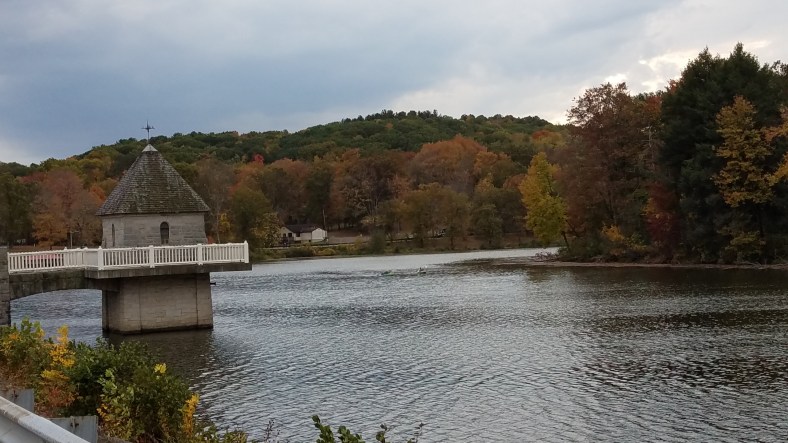
Rachel Carson’s last book, The Sense of Wonder, published in 1965 encourages adults to nurture children’s sense of wonder about nature. It is that wonder I return to when I step off the trail at its terminus facing a wonderful tree rimmed lake in the park. I wrote, “there is a county park with a hiking trail labelled on maps as the Rachel Carson Trail,” and that is true but misleading. The trail is only partly in that park, not even 3 miles of it. That’s the trail where I will wander. The entire trail is nearly 46 miles long and connects two county parks, running through and near several other parks. About 9 miles of the trail at various points follows roads. The rest of it goes where nature leads. There are no shelters, no campgrounds, and often the trail where crossing a stream literally crosses the stream, no bridge included. It’s quite primitive. And quite beautiful.
That is the sort of place one should go to celebrate Earth Day. Maybe you can visit sometime on one of the other 364 days this year. Today celebrate with a cup of compostable coffee and a renewed tire pressure gauge. After all, what says “Happy Day, Earth!” better than a good cup of coffee and a tote bag.
 The Real Reality Show Blog