Hunting for Easter Eggs

Are you still looking for Easter Eggs? Not the colorfully dyed ones. At least I don’t think they’re colorful. Honestly, I really don’t know. I only found one and it was ok. A little color in the corner and the links were in the traditional Internet hyperlink blue, but mostly it was black and white. What am I talking about? Easter Eggs.

See, I’m not a gamer so even though I have heard about cheat codes I never really understood what they were or how they worked and I never heard how video game programmers would hide writing credits in the program. Since I didn’t know of these I certainly wouldn’t know that those who do know call these things Easter Eggs. Nor did I know that EasterEggsthe term had then expanded to include other surprises hidden in programs and apps, on DVDs, and even on Google.

Last week I was reading a blog on Dictionary.com and discovered my own little surprise. I’m sure I remember someone once telling me of Google’s fun presentation when you search the word “askew” but I don’t remember ever actually seeing it. Of course, after I read the on-line article I had to type the word into my Google and sure enough smiled when the page returned was itself somewhat askew. That’s when I began my hunt.

Reading that many Android devices have Easter Eggs hidden in their operating system “about” sections and knowing I have a handful of the devices literally at my fingertips every day I set on a search, an Easter Egg hunt if you will. I haven’t found any yet but I know if I keep my eyes open and follow my instincts I’ll soon end up with a basket full!

Oh, how this reminds me of the days when we’d play every Beatles record we could find backward. Of course back then we did call any found secret messages Easter Eggs. We just called them weird.

That’s what I think. Really. How ’bout you?

And the Survey Says…

Two or three times a month I take an Internet poll. I’d love to be one of those people who make $100,000 a year taking polls on line. Frankly, I don’t have 48 hours a day to take that many polls and if I did, even with no life, I have a life. And even more franklyer than that, two or three a month is getting to be too many any more.

I do most everything on a mobile device nowadays. Even when I’m not out of the house I’m more likely to be on my tablet than on the desktop computer – which, oddly enough is actually on a desk. I don’t think that it’s so unusual that I’d rather connect with a handheld device in the comfort of a comfy chair. Yet more often than not when I open a survey invitation polling people’s opinions on “technology,” I’m presented with the error message explaining “that survey does not support mobile devices.” Am I using old tablet technology?

ResultsThis weekend I opened my emailed during one of the intermissions in the hockey game I was engrossed with on TV (and you thought I was too old to multi-task) and found a survey opportunity on “social issues.” The notice claimed it would take about 15 minutes to complete the poll. Since I had 17 minutes of non-hockey time left I clicked the link. There I was presented with a survey on “social issues,” AKA what I think of my cable provider. Such burning “social issues” we should face every day.

Yesterday I did a little shopping and was presented with an opportunity to express my opinion on a truly pressing “social issue.” Let me see if I can present it in poll-like fashion.

People who stop suddenly as soon as they cross the threshold to a shopping establishment, i.e. stop in the middle of the freaking doorway:

[    ] should be avoided with all available alacrity so as to not be made to feel like their presence is at all any sort of intrusion into your space lest you intrude into their space.

[     ] will have their shoppers reward cards revoked and never be allowed in public without a escort

[     ] must be run up the back of their ankles with any available shopping cart

[     ] truly deserve the death penalty

Now that’s a poll on social issues.

That’s what I think. Really. How ’bout you?

Euphemistically Yours

I was going to write a light, breezy post about something humorous that happened to me. But all of that changed when I saw what was on my coffee table. Let me start in the middle. (The beginning would make this just WAAAAYYYYYYYY too long.) A couple of weeks ago I bought a new television. Sometime over the weekend I read the instruction manual. At least I got around to it eventually. Actually I didn’t get around to it. It somehow ended up on the table instead of the recycling bin and as I was walking it over to said bin it fell out of my hands and broke open. And that’s when I started reading.

At first I wasn’t sure I was really reading it. I thought that maybe I was having a dream but one of those dreams that is so lifelike that you wake up thinking that you really did just have lunch with Aunt Ella even though she died 12 years ago and even more that you don’t have an Aunt Ella. Now that’s a dream. But I thought that maybe that’s exactly what I was having because no company on Earth could actually put into writing what I was reading right there in black and white.

About halfway through the “IMPORTANT NOTICES” was, in bold letters, “End of Life Directives.” This is why I at first thought that I was having and/or had had a dream. And probably a bad dream. To someone who spent 40 years in health care, “End of Life” has a very specific meaning. Usually, no, always, end of life means someone’s life has ended. Died. Checked out. Kicked the bucket. 86’d on out of here. Gone. Never to return. Dead.

On top of it, I’ve spent the last few years in and out of hospitals where the first thing anybody asks (after “are you bleeding?”) is, “Do you have a living will or advance directives?” And just last week the dialysis clinic social worker brought to me a stack of papers to be signed for this year and at the top of the stack was a pre-formatted form labeled “End of Life Directives.”

So you can see why when I saw that associated with an Open Box Internet Special yet still over-priced television set I thought I was hallucinating. Or at the very least way past my bedtime. We have enough things that are challenged, sufficient opportunities, plenty of stuff that is deprived, depressed or disadvantaged, that we don’t need to borrow an actual sentiment to be euphemistic for something that really doesn’t need to be spoken of gently.

Exactly what is this “end of life” that the manufacturers of electronic components are afraid to call a spade? Apparently, as I learned upon further reading, it’s when the TV has reached the end of its usefulness to me and the manufacturer wants to make me aware that there are environmentally responsible means of disposal that are at my umm, disposal.

I know it’s terribly politically incorrect to call a shovel a shovel but hasn’t the need to call everything anything but whatever thing it is gone too far now? We can’t even put in an instruction manual that this thing you just bought might break, fail, quit, or stop working. We have to speak gently so that if you actually paid full price for the item you won’t file an wrongful breakdown suit against the manufacturer. Bull shit. It will break and when it does either recycle it or throw it away. Those are your choices. Directives or not.

But if I should happen to outlive the newest electronic member of my family I will be certain to dispose of it in a responsible and thoughtful manner. I’ll hold a respectful gathering of its friends, we’ll have a non-denominational service with a few of the other appliances offering their thoughts and best wishes for the survivors and afterwards some light refreshments and fellowship. We will then gently load the life-challenged inanimate object into the back of my pre-hybrid automobile, drive several times around the county looking for a recycling center that accepts electronics, pay $1 per pound or $45 per dropoff whichever is less, and then hightail it back home. In air-conditioned comfort.

California will be proud.

That’s what I think. Really. How ‘bout you?


Once and For All

Yesterday’s mail included a post card with large letters screaming to me “Quit smoking now…for once and for all!” Once and for all is a strange sentiment. I remember that phrase from my mother using it mostly when talking about things that happen more than once because they don’t last for all. Typically something like “I’m telling you for once and for all to get in there and clean up your room.”

That post card didn’t encourage me to clean my room. But that probably wasn’t its intention. It didn’t encourage me to stop smoking either, nor to sign up for the very successful (in its words) smoking cessation program it was hawking. Why not? Because I don’t smoke. A run of the mill solicitation for behavior modification may not know that but my own insurance company should, especially since every time I fill out one of their health questionaires I check “no ” where they ask about smoking.

Last week I got an email from my cable company encouraging me to consider paying my bill electronically. I can save time and money it explained if I would pay my monthly fees using a computer instead of a checkbook. I’m not convinced that it takes less time to open a browser than to open a checbook or if the saving money refers to the one postage stamp a month I can rescue from the clutches of the mailman that comes to a whopping 4 bucks a year is worth the effort. Butler  I am convinced that I already pay them using a monthly auto draft that takes me no time (and saves me at least 4 dollars a year (woohoo)) and they should know that.

About a month ago I was multitasking by watching TV, reading emails and intermittently dozing in my recliner. I opened an email asking me to complete a survey on new trends in technology. Since I was in one of my non-dozing periods I thought I would and clicked on the link in the email – on my tablet. It directed me to a page that read “Were sorry, this survey does not support mobile devices.” Hmm, the survey on new trends in technology doesn’t support the old tablet technology.

It seems to me that there is a lot of information about us that “service” providers have that they must not realize what they have. Or don’t care. Could it be that exemplifies the rest of their service also? Maybe they should reconsider that. For once and for all.

That’s what I think. Really. How ’bout you?

What Gimbels Didn’t Tell Macy

Last weekend I had the occasion to hold a credit card in my hand. It was my own. No need to call out the diversion police. And indeed I’ve held it once or twice before. Usually the only time we hold a card is when we swipe it through or slot it into a card reader. But this time I had to actually pay some attention to it. I was ordering something on line and, no matter how politely they ask, I won’t allow a merchant or browser to store my card information. Call me old fashioned. Anyway, it was while I reading it, or I should say struggling to read it, that I thought how little these little chunks of plastic have changed in the 40ish years that I’ve been carrying one.

The first card I carried was for Gimbels department stores. You might remember Gimbels
from the movie “Miracle on 34th Street” as the main competitor to R. H. Macy and his juggernaut of an outlet that doubled as a destination to New York’s second oldest gimbelsThanksgiving Day parade. Gimbels beat him by four years on that one. Again anyway, my Gimbels card had none of the modern improvements like the RFID chip and magnetic strip, the issuer ID and hologram, the CVV (that three or f
our digit number on the back that is supposed to mean you have the card in your possession but everybody wants when you aren’t in their company), or even a signature strip and expiration date. Nope, all it had was my account number and name. In that same embossed type that today’s “modern” cards use.

That’s why I was struggling so hard to read that credit card this weekend. It was those silly embossed characters. They start out in a different color than the body of the card but after a while (like a few hours) of being carried around in a wallet, that color wears off and all you are left with are the raised ghosts of the numbers identifying your account number and expiration date. Fortunately I know my name. With all the advancements made on that little piece of plastic why are they still using raised letters for the most important characters on the card? Well, it seems they are still about, and still being used I would imagine if they are about. And the it are credit card machines. Not the reader thingies you slide your magnetic stripped equipped card through. The imprinter thingies that run an ink-covered roller over the card.

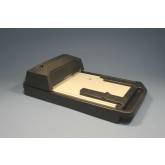
If you are old enough you might remember one like  this:

imprinter2

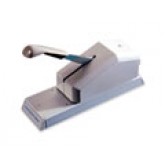
But I remember one like his:

imprinter1

From where do I remember such a dinosaur? From Gimbels, of course. The only reason I had that early card was because that was my in-the-summer-and-on-breaks-and-vacation job during college. You don’t think they’d give a 20 year old a credit card unless they were controlling his income, do you? Back then, twienty wasn’t even old enough to vote. No, I’m not kidding all you 18 to 20 year olds out there. But for a third time anyway, while I was struggling trying to read those horrible raised numbers I suddenly remembered those old imprinters. And that got me wondering if they were still out there. That was the only reason anyone could imagine still embossing the name and number on a modern credit card. Since I have that kind of time, I checked. Indeed you can still buy a credit card imprinter (both styles even) if you were in I would imagine a rather vintage retail business and really wanted to carry on the nostalgic feeling.

For the zillions of us who really don’t care about nostalgia carried to that extreme perhaps the next time I’m due for a new card, Capital One will issue me one with a printed number that I can actually read.

That’s what I think. Really. How ‘bout you?


Can You Heat It Now?

I was working on a household budget for this year over the weekend (so I’m a little late – things happen), when I had to make the decision of whether to renew the car’s satellite radio subscription. That got me thinking about all the iterations of mobile music over the years.

The first car radio I remember was in my father’s 57 Chevy. Of course that was in ’61 long before it would become a classic but that’s a story for another post. That radio was a simple AM job that got music, news, and sports from a handful stations that were within 20 or so miles of the read mounted, stainless steel antenna. It came as a package option that included the radio, an under-dash heater, and cigarette lighter. Talk about luxury!

Sometime in the mid-60s I remember friends’ parents with cars that had AM-FM radios. Now that was something. None of us knew exactly what FM was although a few years later in high school physics they talked about the different types of sound waves and that had something to do with the difference between AM and FM but by then we were too concerned with the music coming from the radio than how it worked. But back in the 60s all we knew about FM radio was that was where the classical music stations lived and that one station that played what they called “album tracks” that our parents wouldn’t let us listen too.

radioAnd that was it for car radio until those high school years. Then the changes came fast and furious. Nobody’s factory model was good enough. The aftermarket offerings included AM, AM-FM, 8-Track, and that newest alternative, the cassette player. Cassettes were cool. They let you listen to “your music” instead of relying on the DJ choices on the radio, they didn’t skip when you couldn’t dodge the potholes fast enough like the 8-track players, and the really good ones include auto-reverse so you could listen to the same album over and over without even having to pull the cassette out and flip it over.

Fast forward (no pun intended but now that I think about it not a bad segue) through college and young adulthood when nothing much new happened other than the ubiquity of CD players in addition to or in place of the cassette to the 1990s and the advent of MP3 players, Bluetooth, and satellite radio. Suddenly deciding on a source of music while riding down the road brought back memories of debating the merits of cassette versus 8 track.

After a few years you didn’t have to make a choice which one to get as much as which one to use since every car seemed to offer every option. Even in my modest family sedan I can choose between AM, FM and satellite radio, an auxiliary jack into which I can plug an MP3 player (or a portable cassette or even 8-track player if I could find one, or the other, or both), or anything that can transmit Bluetooth such as my phone that could play music from memory or stream music from an outside source. With all that decision making to do it’s no wonder only 85% of people decide to buckle up before pulling out.

Now that I’ve put this all down in writing I can see I have plenty of options even if I don’t opt to renew the satellite subscription. That saves me a couple hundred dollars for this year that I can use on 5 or 6 weeks of cable. Hmm, I think it might be decision time again.

That’s what I think. Really. How ‘bout you?


Shower Power

Yesterday I had more fun naked than I’ve had in years. I took a shower. Talk about good, clean fun!

To many of us, pretending to be the recipient of an automatic car wash might not seem to be epitome of carnal satisfaction. But I had just been released from an 8 day stay at one of the cleanest places on Earth, a hospital. And boy did I feel grungy.

I am not at all unfamiliar with America’s health care system. For almost 40 years it provided me my pocket change as I toiled on the provider side and for almost 4 years it provided me a place to hang out and spend said hard-earn pockrt change on the patient side. I am very aware, and very appreciated of the advances it has made. Technically, that is. Humanly, maybe not so much. Consider the following.

With modern imaging they can see tiny slivers of our insides down to the 32nd of an inch in detail almost better than lifelike. They can see with sound. My surgeon worked to delicately open my abdominal cavity, clean and repair the offending parts, and then put me back together using a camera through a couple of holes not much bigger than one made by a flu shot needle. Yet when all of that was done I was left to recover in a room with a TV the quality almost as good as a 1960 portable set with rabbit ears wrapped in aluminum foil. (Ask your granfather. He’ll explain.)

I was attached with the necessary wiring so my pulse, heart beat, breathing, and temperature could be monitored from a station 80 feet away. But the aforementioned television was controlled by a remote that contained only Power, Volume Up/Down, and Channel Up/Down buttons. This in a housing that also held the Nurse Call button and, for some reason, a button to set the room lights to three different brightness levels. All that looked much too alike.

And of course, unlike even the smallest movement towards improvement the silly remote has provided to the patient since I started my career those years ago, the one thing that hasn’t changed at all is the hospital gown. The famous see-through garment with non-sleeves that nobody can get their arms into, a neck fastener reminiscent of a backward bow tie, and all in an indecent package that only makes it 80% of the way around your body. And of course the remaining 20% is not on the side.

Yet given all this, on my return I was not overcome with the urge to finger my high tech remote, triggering the high def TV and the surround sound, grateful for work done to keep me going for another 4 to 40 years. It was to strip off those clothes that completely covered me and bask in joy of hundreds of gallon of hot water pouring over me, drenching every pore, soaking every personal nook and cranny. Thank all that is holy that one imorovement we’ve never had to endure is the restorative power of water.

It was enough to make me want a cigarette.

That’s what I think. Really. How ’bout you?

Buttons, Buttons, Self-Controlling Buttons

In our last post we riled for a bit about buttons.  Buttons on the remote controls that we’re certain on there just to frustrate us when we’re trying to change channels in a dark room. We’ve discovered another set of buttons that are out to rule the world.  Unlike the irritating but basically innocent buttons of remote controls, household appliances, even car radio and climate controls, these buttons pose threats and real danger.  They are the buttons on your hand held electronic devices.

Phones, readers, and tablets all have those cunning buttons along their edges, built into the seams separating the front and back pieces, hiding where nobdoy with fat fingers or long nails can reach but are pushovers for a little pressure from a nearby pen in a briefcase.  Yes, they are…turned on remotely.

Consider these real life examples.  On a recent trip, He of We dutifully turned off his phone before boarding and slipped it into his carry-on soon to be stowed under the seat in front of him.  When arriving at his destination, he took it out to text his progress to She of We and discovered it was already on.  It was on without him having to have held the power button in until his finger went numb. Not long ago at a food court a young lady a couple tables away shrieked (yes, shrieked) in horror and dismay that her tablet not only turned itself on in the depths of her classic messenger bag, but had also drank up the last of the juice in its battery.

Power switches work both ways.  Both of We have had readers and phones turn themselves off.  Usually He of We’s phone magically turns itself off sometime before She of We calls, thus prompting wonderings of why he bothers to carry a phone that he never answers.

Turning electronics on or off isn’t all these device controllers do for themselves.  No, these pieces of silicon and solder switch modes, take pictures, open files, and call friends or relatives with no human assistance.  Remember that the next time your phone rings and you’re standing in the middle of an intersection yelling “Hello, hello.  You pocket dialed me again!” into it.

Buttons, buttons.  If they aren’t frustrating you when you can’t figure out what they do, they’re frustrating you by doing things on their own.  Maybe when the day of everything being voice activated comes along it wil all be better.  Yeah, right.

Now, that’s what we think. Really. How ‘bout you?


Buttons, Buttons, They Have Too Many Buttons

He of We never thought of them as too many until She of We brought it up.  After all, there were only three of them.  But to be honest about it, one was confusing, one didn’t make any changes, and one nobody really knew what it did.  But still, how confusing could it be.  After all, it’s only a toaster.

She of We has been on an anti-button quest for as long as He of We has known her. “All you need is power, volume, and channel,” she often says of the TV remote.  He of We secretly agrees with her but sometimes really just wishes for one remote. The one for the cable that’s suppsoed to run everything never does and the one for the DVD is never there when you need it.  But fewer remotes mean more buttons.  Or does it.  Even if one remote is running three or even four entertainment devices, the commands are as universal as the remotes are supposed to be.  Power, volume, channel, and for the DVD, play and stop.  Throw a “menu” button in for the DVD and the cable and that’s still only 10 buttons.

The point of too many buttons was hammered home the day She of We counted them.  Fifty-three buttons on the cable remote, 32 on the TV remote, 19 on the microwave, and 10 on the coffee maker. Do they all have to be so complicated.  It’s like all of the appliances were designerd by committee.  Perhaps they were.  Hopefully they won’t revolt.

As we’re typing this, we’re counting buttons.  Excluding those for the letters and numbers, this computer has 27 additional buttons.  That’s 27 more buttons than a classic Underwood typewriter of 85 years ago.  And it gets us to the Internet and around the world.  Yet the cable remote has twice as many buttons and it barely gets us around the channel guide.  Like that third mystery button on the toaster, we aren’t actually even certain that they all do anything.

Se here’s our advice for the electrical engineer who is charged with designing people friendly accessories.  Power.  Channel.  Volume.

Now, that’s what we think. Really. How ‘bout you?