Positively Impossible

Every day can bring new reasons to be positive, and to connected with yourself and the world. Unfortunately, every day can also bring myriad opportunities to confirm the world really has gone bat shit crazy.

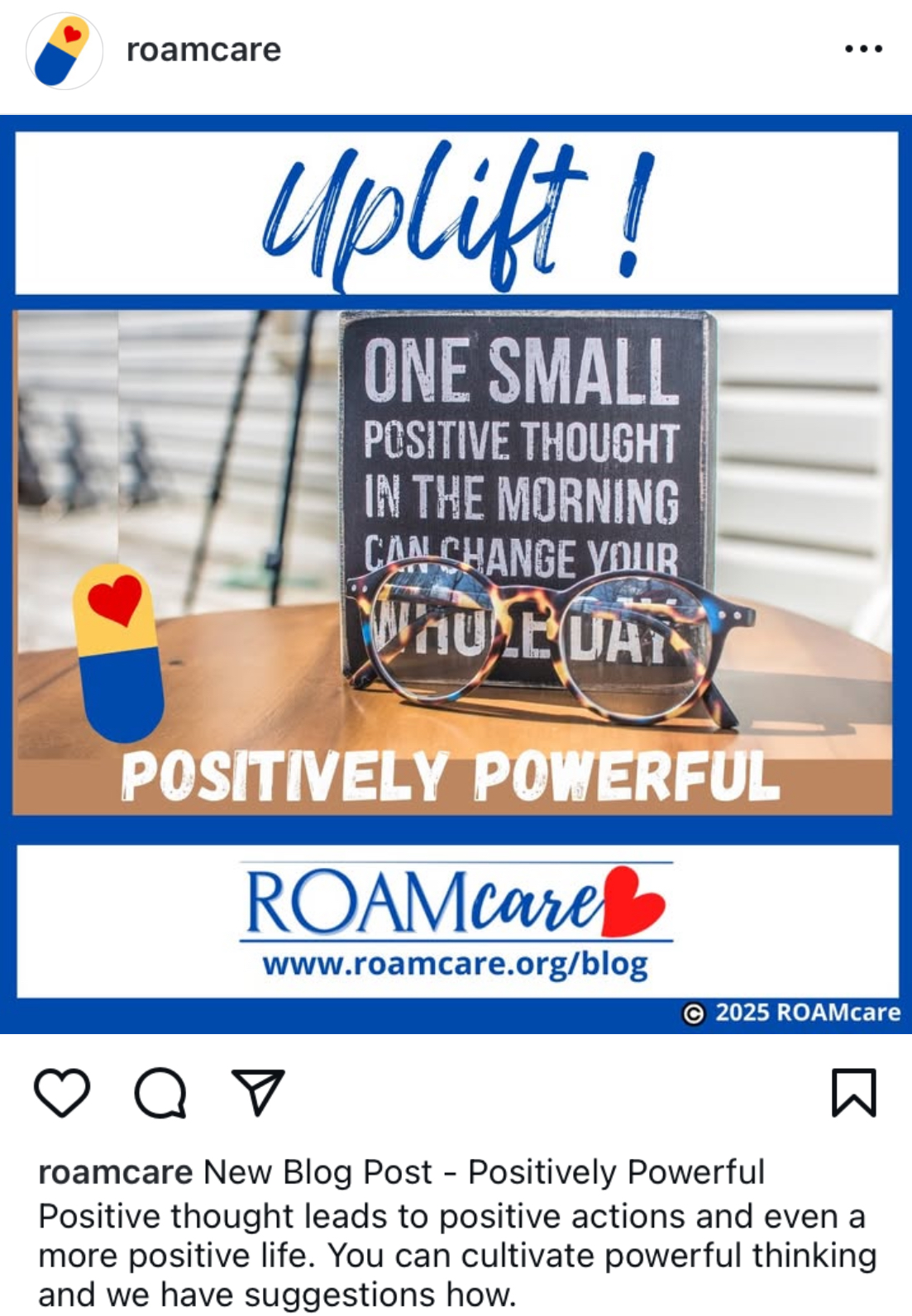
Take a look at the screen shot I’ve posted below. This innocent looking post violates Facebook’s terms of use or service or appropriateness or whatever they want call it. When I clicked in the “click here to find out how we arrived at this decision” the answer is, “this post does violates our community standards.”

I’ve had issues before with anti-social media. I’ve posted literally hundreds of posts for ROAMcare with artwork I’ve generated myself to have several of them removed because of suspicions of being AI generated without declaration. I’ve had posts removed because they included links to websites and therefore are spam and I’m trying to “trick” people into clicking to potentially dangerous sites.

So far, Instagram and Blue Sky are the only sites that haven’t come up with some stupid excuse for removing or limiting any posts.  Give them time.

Now, here’s the most annoying part of all this. We at ROAMcare make nothing from the site or posts. Nothing we do is monetized. We don’t ask people to for access, we sell no ad space. We don’t even ask people to “buy us a cup of coffee.” Everything we do is because we truly believe in what we post and publish and want to spread awareness that it is possible to be enthused about life.

Take the blog post that this post is about, Positively Powerful. A thoughtful discussion about the power of positive thought. Am much as I believe every word that we printed, I get increasingly discouraged by the blatant double standards of the social media world. Unfortunately, most of the outside traffic to our site is generated by the Facebook posts. Oh well.

Perhaps you can look at Positively Powerful or any of the other posts and clue me in on what community would be offended by our work.  While you’re there, consider joining the ROAMcare community and subscribe to have Uplift delivered to your email as soon as it hits the website. In addition to an Uplift release every Wednesday, you will also receive weekly our Monday Moment of Motivation and the email exclusive Flashback Friday repost of one of our most loved publications every Friday. All free and available now at ROAMcare.org.

IMG_2119


Artificially yours

I’m on notice. Me. Mr. Niceguy. The one who follows (almost) all the rules no matter how boring that makes me. Still, I’m the one in trouble.  But… I admit I did what I’ve been accused of. No “not guilty by reason of I said so” plea for me. No, I did it, I got caught, and I’ll tell you and whoever else wants to know, I’m going to do it again! I posted a manipulated picture. And the bad thing about that is, I didn’t say it wasn’t real. Here it is.

IMG_1289

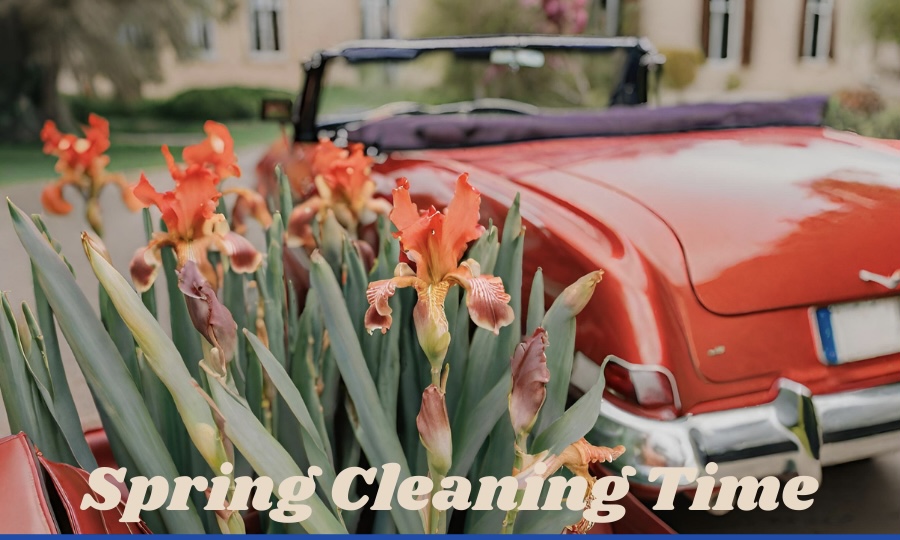
Some of you might recognize this. It is the “cover art” that accompanied the ROAMcare blog post Spring Cleaning. I wanted a picture of a spray of daffodils and a red convertible. As luck would have it, I happened to have in my own photo library two very such pictures, and in years past, I would have spent hours cropping them, removing backgrounds, matching sizes, colors, brightness, and perspectives, then combining them and adding the resulting composite to the placeholder, overlay the text, and finally celebrate the job well done with a bowl of moose tracks ice cream. Instead, I took advantage of a tool at my disposal and told my handy dandy image generator (i.e. AI app), “show a spray of daffodils with a red convertible in the background,” and dished out the ice cream while it thought about this for a while. I knew it wouldn’t be exactly what I wanted but I made up for that with an extra scoop

Some time later, I added that image to our website, the email campaign, and the social media sites, Instagram, Threads, LinkedIn, Facebook, and the one that used to be known as Twitter. And there was the problem child. That last one. The one that doesn’t even have enough confidence in itself to give itself a name, just some generic letter used for centuries as the signature stand-in for the illiterati. It dared to lock the organization account until I could prove we are humans. Thus, I was forced to solve a series of computer-generated puzzles to prove I am myself not computer-generated.

I suppose I will now be counted among the many when the owner of said anonymous site defends his company from claims of spreading questionable if not outright false information by saying “Why in the last month alone we limited access and deterred the activities of 196 billion, and that’s so big it starts with a b billion, users caught red-handed posting AI manipulated photos. We the best there is at not spreading lies. And while we’re at it, the earth is flat and we know smart people who say so!”

And guess what? I did the same thing a week later when I posted a generated image of two geese sitting on eggs in a nest. What can I say. Lock me up!


Every life is a life worth living. Celebrate with us the memory of a man who kept so many very much alive in Staying Alive.


The polarizing of America

At a time when most everybody in America is lining up, taking sides for the next us versus them battle, I read an interesting article last week that posits America is not as divided as some who may be benefiting from division would have you think. Joseph Ratliff, an editor at Allsides.com opened with a critique of a Washington Post article reviewing a recent survey of American priorities for education. (“How Media Bias Makes Polarization Appear Worse Than It Actually Is,” allsides.com, Apr 6, 2022) The gist of Mr. Ratliff’s commentary was although the Post headline “Democrats want to teach kids sex education. Republicans want to teach them patriotism” and lede highlighted significant differences on two education initiatives noted in the survey, it buried the striking agreement on 10 other initiatives, including respect for people of different races, languages besides English, and independent thinking.

Why is the division between the two controversial initiatives emphasized rather than the 10 that the ideological groups agree on? Because conflict sales. It may be healthier for the country and its populace that to note there is more consensus and commonality than discord and disagreement among Americans, but it is healthier for a new outlet’s bottom line to focus on the disparities, People pay more attention to news that can adversely affect them than positive reports. But people also want to know that others are even more adversely affected. This is reinforced in the “us versus them” manner of reporting, establishing clear lines between us and them so the outlet can rely on a consistent audience to present to its advertisers, sponsors, and contributors. By manipulating the importance of datasets and presenting what they feel is of importance to its consumers. outlets can honestly say they are not manipulating the data, only reporting it, although not necessarily all of it or not all of it until after the average reader/listening/surfer has reached his or her attention span limit.

The media has been able to take advantage of the average American to be unaware of much outside his or her own social network. An unawareness that has also been exploited by social media’s algorithms. This unawareness was described in detail in a report of a pair of surveys conducting in January of this year by YouGovAmerica. (“From millionaires to Muslims, small subgroups of the population seem much larger to many Americans,” yougov.com, Mar 15, 2022) When people’s average perceptions of group sizes are compared to actual population estimates, Americans tend to vastly overestimate the size of minority groups, but underestimate the size of majority groups. For example, people surveyed estimated that 19% of Americans make more than $500,000 per year when the actual is 1%, that 24% of Americans are gay, lesbian or bisexual when the actual percentage are 3, 3, and 4% respectively, that 37% of Americans are military veterans and the actual is 6%, and that 52% of Americans own a gun and the actual is 32%. Similar findings were noted for ethnic and religious minorities. However, when groups are clearly in the majority, Americans underestimate. Those surveyed estimated 49% of Americans own their house and the actual is 65%, that 61% of Americans have flown on a plane and the actual is 88%, and they estimated that 68% of Americans have a high school diploma or equivalent when the actual is 89%. It is important to recognize that Americans by and large cannot determine what is and is not prevalent because if the public cannot make that determination, the media can more easily skew reporting and maintain the polarization that benefits them.

they is so wrong (1)

How do we avoid becoming pigeonholed by media influencers. Always read complete articles rather than just the headline or highlight. If you see a blurb on social media, go to the full article cited in the post and if a full article is not cited, consider the information suspect. And know your own susceptibility to misunderstanding. I recommend you review the YouGov survey results and see how you estimate common standards). The survey explored how people estimated groups in family, religion, ethnicity, sexual orientation, politics, income, and education.  Actual percentages were determined based on information from the U.S. Census Bureau, the Bureau of Labor Statistics, and the results of well-established polling firms.

Don’t be stuck on one side of “us versus them” when the middle group is actually where you will likely find most of your neighbors.

Tell Me a Tale

Finally! Yesterday they finally awarded this year’s Oscars. Sorry, Oscars®. You’ve read me long enough to know I like movies. Old movies. Not so much old as good movies, so yeah, old movies. I don’t particularly care who won yesterday. See me in 24 or 25 years about the 2021 awards. We’ll see then which ones stood the test of time. I’ll tell you right now, it won’t be the ones that told a story. It will be the ones with a story worth telling.

Quite coincidentally this year, tomorrow is National Tell a Story Day. When one thinks of “a story” the first thought is usually a tall tale, perhaps inspirational, perhaps traditional, maybe something fictional with just enough truth in it to keep it interesting. Few stories hit all the notes although through the years you will find one or two each generation that live on through many generations. They are the ones with a story worth telling and telling again.

Today, everyone can tell a story. All you need is a connection to the Internet. Thirty years ago I would have said all you need is a typewriter, a fresh ribbon, a ream of paper, and a willing audience. Twenty years ago I would have said, all you need is a word processor, access to email, and a willing audience. Ten years ago I would have said, all you need is a keyboard and a connection to the Internet. Today you don’t even need a keyboard. A phone, a camera, a screen and access to your favorite social site, and the modern day storyteller has all the tools needed to tell the tale. You will note that the willing audience has dropped from the list of needs. With the internet comes an audience. Willing or not, there are people there. When we accepted losing the typewriter or keyboard as tools of the storyteller, we may also have lost the criterion that a story, a good story, be one worth telling. Another loss in many stories we hear today is the presence of truth.

Of course truth is not necessary for a good story. Any successful novelist knows the truth is incidental to a good story. Any successful novelist also knows nobody expects fiction to be truthful or accurate. That’s pretty much the point of fiction. But just to be on the safe side the successful novelist also…well, go pull your favorite novel off the bookshelf. I’ll wait. {Dah di dum di dah di dum dum dum} Oh good, you’re back. Okay, now turn to the copyright page. There, do you see it? It says something like:

[Name of Book] is a work of fiction. Names, places, and incidents are the product of the imagination of the author or are used fictitiously. Any resemblance to any person, living or dead, or any event, company, country, or location is entirely coincidental.”  

Disclaimers have long been used on fictional works, written and filmed. They aren’t on computer, tablet, or phone screens even though it is more likely that fiction will be taken for fact there than on the pages of that book you pulled off the shelf or in the movie theater. The social media storyteller specializes in sharing and forwarding unconfirmed material in the guise of news or pertinent information is as guilty as spreading lies and fabrications as the one who intentionally misleads or deceives, and the one who intentionally misleads or deceives is no more than a common liar who isn’t worth the electricity needed to post a rebuttal. But rebut we must. The charlatans foisting untruths, fact-sounding fallacies, misinterpretations of scholarly works, and ugly harassment must not be allowed to spread misinformation without challenge. If the social network platforms will not police their lines of distribution themselves then the professionals must remain vigilant to the lies circulating, whether about health, policy, government, or safety and security. Those who use the internet for news and information must recall the social networks are entertainment and any “information” gleaned from a social post should be taken with the consideration afforded to the “news” heard over the backyard fence or while standing in line at the supermarket deli counter. Consider any story heard on line as just that, a story, no more factual than Snow White and the Three Big Bad Wolves.

Hopefully your only encounter with storytellers will be with those with a story to tell that is perhaps inspirational, perhaps traditional, or maybe something fictional with just enough truth in it to keep it interesting – and with a story worth telling and worth telling again. No disclaimers necessary but there – just in case.

Once upon a time they lived happily ever after

Cleaning My Desk

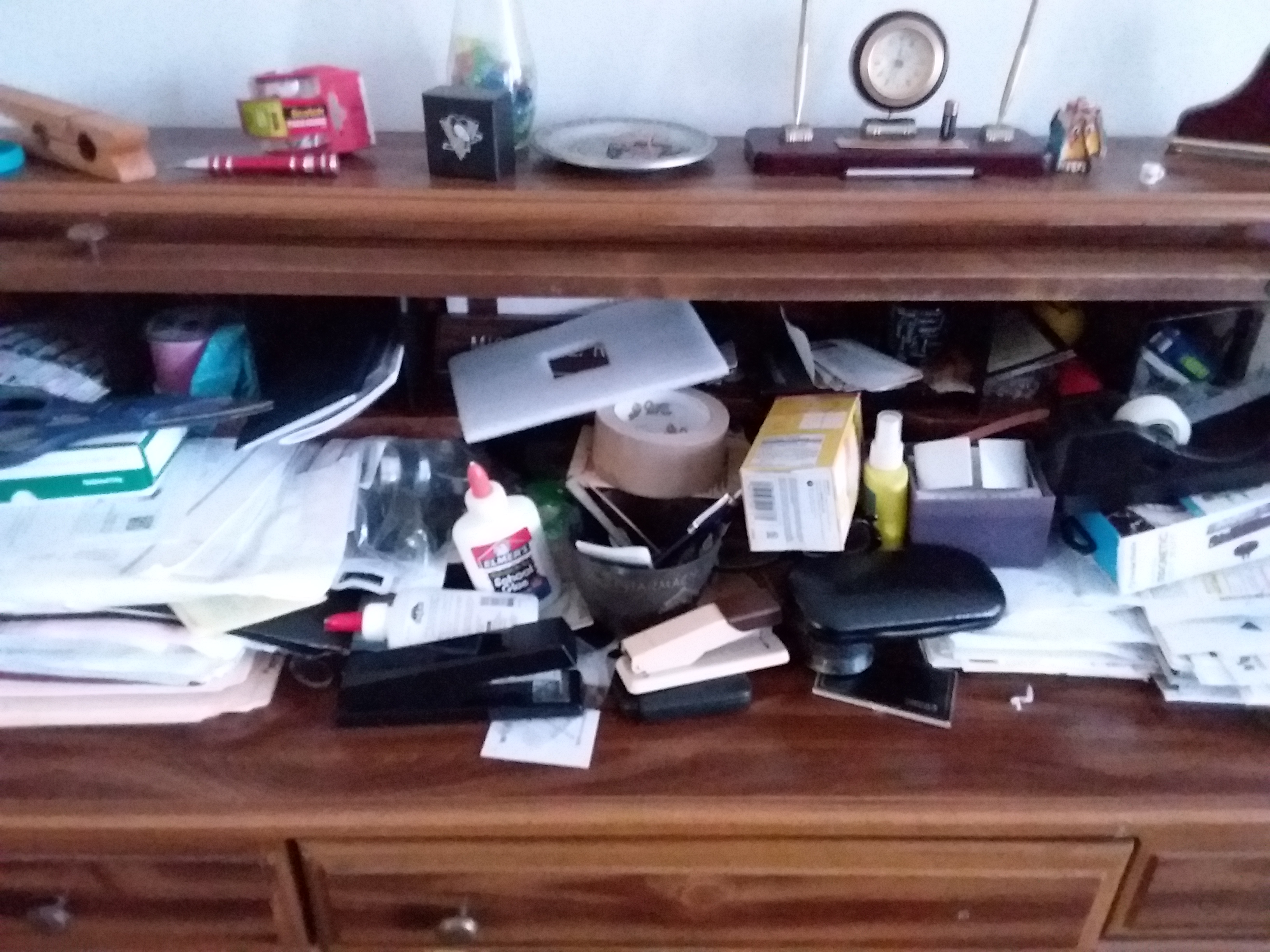
Today is “Clean Out Your Desk Day” so I think I will. Before I get to the one in the corner I’ll clear out some of the mental clutter. I warn you right now that today’s thoughts cover politics, society, and religion so I’m sure to tick off everybody with something before you reach the end of this post. But if I missed you, please let me know in the comments section and I’ll be happy to try harder next time. 
—–
 
This morning’s news had an report of a toddler vaping. According to their release the Pennsylvania State Police received a “Snapchat-like video showing what looks like a young toddler taking a hit with the help of a woman, then the video shows the toddler sit down and take another hit. The camera then cuts to a shot of another woman laughing.” The women have been identified as high school students and the toddler is a two year old one of the girls was baby sitting for the evening. There’s just so much wrong with this. The obvious is you don’t give a baby something to smoke, vape, swallow, or inject. Then where did high school kids get vaping pens and solution since the legal age to buy vaping accessories and supplies in Pennsylvania is 21? (Yeah, I know, nobody enforces “legal age” before the fact for anything anywhere except alcohol and that often only poorly.) Last on my list but certainly just one off many more things wrong with this picture is why is it going out on social media? If there was not an audience for this type of behavior it wouldn’t be shared so blatantly. Are we are better off now than when teenagers lived in a “Leave it to Beaver” world?
..
Groundhog Day is the best holiday ever!
 
A local supermarket chain is joining the growing number of stores eliminating single use plastic bags, plastic food containers and plastic straws. A very positive step in the fight for the environment by reducing resources required to supply a disposable world and the impact on the world after their disposal. A word of caution though. Once you put a biodegradable item into a black plastic garbage bag you just threw away all your good effort. 
 
If your parents used to threaten you with no dessert until you ate your veggies don’t complain that Burger King is cooking plant burgers on the same grill as the real burgers. 
 
In the “Just Because You Can” drawer boy do I have a lot of things I bought on sale.
 
Have you seen the commercial where a guy walks away from the coffee shop register after paying for his latte with a debit card and a balloon pops up displaying “overdraft fee $35?” He opines that he wishes a bank existed that won’t keep charging him all these fees. His companion happily informed him that one does, the sponsor of that very ad they are in. Imagine that! No more annoying overdraft or any other fee – yay! Hey, I have a way to avoid overdraft fees too. Don’t spend money you don’t have! Schmuck.
 
Thank you Ricky Gervais.
 
Over the weekend Ontario officials apologized for sending a false emergency alert regarding an unspecified issue at an atomic power plant outside of Toronto. It was not the first time a government warned of impending peril that wasn’t there. Most recently in 2018 the U.S. Dept. of Homeland Security apologized when an erroneous alert was distributed in Hawaii warning of incoming missiles. Maybe the world is getting used to false alarms. In Canada, Jonathan Davies noticed Sunday’s alert while he was driving but he waited until after he picked up his Tim Hortons to check the news. “I can’t cope with much until I have my coffee,” he was quoted in an Associate Press article. 
 
Today Pope Francis tweeted (yes he does, doesn’t everybody?), “it is not enough to be knowledgeable: unless we step out of ourselves, unless we worship, we cannot not know God.” Sound advice for all religions, all societies, and all people. It’s not enough to just think, if you want to matter you have to do.
 
Finally,  an oldie but goodie:  love thy neighbor, no exceptions!
—–
Okay, I think I’m ready to work on that other desk now. Altogether now,  go clean your desks!
.
20200113_102329.jpg

Let’s Stay In Touch

It’s much too early to make any New Year’s resolutions.  (If you haven’t already, you can see our thoughts on New Year’s resolutions at “Revolving Resolutions (Dec. 30, 2013), Resolving to Keep It Real (Dec. 31, 2012), Be It Resolved (Jan. 2, 2012), and/or Be It Further Resolved (March 22, 2012).)  However, it might be just the right time to make a New Year’s Eve resolution.

It was sometime last week when there were five people and four oh-so-smart phones at the table all at the same time.  This was He’s extended family and usually that group can never find any of their phones.  But for some reason, on that day everybody but one (and oddly enough that was the youngest of the group and a true card carrying member of the “Don’t Leave Home Without It As Long As It Is a Phone Brigade”) had his or her cell phone strapped, perched, or holstered onto his or her body or close by.  Miraculously, nobody’s phone made a peep during the meal which is why all of them were at the table at the same time.  But the site of all that electronic wizardry did start a story.  And so it went.

Once upon a time, staying in touch was easy.  If you wanted to speak with someone you called that someone.  Landline and then cell phone calls were an easy push button distance to just about anyone.  If nobody answered there was usually an answering machine or voice mail willing to take a message.  Even as home computing became the norm, e-mail was available and handy for sending large amounts of information or even sharing files.  And thus we managed quite well getting our lunches planned, our rides scheduled, and our points across.

And then the madness struck!

It was even before the smart phone revolution.  Texting.  At first, only the 13-18 demographic texted.  It made perfect sense.  Texts were free.  Calls were still charged by the minute.  Parents knew about every call made.  Parents cared less about texts.  They showed up on bills as numbers of but followed by NC – No Charge.  HW!  (How Wonderful).  As the 13-18 year olds aged, their favored means of communication improved.  Texts became faster and clearer.  And as the texting became easier, the parents and other fogies suddenly realized they too could be saving time and money.  What two better things are there to save.

With the time saved they all became users of Twitter, Facebook, Pinterest, Linked In, Skype, YouTube, and YouNameIt.  Many, many ways to stay in touch.  Then problems started arising when people started realizing they were on too many services to stay on all of them as much as they wanted.  And thus, each picked a favorite.  All different favorites!  But they rarely shared which was their favored favorite.  So if you want to reach your best friend you have call, leave a message, then text, then private message on Facebook.  At least one of those will be ringing, humming, or vibrating your recipient’s phone.  If all else fails, there’s always e-mail and maybe a landline phone call, possibly to the work number.

So what’s the resolution?  For the callee, everybody should resolve to tell everybody they really want to hear from how to reach them.  And don’t get miffed if someone picks the wrong means.  Stuff happens you know.  And for the caller, make certain you listen to all your contacts and somewhere mark their preferred means of…. No, how about once you send out the message you give your intended recipient enough time to get back before you…. No, make sure you’re using the right platform for the right…. No, how about don’t assume that your favorite means of being gotten hold of is everybody’s favorite…. Oh heck, was it really that important anyway?

Tell you what, have your people get hold of our people and we’ll do lunch.

Now, that’s what we think. Really. How ‘bout you?


And to Aunt Shirley I Leave My Blog

The Uniform Law Commission made a monumental decision this week.  It released information to the general public letting everyone know it exists and what it does.  No, we’re just kidding!  That’s not it.  We still have no idea who belongs to this group and what they actually do.  But very recently we read that the Uniform Law Commission (ULC to its closest friends) has published legal guidelines for what to do with all of your electronic accounts once you are no longer you.  All that has to happen now for this to become law and close a gap that has been widening like a pothole on the information highway is for every state legislature to adopt it as law.

Apparently people have actually sued on-line providers for access to accounts held by deceased relatives.  On-line files at e-mail, file storage, and social media sites are being compared to records kept in vaults, safes, and shoeboxes from another era.  Banking, insurance, and ownership records are just some of the items kept in today’s on-line shoeboxes.  These are things that would be of much interest to the executor of an estate and importance to the estate.

The way the proposed law addresses the release of information is that a designated person, presumably the executor, would be able to access the files but not act on the files.  He or she could read the posts on a social media site but could not post to the site, could read the files at a cloud storage site but could not copy the files from that site, could read e-mails but not send e-mails from that account.  Does that help?  We’re not sure.  It seems that still leaves a lot of room for someone to commit identity theft.  That room might be made smaller if the law gave the designee the power of action.  We may not want someone to read every e-mail we’ve ever saved over years (nor may they want to) but we certainly want someone to purge our banking information before the bad guys get to it and clean out our accounts.

In the spirit of excess, people are already reading more than the practical applications into the proposed rules.  In reporting on the ULC’s actions, the Associated Press said “Imagine the trove of digital files…and what those files might fetch on an auction block.”  Now the AP was specifically referring to Bill Clinton and Bob Dylan and their electronic writings which would fetch an attractive sum at auction.  They might fetch even more than The Real Reality Show Blog posts will.  (Don’t you just love the use of “fetch” regarding high prices returned of sold items?  Come on fella, go fetch those millions of dollars!  But we digress.)

Do we need a law to make this happen?  Not really.  Just like you can put into your will who gets access to your safe deposit box, you can put into your will who gets access to your electronic storage areas.  It might sound funny today but in a few years it could be routine to read at the opening of a will, “And I release all my Instagram pictures to my friend John Doe,” or more likely, “And I allow full access to and disposition of accounts held at the First National Bank on-line banking service by the Executor by way of the user name and password found in the addendum to this will.”

Of course, Aunt Shirley will get control of all the posts to this blog and whatever they fetch at auction or the garage sale, whichever is greater.

Now that’s what we think. Really. How ‘bout you.