It’s been six months in the US since the Corona Virus began making inroads into daily news reports. In early February, unless you were living in the Pacific Northwest, it was more a curiosity than a lifestyle. Some people weren’t certain of the difference between “corona” and “CoViD” and the really clever people were blaming the new virus on Mexican beer. By early March the news outlets were scrambling to count victims, interview experts, and pretend they knew what they meant when they spouted out the words of a language they hadn’t quite fully learned. Many sounded like parade commentators when they are reading the words on the teleprompter for the first time. By early April the cadence of the reports was smoother and the language of the virus, Coronese, was fast becoming the second language everybody wanted to speak. Today we toss around words and phrases like positivity, epidemiology, herd immunity, contact tracing, and the ever popular self-isolation and social distancing like we grew up with them. This is the language of the virus. The formal language if you will. But there’s another language of the virus the goes beyond the jargon. The language of the street (or social media depending where you spend your time), the slang, the language we speak when we take off our hat and coat and sit with friends. Friends we might still want to think hard about and consider if they are worth violating social distance guidelines for and end up self isolating with.
 Every language devolves into its guttural form and Coronese is no different. Some words are lend words from legitimate language. We now “zoom” whenever we hold a video chat sessions and “mask up” regardless of what body part we are covering with whatever we are covering it with for protection from whatever. Some words are bastardized versions of the technical jargon or legitimate language. Such as “the ‘rona” when referring to anything virus related, “iso-” anything when done alone, or “blursday” for any unspecified or forgotten day of the week.
My favorite words of Coronese are the covomanteaus, itself a portmanteau of CoviD and portmanteau. In my mind, warped as it tends to be sometimes, I’ve not yet decided if CoViD itself is an acronym (thus CoViD) or a portmanteau (as the more popular and in my opinion lazier, covid) of Corona Virus Disease. These covomanteaus include covidiot (anyone ignoring specific virus protection recommendations or clueless of the disease in general), covideo (chatting by video or the video chat session itself), quaranteam (your colleagues also working from home performing as a single work unit), and quarantini (although there are actually specific recipes for a “quarantini” it can pretty much be any cocktail made with any ingredients readily available generally using whatever vodka remains after making your own hand sanitizer).
Still with all the technical jargon, legitimate language, and coronaslang, Coronese is missing some important words and giving it due consideration, I’ve decided I am just the one to start filling those holes, or virogaps as any knowledge gap regarding the ‘rona will now be known. So far I’ve come up with covomanteau and virogap but I’ll be working on it day and night. I may put together a quaranteam and we can work together after a short ronamute to our homeworkstations and have a comprehensive ronapedia distributed before we covexit this virocrisis. Until then, keep washing your hands and remember to mask up!
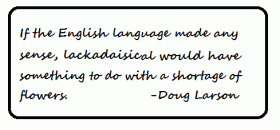 excerpt from I presume one of his favorite authors. I always read them. They often provide a glimpse into the authors mind at the time he or she was working on that piece. But it wasn’t until this time, this epigraph, that I really stopped to think about what I was reading. Not the metaphorical, the inside glimpse, etc., etc., etc. The actual. Why that the epigraph, those borrowed words, are indeed an epigraph.
 So that brings me back, do we need all those words? If they made sense I’d be happy to learn all 600,000 words. But so many of them don’t make any sense. Look at two of the ones that I mentioned: epigraph and paragraph. Both have “graph” and both are similar in that they are a group of words. But when I think of graph I think of a picture.
 And if that’s not enough, then we have to use words that we know don’t fit a particular situation because that’s the in way to speak and Heaven forbid we aren’t trendy. For example good can’t be good. Since the time when I was torturing my parents with popular vocabulary “good” has been groovy, cool, bad, righteous, divine, outstanding (emphasis on the out), epic, excellent, rad, sick, and ridiculous. But what did they expect? They’re the generation that came up with cat’s pajamas and bee’s knees. Unfreakin’ believable.
 The Real Reality Show Blog