Reading Isn’t Believing

And they say you can’t believe everything you read. (I say you even can’t believe everything you think but that’s a topic for a different post.) No, this is really about what you read, or don’t, or think you’ve read. Or maybe even for some people what you think you wanted to read. Rarely it might be what you read that you wanted to think.

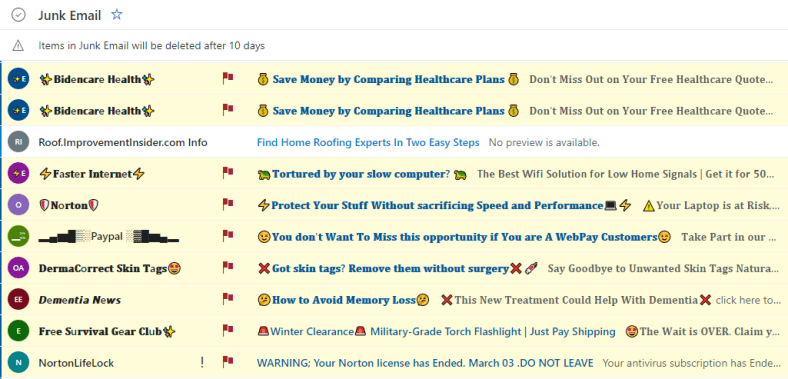
Not only are 4 out every 5 calls I get enticements to either throw my money away on a non-existent extended warranty, or to have them syphon money out of my accounts if I do so much as to actually think to answer it with a phone that had once been near an ATM machine while I was making a withdrawal (I don’t really know about that but it seems like the scammers have to do less and less to get our money, and what could they do to me for presuming otherwise, sue me for libel?) (now where was I?) (oh yes, I remember), not only are there oodles more nuisance phone calls, nuisance emails – either spam or outright phishing schemes – have taken a dramatic upward arc on the occurrence scale. However…every now and then you come across a spammer who didn’t get the new spam scam users guide. These are the ones that have multiple fonts, bold, lots or asterisks and exclamation points, and refer to accounts at banks and retailers you’ve never used or refer to you as your email address.
2021-03-03

Yesterday I found a new one. Just in case you thought all the bold type, red bullet points, and mysterious name weren’t incentive enough to open the email, they included in the subject line, “This message is From a trusted sender.” I know that convinced me to open that missive right then and do whatever it said.  Hey, that Nigerian prince might still have some of his millions left to give away.

2021-03-03 (1)

Clearly that was something not to believe even if I did read it in black and white.

Some signs nobody ever reads. Not far from me there is a stretch of road where for about 30 yards the posted speed limit is 5mph. I’m not sure my car can go that slow. It seems to me nothing between stop and 15mph even exists. Another instance of not believing what I read, although with not quite the same conviction. Oh I’ll slow down as slow as I can get, but 5? Ehhhhhh, probably not.

There is a sign I take with great seriousness and wish everybody who read it would believe it. No, it’s not the “Masks Required” sign but it would be nice if more people believed that too. No, this is this sign.

Gun-Sign-1024x503

The rate of confiscated guns per million passengers doubled in 2020, a year when the number of people flying decreased by 60%. So far, with 2 whole months in for 2021, the rate is close to 4 times that of 2020. That puts the TSA on pace to confiscate close to 15,000 guns at security checkpoints. If that doesn’t worry you enough, over 12,000 of those guns will be loaded. Eighty-three percent of the handguns pulled out of pockets, purses, and carry-on bags are loaded.

The most common reason people give for attempting to enter an airport secure area with a concealed and loaded weapon is that they forgot they had it. Yeah right. Put that in writing and I won’t believe it then either. According to the Pew Research Center, 67% of gunowners say they purchased their guns for protection. If all those people getting on the planes are representative of gunowners, when the time comes to protect life or property I suppose they will have to convince the assailant to “hang on there a second, I want to shoot you which is my right, I just have to remember where I put that darn gun.”
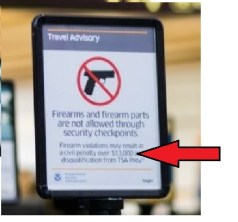
Gun-Sign-Crop-1-768x377It would be nice if people who decide they don’t want to believe the part of the TSA sign that says firearms aren’t allowed through airport check points at least would believe the rest of the sign, the part in smaller print that says they can be fined up to $13,000 dollars for doing so. Then again, maybe that’s not a lot of money to them. In that case … I know this Nigerian prince who needs a little help.

You can believe me on this. I am a trusted sender.

The Big Brush Off

Who knew there was a name for it? I suppose that makes it easier for headlines and reporting, but this one you didn’t even see there. I first heard it when it popped up in the middle of a followup news story. “It’s called brushing,” the helpful reporter helpfully reported. Of course now it’s all over the place.
 
You remember those seeds people would find in the mail. Seeds from China not ordered yet delivered to mailboxes across America. In the third month of wide spread quarantines due to COVID, mysterious packages from China weren’t received with the awe and elation one might more typically express at finding surprise packages under a tree in December. It turned out the seeds were just that. Seeds. Mostly flowers, some herbs. Just seeds. And it turned out that just seeds weren’t just the only things showing up in mailboxes. People reported receiving sunglasses, stickers, speakers, and socks. The common factors in all these, besides the items starting with “s,” were the absence of any sender documents, invoices, or packing slips, and they weren’t ordered by the people receiving them.
 
“It’s called brushing.” It’s also not new. Last year multiple claims of unordered items being received were reported to Amazon as were they also in 2018. The earliest report of the scam I found was in October of 2017 and I wasn’t working that hard to find any. By then it appeared to be already very well established and a common practice in e-commerce. According to the Better Business Bureau brushing is the practice where a company, usually a third-party seller, sends items to an address that they found online or from a purchased mailing list. The intention is to make it appear as though a verified buyer purchased the product and wrote a glowing online review of the merchandise. This not only increases product ratings but since the item is actually “purchased” it increases the company’s sales leading to more contracts for the third party handler. Typically they are cheap items small enough that can be shipped inexpensively.
 
Representatives from various agencies and organizations including the BBB, the Federal Trade Commission, and the U. S. Postal Service recommend that if you receive an unordered package to contact the retailer or shipper if identified on the label and report that you have been the victim of the scam, and in the case of seeds or edible products to forward the package to local authorities or the United States Department of Agriculture. According to the FTC if you decide you want to keep the item you can because it is in its opinion a “free gift.”
 
Where is the downside except for the long shot possibility that a seed could turn your backyard a Little Shop of Horrors clone? For one, the one that all the experts keep bringing up, how did the sender get your name and address? Face it fellas, our names and addresses aren’t secret. I couldn’t begin to count the number of companies, agencies, clubs, and services that have my name and address. Of more concern that nobody mentions is this third party seller is posting a review in your name and that can’t be done unless you are signed into the site. Suddenly the recommendation everyone makes to change your passwords, even though they don’t say why, is making more sense.
 
And now finally after about five hundred words on brushing I get to the point of today’s post. Just how secure can we make our information even changing passwords and security questions on a regular basis. (By the way, those security questions – does anybody lie about them? Wouldn’t that make more sense? I mean if they are the last line of defense and somebody has already cracked your 23 character upper and lower case, number and special character containing password that you change every 4 days, surely they know what street you grew up on. But I digress.)
 
Banks and security, they don’t go together like pork and beans. I thought of this last week when my daughter told me her credit card issued by a local bank was used by someone to subscribe to some ongoing monthly service. She discovered this while she was reviewing her monthly statement. She contacted the vendor, confirmed the fraudulent charge, contacted the bank and was issued a new card, along with being issued the routine “change your password, PIN, and security questions” instructions. Because that card was one she used for some of her own recurring monthly subscriptions and payments she would have to reenter all that information in those sites. She recieved her new card and began the process of updating payment information when she noticed a vendor already had the new numbers on her profile. Thinking she had just done that and forgot she moved on to another and found their information had been likewise updated. This prompted a new call to the bank and she was informed that “as a service” the bank routinely provides the new information to recurring payment vendors. She reminded them her account had been compromised by way of a recurring payment vendor and asked if they thought was the best course of action to be distributing people’s private information. The response was “most people appreciate not having to go through all that work.”
 
Now that was the real brush off.