Read any good books lately?

There have been a lot of stories this year regarding book banning in America’s schools. Legislature has been presented in seven states and parents have approached dozens of school districts specifically to remove specific volumes or entire categories of books from school libraries. Legislation was introduced in Florida to not limit challenges to school library holdings to parents but allowing any individual to challenge any holding. In Texas, Llano County Commissioners Court forced the closure of the local public library (public library!) so librarians could review all reading material for their younger readers to make sure books are age appropriate. That’s just this year. And it’s only March. That’s following up on a flurry of year end interest around books and children. According to NPR, Texas State Representative Matt Krause put more than 850 books on a watch list, targeting materials he feels “might make students feel discomfort, guilt, anguish, or any other form of psychological distress because of their race or sex.” (npr.org, “A Texas lawmaker is targeting 850 books that he says could make students feel uneasy,” Oct. 28, 2021.) No word on whether he read those books.

Questioning whether the Honorable (Ha!) Krause read all 800+ books on his list isn’t me being ornery as usual. It’s a legitimate question. Not just by me but legitimized by those in the know. Deborah Caldwell-Stone, director for the American Library Association’s Office for Intellectual Freedom said in a recent interview, “We’re now seeing challenges pop up based solely on social media posts. A video gets posted of a parent complaining at a school board meeting, and within days, we see challenges across the country using the same reasons. People are complaining because they saw it on social media, not because they actually engaged with the book.” (Triblive.com, “Book challenges are becoming more frequent, driven in part by social media,” March 14, 2022.)

My concern isn’t about the books being challenged. Book challenges and banning have been going on basically since there were books. It’s the way these challenges are being conducted. Small numbers of individuals uneducated in the library sciences making noisy demands of schools to conform to their (the uneducated small number of individuals’) idea of decorum based on what other uneducated small number of individuals are writing on Facebook, et.al.. In a recent CNN poll, only 12% of Americans believed parents “should have the most sway over which library books are on the shelves” and twice as many felt teachers and school personnel should have more control over library content. (cnn.com, “CNN Poll: Economy and education could shape how Americans vote in 2022,” Feb. 11, 2022.) In the past, challenges were based on the challenger’s personal experience with the book (that means he/she/it actually read the book) and may have actually been able to intelligently debate the content of the book and verbalize why he/she/it felt it (the book) was inappropriate. Now, the majority of challenges are opposing titles simply because they are on some list of ‘controversial’ books. I pointedly use “title” in that sentence because so often the title is all the “concerned” parent knows about the book.

There is no evidence that the current wave of book banning is accomplishing what I think the challengers to the titles are intending, that is a purge of all material contrary to their mores. I’m just not sure they know what their intentions are. Or possibly what mores are. And if anything, the publicity for these books, the classic titles and those barely known to anybody but the most dedicated librarians, has generated increased sales for the books.

We’ve seen when we let anybody with a computer and the ability to cut and paste how America responds to a global pandemic resulting in a death rate twice the rest of the worlds, how we’ve graciously accepted the transfer of power, and how we are politely carrying on primary election campaigns as we run up to the mid-term elections this fall. Perhaps the proposed bans shouldn’t be of books whose only intent is to encourage thought and generate intelligent discussion, we should instead be banning social media whose intent increasingly seems to be to pass off incomprehensible opinion as fact among those who never spent time in their school library back in the day when it was their school library.
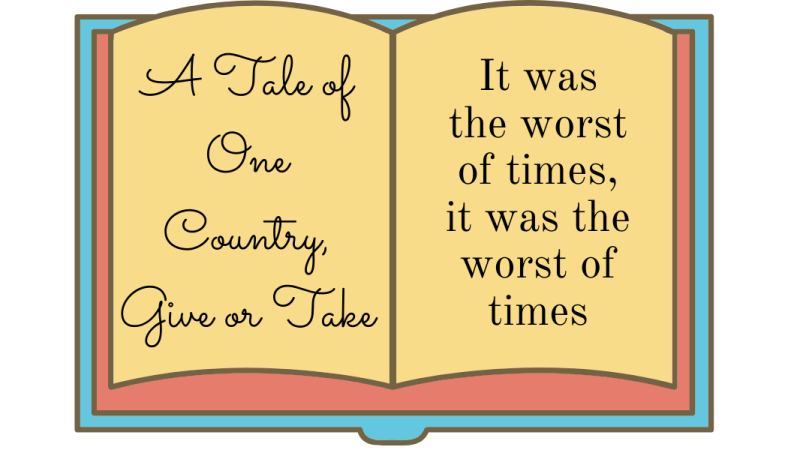
Once upon a time they lived happily ever after (3)

Yes, No, Maybe

I’m a sucker for a good survey. Not the ones people with clipboards try to take at the mall while intercepting you rushing out of Spencer’s attempting to make it to Macy’s before the rest of the family realizes you’re missing. Not the ones that pop up at the bottom of otherwise legitimate online news articles implying (inferring?) you can turn your free time into earnings time. I mean real surveys by real polling outlets for genuine marketing, opinion, or news pieces.

Some years ago I shifted all my verbal correspondence to my mobile number and did away with the landline phone. I was all about eliminating unnecessary or duplicate services and as I was more likely to carry a cell phone around with me than I was a corded (or even cordless) device tied to a hard connection in the wall, the cell won. Unfortunately for as cutting edge as we want to believe our smart phones are and how sophisticated we talk ourselves into believing the service providers may be, they still haven’t figured out how to handle Caller ID. Or for all I know they have and haven’t yet figured out how to charge for such an archaic concept, or the government has decided it is in our best interest not to know who is on the other end of the call, or it is in their best interest not to get into a perceived battle over privacy issues some nut might claim. As a result I don’t answer a call unless it is someone in my contact list or is a number I recognize. As a further result I no longer get to enjoy participating in one of the few random phone surveys that still might come my way.

Now I do belong to a few opinion panels and occasionally get to answer a poll or do a survey on line. I also will answer surveys published by those I follow on social media if the topic interests me and I keep an eye out for new invitations from new or established pollsters. It’s all in fun for me. I haven’t filled any free time with “earnings time” and the most I’ve ever gotten from answering a survey was a $15 gift card.

I like surveys. And I think I like giving people a piece of my mind, but then that’s what this blog is for. And now you know we’ve gotten to the meat of the story, the heart of the topic, the reason for being here you and I. Who is getting a piece of my mind today?

You may not recognize it from my writing but I try to keep myself on the right side of the grammar and usage police. Some time ago I taught a few classes at a university. At that time there was a rather decent size to-do brewing over perceived favoritism demonstrated by the grading of essay type questions on tests and we were encouraged to administer multiple choice tests and to use machine gradable answer cards. (This was in the 90s. Now personally I think somebody had purchased a bunch of these cards for a dying technology and that somebody saw their budget approval rights in jeopardy if said cards did not find their way off the storeroom shelves. Just thinking out loud.) Anyway, I became the Mad Professor of Multiple Choices. Every question not only had three seemingly logical answer choices (a, b, and c) but also multiples of those choices (a and b, a and c, b and c) and total inclusion (all of the above) or exclusion (none of the above). I was always careful to arrange the answers so “all of the above” came before “none of the above” so I could not get drawn into the argument “but Perfessor Evil Tester, how can ‘all of the above’ be right if it includes something that might be right and ‘none of the above’ sayin’ that none of them is right ’cause there ain’t no way nothing can be right and not right at the same time.” I knew my tests, and my test takers! If you consider that a multiple choice test is just a big survey you could say now I know my surveys also.

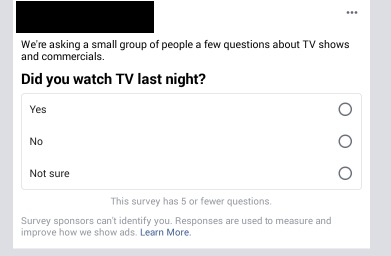
So, to make a long story short (and aren’t you glad you’re not getting the long version?), I had to scratch my head when this little gem popped up in my Facebook feed, although it was Facebook.

Survey

Hmm. Did you watch TV last night? Yes, No, Not Sure. Not Sure? Really? You can’t tell if you were watching TV? Not “Both yes and no depending on when last night.” Not even to old “Prefer not to answer.” Nope, they really asked “Not Sure.” How are you not sure? Wait, I have it. You were watching a television network broadcasted show via a streaming service on your handheld mobile device. That makes sense. Yeah. Probably an offspring of the “Hey Perfessor” guy.

Oh, just so you know, somewhere in this country the “Hey Perfessor” guy is part of somebody’s health care team. Let’s just say I “prefer not to answer.”