It’s That Time Again

Yep, it’s time again to clear some of the cobwebs and other unwanted things and thoughts rattling around in my brain.

I’m happy to report to you this week that Jingle, aka the yointer, had his surgery last week and is recovering nicely. You will recall due to an osteosarcoma he had his left, front leg and shoulder amputated. The surgery was last Tuesday and by Sunday he is bounding up and down stairs (against his vet’s wishes for a quiet, and not overly exerted rehab. Try telling “don’t do that” to a dog.)

In other news, I hope everyone who has has hurricanes and tornadoes pass through their yards over the last couple weeks is well, not injured, and can take a few deep breaths while working on restoring life to normal.

The weather along the east coast reminded me of a favorite gripe of mine. Why are airlines so freaking stupid. There were flights from Nashville to Dallas delayed because Tampa was closed. What genius decided “we’re going route all our flights through and park all our planes at airports all along the coast so that at the first hint of weather, whether hurricanes in the south or ice storms in the north, we can cripple the entire country’s air traffic. [evil laugh].” There are perfectly good airports at Pittsburgh Cleveland, Cincinnati, Nashville and other inland cities that are relatively weather safe and could serve as eastern hubs, but no, they have to pick an airport within sight of the ocean. Delta made a little more sense sticking with Atlanta. If only they weren’t Delta they might actually be able to keep an on-time schedule going.

Speaking of airlines, has anybody seen jeenie.weenie on either Instagram or YouTube? She’s probably on other sites too but those are the two I know for sure. (Hey, I don’t make up these peoples’ handles, I just write what I see). Jeenie is a current or former flight attendant and has some of the most “scratch your head and say dayam, if they ain’t right” posts about stuff, mostly air travel, but other things too. It really makes you think about how we really do that crap. Here’s a link to a random YouTube video.

That’s all I have for this week. It’s been a a little crazy but slowly getting back to normal. What would really help is if all the particularly stupid people running for office would stop sending me text messages about how dangerous, extreme, and radical their opponent is, I’d have lots more time to get things back to normal.

Oh, that reminds me…I put this little news nugget out there every couple of years and nobody believes me, but this year I have proof. Do you know political ads do not have to stick to the truth? Yes, not only can politicians lie, they are allowed to lie. Below is a little snippet from the paper (a real news newspaper) to a television columnist’s weekly Q&A column. Yes, politicians can lie, and stations must run it, if the ad is from the politician’s campaign. Third party ads can’t lie. Politicians themselves can. How can you tell the difference? If the ad includes the words “I’m [an old guy with a bad fake tan] and I approve this message” or something like that, it is a politician’s own political ad and it is also a good chance that it is a lie.


IMG_1689


See you next week, same approximate time, same equivalent channel.


Here we are again at the place where used to seeing a blurb here about the latest Uplift blog post. That post is about how you can Make Me Happy, and it might surprise you how.

But before you go look, have you yet thought about joining the ROAMcare community and have the weekly Uplift blog delivered to your email as soon as it hits the website. In addition to an Uplift release every Wednesday, you will also receive weekly a Monday Moment of Motivation, and our email exclusive Blast from the Past repost of one of our most loved publications every Friday. All free and available now at  ROAMcare.org.


The truth, the whole truth, and anything but the truth

Even in the midst of world wide crises, nation wide closures, and seeming interstate competition of who can develop the most animosity among neighboring states by being either ridiculously lenient or unnecessarily harsh with their approach to virus control, US Presidential elections go on and with them the quadrennial exercise in truth stretching, whopper telling, and general misrepresentation we call political ads.
 
My memory goes back only as far as the 1964 election (I was here for the ’56 and ’60 go ’rounds but I was more interested in the Ringling Brothers’ version of three ring circuses those years) but I can tell you without a doubt, to my knowledge the only occupant of the Oval Office to get there without casting aspersions on his opponent’s reputed good name was Gerald Ford.
 
I suspect it will be nastier than usual this year what with so many people having nothing better to do than to get on social media and join in with the professional besmirching. Truth goes out the window when people spend over 2 billion dollars (yes, that is a “b”) to get a temporary job than pays a mere $400,000 a year. (To give you a little perspective, that is less the minimum salary for all the major American sports leagues and well less than half the minimum NBA salary. As the old saying goes, but they had a better year.) 
 
You would think with that kind of money floating around people would be able to find something their candidate did right to qualify him or her for the position rather than using it to dig up what the opposition did wrong. Or often, to fabricate something that looks like wrong doing. As I wrote 4 years ago, there is actually a regulation that forbids any media outlet from vetting, editing, or refusing a Presidential political ad regardless of content. Truth. The Campaign Reform Act of 2002 takes pains to not mandate the veracity or any requirement to confirm the veracity of any claim made in a campaign ad. With the party conventions about a month away and the election another 3 months after that, the airways, social outlets, mailboxes, and road sides will soon be overflowing with effluent.
 
This is where I usually wrappings up with some pithy saying or on rare occasions actual insight. Sorry, but for this mess I got nothing. I’ll borrow a line from old TV. While you’re out on the mean and nasty streets of American politics in a Presidential election year, remember, be careful out there.
 
truth

A Word From Our Sponsor

Recently I saw something on line that said something like “All the drug ads on TV like for the first 10 seconds tell you its name and then like spend the rest of the time like daring you to take it.” Like I said it was on line. Like what did you expect? But, it raises a good point.  No, not that drug manufacturers are daring you to take their product. Why isn’t everything else advertised like that?

First a little background about prescription drug advertising on TV, in magazines, on-line, or anywhere else they are targeted “direct to consumers” — it shouldn’t happen. Back in the days when drug companies were run by people with pharmacy degrees and hospitals were run by people with medical degrees, marketing was pretty straight forward. Drug companies got approval from the FDA for a drug which included its official product information and that included what had to be mentioned in all marketing material. This included but was not limited to indications (what it is used for), contraindications (when it should not be used), warnings (what might happen if dosed and monitored inappropriately), and side effects (adverse or unexpected reactions that occurred in more than 0.1% (1 in every 1000) of the participants in post-approval/pre-marketing controlled drug studies). The material was typically presented in pages of information and a presentation lasted anywhere from 30 to 50 minutes. The target audience was doctors and pharmacists who spent years studying these things, understood the language, and often challenged the information as presented by the marketing team, also people with health care related degrees or experience.

Then about 20 years ago drug companies started hiring people with business degrees to run their business. They may have had a background in selling fast food french fries and thought there was no reason prescription drugs shouldn’t be sold the same way. This ignored the fact that they were now targeting an audience of people who could not legally walk into a store and buy their product without a prescription. The FDA, medical organizations and pharmacist organizations disagreed with direct to consumer advertising, not because they wanted to “control” the prescription drug market but because it was establishing a dangerous environment. But the Federal Trade Commission (FTC), made up of business people, said sure, why not, it will create competition and keep prices down. Recognizing that the FDA had regulations requiring what information had to be present in marketing material, the FTC thought those were good things people should know and that’s why there is now a demand for fast, low talkers to do the voice-over for prescription drug ads on TV.

AdNow, back to my premise, if it’s such a good idea why not make all advertising follow a similar structure. With that understanding, I now present the way consumer goods and services should be advertised. In the spirit of the FTC mandate I’ll just note the disclaimers. The creative teams can use the rest of the 15 second spots however they would like. Please note that some of the required language might mean the advertising budgets may require some expansion to reflect longer ad time buys and since we know that companies don’t spend money they cannot recover, there may be a corresponding increase in product pricing.
—–

Fast food french fries (with or without bacon)
Do not take if allergic to potatoes, oils used for frying which may change without warning, or pigs if using the bacon version. May cause high cholesterol including high good cholesterol and high bad cholesterol. Do not take if using blood thinners. People with high cholesterol, high blood pressure, uncontrolled diabetes, excess body fat, or uncomfortably tight clothing should consult the fry cook or counter person before consuming french fries. May cause bloating, nausea, headaches, or weight gain. Do not continue use if you notice ankle swelling, excess sweating, or shortness of breath after eating. If taking with bacon do consume if you are vegetarian, vegan, or kosher.

Light beer
Do not take if allergic to beer or any ingredient in beer. Do not take if also taking blood thinners, analgesics, antibiotics, sedatives, anti-depressants, narcotics, illegal drugs, or drugs used for diabetes or high blood pressure. May cause inebriation which can lead to embarrassing questions or answers, karaoke or karaoke style singing, chair dancing, and  loss of bladder control. May cause double vision, slurred speech, or drooling. Do not operate a car, heavy machinery, or juke boxes. Consult spouses, partners, or significant others if you cannot remember where you parked. I’d you do not remember where you parked and stumble upon your vehicle, do not drive. Tell yout server if you become nauseous. Quickly.

All-season radial tires
Do not use if allergic to tires. Requires proper inflation and periodic monitoring. Do not use if bald (the tire, not you), bulging around the middle (again the tire), or if taking beer, wine, or liquor (that’s you). Doing “donuts” in the parking lot will decrease usable wear.

Medical Marijuana
[You know it will only be a matter of time before it or “Recreational” varieties are directly marketed. Oh quick, what’s the difference between medical and recreational opiates. Uh huh.]
Do not use if allergic to marijuana. May cause you to impersonate medical personnel. Is not a cure all. Notify your dispensary of…well it really doesn’t matter because they aren’t medical people and won’t have any idea of what you are talking about anyway but notify first responders and emergency room personal that you take “medical” marijuana when they ask you about drug use.

Cauliflower rice
Do not use if allergic to cauliflower. May cause gastric bloating or flatulence. Do not take if using blood thinners. Although not intended as a weight loss product, cauliflower rice may cause a feeling of fullness decreasing any pleasure in eating. Not intended as a replacement for pizza crust.

Political Ads
What you are about to hear is a lie.

—–

If you agree this is a good idea please write to your congressman or senator. They can use a good laugh too.


Truth in Advertising

One more day and it’s Election Day across America. And this post has NOTHING to do with the election. Yippee!!!

But it is about something that I discovered during the crazed advertising season that this crazed election season has turned into. And it’s something that the consumer advertisers can learn from those abhorrent televised political ads. (But the politicos can learn a thing or two from consumer advertisers so don’t think they’re going to get off without a talking to (or about).)

Did you know that there are actually specific regulations to which political ads are expected to adhere? For one thing, any small print on a political ad can’t be small. Actually it can’t be any smaller, nor in any font/background combination less contrasting, than the smallest font in the body of the ad. Can you imagine what this would mean to the legal, insurance, and new car advertising industry? No more teeny print containing the printed equivalent of a 12 page disclaimer packed into the bottom 2% of the screen, that’s what it would mean!

Another expectation of those political ads is the famous equal time provision. Whatever time is bought by Candidate A must be made available to Candidate B. And there would be no question about a broadcaster not airing either because the law states that television and radio stations must provide commercial time to presidential candidates. (These provisions address time bought by the candidates or their own campaign committees, not to the time purchased by third parties “not affiliated with any candidate.”)  Imagine how easy it would be to truly evaluate the benefits of the Chevy you’re contemplating buying if you were able to see the Ford commercial right after it.

Of course that’s all assuming that the information presented in those competing ads actually addressed factual information regarding the advertised product. And we know they do because of the truth in advertising laws out there. You would never hear a commercial for a Ford say “Don’t buy a Chevy. They can start all by themselves and run you over in your own driveway.” You’d never hear it because nobody would ever produce or air such a statement. But that’s where the politicians can take a cue from the consumer advertiseronadvertisings. Did you know that there is a regulation that a broadcaster cannot vet, edit, or refuse to air a political ad? What they get from the campaign is what they put on the air.

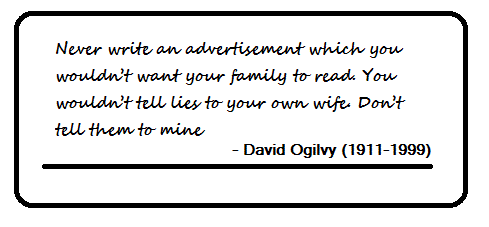
David Ogilvy was a wizard in advertising. In fact in 1962, Time Magazine called him “the most sought-after wizard in today’s advertising industry.” He has been called the Father of Advertising and is known for his attention to reality and his ability to persuade by carrying on a conversation with his audience. He was a pioneer in creating ads that didn’t insult the intelligence of the consumer. Unfortunately his children haven’t been following his life’s lessons whether pushing car makers or candidates.

Now that I think of it, the politicians could stand to learn that lesson also. Perhaps it’s a lesson at least one of them can sign up for on Wednesday.

That’s what I think. Really. How ‘bout you?

PS – Don’t forgot to vote – assuming you have some idea what you are voting for. Yes, I said “what,” not “who.” If you can’t articulate at least one cogent reason for casting your ballot other than “at least it’s not a vote for him/her/it/them” then, um, maybe it would be better if you did forget to vote.

Truth in Advertising

Have you seen the ad on television for a laxative that across the bottom of the screen says “this is an advertisement?”  Really now, is this truth in advertising gone too far?  Is it necessary that every time somebody says something on a television ad that they must be identified as professional or everyday Joe?

Pay attention to the next ads for vitamins, pain relievers, or laxatives as they march across your TV screen.  There in a neatly pressed white consultation jacket is the spokesperson to tell you that the laxative will work gently overnight.  Just so you aren’t too taken away by the efficiency of those who invented said laxative, fine print across the bottom of the screen reminds you that the person in the neatly pressed white jacket is a “doctor dramatization.”  An actor even!  Now you know that he didn’t extoll the laxative’s overnight virtues from years of research but just read the ad copy.

Next, somebody is hawking the latest in floor cleaner.  It could be that she is just a regular Joe (or Josephine).  To be sure the little letters across the bottom of the screen now let you know that the person saying those nice things about the latest mop is being compensated for his or her time to tell you what the ad writers have written.

Labor Day recently gone by traditionally ushers in school starts, fall with its turning leaves, cooler temperatures, and the November general election.  Here, television ads for governor have been running on air throughout the summer.  Now they will only increase in frequency and annoyance.  The two candidates have a handful of different ads to air so that, we suppose, nobody gets too tired seeing the same one over and again.  But the one candidate’s, although with different backdrops, all say the same thing and start the same way.  “Did you see my opponent’s ad with this actress talking about me?”  Gee, we didn’t realize they used actors and actresses in political ads.  Is that important?  If they used real constituents to read the script nobody could keep a straight face for those 30 seconds.

It used to be so much easier when whomever regulates advertising said that a company couldn’t say their car got 100 miles per gallon when it barely got ten, when the hamburger bought at a drive through looked at least a little like the one on television, when the laundry soap got at least some of the stains out.

Now that they’ve taken care of those pesky issues we have to be careful that we don’t confuse an ad with a news report.  Remember the next time you see a person drooling over a frozen dinner on television to check the bottom of the screen and see if it doesn’t say “hungry person dramatization.”  You wouldn’t want to be misled that frozen food is tasty in its own right.

Now that’s what we think. Really. How ‘bout you.