I remember…

Oh we are so very close. Just a couple days separate us from Christmas which means it’s well past time for a Christmas movie post.

I didn’t talk about Christmas movies last year. We were too busy praying. Actually, one can never be too busy praying but last year I put the prayer out in public. But this year, let’s talk movies again.

I’ve visited this subject four time before, the most recent from 2019 when I revealed my then current favorite Christmas movie. At the time I said, “I say my current favorite because like children there can be no real favorite among Christmas movies. The favorite is the one making you smile today or remember yesterday, the one encouraging a perfect alternative to an imperfect world and providing an escape from the ordinary.” I stand by that thought still. There can be no favorite among the 873 bazillion holiday film offerings, even if only a handful are truly good movies. If they make you feel good, then they are. Except Die Hard. It isn’t, it never was, it never will be, end of discussion, period. (And it’s not a western either even though the main character does say, “Yippee ki yay.”)

When you get down to it, almost any of our favorite “Christmas movies” can be reworked to be set in some other month, some other season, with some other set decorations, and would play just as well. Maybe we set the bar too low for what we expect of holiday film fare. Maybe we really need those classics that wouldn’t work any other time of the year. Ebeneezer Scrooge would not convey the same sense of repentance in August. A Christmas Carol is a Christmas movie.

My current favorite most likely would work any other time of the year. In fact, the basic story is released dozens of times every year, and I’m surprised Hallmark or Lifetime or whoever churns out a new Christmas story every evening between Thanksgiving and Christmas Eve hasn’t lifted the very plot for one of theirs. My current favorite wasn’t even in the theaters at Christmas, its general release coming in mid-January although it had a Boston release on New Year’s Day. That’s not at all unusual. There are more Christmas movies released in the summer months than any other time. Many studios feel winter releases won’t generate the type of first weekend or first month income their investors demand. One of the greatest Christmas movies of all time, Miracle on 34th Street, was released in June, the classic White Christmas was released in October, and for the younger crowd, it was barely October when Elf arrived. However, you have to give credit to George Minter Productions who managed to get the definitive Christmas Carol starring Alastair Sim as Scrooge released on Thanksgiving Day in the U.S. in 1951. No, release date does not a Christmas movie make.

If you are to go by set decorations and locations, it would be difficult to call my current favorite a very Christmassy Christmas movie. The tree in the Poseidon Adventure gets more screen time and there are few, precious few, presents unwrapped. Most of the action is in a court room and there is one scene where our top credited stars milk a cow. Other than snippets of “Jingle Bells” heard occasionally, there is no Christmas music in a movie featuring a half dozen full songs. Appearances don’t seem to make a Christmas movie either.

So what does make a Christmas movie and why should my current favorite rank so high this year? It has the same unknown last year’s favorite has. Imperfect characters making imperfect plans, and ordinary people doing ordinary things while dealing with ordinary problems. Somehow, among all that mediocrity come glimpses of joy until the end when you find yourself smiling amid the improbability of a happily every after ever happening and the true desire to wish it could.

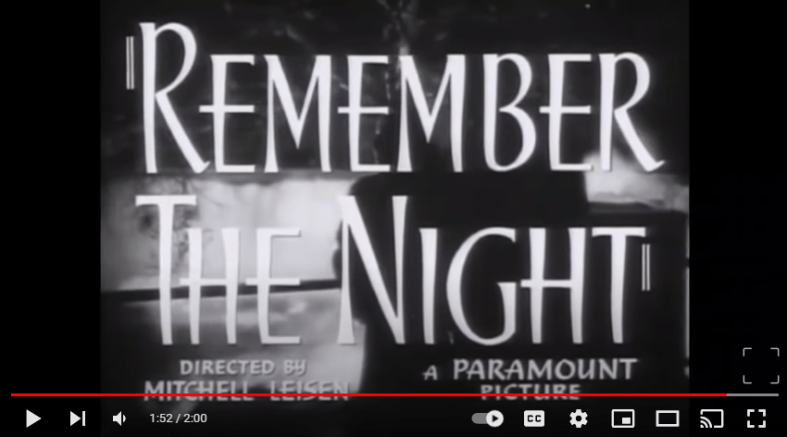
2021-12-22 (1)My current favorite Christmas movie is the 1940 production of “Remember the Night,” pairing Fred MacMurray and Barbara Stanwyck four years before they team up to become the couple you love to hate in “Double Indemnity.” Here they are the non-couple you want so badly to become the couple you love. All the printed synopses are blah. The story they describe isn’t the movie at all. I saw this movie years ago and promptly forgot about it. Maybe it was where I was in my life. Maybe I wasn’t looking for joy. I saw it in the summer and maybe the joy was there but lost in the stifling heat of July. I saw it again a few years ago at Christmas and fell in love with it. This year I can’t get enough of it. To me, it really is “a perfect alternative to an imperfect world.”

As I was doing some research for this post, I discovered it is #69 on Rotten Tomatoes list of top Christmas movies. There are any number of questionable offerings ranked higher, including their number 2, but at least Die Hard isn’t among them and that my friends, is this year’s true Christmas miracle!

2021-12-22 (2)

Watch “Remember the Night” trailer

Tell Me a Tale

Finally! Yesterday they finally awarded this year’s Oscars. Sorry, Oscars®. You’ve read me long enough to know I like movies. Old movies. Not so much old as good movies, so yeah, old movies. I don’t particularly care who won yesterday. See me in 24 or 25 years about the 2021 awards. We’ll see then which ones stood the test of time. I’ll tell you right now, it won’t be the ones that told a story. It will be the ones with a story worth telling.

Quite coincidentally this year, tomorrow is National Tell a Story Day. When one thinks of “a story” the first thought is usually a tall tale, perhaps inspirational, perhaps traditional, maybe something fictional with just enough truth in it to keep it interesting. Few stories hit all the notes although through the years you will find one or two each generation that live on through many generations. They are the ones with a story worth telling and telling again.

Today, everyone can tell a story. All you need is a connection to the Internet. Thirty years ago I would have said all you need is a typewriter, a fresh ribbon, a ream of paper, and a willing audience. Twenty years ago I would have said, all you need is a word processor, access to email, and a willing audience. Ten years ago I would have said, all you need is a keyboard and a connection to the Internet. Today you don’t even need a keyboard. A phone, a camera, a screen and access to your favorite social site, and the modern day storyteller has all the tools needed to tell the tale. You will note that the willing audience has dropped from the list of needs. With the internet comes an audience. Willing or not, there are people there. When we accepted losing the typewriter or keyboard as tools of the storyteller, we may also have lost the criterion that a story, a good story, be one worth telling. Another loss in many stories we hear today is the presence of truth.

Of course truth is not necessary for a good story. Any successful novelist knows the truth is incidental to a good story. Any successful novelist also knows nobody expects fiction to be truthful or accurate. That’s pretty much the point of fiction. But just to be on the safe side the successful novelist also…well, go pull your favorite novel off the bookshelf. I’ll wait. {Dah di dum di dah di dum dum dum} Oh good, you’re back. Okay, now turn to the copyright page. There, do you see it? It says something like:

[Name of Book] is a work of fiction. Names, places, and incidents are the product of the imagination of the author or are used fictitiously. Any resemblance to any person, living or dead, or any event, company, country, or location is entirely coincidental.”  

Disclaimers have long been used on fictional works, written and filmed. They aren’t on computer, tablet, or phone screens even though it is more likely that fiction will be taken for fact there than on the pages of that book you pulled off the shelf or in the movie theater. The social media storyteller specializes in sharing and forwarding unconfirmed material in the guise of news or pertinent information is as guilty as spreading lies and fabrications as the one who intentionally misleads or deceives, and the one who intentionally misleads or deceives is no more than a common liar who isn’t worth the electricity needed to post a rebuttal. But rebut we must. The charlatans foisting untruths, fact-sounding fallacies, misinterpretations of scholarly works, and ugly harassment must not be allowed to spread misinformation without challenge. If the social network platforms will not police their lines of distribution themselves then the professionals must remain vigilant to the lies circulating, whether about health, policy, government, or safety and security. Those who use the internet for news and information must recall the social networks are entertainment and any “information” gleaned from a social post should be taken with the consideration afforded to the “news” heard over the backyard fence or while standing in line at the supermarket deli counter. Consider any story heard on line as just that, a story, no more factual than Snow White and the Three Big Bad Wolves.

Hopefully your only encounter with storytellers will be with those with a story to tell that is perhaps inspirational, perhaps traditional, or maybe something fictional with just enough truth in it to keep it interesting – and with a story worth telling and worth telling again. No disclaimers necessary but there – just in case.

Once upon a time they lived happily ever after

Say What?

Did you hear last week about one of the Trump young’ns (actually I think a youngster-in-law) misquoting Lincoln in his or her speech (the youth or relative youth, not the sixteenth Mr. President)? It doesn’t matter what he said or she said or she said that he said. What matters is how often people are getting wrong things that have been documented for over 150 years. But then, the quote was one attributed to one who was once a living, breathing, actual, real person and real people have a tendency of saying things more than once and not getting it exactly the same each time. (“Oh yes, you’re probably thinking he said “Ask not what your country can do for you,” but when great grand daddy and him were chatting out on the sailboat in the bay he said “don’t go asking what you can and can’t do.” That was the line I was referring to.) But when people misquote the words of fictional characters is when you know you’re dealing with a seasoned misquoter.


Think of the number of times have you heard some variation of “Play it again, Sam,” probably the most misquoted movie quote of all time made even worse because everybody knows that wasn’t the line yet still toss into some random discussion, “As Bogie would say, play it again Sam!” (Technically it was Rick who never said that but that’s a post for a different day.) Misquoting literary and movie characters is an everyday occurence and, now, “Here’s the thing” (as Adrian Monk so often said), those words are written down and no matter how many times you read the book or watch the movie, that fictional person says those same words. Over and over. Always the same. And still…


Sometimes, like Play it again Sam, the misquote just feels right, like the original needed a little spiffing up.


Just the facts ma’am

  • Sergeant Joe Friday probably would have approved this more succinct phrase to his actual more mundane direction to many a witness, “All we want are the facts.”


Damn it Jim, I’m a doctor, not a [fill in the blank]!

  • Dr. McCoy indeed was a doctor, a classy doctor with military bearing not seen much anymore. With all his class and proper southern upbringing he never would use “Damn it” but modern times called for a firmer rebuff than his rather bland “I’m a doctor, not a…”


We don’t need no stinking badges

  • In The Treasure of the Sierra Madre Fred C. Dobbs shouts down to the bandits who claim to be law enforcement officers to show his party their badges. Alfonso Bedoya playing the character identified only as Gold Hat replies with one of the best lines in cinematic history to be later bastardized to the often misquoted abbreviated version. The real line is, “Badges? We ain’t go no badges. We don’t need no badges. I don’t have to show you any stinkin’ badges!”


Hell hath no fury like a woman scorned

  • Another line unjustly shortened perhaps by one whose desire to appear literary is greater than his or her desire to read all five acts of The Mourning Bride to uncover Queen Zara’s lament early in Act III, “Heaven has no rage like love to hatred turned, nor hell a fury like a woman scorned.” Oddly it is from this William Congreve play, his only tragedy, that another famous misquote derives. “Music has charms to soothe a savage breast” so often is said to soothe savage beasts instead. Now that is tragic. 


Often truncated quotes appear to be just a desire to create something pithy out of really good dialogue that just won’t hold up under the fast pace of formal cocktail party rules discouraging soliloquies. Unfortunately sometimes when words are removed from the original lines the original meaning goes with them.


Now is the winter of our discontent 

  • That little piece of dialogue from Shakespeare’s Richard III would seem to imply that they were, or we are in the midst of a really miserable time. It is only when you hear or read Richard’s full sentence, “Now is the winter of our discontent made glorious summer by this son of York,” do you get the feeling that this is actually a great and happy time to be alive.


Money is the root of all evil

  • Another truncation that is more famous that the original line comes from what is said to be the best selling book of all time with over 5 billion copies in circulation, The Bible. You would think with that many opportunities to confirm it wouldn’t be misquoted. Probably shortened by dads confronted with teenagers wishing increases in their allowances, the abbreviated version is fair rebuttal. But in fairness to the author, the line from Paul’s letter to Timothy is “For the love of money is the root of all evils, and some people in their desire for it have strayed from the faith and have pierced themselves with many pains.” (1 Timothy 6:10)


Sometimes the quote we know just isn’t the quote at all. 


A man’s gotta do what a man’s gotta do

  • So often heard from the mouths of teenage boys ready to step onto the playground with shoulders full of chips or ready to defend the honor of mistreated young siblings and weak friends (or so it seemed in the dark ages when I was a teenage boy) the line might have been one said by any of John Wayne’s portrayals. Closest to that are what The Ringo Kid says in Stagecoach, “Well, there’s some things a man just can’t run away from,” and a little closer still from Hondo in Hondo, “A man ought’a do what he thinks is best.” But maybe we just wanted it to be by John Wayne and even got the attribution wrong. Out of all of moviedom the closest of the closest of the close lines was by Charlton Heston speaking as Captain Colt Saunders in the quickly forgotten Three Violent People, “A man must do what he must do.”


And that brings us back to the most famous quote that was never spoken, Play it again Sam, just about always said with Bogart’s unforgettable lisped snarl. Of course his line was really, “You played it for her, you can play it for me! … If she can stand it, I can. Play it!” But the line closest to Play it again, Sam came a few scenes and a montage earlier and is spoken not drunkenly by Rick but very smoothly by Ingrid Bergman in the role of Ilsa. “Play it once, Sam, for old time’s sake. … Play it Sam. Play ‘As Time Goes By’.”


Notwithstanding the most famous quote that isn’t a quote, Casablanca endowed us with some of the most memorable quotes we use so often, “Round up the usual suspects,” “I stick my neck out for no man,” “Of all the gin joints in all the world…,” “We’ll always have Paris,” and the wonderful “Here’s looking at you kid.”


None of them, not the real, not the misquoted, not even the most famous quote that was never said, stand up to my personal favorite quote, a line from my personal favorite movie of all time, the closing line from Casablanca (also often misquoted as This is the start of a beautiful friendship) when Rick walks off with Louis (properly pronounced “Louie”) planning some assumed adventure with the Free French battalion in Brazzaville and says, “I think this is the beginning of a beautiful friendship.”

I’ll Have What He’s Having

The Academy Awards are behind us and the Oscar hoopla has pretty much faded away. I have a few more old Oscar nominees to watch. I’m still used to the awards being presented in March and February being the time to relish in the performances. Is it just me or do actors tend to speak better when reading somebody else’s lines as scripted than when they try to go their own way on the award stage? Anyway, I prefer the movie actor to the award show actor and often the movie world to real realty. Ironic, no?
 
Something that hit me this year watching my usual overdose level of film history is how much out there in movie land we can really use in real people land. Television land also has some pretty nifty gadgetry that we mere mortals could benefit from. Take for instance in 1966 just asking “Yo computer, how much longer till we get to the Romulan border?” and sure enough some snarky female voice speaks back “the. border. is. one. hundred. forty. light. years. away. and. will. be. reached. in. twenty. eight. and. one. half. minutes. if. you. don’t. stop. for. take. out. on. the. way.” Did Gene Roddenberry know Siri and Alexa were coming? If we’ve been able to harness computer power to become our personal assistants, why not some other seemingly outlandish inventions.
 
For example:
Movie people must have dishes that dry and put themselves away. I’ve seen dozens of movies this month with people eating and drinking and even in some instances washing dishes. But nobody ever dries them or puts them away. The only Oscar nominated movie I recall seeing somebody with towel in hand, drying dishes was Carole Lombard in My Man Godfrey. She didn’t do a really great job of drying and didn’t put them away but she was a millionaire socialite so I guess just the attempt at drying part was something special. They all have self-cleaning carpets also.
 
TelephoneThis one we sort of had but then technology took it away and we need it back – a phone you can pick up the reciever and just say who you want and somebody gets them for you. You need to go back to the 1930s for this invention. Everybody from cops to robbers to femme fatales to innocent bystanders could go to any phone and say “Get me John Smith” and sure enough, an operator would find John Smith, and the right John Smith. Progress took this away quickly (The Front Page). By the 1940s people were dailing their own numbers (Going My Way), by the 50s were getting wrong numbers (Anatomy of a Murder), by the 60s they were tearing pages out of phone books (In the Heat of the Night), and eventually we’ve worked our way to a time when there are no phone books and if you ask your computer assistant for John Snith’s number, unless John Smith is among you personal contacts, the answer will be, “I’m sorry I don’t have enough information.”
 
Cars run on no gas. Imagine not just driving for days, week, even months without filling up, but driving hard, fast, and often in multiple countries and never visiting a fuel station. Racing movies aside, nobody ever stops to fill up. The French Connection wouldn’t have stood a chance for Best movie if Popeye Doyle ran out of gas on 86th Street. The only movies I recall seeing somebody at a gas pump are High Sierra and National Lampoon’s Vacation and neither were Oscar nominees in any category. (I should note that in Vacation, Chevy Chase is seen wiping and putting away dishes but I believe they hadn’t been washed yet, so…)
 
Since I brought up non-nominees there are some things in almost every movie I’d like to see happen. 
 
Airplanes with aisles wide enough to walk down two abreast (with a refreshment cart even) and seats with more legroom than in my living room. Sticking with the travel theme, cruise ships with cabins bigger than my living room. Entire blocks unoccupied in front of the building I want to enter so I can just pull up and park – and never having to parallel park (nobody parallel parks in the movies), and airport parking lots that never charge for parking. Formal wear for casinos. Subways never overcrowded and always on time unless being hijacked. And those telephones that when they are set to vibrate you still know a call is incoming even if you are 3 rooms away. 
 
And – a hot tub time machine. Hey Alexa, let’s kick some past!


Lights, Camera, Action!

Yes, it’s February and that’s my favorite month of the year, or at least one of my 12 favorites and not just because of Groundhog Day. It’s Oscar Month!
 
Okay, okay, I’m not all that choked up about this year’s Academy Awards any more than any other year. Once again I have not seen any of the nominees for Best Picture although for a change I have at least heard of most of them. Some time over the next 3 or 4 years I might even get around to seeing most of them.
 
To me, the better awards go to the performers anyway. Of course they need talented writers working with good material and it has to be well produced and adequately funded, but you could say the same thing about a municipal mass transit system. The actors bring the movie to life and in the four performance categories I can honestly say I have heard of everybody.
 
Once again the movies displaying those nominated performances are important, shall we say dramatic stories that certainly will be told well by this group of talented actors but will they really entertain? Where is the laughter? Why is comedy always getting left behind? (Oh if you read the description of Marriage Story and Jojo Rabbit you will see that are classified as “drama, comedy/drama” but isn’t that like “politically correct?” It’s pretty hard to be both. And I’m sorry Jojo, The Producers might have made Hitler funny but that lightning isn’t going to strike again.)
 
So where was I? Oh yes, comedy. Where are the great comedic performances?  There was once a time comedies dominated the Oscar nominations. The first movies to ever feature nominated performances in all four performance categories (actor, actress, supporting actor, supporting actress) was the comedy My Man Godfrey in 1936, the year awards for performances in supporting roles were introduced.  
 
In the 91 times the Academy has recognized excellence in the performing arts, less than 100 performers have been recognized for excellence in comedic performances. That’s using their definition of comedy which is everything not dramatic. For examples, James Garner was nominated for Murphy’s Romance, a cute movie but not laugh until you fall out of your chair funny, and Tatum O’Neal’s win was well deserved but Paper Moon will never be confused with Blazing Saddles. So to say 100 comedy performance have been represented by the four acting award nominees is already a stretch and many of those movies sported multiple nominations. It would be difficult to find more than fifty true comedies among the performance nominations. Narrow the field down to the winners and you are looking at barely two dozen films. But of the winners featuring comedic performances that excelled, excellence might be an understatement. 
 
It just so happened one recent evening I found myself bored more than usual and took a tentative step into the wonderland we call the Internet. And there I found a list of all the comedy performances that had ever been nominated for any of the four performing awards. I was surprised to see how many of them I had seen – nearly 80 of the 90 some movies listed. So I decided to compile my own awards and then and there selected the top ten comedy roles of all moviedom or at least those once upon a time nominated. Here, for the first time ever, are The Realies!
 
unnamed10. Peter O’Toole, My Favorite Year (1983). Mention Peter O’Toole and your first thought has to be Lawrence of Arabia. From there you may recall Beckett and Lion in Winter, big, broad, epic roles where he fills the screen. Even his earlier side trip to comedy, How to Steal a Million will be on more people’s minds than My Favorite Year. It was pretty much a nothing movie. But his performance was big, brash, over the top, fill the screen in his best Errol Flynnesque style. A drunken hasbeen agrees to appear on a prototypical 1950s variety show to work off his debt to the IRS and takes Manhattan by storm, until he realizes he must performed in front of a live audience. “I’m not an actor! I’m a movie star!” His performance is worth the price of a ticket (or movie rental). Unfortunately for O’toole he was up against another great comedic performance by Dustin Hoffman in Tootsie and the winner Ben Kingsley in Gandhi for Best Actor. 
 
9. Jack Lemmon, Some Like It Hot (1960). What’s funnier than a couple of musicians joining a band to escape the mob looking to rub them out? Did I mention it’s a all women band? Um, did I mention the musicians are men? Lemmon’s character and his fellow musician played by Tony Curtis accidentally witness a mob murder and have to get out of town fast. Their “only” choice is to dress as women and join up with Sweet Sue and her Society Syncopators leaving town that day. At their destination Lemmon is pursued by a much married millionaire while Curtis pursues a member of the band (played by Marilyn Monroe) while both are pursued by guys with guns. If you haven’t seen it, you have to see it and stay all the way to the end to see Joe E. Brown’s deadpan reaction to Lemmon’s line about why he can’t marry Brown, “I’m a man!” Brown’s answer? You’ll have to watch the movie.  Lemmon’s performance almost wasn’t as he was the third choice to play the character. He lost the award for Best Actor to Charlton Heston in Ben Hur.
 
8. Marisa Tomei, My Cousin Vinnie (1993). Marisa Tomei’s Best Supporting Actress winning role as Mona Lisa Vito the brash fiancee to Joe Pesci’s brasher Vinnie Gambini shocked the movie going public and most critics of the time. It was the height of “The Important Movies Era.” There was no place for an old fashioned farce. But it was a triumphant return to the old fashioned farce and Tomei’s performance was reminiscent of Myrna Loy as Nora Charles or Katharine Hepburn’s Susan Vance, as the ditzy dame who is neither ditzy nor a dame and the movie wouldn’t be worth remembering without her. Tomei may have had unexpected encouragement to give an award winning performance. During filming Pesci brought the Oscar he won in 1990 for his role in Goodfellas.
 
7. Walter Matthau, The Fortune Cookie (1967). Walter Matthau’s first pairing with Jack Lemmon earned him a Best Supporting Actor award for his role as William “Whiplash Willie” Gingrich, Lemmon’s brother-in-law and lawyer. Matthau convinces Lemmon to feign paralysis after being run over by a pro football player while he was working as a television cameraman. Matthau suffered a heart attack during filming which was suspended while he recovered. He lost 30 pounds during his convalesence. He got 8-1/2 pounds back when he carried away his Oscar.
 
6. William Powell, The Thin Man (1935). The first of six “Thin Man” movies starring William Powell and Myrna Loy, The Thin Man is a fun adaptation of the Dashiell Hammett novel. Roger Ebert said of Powell, “William Powell is to dialog as Fred Astaire is to dance.” The film was shot in just two weeks owing partly to director W. S. VanDyke’s propensity for speedy single takes but also to Powell and Loy not acting but being “two people in perfect harmony” according to Powell. The plot is impossible to follow and clues seem to elude everybody except Powell’s Nick Charles who has a drink in hand whenever Loy’s Nora isn’t. And sometimes when. The acting is so smooth, the dialogue so sharp, and the chemistry so obvious you often lose track of the fact that a murder is being solved before your eyes. Sort of. Powell lost this his first nomination for Best Actor to Clark Gable in the comedy It Happened One Night.
 
5. Dustin Hoffman, Tootsie (1983). Dustin Hoffman solidifies his position as one of the greatest actors of his generation by playing the screwball comedienne and her/his own foil in the same role. Um, sort of. Hoffman’s character Michael Dorsey is a difficult to work with, unemployed actor who successfully passes himself off as Dorothy Michaels to secure a role in a daytime television soap opera. As the story unfolds Dorothy takes on a role within the role, a liberated, self-assured, ground zero “bad ass woman” before women thought they could be bad ass. The movie is a little bit farce, a lot of satire, some social commentary, and tons of fun. Hoffman lost out as Best Actor to Ben Kingsley’s Gandhi. The movie also contributed two nominees for Best Supporting Actress, Teri Garr and winner Jessica Lange.
 
4. Jack Lemmon, The Apartment (1961). I place Jack Lemmon’s role as C. C. Baxter, the overworked office underling who lends his apartment to his bosses for their affairs as one of his best. Lemmon’s trading eventually earned him a promotion as assistant to Mr. Sheldrake (Fred MacMurray) but has second thoughts when he discovers they both have designs on the same woman (played by Shirley MacLaine). Admittedly this falls into that comedy/drama description but Lemmon’s performance has some pure comedy gold such as when he drains the spaghetti through his tennis his racket (yeah, you really have to see that to experience the full impact) and juggles his desk-size Rolodex to solve a “scheduling” problem. The movie won five Academy Awards including Best Picture and received nominations in three of the four performers categories, Best Actor (Lemmon), Best Actress (MacLaine), and Best Supporting Actor (Jack Kruschen). Lemmon lost his bid to Burt Lancaster in Elmer Gantry. (Although MacLaine’s acting was Oscar worthy,  she won’t appear in The Realies Top Ten for The Apartment as I consider her performance more dramatic than comedic but it was a great role in one of my favorite movies. And don’t worry about her, she’ll be back.)
 
3. Shirley MacLaine, Irma La Douce (1964). (She’s back!) Shirley MacLaine is reunited with Jack Lemmon in this adaptation of Marguerite Monnot’s and Alexandre Breffort’s musical for the French stage. Lemmon is a policeman fired from the force who falls in love with a prostitute, MacLaine’s Irma. In order to keep her from working he attempts to monopolize her time as the mysterious Lord X. All through the convoluted plot, amid bribery, lies, and a murder that didn’t happen, MacLaine provides the anchor for an otherwise exceptionally outrageous, and long (nearly 2-1/2 hours long!) farce. MacLaine agreed to the part without reading the script because of Lemmon’s and Director Billy Wilder’s involvement in the movie. Afterward, she did not like the final product and contrary to reviews at the time felt the movie was not among her best work. She was surprised to have been nominated for Best Actress but based on her own assessment probably wasn’t surprised that she lost to Patricia Neal in Hud.
 
1 (tie). William Powell and Carole Lombard, My Man Godfrey (1937). No I wasn’t getting tired when I got to this point. I really believe without the other,  neither would be this good and together they are the best. William Powell plays Godfrey, one of the depression’s “forgotten men,” a target of a society scavenger hunt. Carole Lombard as Irene Bullock convinces Godfrey to allow her to bring him in to mark her scavenger list complete. In gratitude, but without the knowledge of her family, Irene offers Godfrey a job as their butler. Godfrey accepts and smoothly makes the position his own. But he has a secret background and a secret mission. Carole Lombard perfected the role of screwball comedienne and is particularly screwy here. Powell brings an enjoyable sense of a diamond from the rough among the family more resembling the discarded shards from the diamond cuttting. The movie is a shining example of “they don’t make them like that anymore” in large part to there not being actors like that any more. Powell and Lombard were nominated for Best Actor and Actress and Mischa Auer and Alice Brady were nominated for Best Supporting Actor and Actress. It was a shame that none of the four won nor did it win in the other categories it was nominated, Best Director (Gregory La Cava) and Best Screenplay (Eric Hatch and Morris Ryskind). It remains a mystery that it was not even nominated for Best Picture. Powell lost to Paul Muni in The Story of Louis Pasteur and Lombard to Luise Rainer in The Great Ziegfeld.
 
There are my pick for the top nominated comedic performances. Obviously I have a preference for the older entries and I admit I have some favorites. The years represent the year the Oscar was awarded, not the movie’s release date.
 
If you are still reading, I congratulate you. This is a long post, but I bet it takes less time to read than some acceptance speeches will this year! Thank you for reading! Now go have a laugh or two.


Happy Old Year

Movie goers who are certain they don’t make ’em like that any more, like me, often find themselves wishing for 1946 again. The Big Sleep, Razor’s Edge, The Postman Always Rings Twice, Gilda. Those were some of 1946’s bigger box office pay days. Oh yes, there was that big box office flop, It’s a Wonderful Life
 
Oh to relive 1946. That’s just what Sheila Page played by Joan Leslie gets to do in 1947’s Repeat Performance. In a heavily reworked version of the 1942 William O’Farrell novel, Sheila gets to relive 1946 from New Years Eve to New Years Eve. Well people had been reliving past cinematic lives for a while, particularly around the holidays, the previous year’s Capra classic being just the latest. Ah, but this one had a twist. Sheila doesn’t just watch her past life like Ebenezer Scrooge or George Bailey. Nor does she dream or imagine what a do over might get her the second time around. She gets dropped right back into her previous year with the full knowledge of the happenings of her first go at it and her plan for rewriting the script. 
 
Surely you’ve said to yourself a time or two “if I could only do that again” or “I wish I could have that day back.” Without revealing any more of the tale if you should want to see it for yourself* you probably can figure out that things aren’t going to go as planned. Obviously she didn’t live her first shot at 1946 in a vacuum and she isn’t going through version 2 alone. That’s the trouble with wishing for a redo, everyone else comes along too. Whether you want them or not. And there’s no guarantee that even if you could do your part differently that with everybody else adjusting and refining the end result won’t be the same.
 
My 2019 was not a banner year for me. If you’ve been reading these posts for a while you know that. If you are new just read the last posted kidney transplant update and you’ll get an idea of what I did on my summer vacation and it didn’t involve Disneyland. So if I had a chance to repeat this year would I leap at it? 
 
I think I’ll take a crack at revising things in the new year. In fact, I wouldn’t mind if we could dispense with today and tomorrow. I’ve already had enough of 2019.
.
NewYearsClock
.
*The 1947 movie Repeat Performance was lost until very recently. There are plans for a DVD and BluRay release. It is currently available in Turner Classic Movie’s on demand listings. There is a newer movie of the same name from 1996 that was a completely different story, perhaps even more obscure that the one lost for 70 years. Don’t be fooled by that. In 1989 NBC released a remake of the 1947 film as the made for TV movie Turn Back the Clock starring Connie Sellecca in the Sheila Page role as Stephanie Powers. That movie should not be confused with the 1933 comedy offering Turn Back the Clock which involves people reliving past lives but they were having a lot more fun than those that came in William O’Farrell’s novel released 9 years later which became the source material for the 1947 and 1989 movies. And you wondered why I wouldn’t want to redo a year. They can’t even get redoing movies right and that stuff is made up!
.

Yippee Ki Yay…

We’ve bitten off the better part of the first week of December. That certainly makes it Christmas movie time without complaints that it’s “too early for Christmas!” Personally, I watched my first Christmas movie for this year, this year’s new favorite Christmas movie, on Thanksgiving night and I’ll watch it again at least once a week until Christmas Eve. More about that later. 
.
I haven’t done a rant on what makes a Christmas movie for a few years and it’s probably time to revisit that topic lest some of you try to use the season as an excuse to pull out Die Hard from your old VHS library. Yes, there is a Christmas tree in the ball room or whatever that room was supposed to be. If it was the company’s reception area that was the grandest display of corporate opulence even by movie standards. Anyway, the presence of a Christmas tree is not the defining factor of what makes a Christmas movie, otherwise The Poseidon Adventure, Gremlins, and Eyes Wide Shut would be experiencing revivals at your local Bijou every December. 
.
Along with characters and plot, movies have to have a setting. Even if it’s an indeterminate long ago and far away they take place at some time in some place. Sometimes the some time is around Christmas. The Shop Around the Corner (which grew up to become You’ve Got Mail) and Untamed Heart are two movies that spend a lot of time around Christmas yet neither identifies as a Christmas movie. The production companies, distributors, and audiences recognize them as love stories and if some scenes have a Christmas tree it is just creating a believable setting. 
.
Every once in a while things get more than a little confusing in that regard. In 1947 George Haigt, and Robert Montgomery, and MGM Studios teamed up to present Lady in the Lake, a Steve Fisher adaptation of Raymond Chandler’s 1943 novel of the same name featuring private detective Philip Marlowe. Movies don’t often mimic the books from which they are adapted, in fact you can say they rarely are on the same page. Chandler’s readers were probably confused right from the opening credits of the movie which were presented in a series of Christmas cards with popular Christmas carols providing the background music. Throughout the movie, Christmas trees and wreaths are prominently displayed, holiday greetings are offered and returned, the season is toasted, gifts are exchanged, and one scene opens with a recitation of Dickens “A Christmas Carol” playing on the radio. All from a book whose action takes place entirely in mid-summer in a movie that was released in late January. Christmas movie? Um, no.
.
But fear not Christmas movie lovers, there are scads of films, old standbys and newer releases, that will transform the Scroogiest viewers into holly, jolly revelers without ambiguity – movies that add punch to any nog and present their presents wrapped in bows and delivered with care. Everyone has a favorite and every favorite has an ardent following. Yours may be a classic in black and white or an animated interpretation of a classic tale. It could be a big budget musical or an independent dark horse. It’s your favorite because you identify with a character or are reminded of an event every time you hear the title song. Or perhaps it offers a dream holiday you know you will not experience in your own life. Or, like my current favorite, offers an experience almost exactly like my own life.
.
I say my current favorite because like children there can be no real favorite among Christmas movies. The favorite is the one making you smile today or remember yesterday, the one encouraging a perfect alternative to an imperfect world and providing an escape from the ordinary. My current favorite is full of imperfections. Imperfect characters making imperfect plans, and ordinary people doing ordinary holiday things while dealing with ordinary year long problems. With all that mediocrity come the glimpses of joy and the fleeting feelings of fun that accompany real people living real lives. Before the closing credits roll you are smiling at them and yourself and ready to get back to whatever is next on your to do list only now you do it with that song running through your head. And not annoyingly.
.
My current favorite Christmas movie for this year is Love the Coopers. It’s so unmovielike! It asks you to suspend very little disbelief and quite believably could be about any family, including mine. You want to give them all back but you can’t because you love them so dearly. Love the Coopers, I think it needs a comma but Steven Rogers didn’t and it’s his story so I guess he should know. Maybe it’s more commanding that way. Or maybe it’s supposed to be just a little ambiguous. Just like us.
.
Merry Early Christmas!
.
20191204_161307
.

Who’s Calling?

It’s no secret mobile phones have reshaped the very notion of communication in today’s society. From the electronic equivalent of 2 cans and a string to commonplace video calls in a little over 100 years is remarkable. But with progress so comes loss. A not often recognized victim of telephone’s technological advances is film noir. The character in noir, and in its print cousin the hardboiled detective novel, is the phone itself. Aficionados of the genre easily recognize the pivotal shifts in plots telephones make in the telling of the dark tale.
.
It’s not by accident the protagonist spends so much time on the phone. The telephone is as important to the story as he is (always a he) (hey, it was mostly the 30s and 40s) (and these guys weren’t known for their “sensitivity” you know). When the good guy needs to determine if the bad guy (also almost always a guy) (they weren’t so sensitive either) is home (which is always a two-bit hotel room), he (the good guy) looks up the number and calls him (the bad guy). If he (the bad guy) isn’t in, he (the good guy) rips the page out of the phone book and heads over to lie in wait. If the bad guy wants to make a quick escape from the good guy, he (the bad guy) ducks into a phone booth, breaks the overhead light, then slinks back into the shadows. Fast forward to the 21st century and none of those scenes gets played out.
.
In a classic example of “none of the above” where nobody seems to be the good guy, the phone in “Double Indemnity” is the only point of contact between Fred MacMurray and Barbara Stanwyck after they do what they do. (I’d be more specific but I won’t spoil even a 75 year old movie by giving details. Know that’s it’s frightening even for 2019.) Today the authorities would just subpoena their cell phone records and the last 40 minutes of the movie would be anticlimactic. Heck, they be unnecessary!
.
In some case entire movies would be jeopardized. In the absence of an good old fashioned phone, how could you “Dial M for Murder” with a keypad that just beeps and boops. Nobody even answers “A Phone Call From a Stranger” not recognizing the caller ID. With everybody not reaching everybody else “This Gun For Hire” would never have been since that’s not the sort of message one leaves in voicemail.
.
Of course in the 1946 classic “The Big Sleep,” Bogart and Bacall could have been using smoke signals and you would still need to sharpen your knife between scenes to cut through the tension. But then every good rule needs an exception and those two were particularly exceptional.
.
Bigsleep2
.

Script Girl

February might be my favorite month. It’s certainly in the top ten. (I can do without March and its schizophrenic weather patterns and August’s unending humidity. The rest are okay.) February is among my favorites because of the Academy Awards. Quite honestly I don’t think I could possibly care less who goes home with an Oscar this year. I love February because of the old winners.

I love old movies and there is no better time to get a fill of them than in the month leading up to the Oscars. Whether your film love is for musicals, thrillers, book adaptations, war, epics, comedies, or tragedies you will find it on a small screen near you in February. February is when movie services and networks go all out to rake in the viewers with past nominees and winners. The good movies. The ones produced before Hollywood decided America needed a conscience and it was the perfect choice. These are the ones you watch and say to yourself, “they wouldn’t do that today.”

Something else about those old movies they don’t do today is the credits. (Hmm. Some things else are the credits?) I’ve bemoaned the state of movie credits before but it never rears its ugly head as much as now when the screens are filled with the elegance of crediting those who deserve credit and not every Tom, Dick, and Harriet who come close to the set or is close to the financiers.

Buried in those early credits is another thing “they wouldn’t do today.” Among the actors, director, producer, editor, cameraman, set designer, and costumer, almost always is “Script Girl.” Sexism notwithstanding, the title was gradually changed to Script Supervisor in the 60s and 70s, long before males entered the role. But for years, and as long as February remains Oscar Movie Month, for years to come, “Script Girl” was how the continuity expert was defined around the world. Literally.

AdmitOneJust over the weekend I was watching the 1974 Best Foreign Language Film winner, François Truffaut “Day for Night.” (Reading maybe as much as watching as my French comprehension was never as good as my high school grades suggested. Hooray for subtitles.) As the credits rolled (before the movie as they should be) after the acteurs, among the équipage, and before the producteur and the réalisateur was “Script Girl,” just like that, en anglais, capitalized, and in quotes.

And what does this “girl” do. At one time she or he, although then it was almost exclusively she would be the director’s secretary and would record information about how of each scene was shot, prompt actors, and often write notes to be used in publicizing the movie before it’s release. Today the Script Supervisor also keeps notes of wardrobe, props, set dressing, hair, makeup and the actions of the actors during shooting to assist the editor in maintain continuity during and between scenes. Thus when the hero enters a scene with a half full cup of coffee it doesn’t turn into a can of ginger ale 24 seconds later in the final cut.

I’d love to stick around longer and talk about old movies but there’s only 17 days left to February and my DVR is filling up. I have to catch up on some classics today.

Disbelievable!

The suspension of disbelief, so Aristotle says, is that theatrical principle which allows the audience to accept fiction as reality and fully experience the moments. I’ve always thought it should be the suspension of belief because what’s so hard about not not believing. Fiction by definition is that which is not real (though not necessarily unreal, at least as of the mid-1960s), or as Lawrence Block so well put it, “telling lies for fun and profit.” But I guess if you’re willing to shell out the money to have someone lie to you, whether at a play or through a novel, you’ve already surrendered at least some of your beliefs. To give up disbelief is the willingness not to stand up in the middle of Act III shouting “Oh come on now!”

Of course the author has some responsibility to make it not absurdly unbelievable except perhaps in a good farce. I thought of this while watching television the other night. It was a new age television drama that is supposed to reflect life itself. But I’ve seen this particular problem is lesser dramas, comedies, and even movies of the theatrical release type. That is the vibrating cell phone.

I am willing to disbelieve when our hero shoots it out with 5 or 6 bad guys all outfitter with automatic weapons against his pistol compact enough to slip into his tuxedo breast pocket. I can disbelieve with the best of them that someday man will fly faster than the speed of light. It even doesn’t stretch my discredibility that a fresh faced girl from Kansas can move to New York and beat out the actresses who have trained since they were 4 for the lead in the new Broadway musical winning a recording contract, and a Tony, in the process.

CellPhoneBuzzingBut I cannot disbelieve close to enough that everybody on TV and in the movies can hear their phones on vibrate from 2 rooms away. Seriously.

Seriously, is it only the programs I watch and the movies I go to that even the actors take the notice when we are instructed to mute our pagers, phones, and other electronic devices?

Maybe in the movies I can see the director being paranoid that if he or she were to call for a real ringtone too many audience members would reach for their phones and miss whatever nuance is playing out in the screen as we watch the character carefully traverse the rooms to the buzzing handset. I guess on the television shows a ringing phone would distract us to the point of missing the next commercial. Although I might be tempted to go looking for my phone thinking a) nobody in the show has a phone on them and b) holy crap, where did my phone get to?!

So I’m willing to not disbelieve in ghosts that run roughshod over New York, to take on non-unfaith that mild mannered bartenders double as CIA operatives, and to really buy that a computer can inhabit the body and soul of a foreign exchange student. But…

If anybody out there is working on a screenplay, please keep in mind that the suspension of disbelief goes only so far. And it stops at the end of my cell phone.

Bzzzzz bzzzzz