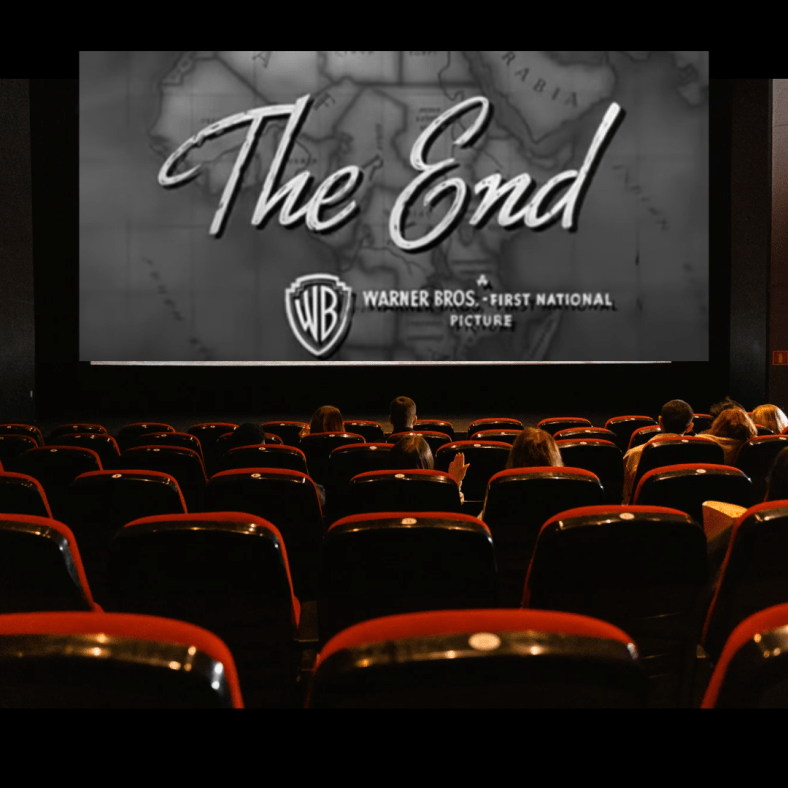
“The End” is not as near as it once was

I’ve noticed a disturbing trend that’s been going on for years, and it’s mostly most disturbing (mostly) because I’ve not noticed is before, yet it’s really mostly out there, like more than it isn’t. What you asked? Go ahead and ask, I’ll wait. What? Oh I’m glad you asked. “The End” is missing. That practice that once was a staple on movie end title cards, and in books on their end pages of declaring the end as “The End” is ending, in fact, seems to have indeed ended, and nobody is in a hurry to bring it back.

It may seem a silly thing, in fact it most probably is a silly thing, but that “The End” wrapped things up neater than solving a locked room murder. It closed the book, as it was. It put the stamp of a job well done on a job well done. There was no mistaking when you got to the end that it was the end. Any cliffhangers, unanswered questions, or unresolved loose ends, were more often the result of your not having paid attention to some seemingly unimportant detail than it was to the author’s or screenwriter’s lack of imagination or meticulous care to continuity.

It seems to me, the disappearance of “The End” occurred quite simultaneously to both print and film media, not unlike the unexplained (although welcomed by me), change of printing copyright dates in Arabic numerals rather than Roman numerals. (If you’re intrigue by that, check out my post here. It doesn’t explain it but I do have fun talking about it!) (But back to “The End” which I’m sure you’re now hoping we are getting close to as far as this post is concerned.) I noticed, or I think I noticed, “The End”’s demise in books and at movies because I’ve been on an odd quest (yes, odd even for me) of attempting to read the source material of all the old movies I am so addicted to. I want to see if the observations I made last year about movies based in books in the early days of the Hayes Code were more universal than just those handful of stories i mentioned

Even the most casual of casual readers knows that I much prefer movies of the 1930s, 40, 50s, and in a pinch, very early 60s to any other dreck put out since, but that’s just my opinion. Why do I say “attempting to read” the sources of the screenplays of those early movies? Because the source material is not always 1)known, 2)published, or 3) available even if it is both 1) and 2). But in those cases I have found a source that 1), 2), and 3) and the material ended in “The End” (or the more exotic “Finis”), so did the film. Those that did not, neither did they, and they did not about the same time as movie credits expanded to included everybody who happened to be in Hollywood at the time of filming, perhaps to make up for the lost screen time and then some by not including “The End.”

And so I suppose I’m going to have to watch more and more 60s and maybe even 70s vintage films to see exactly when movie producers decided it was more important for us to know who drove the catering trucks than that the movie is over, now please go back to your real lives.

And now, please go back to your real lives.

-The End-

Bonus points if you can identify the movie from the end title card below.


Do you plan so much you never get around to doing? When you do, are you overly concerned about what others think about what you’ve done? The most recent Uplift! explores why it is better to just do, and then do some more! Approximate reading time – 2 minutes.

8B543F91-85DD-4DF1-91D6-319398C44780


Read the book

Not too many posts ago I wrote one about the changes that a story goes through on its way from printed page to silver screen. That got something stirring in me and I set out to read or reread as many of the books that have been the inspiration to some of my favorite movies. Along the way I noticed something curious. Many modern movies hold themselves much closer to the original stories than movies from the golden age, and while I think that’s a good thing for the high school football star who has little time for such nonsense as reading, the older movies are typical of a higher quality, story telling wise and even production wise. (Yes, I know, but that’s my opinion. It’s also my blog. Get over it.)

We likely have Will H. Hays to thank for the creative license taken by screen writers in the 1940s and 50s. Although the so-called Hays Code “governed” film propriety until 1968 when the now familiar 4 tiered Motion Picture Association of America rating system was adopted, it was during the golden age of moviemaking (1936-1962) that the classic movies differed much from their classic written beginnings – but often in a good way.

Reading the book versions of some film classics revealed three major changes. Most movies were targeted to run from 105 to 115 minutes. Provocative talk was okay, action was not. The bad guy not only never wins, he always gets more than his due.  Although I the past two weeks I’ve read The Thin Man, The Maltese Falcon, The Big Sleep, and To Have and Have Not, I’m going to use Farewell, My Lovely, adapted to “Murder, My Sweet” as the film/book comparison. I’m case you want to read, watch, or do both with this story and have not yet done either, I will not reveal any plot information in this discussion.  

Raymond Chandler’s Farewell, My Lovely, released in 1944 as “Murder, My Sweet”* has enough character exposés and plot twists to fill 3 hours of screen time. Even “Gone With the Wind” couldn’t keep audience members who were honest entertained for 180 minutes. To keep it to a reasonable length, some sub-plots were completely eliminated and characters combined to make transactions flow through the deleted scenes less awkwardly. Of thirteen main characters from the novel, eight made the transition to the screen version and three of them were significantly altered.

Before we discuss plot changes it is worth noting the Chandler was not a stickler for plot details. Rather than relying on formula and a certainty that everything wraps up neatly at the end, he said he was more interested in the message conveyed by his stories. During the adaptation of another of his novels, The Big Sleep, screen writer William Faulkner, a pretty good novelist himself, was unable to reconcile one of the murders. It is said that after many hours of trying to successfully reveal, or at least hint at the culprit responsible for the character’s demise, the screenwriting team decided to call Chandler and ask who did it. His response? He didn’t know either!

In both book and movie, a missing necklace and a missing woman are central to the story. While the compactness of the plot and some subplot elements that were victims of time are obvious if you read the book before watching the movie, but if your first exposure to the tale is at the movies, there are no unresolved issues.  How the woman and necklace become missing and found, and what happened in between were victim to the censors and may leave your wondering if the suspension of disbelief might be stretched just a little. Illegal drug use, questionable social couplings, racial and economic disparities, and police corruption were tempered or cast aside. The resulting screenplay, although missing many of the stops along the way to the conclusion, does not suffer for these details. In most cases, the viewers can replace with their imaginations what was handed to them in writing. This is not always a bad thing. Often your imagination can make a better story than the one first considered and when the inferences are made deftly, the conclusions can be fairly consistent. In a different movie/book tandem, The Thin Man by Dashiell Hammett, although Nick and Nora sleep in separate beds in full pajamas with dressing robe and gown, there is no question that they are giddyingly in love with each other and present as a passionate couple.

The conclusion of “Murder, My Sweet,” although satisfying, takes a major departure from the novelist’s vision. Again, needing to satisfy the censors of the time, the character wrap up are quite different. Some “bad guys” in the novel are still walking around when the last page is turned. The Hays Code wanted audiences to see that crime not only doesn’t pay, but exacts a price. We never see the bullets fly (too violent) but we see the results. And who does the “cleaning up” and how they are manipulated so nobody gets an easy way out are somewhat vague. A final twist is the movie’s version of a happy ending, although working well for the movie, may not have been exactly as Chandler would have written it.

The is no question that if you watched “Murder, My Sweet” you know you are watching the story behind Farewell, My Lovely. It is faster paced, you might think you missed something when you went to re-butter the popcorn, and at the end you could be saying, “oh, yeah, I can see that,” but it’s clearly the same story. It’s just not the same.

Is it a bad thing that movie adaptations deviate from their source materials? Not always. When nothing but the title and a character name are all that are recognizable you get the sense the studio or production company know they have a dog of a story and the only way they stand a chance to make money is to buy a popular title. But a good story in the hands of talented screen writers, especially if they are source writers themselves, will show through regardless of constraints placed by the questionable morals police or to the keep it short so they don’t get bored police.

To quite somebody from some book or movie, “It’s all good!” (But it wouldn’t kill you to read the book.)

Blog Art 2 3


* Murder, My Sweet was not the first screen adaptation, nor the last, nor was the screen the only adapted medium of Farewell, My Lovely. Although the latest adaptation was made in 1975, it still was subject to significant changes for time and cultural references.


You affect everyone you meet, whether with words, actions, or just a smile. Read why we say you brighten everybody’s day with your presence at http://www.roamcare.org.


Based on a story by…

I don’t know why but last weekend I was thinking about Raymond Chandler, Ernest Hemingway, William Faulkner, F. Scott Fitzgerald, and Alfred Hitchcock. Not necessarily in that order. As I’ve written before, I don’t know why I think the things I do, but I do and that is enough to make me think, and then think that I’d rather not want to think about it.

It all started with me re-reading The Curious Case of Benjamin Button which got me thinking about how a movie and a book can be so different. A movie and a 600 page novel, an epic, the proverbial tome may differ because who could get all that detail into a movie people would be willing to sit through, except perhaps Gone With the Wind, but that has its own problems. But with Ben, or BB as I like to call him, that’s a short story, and still Eric Roth managed to write a 2-1/2 hour movie based on a tale that took me a fifth of that time to read, with a bathroom break thrown in. How did he do that! The answer is, he didn’t. Roth and story writing partner Robin Swicord wrote a different story with a title and a character of the same name. It’s a good movie. It’s a good short story. They just aren’t the same. And that’s been going on pretty much since we’ve had movies.

William Faulkner’s 1944 treatment of Hemingway’s To Have and Have Not does the same thing. A character or two are mentioned in both book and movie, and those plus the title are the total of what remains of the story the movie was based on. Now the 1950 adaption, “The Breaking Point,” by screenwriter Ranald MacDougall is much closer to the Hemingway classic. It’s on a different ocean and there’s an extra couple of characters, but it’s recognizable as being a story based on. But does that make it better than the 1944 classic or just different?

You can’t say that Faulkner, who was no slouch in the book writing department, was flexing his writing muscles, because he quite faithfully followed Chandler’s The Big Sleep, changing only what needed changed to make the movie acceptable to those who moderated the 1946 version of the production code (and to make it acceptable to those who wanted to see Bogart and Bacall become Bogart and Bacall). Perhaps that is why when Chandler took to the task of writing the screenplay to Patricia Highsmith’s Strangers on a Train, he stayed as close as he could to the original story. Oh wait, you’re going to say, they aren’t close at all. You might even say in the movie, the strangers are on an entirely different track than the one the train chugs along on in the psychologically thrilling novel. The “Strangers” presented by Alfred Hitchcock that we see is not the version Chandler wrote. That script ran afoul of the censors (and to a large extent, of Alfred) and was almost entirely rewritten by Czenzi Ormomde. 

When Chandler and co-screenwriter Billy Wilder adapted James M. Cain’s Double Indemnity, they took much liberty with the original story, changing names and timelines, and most radically, they added a new character, the insurance investigator, which created a completely different story.  

“Double Indemnity” and “Strangers on a Train,” a double dose of two books, two movies, four stories, none of them bad but none of them based on any other. So maybe when you have great writers adapting great works of writing, you will get great results, just not always recognizable as the story they are based on. 

Now let’s talk about what Leon Uris and Dalton Trumbo did with “The Exodus.”

Blog Art (26)


Blog Art (25)Everybody is more engaged and more fun to be around when they feel valued, and they feel most valued when they are treated like people. Read why we say good manners never go out of style at www.roamcare.org. While you’re there, check out the rest of our site, then share us with your friends and family!