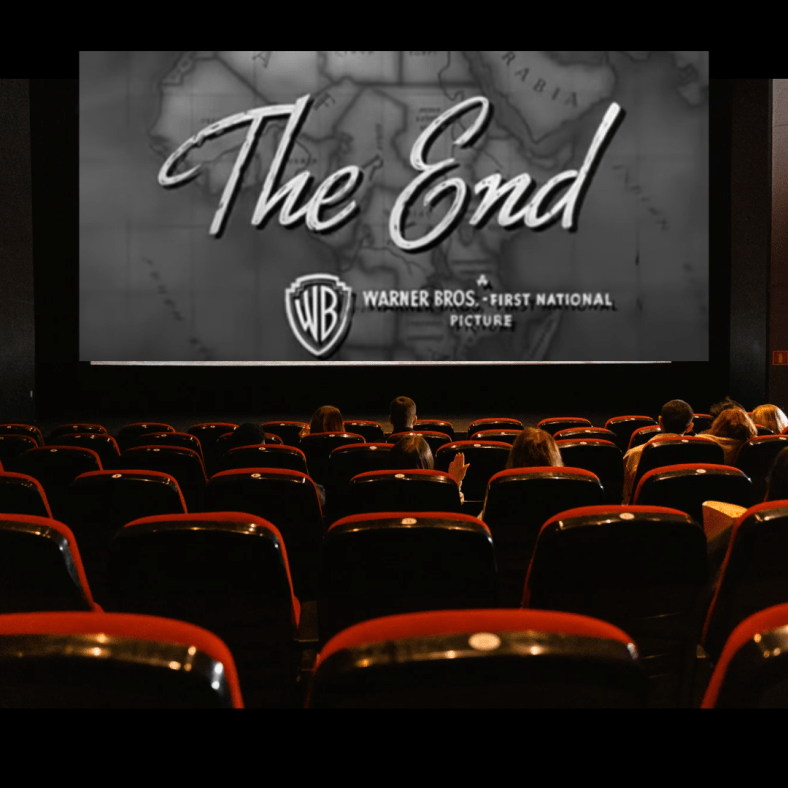
I’ve noticed a disturbing trend that’s been going on for years, and it’s mostly most disturbing (mostly) because I’ve not noticed is before, yet it’s really mostly out there, like more than it isn’t. What you asked? Go ahead and ask, I’ll wait. What? Oh I’m glad you asked. “The End” is missing. That practice that once was a staple on movie end title cards, and in books on their end pages of declaring the end as “The End” is ending, in fact, seems to have indeed ended, and nobody is in a hurry to bring it back.
It may seem a silly thing, in fact it most probably is a silly thing, but that “The End” wrapped things up neater than solving a locked room murder. It closed the book, as it was. It put the stamp of a job well done on a job well done. There was no mistaking when you got to the end that it was the end. Any cliffhangers, unanswered questions, or unresolved loose ends, were more often the result of your not having paid attention to some seemingly unimportant detail than it was to the author’s or screenwriter’s lack of imagination or meticulous care to continuity.
It seems to me, the disappearance of “The End” occurred quite simultaneously to both print and film media, not unlike the unexplained (although welcomed by me), change of printing copyright dates in Arabic numerals rather than Roman numerals. (If you’re intrigue by that, check out my post here. It doesn’t explain it but I do have fun talking about it!) (But back to “The End” which I’m sure you’re now hoping we are getting close to as far as this post is concerned.) I noticed, or I think I noticed, “The End”’s demise in books and at movies because I’ve been on an odd quest (yes, odd even for me) of attempting to read the source material of all the old movies I am so addicted to. I want to see if the observations I made last year about movies based in books in the early days of the Hayes Code were more universal than just those handful of stories i mentioned
Even the most casual of casual readers knows that I much prefer movies of the 1930s, 40, 50s, and in a pinch, very early 60s to any other dreck put out since, but that’s just my opinion. Why do I say “attempting to read” the sources of the screenplays of those early movies? Because the source material is not always 1)known, 2)published, or 3) available even if it is both 1) and 2). But in those cases I have found a source that 1), 2), and 3) and the material ended in “The End” (or the more exotic “Finis”), so did the film. Those that did not, neither did they, and they did not about the same time as movie credits expanded to included everybody who happened to be in Hollywood at the time of filming, perhaps to make up for the lost screen time and then some by not including “The End.”
And so I suppose I’m going to have to watch more and more 60s and maybe even 70s vintage films to see exactly when movie producers decided it was more important for us to know who drove the catering trucks than that the movie is over, now please go back to your real lives.
And now, please go back to your real lives.
-The End-
Bonus points if you can identify the movie from the end title card below.
Do you plan so much you never get around to doing? When you do, are you overly concerned about what others think about what you’ve done? The most recent Uplift! explores why it is better to just do, and then do some more! Approximate reading time – 2 minutes.

 What’s the most significant day in your life? Did we answer that question last week at
  Just over the weekend I was watching the 1974 Best Foreign Language Film winner, François Truffaut “Day for Night.” (Reading maybe as much as watching as my French comprehension was never as good as my high school grades suggested. Hooray for subtitles.) As the credits rolled (before the movie as they should be) after the acteurs, among the équipage, and before the producteur and the réalisateur was “Script Girl,” just like that, en anglais, capitalized, and in quotes.
 The Real Reality Show Blog