One of the annoyances of being addicted to 70 and 80 year old movies (and older even), is having to translate certain period references to their twenty-first century equivalents, most notably (at least for this discussion), is money. As in, the value of money.
An obvious fact of money is that money of this year is almost always going to be worth less than money next year. (Eventually it will likely become worthless but that is a discussion for a different day.) The point being, when someone in a movie made in 1933 tosses down a dollar coin in payment for a meatloaf dinner, pie, and coffee – and gets change(!) you instinctively know money went a lot farther then. (Further?) (Whatever). Those aren’t so bothersome. But when someone says something like, “I want to put $1,000 down on Nag #1 to win in the third race,” I get to wondering, just how much is that guy gambling.
I did some research, and I found out that $1,000 American dollars in 1933, when adjusted for inflation is the rough equivalent of $24,000-$27,000 today (depending on whose rate of inflation you want to apply. So our erstwhile horse race lover is splurging with let’s say $25,000 on his horse race.
Some of the more criminal endeavors in the so called gilded age were really up there. A garden variety kidnapping when the perpetrators then demand “$50,000 or youse’ll never see da brat again,” are looking for a payout of $1.25 million of today’s dollar bills. (In December 2024 a cryptocurrency executive was kidnapped and returned after a ransom of $1 million was paid so maybe that’s not so far off.) (I wonder if those guys got money or crypto for their ransom???) (Anyway…)
In the 1930s, the richest man in the world was John D. Rockefeller. Topping out at about $1.4 billion 1934 dollars, making him worth $35 billion dollars today. Some would pooh pooh that trifling amount. Today’s richest of the rich are worth over $200 billion dollars, except they aren’t. A billionaire in the 1930s had a billion dollars in dollars. True, some of that might be in the value of their business (in Rockefeller’s case, Standard Oil), but their businesses were worth their values in real dollars. Today’s wealth is more a standard of leverage than liquidity. If John D. wanted to buy the New York Times for $20 million dollars, he would have gone to the bank, taken out $20 million dollars (or maybe he’d get it out of his change jar at home), and paid Adolf Ochs $20 million dollars. (He didn’t do that and probably missed out on a great deal because newspapers were a dime a dozen during the depression years.) Today if someone wanted to buy say Twitter, they’d be lots of stocks transferred and “financial considerations” made but nobody ends up with real folding money to put in their wallets.
The other thing about the difference between 90 years of inflation is that not only has inflation devalued the dollar. So called market adjustments must also be taking into consideration to really determine the purchasing power of a dollar is. Remember those $25,000 dollars oof today’s money that would buy you 1,000 of 1933 dollars. You need about 2&1/2 times that much to buy what $1,000 would buy in 1933. The actual spend equivalent of $1,000 1933 dollars in about $62,000 today.
Put another way, in 1933 the average income was $1,300 per year. The average house cost $5,700 or 4.4 times the annual average income. In 2024, the average U.S. income was $62,000, the average house cost $520,000 or 8.4 times the average annual income. We are actually making more money but getting less spending power. By inflation only, that average $1,300 dollars is about $32,000 today but the average income is almost twice that. By calculating for inflation alone, that $5,700 house should cost $140,000 today. The house price rose 3.4 times higher than the rate of inflation.
Remember those numbers when you read in this morning’s paper that your Senators approved the Big Bastardly Bill taking even more of your money away. I’m sorry, any billionaires reading please, please ignore that last statement. You’re going to get to keep 38% more than you did last year. Everybody else go out for dinner this year. After next year’s tax bill you probably can’t afford meatloaf, pie, and coffee all in one meal.





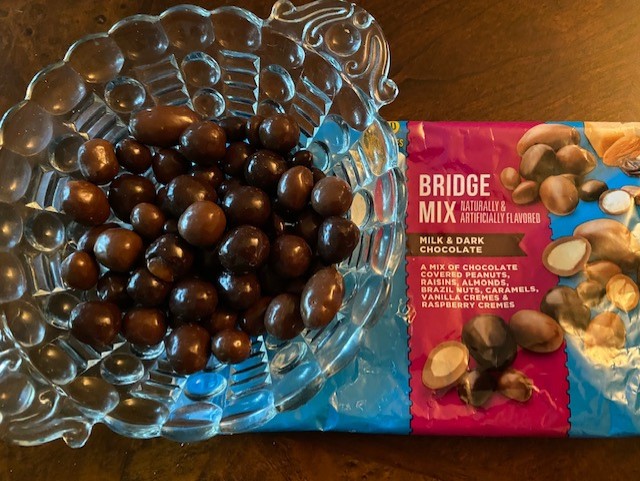 (Just out of curiosity, am I the only person left in the world who keeps a dish of bridge mix on the coffee table?) (Am I the only person who still keeps bridge mix?) (Am I breaking etiquette having bridge mix yet never having played bridge?) So I did my research, narrowed my choices, and what usually would have taken me 3 to 5 weeks of intense searching took me 3 days.




 So where was all this going? Oh yes, the new scam. But first, a question. Do you have a Zelle account? A more pertinent question, do you know if you have a Zelle account? Zelle is a money transfer system used by almost every bank in the U.S. Interestingly, if you have installed your bank’s mobile app on your phone you almost certainly have a Zelle account whether or not you know it or want it. It’s just waiting to be activated. And there is the next biggest scam we’ll not hear about until some Senator’s son is duped into losing his allowance.
 Odd Week Exhibit A. If you were anywhere in the “48 states, Washington DC , and Puerto Rico” (more on that later too!) or even close by (and maybe even in one of those other two states) and you were seduced by “Black Friday in July” (oddly held on Monday and Tuesday) like I was, you might have purchased an all the rage, newest and hottest, must have, can’t live without item of the year, or an air fryer. In my case it was the air fryer. A week earlier I hadn’t even considered an air fryer but coincidentally Big Lots held its quarterly 20% off weekend immediately before Black Monday/Tuesday. If you don’t have a Big Lots in your state or country think of your favorite discount/buyout store. I saw an air fryer in the ad that came out in advance of the sale and thought “at that price I’ll try one” that price being almost half what it was in a department store plus an extra 20% off. Short story long, by the time I got there they were out. I’d not have given it a second thought except on Monday afternoon I was busy deleting emails when I came across a Macy’s ad featuring that very air fryer at exactly the same price I missed, extra 20% and all, at Big Lots. To make a shorter story longer, when the package came this week it included instructions to submit for a rebate for an additional $10. Just fill out the on line form and they’ll send me a VISA card with $10 loaded on it. The on line form included several fields, all required, including a space for “rebate code.” The instructions noted 6 or 7 countertop appliances each with its own rebate code. Except for my air fryer. Of course.
 If you crunch some numbers and divide this into that, that being how many people claim to celebrate Halloween with more than spiked cider and this being that 9 million figure, you come up with a spend of about $86 per person. I’ve spent that much on a nativity set and I have well over 50 of them. (Really. Some people are into hairy spiders, I’m into nativities. I have them, many complete with wise men, made of clothes pins, cheesecloth, corn husks, ceramic, glass, plastic, straw, bronze, wood (carved, sculpted, machine cut and assembled, hinged, and nested), bronze, stone, steel, marble, paper, wool and rubber, sawn from barn board, and cut out of paper.) It’s what I do for Christmas so I can’t say if you want to eighty-some bucks on Halloween you’re nuts. But if you’re planning on spending eighty-some bucks on Halloween, you’re nuts! Except for the little candy bars. Those are cool.
 The Real Reality Show Blog