Out Yinzered

In an area where toilet paper hoarding is legendary, folks here have taken to different shelves and sections in the stores to strip bare. 
 
There are solid psychological theories about why people choose toilet paper as their survival equipment of choice. In the Greater Pittsburgh area, land of  Yinzers*, we augment our pantries at every snowstorm with milk, bread, and toilet paper. We’ve been doing it since the big snow of 1950 when three feet of the stuff fell in less than 24 hours. After the initial shock wore off and people could get out to replenish their larders they found grocery stores fairly well stocked. The only shortages were milk and bread. People were encouraged to buy only what they needed so the thin supply could serve as many families as possible. The people responded and kept their purchase quantities reasonable but ever since when the weather brings less than ideal local travel conditions, second and third generation Yinzers flock to the stores ahead of the storm to stock up on milk and bread – and you might as well grab an extra pack of toilet paper. 
.
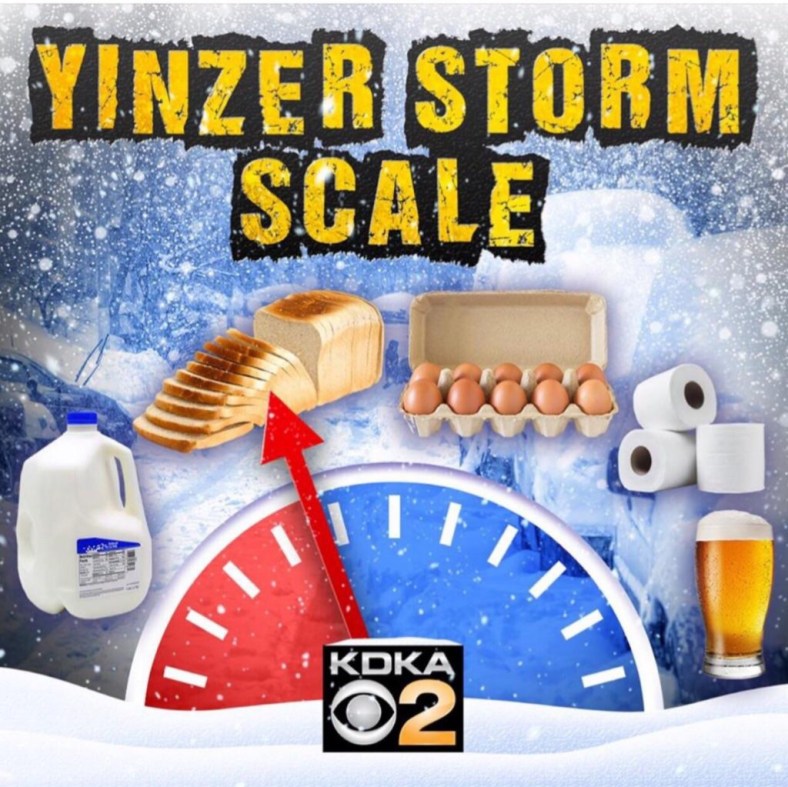
20200316_135415

Yinzer hoarding is so ingrained it’s even included in winter weather forecasts. (CBS Pittsburgh)

So now that the news is reporting on hoarding activities outside of Western Pennsylvania we have to up our shelf-clearing game. Here then are my personal observations.

 
Standing in the produce section of the local mega-mart, the onion and garlic bins have been decimated, even the exotic black garlic. Checking the corner cabinet I see the tomatoes and green peppers are also well picked over. It’s clearly a case of tomato sauce over prep. In a very high Italian background area, we spend our late summers putting up quarts of tomato puree and Grandma’s Sauce. Apparently the jars on the shelves in the basement are running low and in case we don’t get to put in the plants in the backyard garden this summer we better get what we need and work on new stock now.
 
Moving to the deli department, the dry sausages and meats were in short supply. In the center store tuna in pouches was nowhere to be found but bags of dried chipped beef were plentiful. Along with the vanishing dry pastas I can deduce that tuna noodle casseroles will be on many future dinner tables with pepperoni for late night snacking and jerky for an on-the-go bite during afternoon walks. I guess even the threat of extended isolation doesn’t improve the outlook for a big platter of SOS. (Personally I like chipped beef on toast. Perhaps a remnant from my army days.)
 
Over in the coffee and tea section the caffeine fiends perhaps realizing the critical need coffee drinkers exhibit have left a wide variety of blends and flavors and in imppressive quantities. Tea, loose and in bags, however were almost completely gone. Likewise hot chocolate. However, instant ice tea, lemonade, and other drink mixes were so-so. It seems everybody believes the power of a nice cup of tea will cure all ills and the hot chocolate will keep the kids quiet.
 
The frozen food freezers (redundant?) were extremely low on pizzas, ice cream, and potato products (french fries, waffle fries, hash browns, etc.). Oddly French bread style pizzas were still well stocked. That works out for me because I have a small freezer. Those big pies take up way too much space! And thank you to the ice cream hoarders for leaving a sufficient supply of blueberry cheesecake gelato, my frozen dessert of choice.
 
The poor pharmacy area didn’t have enough left to even be called a shambles. To shamble you have to have things strewn about. There was nothing to strew! Even aftershave was depleted I suppose for the alcohol content. (By the way, if you want to make your own hand sanitizer don’t use vodka. I don’t know how that started but it seems to be all over the internet. If you find yourself with some rubbing alcohol (70%) and aloe gel you can make your own hand sanitizer by mixing 9 parts alcohol to one part aloe. It will be thin but it will be the required 60+% to be effective. If you can find 90% alcohol you can use 2 parts alcohol to one part aloe.)
 
The cleaning aisles had given up anything that bears the word “bleach” on its label. This included Tide with Bleach Alternarive and other “color safe bleaches.” Hmmm. (This reminds me of something I overheard in Walmart if you don’t mind leaving the supermarket for a minute or two. “They use Dawn [dishwashing liquid] to clean those ducks. We’ll use it until we can find some hand stuff. Get a couple of the big ones.”)
I still had more shopping to do but I didn’t need anything in the baby or pet sections and I knew the bakery was going to be out of bread so I skipped that area figuring I have plenty of flour at home and yes, I can make my own if I have to.
 
I hope your shopping yields what you need even if it’s not all you want. Remember,  it’s nice to share.
 
—–
*Yinzer: One from or with roots to Pittsburgh Pennsylvania and immediate surroundings. Derived from the vernacular second person plural, yinz. Although yinzers (myself included) agree that “yinz” is proper Pittsburghese for gatherings of 2 or more yinzers, it isn’t a clearly articulated word. An outsider probably will not be able to identify it when heard by the uninitiated ear. Our speech patterns involve a lot of mumbling, slurring, and elision. Strict Pittsburghese maintains a subtle difference between second person plural groups of two (closer to yunz) and groups of 3 or more (full on yinz). It’s a ‘burgh thing. If you get bored during your self quarantine and would like to read more on how we talk in “Pixburgh”, go here: How to Translate the Yinzer Vocabulary.
 

Now I’m Just Milking It

I think it’s happened. I have finally gotten so old that I don’t understand what’s happening. Not that I don’t think I understand or I misunderstand. I don’t understand what’s happening.

With milk.

BananaMilkdI was going over this week’s grocery store ads (you know, those things that come in the mail) (yes, that mail) (yes, in email too if you want) (or on line) and saw that this week’s sales include banana milk. What do people have against cows?

I know many people have dairy allergies and need a cow’s milk alternative. That’s why we have soy milk although I don’t understand how they fit the little stool and bucket under a soy bean. But that’s a different kind of not understanding, not the big not understanding what’s happening of understandings.

Then somebody decided soy milk wasn’t any better for people than cow’s milk so they had to invent new milks. (Just to mention another thing in the long list of things that I don’t understand is how the soy in soy milk isn’t good for us but the soy in tofu is still ok.) So now we have almond milk, cashew milk, flax milk, quinoa milk, hemp milk, oat milk, rice milk, coconut milk, and pea protein milk. And now banana milk. All with nothing in common with dairy milk (and soy milk) except they are sort of white but without all the pesky allergens. And most of the nutrients. Then we add to each one its proponents. Check that. Each one’s fanatics.

Why is it that food attracts so much controversy? There always seems to be as much debate with food extremists as with partisan politics zealots. And sometimes not even as much fun. We have vegans, gluten freers (who are not celiacs), paleo dieters, juicers and cleansers, and now milkers. But not the kind with stools and buckets. Each trying to convince anybody not in said camp why theirs is the one way, the right way, the only way. Next you’ll be seeing them soliciting in airports handing out banana peels in exchange for your loose change.

Well, while all those others are trying to fit their stools and buckets under their nuts and peas and bananas I’m going to have a nice big glass of old fashioned milk milk. With a cookie. Baked. If that’s not too old fashioned.

Cow

Moo.

More things that make us go “Hmm”

These were some of the things overheard or read over the last week that made us go hmm. 

An article released by the Washington Post discussed the rise of non-dairy milk products.  We’re not so certain you can call soy “milk” a milk product but we suppose it sounds better than “plant-based, non-dairy dairy-substitute beverage.”  Anyway, in this article, the author contends that the plant-based products are the fastest growing segment of the dairy beverage industry segment.  In two years it has doubled its market share.  If you continued to read and did a little extra research you would find out that plant-based, non-dairy dairy-substitute beverages’ market share rose from 3% to 6%, a 100% increase.  Of course it’s the fastest growing segment.  It’s the only growing segment.  Every other beverage has already been at the top for a few generations.  If dairy-cow milk products rose a modest 10%, that would make milk’s market share 104%, clearly impossible.  Anything other than milk, the cow-type, is going to be the fastest growing segment.  Hmm.

That same article postulated why the plant-based, non-dairy dairy-substitute beverage was growing at such a phenomenal rate.  Because it tastes good.  Actually it’s not the plant-based, non-dairy dairy-substitute beverage that tastes good; it’s the flavored, plant-based, non-dairy dairy-substitute beverage that tastes good.  We’re pretty certain that if you took the vanilla flavor out of the soy “milk,” it would taste much like a hot and sour soup without the hot or sour.  Hmm.

While reaching for a gallon of milk (cow-based), He of We overheard a man on his cell phone while standing in front of the creams, half-and-half, buttermilk, and other milk products at the store.  “Are you sure 8 ounces is a cup?” he was saying.  “There isn’t anything on the carton that says so.  Maybe I should get a big carton.”  A pause.  “Well if you say so, but if you run out don’t expect me to come back out here for more heavy cream just because you’re too stubborn to admit that 8 ounces might not be a cup.” Hmm.

Further on down the aisle, He was at the deli counter and asked for a half pound of Colby cheese.  The counterperson plopped some slices on the scale and it registered 0.45 pound.  “Is that close enough” asked the cheese seller or do you want me to take a slice off?”  Hmm.

In the television news there was a story about the rising cost of cooking out. Actually, it was about the rising cost of the food most of us put on the grill, that is, beef and pork. The story mentioned that the rising costs of beef and pork could increase the cost of a backyard cook out by as much as 20% from last year.   They made no mention of the relative cost of charcoal or bottled propane. They did suggest that to keep the cost of cooking out down we should consider not cooking out as much. We’re not certain because we aren’t the ones important enough to be on television, but it seems that if the cost of hamburger meat used to grill a burger outside went up, it also went up if you use it to broil that same hamburger inside. Hmm.

This one was heard on a radio commercial for vodka. It claimed that the advertised product is gluten free. Of course it is. The Academy of Nutrition and Dietetics advices that all distilled spirits are gluten-free. It also seems to us that if you’re really required to worry about the gluten content of anything, who would be one diagnosed with celiac disease, you’re probably not going to be drinking much vodka, with or without gluten. Hmm.

We know that you can believe everything you read on the Internet (just ask anyone who works for the Internet). We suppose that goes for TV, radio, and newspapers, too. Hmm, we’ll get back to you about supermarkets.

Now that’s what we think. Really. How ‘bout you.


Eat the Chicken

Sometimes you run across a story that just won’t quit.  Such is the news that hamburger is soon to be as expensive as steak.  Over the past month we’ve seen this story in the local evening news, the morning news, the weekend news, the national morning news, the Internet news, and in two newspapers.  We’ve even heard it on the radio.  We’re guessing it’s getting close to the time that our next burger will require a home equity loan.  Maybe we should start from the beginning.

The news media and/or the cattle industry started priming us to expect higher beef prices last summer.  The drought, which may or may not have already happened, was resulting in less prime grazing land and thus smaller, lighter beef cattle. Eventually that morphed into farmers were keeping less cattle so those that were grazing would be well fed.  By the end of the year, as the well fed cattle made it to market, they weren’t as fattened up as they should have been and they sold off for less than expected.  And that meant that our consumer prices had to go up to make the differences.  In a nutshell.

Prices go up, prices go down.  We know that when one is dealing with food that itself has to eat before it becomes food, whether livestock or agri-stock, variables such as the weather will create variables in the ultimate market price.  Pigs went through the same pattern last year and that is why we now have $4.00-$5.00 per pound bacon.  It doesn’t explain why the price of pork chops remained essentially unchanged.  After all, it is the same pig.

Back to the cow.  The most popular cut of beef is not cut but ground.  Whether ground chuck, round, or mixed source, whether 85%, 93%, or 97% lean, Americans buy more ground beef than in any recognizable cut.  Thus the headlines that hamburger is soon to as expensive as steak.  Nobody said all beef prices are going up, just that ground beef is following the trail blazed by bacon.  This makes us wonder once again that it is all the same cow, or steer, or whatever.  How long before pot roast is out of reach of the average American family?  Will filet mignon no longer be the center point of a celebratory dinner, giving way to Salisbury Steak?

Not to be outdone by the western cattle farmer, the eastern dairy cow farmer has now announced that due to our most recent bouts of inclement weather, the dairy industry is faced with less nourished dairy cows and we should expect a gallon of white milk to soon rival the price of a good white wine.  Here too, less water means fewer cows and fewer cows mean less milk and nobody has suggested that butter, cheese, or Klondikes will also experience a sudden price increase.  Only with the most common cow product will the dairy industry be milking the public.  (Sorry.)

I suppose we’ll just have to wait things out.  In the meantime have a breakfast of pricey bacon with a glass of pricey milk, a lunch of a pricey hamburger with a pricey milkshake, all wrapped up with a dinner of a pricey meatloaf and a cheap bottle of wine.

Or, we could have chicken.  Seems the weather hasn’t bothered the poultry group much.  Yet.  But then, what’s it cost to feed them anyway, chicken feed?

Now, that’s what we think. Really. How ‘bout you?