This I found out last week

Trees and apples

You remember last week I wrote about teens’ level of and interest in news literacy. Most consider content presented by celebrities, podcast host, and social media influencers as legitimate as legacy news sources. I wrote, “they [the surveyed teens) are three times as likely to trust TikTok over their local newspaper, and nearly half of those surveyed said journalists do more harm to democracy than good and that news articles are no more trustworthy than other online content creators.” One in five, 20%, are likely to believe whatever is out in front of them in the guise of “news.”

Today’s teens are offspring of those in the cusp between Millennials and Gen Z, the latter particularly social tech savvy. Enough so, it makes you wonder, how far from the tree did those apples fall.

The Pew Research Center may have taken the measure to that answer. A survey of more than 10,000 U.S. adults revealed one in five Americans (a familiar number?) regularly get their news from social media influencers, 77%of whom have no affiliation, or background, with a media organization.


Fly now or pay later

Delta Air Lines CEO Ed Bastian says the incoming Trump administration will be a “breath of fresh air” for airlines, a sentiment echoed by Southwest Airlines CEO Robert Jordan. The airline industry in general is hoping the incoming administration will roll back rules requiring automatic refunds after canceled flights and requiring airlines to advertise the full price of fares, including mandatory fees and taxes. They were most vocal about relief from advertising the full price to fly, claiming that will confuse consumers by giving them too much information. Clearly they are confusing consumers with the nominees for the incoming administration. 


On a personal note

My small appliances are rebelling. The toaster doesn’t, the spice grinder doesn’t, and only 3 out of the 4 digits are complete in the number display on the microwave. The most frustrating is the toaster. It doesn’t except when it does, and then inconsistently, so inconsistently that I can put two pieces of bread in and get one warm piece of bread and one piece of charcoal back. The entire rest of the world will be lining up in front of all the Walmarts and Targets or sitting with fingers poised over “add to cart” in the hopes of scoring a huge deal on 78 inch OLED TVs, robot vacuums, and new computers come this Friday, and I’ll be looking for deals on a toaster. It just isn’t fair!
Blog Art 2


Time again for a shameless plug for the latest Uplift blog post. That’s the one where we encourage you to be thankful for the things that are working out so well. Hmm. Maybe I should be more thankful for my toaster after all.  Take a look at Give Thanks for All That Is Broken  

But before you go look, have you still not thought about joining the ROAMcare community and have the weekly Uplift blog delivered to your email as soon as it hits the website? In addition to an Uplift release every Wednesday, you will also receive weekly a Monday Moment of Motivation, and our email exclusive Friday Flashback repost of one of our most loved publications. All free and available now at  ROAMcare.org.


All the fits that’s new to print

I read an interesting article in the paper, as in newspaper, last week reporting on a survey conducted in May. It would have been nice to know this information sooner but I suppose there were more interesting events to report on between then and now. It was in a local paper so maybe it may the national news and I missed it but it seems to be the sort of thing that I would find if it was out there. Then I dug my way to the source and discovered the results were published just last month, so this might be the first I could have seen it.

It is a report of the News Literacy Project’s survey of teen’s interest in, sources of, and understanding of media, news not social. If you’d like to slog your way through all 101 pages, you can find it here. (Naturally I wondered if it got to that length naturally, or if it was padded or cut to make it work out to 101. But my brain works that way so naturally, I’d naturally wonder about that. Now I need my fellow old people to help me out with this, wasn’t there a cigarette that was 101mm in length and built an entire campaign on the silly little millimeter?) (Anyway…) If you don’t feel like slogging this early in the day, alloy me to summarize my slog of this report of a survey of 1,110 kiddies aged 13 to 18.

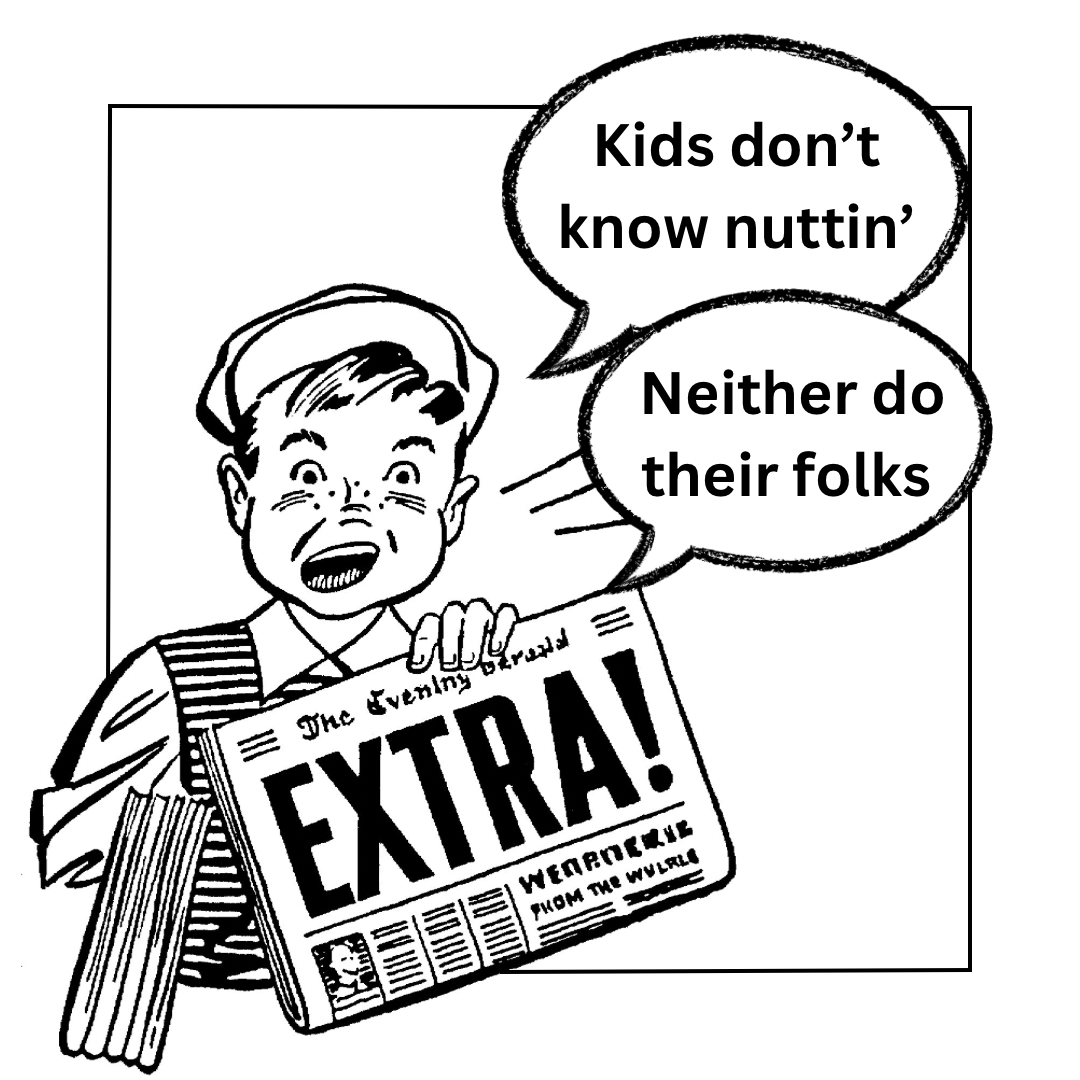
The conclusion: Kids don’t know crap but think they do.

More detail? Teens are exposed to misinformation (unintentional false information), disinformation (intentional false information), and conspiracy theories (whack job BS), in up to 1 or 5 of the post sources of “news” they consume. AND…81% believe the false information is true Their shared experiences added to their acceptance of the legitimacy of the source and the frequency and placement of the posts added to their reception validity and veracity of the information. (Those big words were mine, not theirs.)

In the above paragraph I added the quotes around news for two reasons. One, the type of information they are being presented, and the source of the information. Per the survey report, quoting a 2022 Reuters Institute study, teens distinguish between “news” and “the news.” It goes on to say, “The News” is narrow in scope and defines as mainly politics and current events. “News” is broadly anything that is happening in any walk of life including content presented by celebrities, podcast host, and social media influencers.

So that also explains the source of their “news.” Most teens get their “news” from social media, the specific site mentioned most was TicToc. When they consume news from “legitimate” news outlets, the most common sources mentioned were CNN and Fox News, the most biased of the major outlets. And that might explain why they are three times as likely to trust TikTok over their local newspaper, and nearly half of those surveyed said journalists do more harm to democracy than good and that news articles are no more trustworthy than other online content creators.

Now we get to the interested part of the report. These aren’t just young teens that may not have been exposed to much news (or to much of “the news”). The survey showed common results from all ages 13-18. Apparently, teens not only are not being exposed to much news but do not understand the purpose and process of news gathering and reporting.

Less than 40% of those surveyed had ever been presented with educational programs discussing news, the traditional news media, social media, and their differences and purposes. Of those who did, there was more willingness to accept legacy news sources as trustworthy and social media sources as entertainment.

Another interesting result of the survey is that of those who had not ever been presented with news-related educational programs, 94% said they would prefer such teaching and schools should be required to teach classes on media literacy.

What does that mean? To me it means these kids have some little inkling that what they are hearing may not be the truth, the whole truth, and nothing but the truth, and as most young’uns are, are willing to suck up any information we can get to them so they can figure it out.

As far as us oldsters are concerned. We’re probably too far gone to be taught how to tell if a “news” story about people eating the pets is real or not.

Blog Art 2-2


Time again to tell you about the latest Uplift blog post. It was a good one, maybe the best one yet. Certainly one of the best, featuring the exploits of Jingle, our favorite tri-pawed. He reminds us that the easiest way to a happy life is not found living in the present. It is found living in your present. Take a look.

But before you go look, have you still not thought about joining the ROAMcare community and have the weekly Uplift blog delivered to your email as soon as it hits the website? In addition to an Uplift release every Wednesday, you will also receive weekly a Monday Moment of Motivation, and our email exclusive Friday Flashback repost of one of our most loved publications. All free and available now at  ROAMcare.org.


The polarizing of America

At a time when most everybody in America is lining up, taking sides for the next us versus them battle, I read an interesting article last week that posits America is not as divided as some who may be benefiting from division would have you think. Joseph Ratliff, an editor at Allsides.com opened with a critique of a Washington Post article reviewing a recent survey of American priorities for education. (“How Media Bias Makes Polarization Appear Worse Than It Actually Is,” allsides.com, Apr 6, 2022) The gist of Mr. Ratliff’s commentary was although the Post headline “Democrats want to teach kids sex education. Republicans want to teach them patriotism” and lede highlighted significant differences on two education initiatives noted in the survey, it buried the striking agreement on 10 other initiatives, including respect for people of different races, languages besides English, and independent thinking.

Why is the division between the two controversial initiatives emphasized rather than the 10 that the ideological groups agree on? Because conflict sales. It may be healthier for the country and its populace that to note there is more consensus and commonality than discord and disagreement among Americans, but it is healthier for a new outlet’s bottom line to focus on the disparities, People pay more attention to news that can adversely affect them than positive reports. But people also want to know that others are even more adversely affected. This is reinforced in the “us versus them” manner of reporting, establishing clear lines between us and them so the outlet can rely on a consistent audience to present to its advertisers, sponsors, and contributors. By manipulating the importance of datasets and presenting what they feel is of importance to its consumers. outlets can honestly say they are not manipulating the data, only reporting it, although not necessarily all of it or not all of it until after the average reader/listening/surfer has reached his or her attention span limit.

The media has been able to take advantage of the average American to be unaware of much outside his or her own social network. An unawareness that has also been exploited by social media’s algorithms. This unawareness was described in detail in a report of a pair of surveys conducting in January of this year by YouGovAmerica. (“From millionaires to Muslims, small subgroups of the population seem much larger to many Americans,” yougov.com, Mar 15, 2022) When people’s average perceptions of group sizes are compared to actual population estimates, Americans tend to vastly overestimate the size of minority groups, but underestimate the size of majority groups. For example, people surveyed estimated that 19% of Americans make more than $500,000 per year when the actual is 1%, that 24% of Americans are gay, lesbian or bisexual when the actual percentage are 3, 3, and 4% respectively, that 37% of Americans are military veterans and the actual is 6%, and that 52% of Americans own a gun and the actual is 32%. Similar findings were noted for ethnic and religious minorities. However, when groups are clearly in the majority, Americans underestimate. Those surveyed estimated 49% of Americans own their house and the actual is 65%, that 61% of Americans have flown on a plane and the actual is 88%, and they estimated that 68% of Americans have a high school diploma or equivalent when the actual is 89%. It is important to recognize that Americans by and large cannot determine what is and is not prevalent because if the public cannot make that determination, the media can more easily skew reporting and maintain the polarization that benefits them.

they is so wrong (1)

How do we avoid becoming pigeonholed by media influencers. Always read complete articles rather than just the headline or highlight. If you see a blurb on social media, go to the full article cited in the post and if a full article is not cited, consider the information suspect. And know your own susceptibility to misunderstanding. I recommend you review the YouGov survey results and see how you estimate common standards). The survey explored how people estimated groups in family, religion, ethnicity, sexual orientation, politics, income, and education.  Actual percentages were determined based on information from the U.S. Census Bureau, the Bureau of Labor Statistics, and the results of well-established polling firms.

Don’t be stuck on one side of “us versus them” when the middle group is actually where you will likely find most of your neighbors.