Summertime in the city

Greetings buddy bloggers, blogging buddies, responsible readers, and children of all ages. I missed yesterday. The last two days have been whirlwind days for me with more than the usual appointments, commitments, and after dinner mints. But not to fear, I am alive a well. Wonders truly do never cease.

Over in the ROAMcare site, this weekly uplift took a swipe at bad behavior and defending oneself against it. Summer heat seems to bring out the worst in the worst of us. The best of us have to be on guard. Check it out.

The big news is ROAMcare’s Flashback Friday brings back an old favorite, here and there… in fact it is the most widely read Uplift post… Middle Seat Hump Syndrome. Flashback Friday is a ROAMcare subscriber “exclusive” but this is just too good not to share with everybody.  

The post was first published in June of 2021. We were just rounding the corner from the pandemic back to normal. If you can forgive the couple lines that address the Covid years, we think you will find a lot still right with the thoughts that gave rise to the Middle Seat Hump Syndrome.

And don’t forget, it’s National Donut Day. Make it an especially sticky one! 

See a penny, pick it up

Last week I was called a friend just to chat and the opening line I used was, “HI, what’s new.” “I’m sorting pennies while I still can. I haven’t found any good ones yet.” This was actually the second time in a few months our conversation started thus. Thusly? Started like that.

Last weeks news that the US Mint is officially out of the penny minting business has people across the country breaking into piggy banks looking for elusive billion dollar pennies.

Way way way back, I wrote a post about a someone who paid $1.38 million dollars for a penny. People complain when scalpers ticket brokers charge more than face value for tickets. Nobody said anything about the guy who paid $1,379,999.99 over face for a penny. Okay, so it was minted in 1793, but it’s still just a penny, right?

The chance of you pulling another 1793 penny from your safe deposit piglet is so rare it ain’t gonna happen. The chance off pulling an illusive 1943 or 1943-D penny worth a paltry $1.00 million is close too it ain’t gonna happen either. But digging up a pre-1982 penny is possible. Not probable but possible. In theory, a pre-1982 penny, thanks to its near (95%) all copper makeup, is worth at least three cents.

But is it? Copper is currently trading at about $.01 per gram, those older pennies weigh 3 grams, so they contain about three times their face value in copper metal. Except they aren’t worth 3 cents because as legal tender, it is illegal to melt down coins for their metal weight value.

It has been said the value of any object is how much somebody is willing to pay for it, yet its worth is how much somebody wants for it. Rarely are worth and value equal. If our collections actually cost what we feel they are worth, they would far exceed most people’s ability to pay for them, thus lowering their value. But it is because we place such worth on these objects that give us so much joy that they are so valuable to us. Even pennies.

Was my friend searching for that million dollar treasure or a handful of three penny pennies? Turns out neither was to be found so it didn’t really matter other than it made for a pleasant conversation and a not so worthless blog post. Or maybe that would be a priceless post.

Choose wisely

I was reading the local paper on line this morning and did something I rarely do. I glanced at the reader comments section. The assumption is the comments are made by readers of the article but at least a quarter of them, as many as a third of them had little to do with the article they accompanied. It got me thinking a couple things.

My first thought was who made the decision to allow comments on newspaper articles. I routinely read two local papers, a national news service daily report, and at least one of the local TV/radio conglomerates’ news briefs. Only one allows comments on an article. The others all host “letters to the editor” sections so there is an outlet for concerned readers to voice (type) their views. The comments added to the articles rarely add anything thoughtful and routinely devolve into the sort of online bashing more at home at the site formerly known as Twitter. But someone made the choice to open the pixels to anyone with access to a keyboard, physical or virtual.

My second thought was, “Just because some bozo at the paper caved to the pressure of his backward hat wearing after work drinking buddies to allow backward hat wearing examples of threatened masculinity to put their canned beliefs in the modern equivalent of crayon on the paper, who thought it was a good idea to accept the challenge and put to rest any idea that the backward hat wearing contingent is just misunderstood and might actually be at least as smart as a gibbon.” Yes, it was a long thought. Short version: who thought it was a good idea to accept the choice to add their comments.

My third thought was why did I even bother glancing at the comments knowing they were probably as full of waste as a doggie poop bag after a long walk. It was a choice I regretted. Unfortunately it is sort of like watching a 300 pound man do a belly flop from the high dive. You know it’s going to be messy and someone undoubtedly will get hurt, but you can’t look away.

The decision to allow or not allow comments, to make intelligent observations or spew nonsense, to read or not to read, or to climb the ladder to the high dive in the first place are all pretty easy either/or choices.  It’s good to have choices. Choices are what make us different from the parts of the world that do not have some of the freedoms we’ve been used to enjoying. And choices are a fact of life. Every day you will face some (or many) decision making conundrum (conundra) [For those who might be wondering what I’ve been doing now for the last 40 minutes, I had fallen down a rabbit hole looking for the proper plural of conundrum. I can now say that “conundrums” seems to be the preferred plural but “conundra” is not wrong. Given that I’ve already gone out on a limb with my initial spelling, I’ve made the choice to leave it at conundrum.]

Although many are simple either/or choices, just as many may be complex multiple choice decisions (and in life “all off the above” is rarely the correct answer).

We took the challenge and chose to address difficult choices along with their inherent choice fatigue and potential for choice paralysis in yesterday’s Uplift post, The choice is yours. We would appreciate it if you’d read it and if you choose to comment on it. The choice is yours.

Memorial Day 2025

Today should be a day of celebration. It will be a day of picnics and parades where it is not raining, and one of gripes and grievances where it is. There will be sales on paints and home fixer uppers as well as watermelons and water guns as we welcome ‘the unofficial start of summer.” As close to noon as possible, at the end of a parade or in front of a town war memorial, someone will play taps, and as close to as soon as possible, the revelry can begin, and the memory portion of Memorial Day will conclude.

There are three holidays that celebrate members of the United States military. Armed Forces Day (the third Saturday of May) honors those wearing the uniform, Veterans Day (every year on November 11) honors those who have hung up their uniform, and Memorial Day remembers those who never made it out of their uniform. Over 1.1 million Americans perished in wars since the American Revolution. Many of those we celebrate on Armed Forces Day and Veterans Day believe those 1.1 million are the only members of the armed forces truly worthy of celebration. The rest are “merely doing our job.”

For the most part, those we remember today chose to be Americans, either themselves or by birth. Few of them outside those who served other than those who served in the 18th Century can trace their ancestry back to those earliest Americans. Very few of them can trace their roots to the natives of this land. What is probably an understatement is that the U. S. military is made of members who hail (or hailed) from over 20 countries, bringing their language, customs, celebrations, and memories onto the fields of battle and training along with their boots and gear and weapons. When I was serving, there were in my company those who were born in America soldiers, birthright soldiers, immigrant soldiers, and one Native American soldier. The common denominator was soldier. To the best of my knowledge, all are either still in their uniforms or have taken them off by choice. None of us will be celebrated this weekend and that’s okay.

What isn’t okay is if the 1.1 million who never had the chance to decide if they wanted a life out of their uniforms to be forgotten, or worse, to be remembered in passing, or only as a means to sponsor a sale or take advantage of a photo opportunity.

The history of this nation and the future fate of this nation is rooted in those 1.1 million individuals. Enjoy the parades, the first day at the pool, the 2 for 1 watermelon. Before you do any of that, thank God for sending people with the courage to have defended your privilege to do those things, and pray we won’t soon need more of them.

Lucky chances

I don’t think they still do it but about 10 years ago, the people at BRAVO, put on a show called “Last Chance Kitchen,” that was a second chance for contestants knocked out of their Top Chef competition.

About that same time, Netflix was premiering a series called “Last Chance U” that followed the football programs at very small, community, and junior colleges, attempting to give the athletes there the chance at the exposure those at the major colleges receive.

A last chance saloon (in the wide west, not to be confused with the myriad cleverly named Last Chance Saloons scattered throughout the US and Canada, and the one in England (did you know myriad literally means a thousand?)) was supposed to be the saloon sitting in the border separating a “wet” territory from a “dry” one so folks could get that one more chance at a drink before it was too late.

All these last chances. You’d think Americans live by the “luck of the draw” system. I suppose many do, and even those who don’t, there is no mistaking the contribution luck or chance might have on our lives. That would be luck or chances. Nobody gets just one chance at anything. Really. Stop and think about it. I’m sure you can find a time in your life when you passed on an opportunity and then saw it come back around and sometimes even come back around again.

We looked at the chance of having a decided chance at things in this week’s Uplift, Try Try Again. As we said, “We cannot undo something already done, but we often get a chance to do something that was left undone.”

It’s a sign

There is an account on Instagram, Ian the Sign Guy (ianthesignguy), who posts short videos of himself cleaning road signs in England. (He is also on YouTube.) There is no background music, you rarely see him. The videos are just his brush scrubbing away the filth that accumulates in roadside traffic signs. Here is an example. I think it’s one of the greatest things on the internet today. Sort of a new go at cat videos.

Do I want to explain that? Sure. Why not? There is nobody screaming at you. No UNHINGED USE OF CAPITAL LETTERS, or ridiculously obvious lies to wade through. It’s not an innocent looking post trying to get you to buy something, agree with something, or watch and re-watch over and over to find the hidden meaning. It’s just a guy scrubbing away the dirt and grime of your basic traffic control signage.

I don’t recall ever seeing signs here as filthy as he finds there. Some of his pre-cleaned signs are barely legible, yet they seem to be on some major roadways. I suppose we haven’t yet stripped the Department of Transportation’s personnel budget of the sign scrubbers. It’s quite satisfying to watch the dirt melt away, to see the brush go scrub scrub scrub over the sign surface, and to hear the faint drone of whatever equipment he uses to get the water flowing through the brush head. I could watch video after video and be quite content with it and nothing more. A cat video for the 2020’s.

We need more of these. Yes, it is an unexpected joy to have a random Muppets video show up in your feed, and a daily dose or three of old Peanuts cartoons will surely turn surfing snarls into smiles. But no, they aren’t the sign guy, a real-life person out to make his part of his country a little cleaner so his fellow motorists can tell where they are going or how fast they should be going while getting there. It’s a new twist on “love your neighbor.”

Or perhaps he is the new superhero. Not a Superman dumped on our planet to avoid complete annihilation on his. Not a Spider-Man or a Hulk who happened to be around the wrong radioactive insect or experiment. Not like Aquaman getting the best genes from a human father and an Atlantilean mother. More like Batman, just a normal guy who happens to be incredibly wealthy and has a cool costume. I don’t know if Ian is incredibly wealthy, but on the rare occasion you get to see his work clothes, they seem to be top shelf.

It’s worth it to spend a few minutes or hours watching Ian tirelessly make England’s Motorways Glow Again. And no stupid red hat either.

Wordsmithing and the common man

Yesterday’s Uplift post at ROAMcare revolved around the word “common.” A comment had us thinking about how the meanings of words change. I thought about that a little more on my own and I was amazed at the number of words that once meant one thing now have little and sometimes no resemblance to their original meanings. I was also somewhat aghast at the temerity of humans to play willy nilly with established norms – although, at least with words, the norm established was established by humans so I guess humans can do what they want with them. It’s not like anybody is trying to change science. (People holding high government offices in Washington notwithstanding, given that I’m not so sure they are actually human anyway.)

Some words haven’t quite yet made that complete flip, or flop if you prefer, and carry two meanings opposite each other. Oversight can mean examining for inconsistencies from expectations or the inconsistency itself. These are called contranyms. My favorite contranym is Handicap. – An advantage provided to ensure equality (think golf), or a disadvantage that prevents equal achievement. (Why is this my favorite? Because I am. I have a handicap. Because of reasons too abstruse to go into here, I walk with a cane. It may look cool and all swaggerish, but every time I need to carry or hold something I am limited to only one-half of my carrying and/or holding appendages. People want to call all those with handicaps disabled but we are just as able as anyone else, perhaps more so due to our handicaps, whihch might make that a contranym within a contranym.)

Other common contranyms are model (an exemplary original or a scaled copy), puzzle (a problem or to solve one), and for out baseball fans, strike (to hit or to miss).

And then there are the antagonyms, words that have completely changed meanings over time. Awful is a classic example of a word today meaning the opposite of what it was meant to be. Five hundred years ago a bully was more of a heartthrob, one of outstanding physical prowess. Now it means fake president of a used to be major power. Prestigious, as in renown, has only been a positive example for the last hundred years or so. Before that, a prestigious someone was an imposter who gained wealth by way of trickery (sort of like…oh, never mind).

But back to “common.” I’m not sure where that fits in. everyone’s first definition is something generally met with and of nothing special. But its root is the same as community and it is used to described things shared, like a common border. Or as we wrote in that post, a common good, and even common sense, which most people want to ascribe to individuals but really is knowledge derived from shared experiences. Take a look at it. We think it is uncommonly good.

Not so famous last words

There are entire books of famous last words. Most of them are famous solely because they were said by famous people rather than being famous because they were profound. There are some that are a little of both. Benjamin Franklin’s last words were, “A dying man can do nothing easy.” The back story – that was in response to his daughter telling him to turn over in bed so he can breathe more easily. Sort of profound on its own. Now that you know the story behind it, it sounds like something I’d say!

Anyway, most last words will never be remembered by someone other than to whom they were spoken, except for last words you see and hear every day.

An exceptionally famous set of last words seldom seen today, was de rigueur in a different century, early in a different century, was “the end,” seen on the last page of every book and last card of every movie.

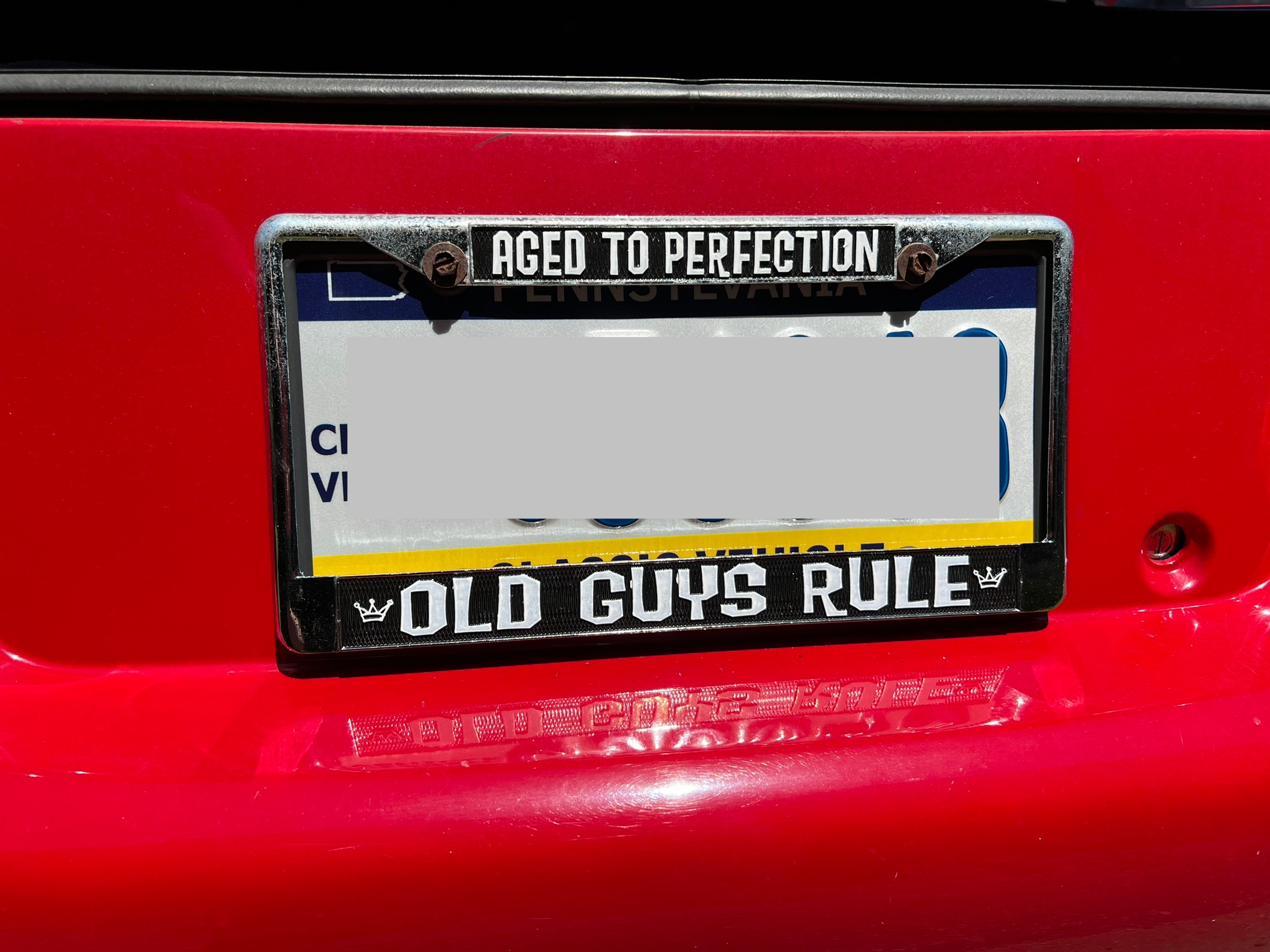
Other last words often more memorable are the last words you see when that car passes you on the highway and you get a look at their license plate, license plate frame, or bumper sticker. There are some pretty clever examples of two of the above specifies at the links noted. I’ve not yet succumbed to a vanity license plate although the frame I have around the classic plate on Rosemary the Little Red Car reads, “Aged to Perfection. Old Guys Rule!”

I saw an interesting sight just yesterday that I had heard of but never had seen in the wild with my own eyes. A Tesla car with its stylized “T” removed and replaced with a lightning bolt. Not quite a last word but a lasting impression.

A particular type of last word I have a difficult time with is the one to end a text message conversation. Not a quick message like “on my way.” That doesn’t even require an answer. But the conversations that go back and forth for a while, the things that have taken the place of phone calls. Phone calls were easy to end. The last word typically was a simple “bye” plus or minus a dear, hon, or second bye. An e-mail’s last words are like any other correspondence. But a text message. No good way out of that and when you usually decide on a last word, it’s more likely an emoji.

Now I’m not sure what kind of last words would be best to tack on the end of these words. I think I’ll steal Michael Landon’s last words. On his deathbed, his son said to him, “I think it’s time to move on.” Landon’s reply – “You’re right. It’s time. I love you all.” Actually, it’s his last, last words that mean the most. I love you all.

Are you talking to me?

There are times when the things I think I think are stranger than the things I think and that I know. Like the other day, I was reading for enjoyment, yes a novel concept and every now then I do get the chance to take on such an inviting task. As is typical for my leisure activities, murder played a major role. Another major role was played by a major. A retired major I would assume because he was described as a “gentleman with a private income” and became a major (sorry) suspect. Now here’s what I think I think about that. At least I think I thought this.

Stories, whether played on pages, screen, or stage, set anytime through the early twentieth century and/or in England through modern days, are filled with captains, majors, colonels, and the occasional admiral or general (or brigadier (across the pond)). I think it would cool to actually see that happen in practice and/or real life. (And for all I know, it does – across the pond.)

Except for the odd “Mr. Michael” from a barely English speaking customer service phone representative, I never am never offered any honorific, haven’t hear a title associated with my name since I left hospital practice. But if people were to start introducing, and speaking of and to me as “Captain,” I could get along with that. And I promise I wouldn’t ever give reason to suspect me as the murderer. Everybody knows the butler always did it. (I wonder if I could still fit in my old uniforms. I’m sure the hat would still fit me.)

There is absolutely no way to tie this in with yesterday’s Uplift post other than to say it’s Thursday, it must be time for my shameless weekly plug. So…shamelessly speaking, if you know where you’re going and you know how to get there, trust that you will get there. Knowing where you’re going is more important than how fast you get there. You might even get there at the speed of popcorn. Check out, You’re a Pop Star at ROAMcare.org, this week’s Uplift offering.

Cite your sources

Somewhere sometime someone is having a crisis. It’s me!

I’m having a crisis. I am losing touch with the part of the world that feeds me information and I’m worried I am starting to sound like a one of those people who spouts so-called facts that you know aren’t true. Their verity may be questioned without question because they (the facts) are so ludicrous that nobody but a Dimwit Donny Disciple (DDD) would believe them (e.g., did you know gas is only $1.98/gallon), or because they (the fact-spouters) are DDDs or DD hisself.

Believe it or not, this is not a political post. It’s a true personal crisis. I’m forgetting not things, but that which made me aware of the thing. Don’t question. Just read on. It will become clear.

It came to me when I mentioned to my daughter, “I just read somewhere that keeping cut fruit in the fridge in glass containers will add at least 2 days to their use by date versus storing them in plastic.” This isn’t something I dreamed or something I overheard in the produce section while working my way around the gaggle of grocery gals gathered in front of the mango display. This was a real “read somewhere” moment, but I can’t recall where. If it was say in Food Network Magazine, then it’s probably a pretty good tip. Likewise in the food section of the newspaper or a real food expert’s social site. On the other hand, if I read it in the comments section of an online recipe or in the social site of the dingy broad who records entire recipes in 30 seconds and posts them to a site known for lip-synched videos and blasphemous AI generated images, it likely is as true as claims of sub $3.00 eggs (per dozen, not apiece).

This worries me because I always would be able to recite the source of my information as readily as the information. I know I found the cut fruit tidbit in a respected, responsible source, but not being able to recite that source feels like I should be being fitted for a red hat. (By the way, why does the Dummy in Chief always have those stupid hats on its desk in the Oval Office. Is there a merch table at the back of the room to visit between acts?) if I should be challenged in the fresh fruit freshness extension tip, I wouldn’t be able to cite my source other than to say, “I read it somewhere.” Well, that’s not an answer. I might as well expound on the sphericalosity of the earth without doing the math.

So you now understand my crisis. (You do, don’t you?) How will I ever be taken seriously again. How will I ever take myself seriously again. I won’t be long before I begin a conversation with, “I saw somewhere that someone did something that I thought was interesting. What do you think?” My sole reasonable conversation partners will be clairvoyants, mediums (It is mediums not media when you’re speaking of those who communicate with dead, right?) (I figure they’d be a decent one to chat with considering by then I’d be at least brain dead), or DDDs (because they are experienced in listening to unfounded, unproven, unreliable sources of disinformation).

Anyway, I read somewhere than fresh cut fruit stored in glass containers will extend its life. That all I had to say.