Edible Portmanteau

We were at a buffet brunch yesterday. There was a time in the 90s when you couldn’t escape to a buffet brunch offering on any a Sunday. Then brunches fizzled. The local “family dining” restaurant option continued the buffet offering. It gave them something to do with the salad bar setup that would have otherwise gone untouched. Otherwise, you couldn’t buy an egg anywhere outside a grocery store after 11:00 for all the bacon you brought home last week. Then McDonald’s said breakfast is good all day and soon the Sunday brunch was back. Sort of.

About 6 years ago brunches reappeared on the local high end dining scene as carefully selected menu selections. You could purchase Eggs Benedict and a fruit cup but your $17.99 was going to get you just that. A poached egg and some pre-cut melon. Still, it was another option for an after church repast.

Yesterday we discovered the return of the all you can eat Sunday Brunch. Omelets to order, sausages, baked fish, donuts, and a Caesar salad all on one plate! Permission to stuff your face with as much as you want for as long as you want (up to 2pm) in exchange for one twenty dollar bill. Only in America! (Actually I’m assuming that. I haven’t ever had a weekend, mid-morning buffet in another country but then my international travel is somewhat limited.)

While I was munching away at my bacon topped salmon cake I allowed my mind to do what it does best when dining with my family. Wander. And it was off and running.

The word “brunch” is one of the most recognizable portmanteau, the words breakfast and lunch combined into a new, accepted contraction. We do this all the time with English. Smog. Dumbfound. Modem. Portmanteau itself is a portmanteau, a small case used to carry outwear. (porter = carry, manteau = cape)

At buffet brunches every serving vessel or station is clearly marked with their, sometimes quite disparate, contents. Baked Salmon/Chicken Parmesan. Fresh Fruits/Baked Desserts. Green Beans Almondine/Potatoes au Gratin. And the ever popular Omelet and Carving Station. How much easier it would be to read and recognize these offerings, while minimizing decision making and thus maximizing eating time, if one didn’t have to read and digest all those letters? But why stop at just renaming the stations when we can reinvent the very offering. And so I began devising the list of Edible Portmanteau.

Hash Brown Potatoes and Pancakes become Hashcakes, a light and fluffy griddle cooked cake made of shredded potatoes and onions served with maple syrup and applesauce. Bourbon Glazed Salmon and Chicken Veronique morph into Salmonique, a patty of ground fish and poultry of indeterminate origin covered with a sauce of orange marmalade, green grapes, and Jim Beam. The ever popular omelet and carving station relieves the low man on the cooks totem pole assigned there from running end to end trying to keep omelets from over cooking while slicing slabs of rare roast beef, redirecting his or her energy into scrambled eggs cooked with spinach, mushroom, horse radish and Steak’Ums at the new Carvlet Station.

I don’t know about you but I think I’m on to something here. I have to go make some calls. This could be the start of the newest breakfast offering since the McGriddle. The Sunday Brunch Buffet, or as I like to call it, The SubRay!
Food Fight

I was making the morning coffee the other day and took a moment to bask in the aroma wafting through the apartment. It made me appreciate the small space as just the right size that it can distribute something so aromatic to every corner of my little world. Of course there is the converse that small space dwellers must also consider. Quite fortunately, not nearly as often as the good stuff. That’s when I started thinking, I really have to remember I’m retired. I don’t have to think anymore. But then…

I like the smell of coffee. Coffee beans, coffee roasting, coffee grinding, coffee brewing. But I know that not everybody likes it. I don’t understand it, but I know it. What makes that happen? It’s the same smell. Why does one person like it and one doesn’t? Or in the case of coffee, why do 7 billion people like it and, assuming that about 500 million haven’t had the pleasure of smelling it yet, 23 don’t. And while we’re at it, what makes cilantro taste earthy and sharp to some, bright and citrus-y to others, and like soap to still more? Then I started thinking more…

I was out of cilantro. I needed cilantro because I was planning on using up some leftover chicken in a stir fry that evening and I always (ok, almost always) use cilantro in my stir fries. If you toss in some peanut butter it gives it a Thai flair. To me. I think so. I don’t know what someone from Bangkok would think of it. No need to get started thinking more. But then…

Thai has gotten very popular around here. Maybe elsewhere Thai food has always been popular, but here? Not so much. Now? Oh, yeah. You can’t swing a leftover chicken around without hitting a Thai restaurant. Before, if you wanted take-out it used to be nothing but Chinese, sandwiches, and pizza. And then I was wondering how close to real is the Thai take-out? How close is the Chinese? For that matter, how close are the sandwiches? OK, maybe too far with that one. But what about the pizza? I never doubted pizza before. I know that most of the pizza isn’t anything at all like real pizza because most of it isn’t at all close to my pizza. But then, I wouldn’t have expected it because very few of the pizza masters were of the same Neapolitan background as my mother, AKA my pizza master. You’d think I would stop there but no. Forget about the pizza palaces, I can only think of one authentic full service Italian restaurant nearby. Probably for the same reason and even there I could have stopped but I was on a roll. And I don’t mean a pepperoni roll. What was I thinking…

Pepperoni roll my eye. That’s nothing but a Stromboli. Not a calzone! A calzone is pizza dough covered with mozzarella, folded in half, baked, and if you wish lightly sauced by the lucky person who gets to eat it right out of the oven. I know. Calzones originated in Naples. The Stromboli is just a pizza with whatever toppings you want, like pepperoni, but rolled up. People always get things wrong. Look at yams and sweet potatoes. Consider all the people who think peanuts are nuts. Still, those are completely different animals. You want a couple of things just as confused as the Stromboli and calzone, see il maccherone versus le macaron, or more familiarly the macaroon and macaron. But the people who do know the difference at least know how to pronounce each of them. Unlike… (yes, more thinking)

What is it with gnocchi? Nobody who is Italian, other than Italian celebrity chefs who don’t want to alienate their celebrity clientele, says “No-Key.” It’s “nyock-ee”!  It comes from the Italian word nocca, which means knuckle. (No, not knot. Knuckle. Just what it looks like. Wrinkles and all. Trust me.) And don’t ask for a plate of gnocchis. Gnocchi is plural. If you really want just one, order a gnoccho. But I bet you can’t eat just one. Anyway, if you forget, the boys of winter don’t play Ho-Key, they play hockey! And that got me to thinking…

I have to send in my payment for next year’s tickets. I gotta go!

(In case you were wondering, yes this is the famous sticky note post. Famous to me. I’ve been staring at that hunk of paper for over a week now. Thank Heaven I can throw the note away. Or do you say throw away the note. You know, I’ve been thinking about that…)

Wordsmithing for Fun and Profit

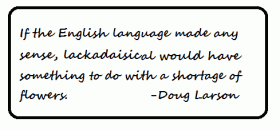
I just started a new book. Reading, not writing. As with many written offerings, before I turned to the first page of the story I was presented by the author an epigraph. A short Lackadaisicalexcerpt from I presume one of his favorite authors. I always read them. They often provide a glimpse into the authors mind at the time he or she was working on that piece. But it wasn’t until this time, this epigraph, that I really stopped to think about what I was reading. Not the metaphorical, the inside  glimpse, etc., etc., etc. The actual. Why that the epigraph, those borrowed words, are indeed an epigraph.

Why “epigraph” and not “group of words?” Who decided this group would be an epigraph. And how did that person come to that conclusion. We have too many words in our language. Just reading this post you’ll read and at least unconsciously recognize five groups of words: title, sentence, paragraph, post, and epigraph. You could throw in phrase and incomplete sentence. And now that I think about it, question. It actually goes on and on. And on.

Where do they all come from? Not the words. Not in English at least. We know where they come from. They come from every other language on earth. The English language is said to have close to a million words in it. I’m not sure who counted that but the most complete, or as they would put it unabridged dictionary of the English language, the Oxford English Dictionary, has about 620,000 words. But language doesn’t equal vocabulary. And vocabulary doesn’t equal language. The average educated English speaking person knows around 20,000 words and uses but about 2,000 words in a week of talking and writing. )I know, sometimes it seems that I try to cram all 2,000 into a single post but that’s a different post for a different day.)

GraphSo that brings me back, do we need all those words? If they made sense I’d be happy to learn all 600,000 words. But so many of them don’t make any sense. Look at two of the ones that I mentioned: epigraph and paragraph. Both have “graph” and both are similar in that they are a group of words. But when I think of graph I think of a picture.
Let’s concede that “graph” actually means “to write” and see how we’ve modified it with the prefixes “epi” and “para.” Neither really gives a clue as to what we are writing. “Epi” comes from ancient Greek meaning on or upon like the epidermis of your skin. “Para” is also borrowed from the old Greeks and means side by side, like the lines of a parallelogram. So an “epigraph” is actually a “picture on top” and when we call a group of words that come after each other “paragraphs” we are actually calling them “pictures that are side by side.”

TheCatsPajamasAnd if that’s not enough, then we have to use words that we know don’t fit a particular situation because that’s the in way to speak and Heaven forbid we aren’t trendy. For example good can’t be good. Since the time when I was torturing my parents with popular vocabulary “good” has been groovy, cool, bad, righteous, divine, outstanding (emphasis on the out), epic, excellent, rad, sick, and ridiculous. But what did they expect? They’re the generation that came up with cat’s pajamas and bee’s knees. Unfreakin’ believable.

No wonder I’ve been so misunderstood all my life.

That’s what I think. Really. How ’bout you?


Got Grammar

I was out shopping at a little neighborhood farm store; I picked up some $20.05 worth of meats, cheese, olives, and fish. I had no change so I gave the young lady manning (womanning?) the cash register a twenty dollar bill and a one dollar bill. She took them then stood there looking at me. I looked back at her and in time she said, “My bad. I was expecting a twenty and a five.” I don’t know why she was expecting anything in particular, as long as it added up to at least twenty dollars and five cents. But, I’ve reported on similar issues with money and people trying to figure out amounts due and to be returned without the aid of a computerized cash register. Or fingers and toes. (See “If You Give a Teen a Penny,” April 7, 2014.) But today’s post isn’t about calculating change or expecting bills. It’s a grammar rant.

It had been a while since I heard anybody other than a daytime TV talk show host utter “my bad.” I was hoping that was because it had finally worn its welcome and was relegated to the what-does-that-mean-anyway pile of bizarre phrases. It’s so bad it’s beyond bad. It should have been expected. Ever since “Got Milk” graced America’s roadside billboards, television screens, and magazine back covers we’ve pretty much given up on grammar.

I’m not trying to be the grammar police and I actually thought Got Milk was a pretty nifty advertising slogan. It was just odd enough to be memorable without being irritating. The same can’t be said for some of its spawn. It seemed shortly after the first milk mustachioed model hit the commercials we were “Gotting” everything from “Got Cookies” to “Got Religion.”

I don’t suppose your old fifth grade English teacher will come out of retirement to correct our slips down the ungrammatical slope. Many things we were taught not to do like begin a sentence with a conjunction or end it with a participle aren’t real rules anyway. If you don’t believe me, take a real good look at your Chicago Manual of Style. Ain’t nothing in there about that. And more than likely most of what actually gets published is far from perfect composition, but it is right around the corner of your average vernacular.

Still, some things really need to stop being uttered in public. “My bad” tops that list. In fact, it tops the list of things that shouldn’t be uttered in private. And definitely never uttered in stores by cashiers trying to calculate change without the aid of a calculator.

That’s what I think. Really. How ‘bout you?

Open Sesame

We’re not even certain how we got onto the discussion of passwords but sometime, somewhere over the past week we ended up asking ourselves did Ali Baba really say “Open Sesame?”

It would certainly be an easier phrase to remember than some of the strange concoctions we’ve concocted to satisfy our computer password requirements.  At He of We’s workplace, passwords must be at least 8 characters, no longer than 26 characters (really, 26) must contain at least two upper case characters, two lower case characters, one number and one symbol, must not contain any 4 letter portion of his user name or any 4 letter portion of his real name, must not have been used in the last 36 months, and must not spell out the company name.

Sometime last week somebody published some list somewhere about passwords.  Yes, we can be more specific but we don’t want to.  Partly because we aren’t sure who these people are.  They are so and so research, such and such consultants, or somebody or other institute.  They have to stay somewhat cloaked if not daggered because passwords are supposed to be secret.  How does one publish an opinion of others’ secret information? 

But we digress.  This list included the worst passwords you could use and the number one worst password of them all, Password.  Apologies to Allen Ludden.  Other bad choices include 12345 etc, iloveyou, and letmein.  Our favorite of the worst is letmein (let me in) because it sounds so plaintive and assumes computers have all the power.

Another point in favor of letmein is its historical significance.  Literarily speaking that is.  When Ali Baba followed the forty thieves to their lair he heard the leader say Open Sesame to open the door to their cave.  Open Sesame did not make it on to the list of bad passwords so either nobody is using it or it’s not such a bad password.  Maybe it’s ok because nobody understands it any better than He of We’s workplace password rules.  Why sesame?  Why not caraway? Or poppy seed?  What about basil or parsley?

One explanation is that Sesame dialectically translates with different pronunciations to differentiate friend from foe and etymologically grew up to become the Hebrew word sisma, meaning password. (Or so we’re told.  On a good day we can be confused with proper English used grammatically correct.)  And everybody knows from the mysterious institute that the last word you want to use for a password is password.

Soon you’ll be able to use a picture for your password.  Imagine those rules.  No smirking, left profile only, colors present in nature during spring in Scandinavia.  Come on now.  Are we really hiding secrets that important in our files anyway?  Open Oregano!

Now, that’s what we think. Really. How ‘bout you?

How Would You Like Your Toast?

It’s probably us.  We seem to bring out the stories in the most harmless of activities.  Not long ago, Both of We and Child of He were out to a diner for a Sunday breakfast.  A real, honest to gosh diner.  The kind where the food is going to be fabulous if you order nothing more than tea and toast.  Well, let us tell you about this toast.

We have to begin at the beginning as we were seated at a table and asked the ritualistic “what would you like to drink?”  Coffee and tea and ice water for three please.  And yes, we’ll need some time to peruse the menu.  It wasn’t that it was too big like some, but it took a little reading because it had things we aren’t used to in the twenty-first century.  Things like sausage gravy and other offerings whose calorie counts were in triple digits.  Among the choices were several four egg omelets. 

After a couple of false starts of “are you ready?” by Waitress #1 we somehow were advanced to Waiter #2.  A pleasant enough young man at home from college for the summer.  On his first trip we figured we’re ready enough if those who know what they want order first and slowly and let those still deciding decide for a few more moments.  He of We went first with a decisive blow to the cholesterol watchers, the aforementioned sausage gravy with biscuits plus two eggs and a side of hash browns.  Two or three swipes with the pen and young Waiter had the order.  Then Child of He is up.  Both of We have seen her eat the equivalent of a lunch intended for a full firehouse but even Child draws the line at four eggs.  That’s nearly a week’s work of one chicken for just one meal.  “Can I have a smaller omelet?” was the innocent enough question.  “Of course, here it is on the smaller plates menu,” pointed out the Boy Waiter.  And there it was, a two egg cheese omelet.  But, Child didn’t want just cheese.  “Instead of just cheese can I have a veggie please,” and Young Waiter Man made a few more marks with his pen and we moved on to She of We.  A straightforward eggs, toast, hash brown, pancake combination order. 

We’re just about through the ordering phase of our breakfast when the waiter asked the question that in our combined whole lot of years we’ve never heard before.  “How would you like your toast?”  She of We was so taken aback that even she, the unflappable She of We, the unquestionable clearest of all clear order givers, was left speechless.  And so, he actually repeated, “How would you like your toast?”  He of We was just about ready to answer over-easy when She of We and Waiter of Three finally got their telepathy going and She of We suggested “umm, do you mean what kind of toast?”

To make a long story short, and after some light hearted kidding of Young Waiter, we settled in and waited for our meals to be prepared and presented.  And not much later an entourage marched down the aisle with several plates that could only be ours.  And as they were all settled in front of us, having finally gotten over “How would you like your toast?” the last dish to be dropped was the omelet for Child of He.  And when it hit the table we all were again rendered as thoroughly speechless as She of We was with the now infamous toast question.  For there, before Child of He sat a plate with a two egg, cheese omelet, her selection of toast, and nuzzled between them, a serving of . . . corn.  Child of He was the first to find her voice.  “Corn?”  “Yes,” young Waiter Man said,” that’s your cheese omelet with a veggie.”  Clearly, the vegetable of the day was . . . corn.

Eventually all was sorted out.  Child of He got her veggie omelet.  She of We enjoyed her toast.  He of We got to hear his arteries clog.  And a fine meal was had by all.

So our advice to you, if you should ever be questioned with “How would you like your toast?” is to answer poached and then mentally review the rest of the order for verbal land mines.

Now, that’s what we think.  Really.  How ‘bout you?


No habla aqui

Hola.  Who decided we need to be directed to where to bring our returns in the mega-hardware-marts in Spanish?  Every sign in the two major home improvement chains down the streets from Either of We’s houses is bilingual.  The only problem is the second language isn’t the predominant one spoken here.  We live in a part of the country where the only people who speak Spanish are the high schoolers taking it for their language requirement.  And of those who do speak more than one language, English is still 100% the first choice although there are a few who specialize in bar talk in Polish, German, and Italian.

Now we don’t mean to be uncaring to Spanish speakers across the country, but something strange is going on and it involves Español.  She of we recently got a new television set.  She set it up according to the detailed instructions that come with televisions nowadays.  You know, that paper packed just under the box top that opens to a 5 foot by 7 foot poster covered with pictograms of the TV and all of the various components one might attach to the TV accompanied by the copyright in 18 languages in a font so small it would never be possible with movable type.  Do you remember when the only instructions for a TV were: 1. plug it in, 2. turn it on?  But we digress.  After several hours and two bottles of wine the set was plugged in and turned on.  Everything seemed to work.  Except…

Except every time she goes to the high definition version of ABC she gets Spanish subtitles.  Closed captioning is not turned on.  We’ve checked.  No default for that channel, no special instruction for that channel.  They just show up.  But only on that channel.  Not that network because the regular non high definition version of the same network doesn’t have them on screen.  Just the high def version.  Just that channel.  Just one out of 800.  And in Spanish!

Allow us to add to the peculiarities of this report.  Friends of ours have a television set that they have had for years.  And for years, one particular show on one particularly network (a weekly live sports cast during the football season on Monday nights) has appeared on their television with Spanish voiceovers.  Only that show.  Only that station.  Only that television.  We really aren’t making this up.  We can call them over to confirm this idiosyncrasy.  They tried different rooms.  They tried different cables.  They even moved.  (Actually they didn’t move because of the television set but it made a dramatic transition, don’t you think?)  Then they moved, brought the set with them, set it up again, but the Spanish speaking commentators stayed away.  Nobody ever found out why.  To be honest, nobody ever looked for why.  They were just happy they could watch football and understand the juego por juego.

Too strange to be true?  Not at all.   Televisions and radios have long picked up spurious signals and played havoc with the one that the viewer or listener was expecting.  He of We had a radio that picked up an AM signal from a city some 900 miles away while seemingly tuned to a station on the FM band.  The strange thing is that it’s all in Spanish. 

Those who should know such things (we’re not sure why they should but they do) say that a little over 10% of the population of the United States speaks Spanish as their primary language and that half of them speak only Spanish or one of several Spanish dialects.  We find it a little odd over 5% of the country cannot speak the official language but that’s a different blog.  What we find stranger is that for the sake of 5% of the country there are small electronics that have taken it upon them to speak and spell in Spanish, dialect unknown.   

Perhaps a bit more unsettling is that all throughout the country, regardless of the concentration of language spoken, there are major retail chains, clearly not wanting to miss a sell to anybody, that have spent millions on signs directing shoppers where to go to find a battery operated destornillador.   Even where the only Spanish speakers only speak it Monday through Friday during Period 3 until the end of this semester. 

We think that’s a lot of duplication of effort that the stockholders might want to look into.  Three hundred million people can find their destornillador on the strength of the English half of the sign alone.  Think of all the paper we would save if we cut those signs in half.      

Now, that’s what we think.  Really.  How ‘bout you?


Terms of Appreciation

You know that every so often new words are officially added to the English language.  We’re not certain exactly how the process goes but we know that “somebody” figures out that we are using non-words so often that eventually “they” decide to make those words official and add them to the language.  Fortunately language isn’t like the physical law of conserving matter.  There is nothing that says there only so many letters available and when you build more new words you have to lose some old ones.  We can keep adding words all we want and we don’t have to put any of the old ones away.  But is sure seems like there are some words that we just don’t hear anymore.  Two of them are “thank” and “you.”

You knew you were getting set up for something.  But really, have you noticed that “thank you” is going fast.  Particularly at the grocery store, bank, convenience store, restaurants, and fast-food drive thru windows.  (We’re pretty sure “thru” is one of the new words we’re allowed to use so we will.  Besides, ‘drive-through’ looks weird.)  And it’s not just that “thank you” is disappearing.  It’s being replaced.  Instead of an expression of gratitude when we hand our money over to the aforementioned clerks and servers, we are now being told “have a good one,” or “there you go” when change is involved.  Quite often, and particularly at the drive thru, we’re told nothing at all.

We don’t like it.  We’re not certain who is in charge of expressions of gratitude but “there you go” doesn’t cut it.  We’re prepared to begin a letter writing campaign so if any of you have a clue as to whom we address our concerns please let us know.  And quickly, before “thank you” disappears into the altogether.

While we’re at it, there are some other phrases we’d like to see when we’re attempting to buy goods or services. 

When we finally get to the head of a check-out line at the local do it yourself center we can do without “did you find everything ok?”  Usually the person asking is a teenager working part time after school or on weekends and has no clue as to what we are buying let alone where we would find whatever it is we couldn’t locate.  “Did you find everything?” is a fine phrase but quite useless by the time one gets to the check-out corral.  Maybe the do it yourself powers that be could shift a few employees to the aisles where the confusion begins to ask that question.  But at the cash register we’d like a return to the old standby of “Hello, would you like some help to your car with that?” particularly when “that” is 500 pounds of wood, nails, shingles, and hardware for a backyard shed that we never did find the instructions for.

When we are out for our weekly dinner date we’d rather not have the server greet us with “can I get you something to drink?” before we’ve even decided which chair who will sit in and do we drape our coats over the backs of the chairs in which we do eventually sit or across the seat of a vacant one.  We’d prefer “You guys get settled in and I’ll bring you a couple glasses of water.  Then if you’d like a drink or an appetizer you can let me know.”  We’ve already had issues with the customary check in question “Is everything ok?” (See “You Want Fries with That?” posted in LIFE, Dec, 12, 2011.)  It’s a great question made up of great words.  It’s just that few servers actually mean it.  And the ones that do are serving in restaurants that if everything wasn’t ok the dish would not have ever made it out of the kitchen.

And can we please dispense with the recorded greetings at the drive thru windows!  It’s bad enough every time you call any business that you are greeted with an auto-attendant.  Why do we now have to have (in an overly cheerful voice) “Would you like to try one of our new triple bypass burgers with the works available only for a limited time?!” This is then followed closely by the bored “Whenever you’re ready.”  Instead let’s move on to “Our menu hasn’t changed since 1955, what will you be having?”  It’s either that or the terribly unimaginative “May I take your order, please?”

There are some terrific new words and phrases that we didn’t have when we were first learning to use a dictionary like the Internet, technical support, and twenty-four hour fitness center.  That doesn’t mean that we can never use the oldies but goodies except in trivia games such as encyclopedia, repair manual, or housework.

We’re all for change.   We just don’t want to be told “There you go” when we get it.

Now, that’s what we think.  Really.  How ‘bout you?