Counting Chickens

As I write this, a few minutes before 4:00pm on May 28, it is a year to the minute that I was getting home from what I hoped would be my last dialysis session. In 12 hours, I would be waking up for a ride to the hospital to have a kidney transplanted into me from my sister. For months after the evaluation process identified her as a candidate and a date was set, the staff at the dialysis clinic would say to me, “it won’t be long now,” or “are you counting the days yet,” or similar words of what they certainly thought were ones of encouragement. I met each one with “I’m not counting any chickens” That last day I think I said, “thanks, you’ve all been nice enough to me you but I hope I never see you again.”

We’ve now made it to a minute after 4:00pm on May 28 and it is juat about a year to the minute that the phone rang with a call from the transplant surgeon’s office. “Doctor wants you to come in this evening so she can run a new CT scan and do as much site review as possible before you get to surgery.” Because of previous abdominal surgeries my insides did not conform to the textbook illustrations budding surgeons poured over in their early med school days. They didn’t even conform to the messy real life version most people walk around with that present to surgeons many years past the book learning phase. Even though I had been scanned and rayed and imaged from every imaginable angle (and 1 of 2 unimaginable) I saw her point. I called my chauffeur who doubles as may daughter on her days off and asked one of them to take me to the hospital. But I still wasn’t going to start counting any chickens.

You’ve read the tale. The operation was a success but the implant didn’t take. Nineteen days later I was finally discharged with instructions to resume dialysis. 

I never felt right at dialysis after that. Not mentally or emotionally not right but physically not right. In the best of times, and there are best of times in dialysis they just aren’t very good, one doesn’t feel right. It’s hard in the body and although it leaves you with sparkling clean blood (I used to refer to the dialysis unit as a bloodromat) it also leaves you with headaches, dizziness, tingking or numb extremities, a little bit of nausea, a lot of muscle cramps, and the need to sleep for 48 hours when you get to do it all over again. But this “not good” feeling was different. All of the above multiplied plus more and others and few etcetera. 

Discussions with the doctor led to new and different tests which led to yet another tale. The transplant didn’t work but I was getting better in spite of it and became one of the few who have successfully been discharge from chronic dialysis.

So, now on the eve of what would be my first kidneyversary celebrating a new normal I am celebrating 4 months of being relatively normally normal.

I still have blood drawn every couple of weeks and see the doctor every couple of months. I still watch my diet, my fluid intake, and my other medications. I still pray every morning and every night. But I don’t still go to dialysis. 

And I still don’t count chickens!

One other thing, my sister is still doing well also. Thanks Sis!


Spare Parts

I’ve been terribly inconsistent posting but I have a very good reason for that. I’ve been making room for a new kidney!

In the last kidney update from a couple weeks ago I said I was starting the annual testing to remain on the transplant list. Just as I was starting those we got word that we had a live donor match! In fact we had two!!

Since you’ve come along this far on the journey, please join me for this step.

From some posts on a support group page I took it that multiple matches although not common are neither rare. I suppose there could be two absolutely identical donor candidates. More common is the possibility of multiple “perfect marches” with cadaver donors. That would be because with a cadaverous donation only the organ is considered. With live donors, although multiple kidneys might match they are attached to people still using them and their lives rarely perfectly match. Considerations for age, family obligations, location, post-op support, and probabilities of future health issues not uncovered in the donor evaluation must be made. If there still is no decision then they have decide how they will decide. I suppose in the extreme, say if the potential donors are identical twins, they may go as far as a flip of a coin or rock paper scissors. Our donors aren’t twins and they were able to make a determination without resorting to playground games. They got together, made their decision, and notified the hospital.

That decided, pre-op testing began. For the recipient this is the same as the annual testing with some additional lab studies. For the donor, pre-op tests include only a chest x-ray, EKG, a complete metabolic panel lab study, and a complete blood count (CBC). All these can be done within a 30 day window leading up to surgery except for a “last minute” final blood and tissue typing. Last minute would be within 10 days or so of the tentative transplant date.

At this point that date indeed is still tentative. All these tests and studies will be reviewed again by the transplant team. Only after an affirmative from that review is the date finalized. Even then the surgery can be “unscheduled” by any member of the team, the recipient, or the donor.

The surgeries themselves aren’t difficult procedures considering the lifesaving result. The donor operation begins up to an hour before the recipient. In our transplant center this a robotic procedure controlled by two transplant surgeons in attendance. Long before this the decision was made which kidney will be removed. After its removal the renal arteries and veins are shunted to the remaining kidney, the unused ureter is tied off, and the donor goes to recovery.

KidneyWhile the donor’s surgeons are finishing their procedure the recipient’s receiving location is prepared by a second surgical team. The recipient surgery is performed through an open incision and two attending transplant surgeons, in my case one of them also a urological surgeon, will operate. Unless there is a medically necessary reason, the recipient’s native kidneys are not removed. The donated kidney will be placed in an abdominal lower quadrant, usually the right although in my case because of previous surgeries and that space already occupied, it will be placed in the left lower quadrant. The renal vessels and ureter from the native kidneys are transpositioned and the recipient is closed up and sent off to recover.

Typically the donor remains in the hospital 1 to 3 days, often ambulatory the same day of surgery. The recipient’s stay is usually 3 to 6 days, hopefully walking and building up an appetite on post-op day 1. When they go home there are lots of other things that have to happen for both to live healthy, full lives. After all, that is the point of that.

When we get to that point I’ll be sure to keep you up to date in just as excruciating detail as you have become used to. After all, that’s the point of this.

Oh, when will all that be? Well… our presumptive surgery date is next week! I’ll have my last pre-transplant dialysis on Tuesday then eat ravenously because I am ordered nothing by mouth after midnight, every surgery’s first order.

Then, if all goes well I’ll get a new, slightly used spare part. Stay tuned!

——

Transplant Journey Posts

First Steps (Feb. 15, 2018)
The Next Step (March 15, 2018)
The Journey Continues (April 16, 2018)
More Steps (May 31, 2018)
Step 4: The List (July 12, 2018)
Step 1 Again…The Donor Perspective (Sept 6, 2018)
And The Wait Goes On (Oct. 18, 2018)
Caution: Rough Road Ahead (Nov. 19, 2018)
And The Wait Goes On (Jan. 24, 2019)
A Worldbeater of a Story (March 14, 2019)

Other Related Posts

Walk This Way…or That (March 9, 2017)
Looking Good (May 18, 2017)
Technical Resistance (May 25, 2017)
Those Who Should Know Better (July 24, 2017)
Cramming for Finals (May 3, 2018)
Make Mine Rare. Or Not (Feb. 28, 2019)
Parts is Parts (May 6, 2019)


A Worldbeater of a Story

Because it is World Kidney Day, and only because it’s World Kidney Day, I’m going to talk about kidneys and then I’ll give you a few weeks without having to hear about my internal organs.

WKD

Since our last kidney transplant report I have lost one potential donor to high blood pressure. That leaves one who has now completed the evaluation and one with one test remaining and then of course the final review. That might bring up a couple questions for you. If it doesn’t, don’t worry, I’ll ask them. Does it seem to be taking a really long time and is it unusual to have a donor disqualified after such a long time into the process?

Honestly it is taking a bit longer than the average for these people to get through the evaluation process although not really by too much. I suppose if all the stars lined up and there was no waiting for appointments and if you had the most flexible schedule in the world and could be accommodating to the scheduling whims of a dozen different hospital departments you could breeze through the process in a couple months. But if you’re thinking the process is

…Step 1 hold sign up at hockey game looking for kidney,
…Step 2 sort through the 99,000 volunteers and pick the one with the best looking teeth,
…Step 3 meet in pre-op the following morning and plan to share a pitcher of beer later that day,

ummmm, no.

Under the best of circumstances it takes weeks and weeks because the process is a few more than 3 steps. And potential donors can be eliminated at any step, including the last.

The process pretty much follows the decreasing chance of elimination. That is, the step that would rule out most people as a donor is first, the second most common disqualifier then next, and so on.

A medical and family history is the first step along with a discussion of what is required for the evaluation, surgery, and recovery for a potential donor. At the same time, lab studies are drawn. Blood and tissue type compatibility is a must. If the donor candidate does not match the transplant candidate there are no further steps. In the spirit of the upcoming baseball season that means one strike and you’re out. There are no further reviews and no reconsiderations. If lab tests note suggestions of compromised renal function, unbalanced electrolytes, or heretofore unknown conditions such as diabetes, a committee will review the results and determine if the donor candidate can continue, be referred for treatment then reevaluated, or referred for treatment but disqualified.

Next are the cardiac and pulmonary functions. Will the donor’s heart and lungs get through the surgery and will they be strong enough to continue serving the donor well with the support of one remaining kidney? These steps include chest x-ray, EKG, stress test, and 24 hour blood pressure monitoring. At this point an abnormal return in one exam might require additional testing while the donor continues, additional testing while the donor holds, or disqualification. For example a slightly elevated blood pressure could require a second 24 hour test but the donor can proceed. A severely elevated blood pressure would hold the donor and refer him or her for new, modified, or additional treatment. A 24 hour blood pressure that remains within normal limits only with the use of more than one antihypertensive drug disqualifies the donor. In my particular set of donors there is one who was allowed to proceed pending a repeat 24 hour study ordered and then held and referred to cardiology for further review.

Next are renal function tests. You might think that if a person is considering donating a kidney the renal function tests would come sooner. People who know they have a renal impairment know not to begin the process. Nine out of 10 people with renal disease do not know it so why would this not be the first system reviewed?  Many of these people know they have a family history or it will be suggested by the earlier lab studies so they may not ever reach this step. A donor who does not initially pass the renal function tests will be reviewed by the transplant committee. Here they will be held until a determination is made that the test will be repeated, the results were expected because of other physical characteristics of the candidate, or the donor is disqualified. In my set of donor candidates, one was held for a repeat evaluation then further reviewed and determined to be allowed to proceed.

Then comes the psychological review. Usually. In some cases when a donor candidate has a history that includes psychological, emotional, or mental medical concerns with or without medication management, the psychological review may come after the initial history and lab studies. Most often it is held here when the potential donor is only two steps from being or not being further referred to as a candidate. In its simplest term, this is when it gets real. A candidate will either move on or withdraw.

To this point each step contains multiple tests any of which can hold or disqualify a candidate. After each test the transplant committee reviews the results and determines the next step: proceed, proceed but reschedule and repeat, hold and repeat, hold and review, or withdraw.

The penultimate step is an abdominal CT Scan. This step is the last physical exam for the donor candidate. This step explores the candidate’s kidneys and their physical appearance and position and is used to confirm the kidneys are normal in size and shape, which is the preferred kidney for harvest, and that all surrounding organs and tissue appear normal and regular. Here a donor will be approved for final review, held for further study due to an inconclusive finding regarding either or both kidneys, held and referred to appropriate specialist for inclusive finding regarding surrounding organs, or disqualified. Among my donor candidate pool, one was referred to a specialist when a nearby organ appeared other than normal.

At the final step the donor’s results and findings are reviewed by the transplant committee who will recommend the candidate to donor status or recommend withdrawal. In the case of multiple donor candidates specific for a single transplant candidate, a recommendation of one or more with consideration to potential acceptance and viability of the donated organ may be made.

HeartAndKidneySo now that it took you so long to read about the process you may better understand why it is taking so long to complete the process. Each of my donor candidates was stopped at some point in the evaluation. One proceeded all the way to the CT Scan when a shadow was noted on a neighboring organ. The transplant committee interrupted the process and referred her to a specialist who in turn determined the shadow was not clinically significant and recommended her to continue which the transplant committed approved. One was held at the renal function test when the IV mediated glomerular filtration rate returned a slightly elevated result. The committee referred the result to one of its own nephrologists who recalculated the result and determined due to her physical structure it was within normal limits for her height, weight, and age and recommended to continue. One potential donor returned elevated 24 hour blood pressure results. She was allowed to move on to the renal function tests but had to reschedule a repeat 24 hour blood pressure monitor. The second 24 hour blood pressure results also returned elevated and she was referred to her cardiologist. Pending his review and finding, even though by this time she had passed the renal function tests, she was held from further candidate progress. Ultimately her blood pressure could be maintained within the standards expected for a kidney donor only with the use of two medications thus she was removed from the candidate pool.

So now with one candidate at final review and one awaiting an upcoming CT Scan, you might be reading one of the last installments in my search for a kidney. And if that’s the case it means you might soon get to start on a new journey, one of a new transplant recipient.

—–

Transplant Journey Posts

First Steps (Feb. 15, 2018)
The Next Step (March 15, 2018)
The Journey Continues (April 16, 2018)
More Steps (May 31, 2018)
Step 4: The List (July 12, 2018)
Step 1 Again…The Donor Perspective (Sept 6, 2018)
And The Wait Goes On (Oct. 18, 2018)
Caution: Rough Road Ahead (Nov. 19, 2018)
And The Wait Goes On (Jan. 24, 2019)

Other Related Posts

Walk This Way…or That (March 9, 2017)
Looking Good (May 18, 2017)
Technical Resistance (May 25, 2017)
Those Who Should Know Better (July 24, 2017)
Cramming for Finals (May 3, 2018)
Make Mine Rare. Or Not (Feb. 28. 2019)

Make Mine Rare. Or Not

Today and tomorrow stretch the limits of diseases. Today, as it is every year on the last day of February, is Rare Diseases Day and tomorrow, as does every March 1, begins National Kidney Month one of the most common medical conditions. I am one of the chosen who get to experience both up close and personal.

Rare diseases and kidney diseases share more than just the cusp of the second and third months of the year. What makes a rare disease a rare disease changes a little from country to country. In Europe a disease or condition affecting is considered rare when it affects fewer than 1 in 2,000 people. In the U.S. that consideration is extended to those disorders affecting fewer than 200,000 people in total. Either way, that’s not a lot of people for a disease. There are over 6,000 conditions listed as rare diseases by the National Organization for Rare Diseases (NORD) and Rare Diseases Europe (EURODIS) affecting over 30 million people. Meanwhile, kidney disease affects over 30 million Americans alone. Coincidence? Maybe not.

RDDayIf you go back far enough all diseases have been rare at some time. The more common conditions like diseases of the kidneys didn’t become less rare because they affected more people. They became more common as those treating them spoke with others treating similar conditions comparing symptoms, patient histories, disease progression, and constants in presentation. Often when enough data is collected it becomes apparent the rare disease wasn’t as much rare as unrecognized. Treatment options and the responses then get shared, refined, retried, and publicized and the goal shifts from just education and proper diagnosis of the disease so difficult with the rare ones to effective treatment and some day eradication of the disease.

Obviously a disease becoming “common” doesn’t automatically mean we know enough about it to say were well in the way to effectively treating or possibly eradicating it. If it did we’d need far fewer fun runs every weekend. The National Kidney Foundation may not face the recognition challenge like NORD and EURODIS but treatment improvements are still badly needed and 30 million people can attest that eradication is not just around the corner.

NKmonth

Sometimes, whether rare or common, the patient gets lost in the struggle to recognize or combat the disease. The rare disease sufferer often suffers in silence while it’s “clear” to his and her friends and coworkers that it’s all in his head or she just complains a lot. The End Stage Renal Disease patient “fortunate” enough to be able to still work is made to feel guilty that he might be a little slower on the day after dialysis even though he got a whole half day off for it, or that she never wants to take a real vacation, just a weekend here or there when she can work it around her dialysis days.

If you know one of the 30 million people with a rare disease or one of the 30 million people with kidney disease or maybe one of each or one with both take some time today and tomorrow to learn what they go through, what they need, or how you can help. If you feel generous, a donation to one of the hundreds of organizations looking to educate people on, or advance recognition and treatment of one the diseases affecting your friend can’t hurt.

But if you’re feeling really generous, give a call to your friend and say, “Hi, can I do anything for you today?” That could be the rare treat that really makes a day.

Acts of Love

Over the last two or three weeks I’ve seen at least a half dozen TV shows and movies that featured a scene where a parent treated a child to a lunch, a shopping day, or some trip or event that ended with the child asking, “Seriously, why are you being so nice to me? You want my kidney!!!” I mentioned this to my daughter on our way out to lunch. She didn’t comment. Hmmm.

If you don’t know or don’t remember reading it, my daughter is one of those being evaluated as a potential kidney donor for me. She didn’t have to be asked and I treated her to many lunches before my body demonstrated a need for spare parts. Likewise are my sisters going through the evaluation process and I’m not sure I’ve ever treated either to lunch, maybe an occasional birthday brunch or holiday dinner but not a random, middle of the day, full on lunch. Even a friend of my daughter has said he would be willing to go through the process when he found out I was in need. And not one of them was asked.

The story is actually one years in the making. I had been teetering on poor kidney function for a few years. The Wegener’s granulomatosis (GPA) had over a dozen years to work on marginalizing those organs. Drugs and diet had been keeping me functional. Unfortunately function slipped to the unreasonable level and I entered dialysis about 2 years after I had been diagnosed and treated for bladder cancer. The rules at the transplant center called for a 5 year cancer free window before I would even be considered for a transplant.

HeartAndKidney

Image: National Kidney Foundation

Everyone knew the date I had been declared “cancer free” and as the 5 year anniversary approached they seem to take for granted that they would celebrate by scheduling donor evaluation appointments for themselves. No bribing needed.

I think of all this today, Valentine’s Day. This is love. Love isn’t a card, a greeting, or a thought. Love isn’t a saying or a feeling. To truly love someone we must do for one. Love is an action. Love is in doing. Love is in the work.

I love how these people are working for me. I know I’ll never been able to work as hard at loving them.

Happy Valentine’s Day!

And The Wait Goes On

It’s time to bring you up to date with the kidney search. Okay, now you’re up to date.

Seriously, not much has happened since my last update other than the donor pool continues to march (swim?) (you know – pool, swim. okay, I’ll stop) toward completing all the required tests.

Actually, that is reportable. Three candidates are all moving along but are at different stages. One has completed all of the required steps and is waiting for the transplant group to review everything. One is awaiting a test date for the final step. One has one last test to complete before moving on to the final step.

So, everybody is through, near, or approaching the “final step.” What is it? It’s a CT Scan of the pelvic area including the kidneys and surrounding structure. If a candidate gets that far and nothing has derailed the process, the transplant surgeons will use the results of that scan to determine if the potential donated kidney exhibits any obvious defects that will disqualify the donor, which kidney would be harvested, and if the surgeon would need to consider any special procedures for retrieving the kidney.

So it’s been a while since they started the process and all are getting close to completing it without being disqualified. Yay! But it has been a long time, over five months, since that first phone interview. It’s not like in the movie where somebody holds up a sign at a hockey game that says “Need a kidney, Call me!” and the following scene they are being wheeled into the operating room.

What have I been doing while all this is going on? Other than my regular dialysis sessions, as I reported in my last Transplant Journey post I had a new fistula fashioned. Unfortunately, the central venous catheter that was placed so I could have dialysis until the fistula is healed, hopefully sometime next month, failed and I had to have a new one inserted the day after Christmas. I also hope to be able to report sometime next month that at least one potential donor has been cleared and we are awaiting a transplant date.

Until then we keep going on with our lives like nothing remarkable is going on. When you stop to think about it, other than I actually got basil to live indoors so far this winter, nothing remarkable has is going on. Yet.

——

Transplant Journey Posts

First Steps (Feb. 15, 2018)
The Next Step (March 15, 2018)
The Journey Continues (April 16, 2018)
More Steps (May 31, 2018)
Step 4: The List (July 12, 2018)
Step 1 Again…The Donor Perspective (Sept 6, 2018)
And The Wait Goes On (Oct. 18, 2018)
Caution: Rough Road Ahead (Nov. 19, 2018

Other Related Posts

Walk This Way…or That (March 9, 2017)
Looking Good (May 18, 2017)
Technical Resistance (May 25, 2017)
Those Who Should Know Better (July 24, 2017)
Cramming for Finals (May 3, 2018)


Caution: Rough Road Ahead

I don’t think I’ve ever started a post apologizing for not posting. As much as I find myself an interesting fellow I can’t imagine any of you (if there are any of you still reading) working yourself into a lather because I’ve deprived you of my drivel these many days. But that’s just it. It’s been many days. Many more than I’ve ever gone without posting unless I was unconscious in a hospital bed. That’s just plain rude so for that I apologize.

Technically though, I have been unconscious in a hospital bed but just for a couple of hours. And I’ve been awake on a hospital bed a few days but not any of them in a row. Let me start in the middle for you and maybe that will clear things up.

When we last left our kidney transplant journey there were potential donors being poked and prodded, tested and vetted. They still are but all are nearing their finish lines. Will any be found as able as they are willing? The best I can say is we’ll see.

Until then, dialysis continues to be the means by which my own, slightly overworked and underappreciated kidneys are given a hand doing what they used to do best. Smoothly is generally not a term used to describe how dialysis goes. And it isn’t. Three weeks ago at an anything but routine dialysis session (routine also not descriptive of the dialysis procedure) my fistula imploded. You remember my fistula. It’s a pair of blood vessels surgically connected then anchored just below the skin so the dialysis nurse can shove two needles about the size of ball point pen cartridges into the arm to get the blood to and from the dialysis machine. Repeated stabbings cause scarring and plaque to build up inside the fistula and about every six months the surgeon runs a catheter through my arm by which he can clean things up in there. There is a fairly descriptive description (which is truly the best kind of description you can have) along with a couple truly disgusting pictures (and when describing a fistula, disgusting is truly the best description you can make) in a post from earlier this year.

Even with careful maintenance, sometimes the fistula just fails. That’s what happened to mine on November 6 which just happened to be the day after the last day I posted anything. Coincidence? Umm, not really. After repeated attempts to get a needle seated properly in the fistula with nothing but resistance to show for it, the nurse declared my arm a no dialysis zone. Unfortunately that did not give me carte blanche to swap the dialysis recliner with a seat at the Chinese restaurant down the road although lunch would have been welcome since I rushed through breakfast in order to participate in the American election process. Instead I was able to swap that chair for a bed at the hospital outpatient surgery area and await an emergency clearing of the fistula.

To make a long story short (I realize I’ve already exceeded that marker but it sounds good and I rarely get to use that as an opening line), after two more attempts with equally poor results, everyone admitted that the fistula was no longer a viable and a temporary catheter was tunneled into the right external jugular vein. It was during that procedure I had my previously noted period of unconsciousness in a hospital bed. (I get to be awake during the cleaning procedure, known as a fistulagram, and can actually watch the progress. It’s fascinating stuff but I’d still rather see a Bond, James Bond movie any day of the week.)

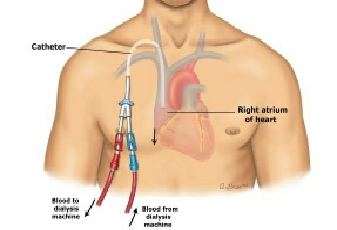
CVCThe unfortunate thing about dialysis catheters is that unlike say administration ports one might receive chemo through, they terminate outside the body and do so on a pair of tails. I’m posting a drawing so you can better see what I am trying to describe. (I could take a picture of my actual catheter but it’s not a selfie I’m anxious to snap and if you just type “dialysis catheter” into your favorite search engine you’ll get no end of new disgusting pictures to peruse at your leisure.) The part of the catheter inside floats and can actually be felt depending in where the tip resides at any particular moment. Reaching for anything higher than one’s shoulder, which given my modest height is anything off the counter, means moving the catheter around in there, also rather obviously noted. And because there is really no good way to anchor the outside tails, any movement or position change comes with a reminder that there is a part of you that isn’t really a part of you.

Fortunately I have the opportunity to be unconscious in a hospital bed again next Thursday when a new fistula will be fashioned into my other arm and I’ll get to have the catheter removed as soon as the new fistula completely heals and toughens enough for dialysis use. That shouldn’t be much after Ground Hog Day.

Just because I was having so much fun at the hospital, last Thursday when I was preparing to return to the world of blogging, I received a call from the dialysis center. The labs drawn earlier returned with a critically low calcium level endangering my health on any number of levels and I was instructed to return again to the hospital, this time to the emergency room where orders would be waiting to repeat the test and administer IV calcium if still returning a lower than normal level. It was, they did, and I got to recline on the sixth hospital bed (but conscious for five of them!) in 11 days.

And you thought getting on a transplant list was going to be boring between the listing and the planting.

Related Posts:

Transplant Journey Posts

First Steps (Feb. 15, 2018)
The Next Step (March 15, 2018)
The Journey Continues (April 16, 2018)
More Steps (May 31, 2018)
Step 4: The List (July 12, 2018)
Step 1 Again…The Donor Perspective (Sept 6, 2018)
And The Wait Goes On (Oct. 18, 2018)

Other Related Posts

Walk This Way…or That (March 9, 2017)
Looking Good (May 18, 2017)
Technical Resistance (May 25, 2017)
Those Who Should Know Better (July 24, 2017)
Cramming for Finals (May 3, 2018)


And The Wait Goes On

It’s been 6 months since I wrote the first post about the kidney transplant journey I’m on. Since then a lot of tests have been performed, a lot of blood and urine analyzed, a lot of x-rays and scans shot. Three months after that first post I reported I was officially placed in the list to await a transplant and if any willing and available volunteers could be evaluated for a potential live donor transplant.

Right now we’re still waiting for donor evaluations to be completed. It seems a long time but it really isn’t. Maybe to a chameleon but not to a human type person. Not even to a human type person waiting for a kidney transplant. With the possibility of waiting up to 5 years, 6 months is nothing, just 10% actually.

But it is long enough that now I’m thinking. Not good stuff all the time. Some of it is good. It’s amazing that of my 3 closest living relatives all three are willing to put themselves through this process. Then that gets me thinking would I for them? I’m sure. What about for a more distant relative…a cousin or cousin’s offspring,? How about a really, really close friend or child of a friend? What about a not so close friend? An acquaintance? A fellow church member or coworker? Stranger? Some people have said yes to all. Altruistically, I’d like to say sure I’d say yes to all. Realistically I know I wouldn’t. But where would the line be drawn? We know intentions are always better than actions but how close are the two when the reality is losing a major organ.

My driver’s license says “Yes I’m a donor. Feel free to use me. Um, but please wait till I’m gone and the only voice I have is this little plastic card.” Would I be willing to say “yes I’m a donor” while I can still speak those words? I suppose I already have. I mean, I’ve donated blood. Does that count? Does it count if I’m a true trypanophobe, which one has to get over if one is going to survive dialysis. (By the way, numbing creams and sprays really do help if you should be interested.) But donating blood isn’t like losing a body part. Blood grows back. Sort of. Kidneys don’t. No way.

Another thought that sporadically pops into my brain is a biblical question. God fearers learn that God not man determines life, thus the opposition to euthanasia and capital punishment. But the converse never seems to be debate. Churches are a main provider of support to transplant recipients even to the point of holding fundraisers to provide financial assistance. If God, not man determines life, is a transplant a means of man extending life? Or is it maintaining life to get the recipient to what would have been the natural ultimate endpoint?

I hope all these thoughts are just my mind doing its thing to fill the void left by the manic pace I underwent doing my evaluation and testing phase and it will quiet itself as it gets used to the waiting period. Maybe after it’s had its fill of playing ‘what if’ games it will settle down and think more productive thoughts like why shouldn’t Seattle get an NHL franchise.

—–

If you’d like to re-read all the posts in this thread as well as other related posts, I’ve put links to all of them on one page. Go here, to join the journey.

Related posts

First Steps (Feb. 15, 2018)
The Next Step (March 15, 2018)
The Journey Continues (April 16, 2018)
More Steps (May 31, 2018)
Step 4: The List (July 12, 2018)
Step 1 Again…The Donor Perspective

Step 1 Again…The Donor Perspective

Now that I’ve been added to the kidney transplant waiting list the hard work begins. Finding a donor. On one hand you can sit around, stay healthy, make sure the transplant center has your current contact information, and just wait. On the other hand, you can try to find a living donor and go through all new sorts of levels of stress.

My immediate family has dwindled to a pair of sisters and a daughter. That would not be a good hand to hold in poker. But all three have expressed interest in donating and that closes the odds. They decided they would go through the donor evaluation process before we would ask if we should look to others. All three are currently in the process but at different stages. Two have been determined to be acceptable matches, one still awaits those results, and none is anywhere near completing the battery of tests donor candidates face.

You remember all the examinations and tests I had to go through? If you don’t, type “kidney transplant” in the site search bar and refresh your memory. We’ll wait. … Ok, ready? Well, as the saying goes, you ain’t seen nothing yet!

Like mine, their first appointment was a phone interview, a few basic questions designed to screen for obvious exclusions like diabetes, untreated high blood pressure, or various cancers. Also like mine, their first on site appointment meant lots of tubes of blood, a chest x-ray, an EKG, and face to face interviews with a nephrologist, surgeon, nurse, social worker, and transplant coordinator. Unlike mine, theirs also includes a donor advocate who is also a previous donor.

Like my first appointment at the hospital they left with a handful of appointments for follow up tests. Unlike mine, theirs were unlike mine. Where mine were targeted to make certain I could sustain the rigors of the operation and maintain the required follow up to prevent rejection, potential donors are tested to make as certain as possible that they are as healthy as possible and will be able to withstand the rigors of life with a single kidney.

Potential organ donors must be at least 18 and not more than 70 years old. That’s quite a range and obviously an 18 year old is going to be and is going to expect a different level of health than a 70 year old. My potential donors are just shy of 29 and a little over 67 years old. The one in between just turned 56. Three different stages of life, three different batteries of tests. Any single test can exclude the person or become the focus of a follow-up test. Surprisingly the youngest has the biggest list of baseline tests. As she explained it, the reviewing nephrologist said a 48 year old who is healthy today has a pretty good chance of still being healthy in 20 years. He has already passed the age when chronic illnesses would have taken hold even if they aren’t obviously obvious. Being healthy today means less to the 28 year old and how she will be at 68, 58, or even 48 so her testing will be more in depth and her expected results more stringent to mitigate missing sign of problems that might develop in the future.

In all cases they are going to get the best physical they’ve ever received. And if they pass all the physical exams they even get to have a go with a psychiatrist.

That’s just in case you thought you were nuts giving away part of your body.

——

If you’d like to re-read all the posts in this thread as well as other related posts, I’ve put links to all of them on one page. Go here, to join the journey.

Related posts

First Steps (Feb. 15, 2018)
The Next Step (March 15, 2018)
The Journey Continues (April 16, 2018)
More Steps (May 31, 2018)
Step 4: The List (July 12, 2018)


Step 4: The List

We are making progress. Tuesday afternoon I received a call from the transplant center at the hospital that the test results are in, the clearances have been reviewed, the committee has met, and I can now say I am officially sick enough to need a new kidney if one can be found for me. Have a seat, pour your favorite beverage, and I’ll tell you the next chapter of this story.

Saying I am sick enough for a transplant is really not accurate and was not the point of three months of testing. We knew the level of my sickness of those organs the first time they stuck a pair of needles into my arm, attached the other ends to a dialysis machine, and said it will get easier over time. They were, they still are, and it hasn’t yet so it probably won’t. It won’t.

The point of the tests, the examinations, and the reviews was to see if I am healthy and strong enough to withstand the surgery, recovery and follow-up to replace those pieces of mine that zipped right on passed middle age outpacing the rest of me to done for. And we discovered and now have documentation that I am. Er, healthy and strong (sort of), not yet done for.

Now we just have to find a replacement for those pesky, unproductive pods. Unlike other parts of me that have been unceremoniously replaced, there aren’t any replacements for a kidney other than another kidney. That means finding somebody who is done using his or hers or someone who is ready to part with one of the two that come as standard equipment in homo sapiens.

And now we come to the point of Step 4. The List. People, including me (well, I’m people too), refer to The List. There really is no single, all encompassing, first to last list. If you want to think of a list, it would more appropriate to think of each donated organ having its own list. When a person is accepted into the program and begins waiting for an organ, his or her matching criteria is placed into a database. When an organ becomes available, the organ’s criteria is compared to the database and all those people whose needs match the offered organ are retrieved. With some exceptions they are retrieved in the order they were entered into the system. Thus, The List for that organ.

There are exceptions to being positioned on the list from the order a person entered the system. Neonatal and pediatric patients are given some preference and people in need of a transplant who had earlier in their lives donated an organ receive placement preference.

When my blood was drawn in April at that first test in the transplant center, there were already over 114,000 people waiting for an organ transplant in the United States. When I became approved on Tuesday, 143 other people joined me being added to The List. About 95 transplants were performed that day and 20 people died waiting. The List grew by about 3,600 since April.

A recent poll revealed that 95% of people support organ donation but only 54% have ever signed up to be a donor. Unfortunately, only 3% of deaths result in actual available organs appropriate for transplantation. And so, the list grows. I could wait for 3 to 5 years until I make it to the top of an organ’s list.

There is a way off the list without dying or becoming too sick that a transplant’s benefits no longer outweigh the risks. The living donor. Kidneys and portions of livers can be donated by live individuals directed for a specific recipient. (Some people actually make altruistic donations that enter the general pool and are designated to a recipient as a deceased donor organ would be.) Under very rare circumstances, lung, pancreas and intestine live donations may be possible. Living uterus donations are undergoing clinical trials.

Living donors account for about a third of kidneys transplanted in the United States. Kidneys from live donors not only mean a faster transplant for the recipient but a more successful transplant.

Already four people have stepped forward and asked about making a living donation of a kidney for me. Their evaluations will begin next month and can take two to six months to complete. I’ll take you along that side trip as we make this stop on my journey. That way you’ll know what a potential living organ has to go through.

Just in case.

——

Related posts

First Steps (Feb. 15, 2018)
The Next Step (March 15, 2018)
The Journey Continues (April 16, 2018)
More Steps (May 31, 2018)