No muss, no fuss, no parking

The last couple of years have been hard on many people. Contrary to some of the posts you may see on Facebook, everybody was affected, and some good things actually came of these years. This is one I have enjoyed a lot and I hope it doesn’t disappear as we approach the end of the pandemic*.

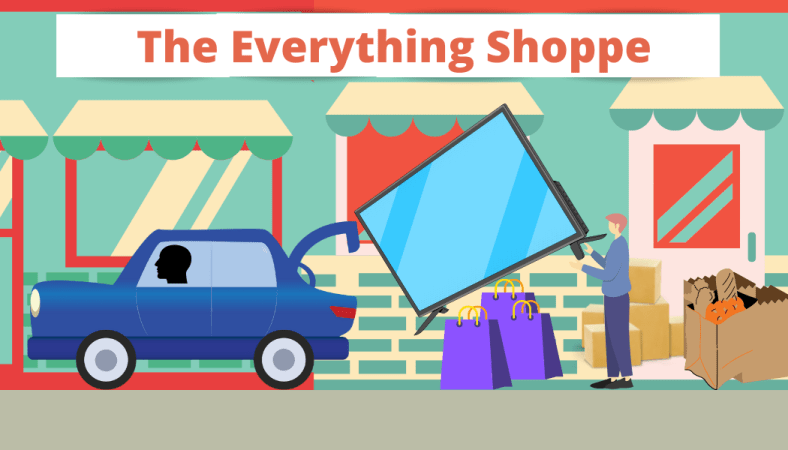
Curbside pick up. CSPU to afficionados. I am loving this concept. Everybody from grocery stores to garden supply sellers to liquor stores to warehouse clubs. Just as Zoom spawned a mini-trend of the meeting mullet (business on top, pajamas on the bottom), curbside shopping has turned shopping into an ultra-casual activity. To be sure, “buy online, pick up in store” has been around for years, decades, stretching back into the last century even, but the process always involved some time spent in the shop. It’s right there in the name – “pick up in store.” Let’s face it. If you’re going into a store, you’re going to have to put pants on. The signs may say “no shoes, no shirt, no service” but they’ll stop you from going in trouser-less too (or skirt-less or dress-less even though we’ve seen how close some people can get in those “People of Walmart” pics and videos). But with curbside pickup, as long as you have an internet connection, a means of electronic payment, and an inside trunk or tailgate release, you can go shopping in a bathrobe if that suits you. It’s not just comfort that has me so enamored of CSPU (and I’ve yet to participate in a pick up in just a bathrobe), but the convenience and the savings. Yes, the savings!

Convenience is obvious. You sit in your favorite chair, put up your feet, and stroll through the aisles. You see that 84 inch OLED smart TV you’ve been waiting to go on sale. It is, and it’s time to buy, and it doesn’t matter that it’s over your doctor-ordered weight limit by 50-some pounds. Someone else will wrestle it off the shelf and into your car. Need a new pair of jeans. No problem. Buy them with confidence because almost everybody has a ‘buy now, try on’ at home policy easing returns for those brands that run small when you get them home. Need to do toilet paper math? You have a calculator, all the time in the world, and nobody trying to get around you while you calculate. So convenience is a given.

How can CSPU be a money-saver? You might think being able to click you way to a full shopping cart would lead to unchecked, indiscriminate buying, but nay I say! You can always stop and check the shopping cart (or the cuter shopping bags and baskets) for your running total, and even at checkout you get the opportunity to delete something. How often have you ever done that in real life? But the true genius to CSPU (and its older cousin OOLPUIS as long as you’re careful) is NO IMPULSE BUYING! No tunnel of candy and cold drinks, magazines and lunch size bags of chips, nail clippers and rolls of mints, key chains and energy drinks to pass through on the way to the final check out. No endcaps filled with unadvertised specials (that never are that much) or overstocks and clearances (that are there for a reason). No electronics counters filled with car chargers, charging cables, and brochures for cell plans, all trying to wrestle away more of your spending dollar (and/or your favorite local currency). Oh some e-tailers have tried to emulate the impulse buy with “people who bought this, often add this” or “don’t forget the…” and “would you like to add…” throughout the shopping experience, but those intrusions are easier to ignore that the constant barrage of political ads that pop into your text messaging app nearing general election time.

Yes, of all the benefits being locked down, quarantined, socially distanced, and generally wanted to stay off the streets, I hope curbside pick up is here to stay.

——

* People keep saying we’re getting close to the end of the pandemic but there is no end to the pandemic, or more accurately, the Covid virus has not waved a white flag, agreed to peace talks or will quietly leave the planet. It is like your favorite Russian autocrat.  There will be a point that we may (may with a capital M and an exclamation mark) not experience worldwide stoppages of life as we know it no even country wide interruptions. But the virus will still be out and about and we will still be susceptible to it and its periodic annoying intrusions on intelligent life on earth, much like your garden variety politician.
Once upon a time they lived happily ever after (4)

And If You Order Now…Part 2

Some time ago we supposed, “We believe that with two you have a spare.  With three you have a collection.” (See ‘With Three You Get Collections,’ Jan. 9, 2012). Hold that thought.

When we last left our heroes, we were wondering how America has managed to create so many different ways of separating one from one’s money without leaving the house. And wondering beyond that if the trend might ever reverse.

We think we have some other trends that have to reverse first. Some time ago, He of We was at a financial seminar where the focus was keeping one’s money. One of the exercises the 30 or so attendees took part in was a card count. Not as in blackjack. As in credit cards. Not debit cards. Not insurance cards. Credit cards. With those 30 or so attendees there were 187 credit cards also in attendance. That’s at least 6 per individual. That’s a collection. If you add in the debit cards there were 245 cards hanging around in purses and wallets. If you run the math you’ll see that is more than one debit card per person. That might be a spare. The whole kit and caboodle is definitely a collection.

Let’s go back to January of 2012. We also said that collections are not rational and just a little obsessive. You might say that makes sense if we are speaking of coins or art or other objects of value and beauty. But credit cards? Yep, even them. Having six credit cards is not rational and a bit obsessive.   It is also empowers the marketers to continue selling to those who haven’t left the house.

The only way on-line shops, infomercials, magazine inserts, and television shopping networks work are if they accept something other than money. The ready availability of credit and debit cards is their ticket to your bank account. According to the Federal Reserve, credit card balances now total nearly $857 billion. With an average of just about 13% interest on that balance, Americans are paying just about $110 billion a year in credit card interest. And since we all seem to have a collection of them, once one is maxed out we can move on to another and never miss the opportunity to buy that $400 purse.

So there we go again with the purse. Is it so terrible that someone sells and someone else buys a $400 purse? No, it’s not. We’d just prefer to see that if someone is going to buy it for $400 that someone has to reach into her, or his wallet and pull out four $100 bills to pay for it. Then it will mean something. But that’s a different post for a different day.

If you too are concerned about the rollercoaster of remote shopping you too can do something about it. Break up your collection and get back to using money. If Capt. Kirk was able to figure out how to do it, you can too.

Now, that’s what we think. Really. How ‘bout you?


And If You Order Now…Part 1

A local television station recently reported on new shopping sites that lower your costs. Television shopping channels are comparing their prices to those in brick and mortar retail outlets. Infomercials are offering “free” or dramatically reduced trial periods. What do these all have in common? Boy are they expensive!

Selling products remotely is nothing new. You can go back to the sixties and find record clubs that offered 10 albums for a penny. Selling music on TV was a staple then. And the penny sale was the hook they all baited to get you into a long-term arrangement. Get your 10 albums now and agree to buy a certain quantity over time. Don’t like that idea? How about get your 10 albums now and never have to buy another one ever, period. But you would get an album or two every month “on approval.” If you wanted it, you kept it and sent them money. If you didn’t want it, you sent it back by a certain date.

While the record clubs were fine-tuning their pitches, home shopping was starting to take off. The earliest versions were the televised equivalents of the print ads found in the Sunday supplements of every major American newspaper. No longer were you limited to a picture and your imagination about how something worked. Now you could see it in action on your TV screen. The prices were reasonable even though shipping was extra, and you could always count on some special bonus if you ordered a certain dollar amount, usually a “surprise package.” Woohoo.

But the real money was still around the corner. The televised department store. Entire networks were set up to do nothing but sell. All of them had some catchy 3 letter name so they sounded like real television networks. And they all started out as economical alternatives to going to the mall. It’s two in the morning and you’re bored. Let’s go shopping! It won’t cost any more than going out and you don’t have to get out of your jammies to do it.

And here we are today. Television shopping networks, infomercials, print ads, and on-line stores. Somewhere we’ve lost the record clubs but we have Hulu+ instead. No longer are they content with competing with the brick and mortar outlets, they want to be better. Now there are high end fashion sites with real couture. Accessories from shoes to bags to scarves to belts. Jewelry from costume (a few pieces here and there), to this week’s favorite gemstone. We’ve seen purses over $400, rings in four figures, and a dress suited for a red carpet. Don’t worry about the price. There are payments available. Without interest. Is a one-time “Holy Cow” hit to your debit card out of the question? Just make 4 easy payments of “oh-my-gosh” instead and it’s yours.

Do we begrudge those businesses making money. Of course not. Do we begrudge those who buy a purse for more than their weekly salary to carry around in it? Absolutely not. Do we think things are getting out of control? For sure!

In the original Star Trek movie, when they return to the 1940’s Capt. Kirk says to Mr. Spock, “They are still using money.” We’re pretty certain that’s a statement that we never want to make. How do we stop this roller coaster? Part 2 is coming.

Now, that’s what we think. Really. How ‘bout you?


Dat’s a Nice Burs

In the 1983 movie “Trading Places” a creepy man sits down next to Louis Winthorpe’s fiancé Penelope Witherspoon, points to her handbag and says, “Dat’s a nice burs,” which we believe translates to “that’s a nice purse.”  Very appropriate because Penelope was played by Kristin Holby whose daytime job was an Yves St. Laurent model.  YSL was big into purses in the early 80’s.  Actually, everybody was then.  And they still are now.

In was just this past weekend that our local weather turned bad enough that everybody who is anybody stayed indoors.  She of We took advantage of staying inside her doors by spending time with several of the home shopping channels.  She enjoys shopping on television, out of catalogues, and through the Internet and she has figured out the good, the bad, and ugly of no-touch purchasing.

It seems over this weekend all of the shopping channels were featuring — purses!  Not just any bags.  No these aren’t the $40 variety that a lady wouldn’t mind being seen with while at the same time wouldn’t mind when the local bus drives by too close to the sidewalk and the only thing between that geyser of water it just launched and the lady with the handbag is the handbag.  These are the bags that everybody will be looking for this season (as the shopping hostess will shortly proclaim) and can be yours for the one time, never to be seen again, super special price of only $327, or $109 in three easy payments.  The good – take advantage of that easy pay option.  There’s no interest, no extra charges, no hidden fees. That’s borrowing money for free!  The bad – that purse is over $300!  Even in free money that’s a lot of money.  Leave it on the screen.  The ugly – compared to the retail stores, that’s actually a good price.

When did purses get to cost as much as 1980’s vintage refrigerators?  With all the company monogramming and logo-ing on just about every offering, why are you paying them to do their advertising?  And the one we couldn’t resist asking, if you buy a $300 purse, how much could you possibly have left to put in it?

Another disturbing trend being broadcast on the shopping channels, in commercial spots, and as stand-alone infomercials is skin care.  We’re both old enough to remember when skin care was a jar of cold cream.  Today it’s a billion dollar business coming $100 at a time.  Serums and oils and creams made of fruits, vegetables, sea water, and the occasional cold cream base are everywhere.  For them to work their magic you must buy the whole set.  And the whole set runs well over $100.  But that’s ok.  Buy now and they are willing to charge you only $39.95 for that vital full kit.  But buy now and you are also agreeing to an automatic shipment of the whole kit every month at the regular price.  One hundred dollars of skin care products every month.  Now there’s a budget buster.

Watch out for more “too good to be true” deals out there.  Like, did you know that the gold dangling bracelet on the screen up there may be gold plated resin?  Someone out there is coating plastic bracelets, pendants, and earrings with a bit of gold and calling it gold plated jewelry.  It sounds good but do you really need a $90 plastic ring?  A great price for gold.  Not so great for fake.

We know every woman wants flawless skin, a nice bauble on her finger, and for someone to come up to her and say “Dat’s a nice burs.” Our suggestions are find a jar of cold cream, keep you purses under $50, and get the good jewelry.  Be a critical thinker before clicking away a few hundred dollars because someone is telling you it’s a good deal.  Don’t be a sheep.  Be unique.  Start a trend.  Buy what you need, not what someone else tells you that you absolutely have to have.  Now get out there and shop.  Or stay in there and shop.  It’s not going to snow forever.

Now, that’s what we think. Really. How ‘bout you?