Resolving to Keep It Real

Last year the Monday adjacent to New Year’s Day was actually January 2.  We called it the day resolutions die and posed that if we made our annual resolutions more toward a climatic re-awakening, say the beginning of spring, we’d be more likely to keep them for more than 24 hours.  So last year we made our resolution to make our resolutions come spring.  (See Be It Resolved, Jan. 2, 2012.)  How did we do?

Let’s pick two.  When we finally got around to making those resolutions She of We felt she was watching too much television and to combat that would read more.  Well she’s reading more but still feels she watches too much television.  He of We clearly needed more exercise and by the time spring rolled around had a positive plan.  That was to walk the local high school football field every morning before work. Well he walked some for about a month but that was still better than just 24 hours.  (See Be It Further Resolved, March 22, 2012.)  The real question is, was delaying resolution making successful in making rational, keepable resolutions?  Really, not much.

So here we are, back to another winter Monday and this time it’s New Year’s Eve, the day resolutions are made.  Will we?  We have some time to think about.  We might.  We still know January is a terrible time to start a new year.  But we also know we need to still exercise more no matter if we’re at the beginning, middle, or end of the year.  We know we need to still keep our minds nimble no matter if it’s hot, cold, or comfortable outside.  And we need to spend less, save more, and eat better.  Do we need resolutions for those?  Really, not much.

We like the idea of not making any serious goals while it’s only 20 degrees outside.  The mind is challenged enough at the holidays and New Year’s Day is still best suited for continuing the stress of the holiday period.  That hasn’t changed from last year.  But we think we can come up with a few rational, keepable resolutions. 

We resolve to keep having fun.  We resolve to work on the hard stuff later.  We resolve to keep you posted on how we’re doing with both.

Now, that’s what we think.  Really.  How ‘bout you?


The Gift of Music

What do pumpkin cakes, ceramic penguins, dip dishes (with dip mixes in 2 flavors!), and holiday CDs have in common?  After tonight they will have all been party favors at our Christmas Eve dinner.

Christmas Eve is a special time for us.  It was the first holiday that we combined families at a formal gathering.  It was the first holiday that we lightened up a formal gathering.  And it’s probably the holiday that almost everybody most looks forward to.

Christmas Eve has also become a holiday that we never know exactly how many people will be with us.  Our core families will be there.  But there always is at least one extra couple and never invited by Either of We.  We don’t care.  There’s always room at the table.  But it makes those favors a bit interesting.  This year we decided on holiday music CDs.  You can’t beat a good Christmas Carol.  We have the gamut from Carol of the Bells to Grandma Got Run Over by a Reindeer.  We’re planning on 10 at the table but we got 14 CDs because we’re never really sure.

A formal dinner for 14 might seem a bit extravagant to begin with.  Neither of We hit the rich mark in the ‘how well off are you’ scale.  We still manage to put together a traditional Italian feast of the seven fishes (for He of We’s side) and a traditional seafood themed American Christmas Eve (at She of We’s urging and to the great relief of many on He or We’s side).  With all that seafood, how do we manage to put together a dozen unique favors especially when they are favoring our guests with the gift of music, usually not an inexpensive offering.  He of We will take credit for that one.

We were out shopping and not even thinking of favors for Christmas Eve.  We had just finished up with Thanksgiving and were trying to shift ourselves from one holiday to another.  We ended up in one of our favorite, but not routinely visited stores.  It has literally everything.  Water heaters, garden flags, canned goods and canning goods.  Local sports teams doo-dads and needlework craft sets.  Hoses and hooks.  Books and — CDs.  While checking out the holiday themed flashlights He of We spotted a pair of spinner racks at the end of an aisle.  Thereupon sat hundreds of CDs.  All Christmas music, all the time.  And every one of them priced at one dollar.  One hundred cents, ten thin dimes, a buck a piece.  They had “favor” written all over them.

But (isn’t there always a but in a perfectly good favor find?), but, who gets what?  Who likes what?  We have a most eclectic Christmas Eve group.  We run the gamut from refined, retired ladies to a couple who met on an oil drilling rig.  Not to say that a well driller isn’t refined.  But there are probably differences in musical taste.  Do they get the CD with Mariah Carey, or the one with the studio group singing “Good King What’s His Name?”  And not only is the group eclectic.  So are the CDs.  Let’s face it, these are dollar CDs.  You aren’t getting the Mormon Tabernacle Choir for a dollar.  Well, actually, now, there were two of them that had selections sung by just that choir.  And some had Glen Campbell.  There were those with the London Symphony and there were those while listening you could Swing and Sway with Sammy Kaye.  Every case we turned we saw names we’d not imagine would see on a dollar CD.  Every couple of cases would actually bring out a little vocalization.  Yes, people did turn when She of We waved one she found with Liberace!  Most probably because she shouted, “Liberace!”

So we stood there, Each of We stationed at a spinner, sorting through the jewel cases like little kids picking out candy in the corner store.  Would this one work for She of We’s 28 year old son.  What about He of We’s cousin who grew up at the symphony.  Does anybody like country?  Does anybody like operatic?  Which semi-regular couple friend of a relative will show up this year?  Plan for both, we’ll never get another chance.  How could we resist?  It’s hard enough to be creative but to be creative on a budget is a million times harder.  To be creative for over a dozen people for less than a 20 dollar bill was a Christmas miracle.

Almost an hour later we were done.  Fourteen individual CDs plus a couple for our cars.  If you were to show up at our table this evening we’d probably have something to fit your taste.  You’d get something.  Everybody gets something.  It’s a rule.  And if you bring a lot of friends with you everybody will still get something.  We might run out of CDs but there are always the holiday crackers.  Maybe you’ll be the lucky one to sit through dinner wearing the paper hat.

Remember, everybody gets something.  It’s the rule!

Now, that’s what we think. Really. How ‘bout you?

We regret to inform you…

‘Tis the season for catalog shopping. Whether on-line or a hard-copy catalog, people are still looking at colorful pictures, picturing loved ones in those colors, and sending off credit card numbers and waiting for packages on the porch to be there to greet them every day after work. Neither of We is any different.

Sometimes the operation is as smooth as we just described it. Every now and then an e-mail pops up that says, ‘Sorry, we regret to inform you that something bad happened and you won’t get your gift until May’ dashing hopes of holiday cheer and now wondering what to get Uncle Ed. She of We had just such an e-mail a bit ago. Well, actually, no, she didn’t. She got an e-mail not at all like that. This is what she got.

Unfortunately, we have to inform you of an error the fulfillment warehouse made which resulted in your order not shipping. Nope. Nada. None. It had not shipped as of yesterday. We are so sorry for this error!

We have confirmed that the warehouse has now fixed the error and your order will be en-route to you as of Monday 12/7 if it is not already.

Of course, the big question is: Will it arrive by Christmas? YES – you will receive it in time!

Don’t you just love it? ‘Dear customer, we made a mistake and you weren’t getting anything but we fixed it and now you will get it. And on time.’ No blaming the slowness of the mail. No blaming the foibles of electronic transmissions. No blaming volume or “this unanticipated popularity of our items.” Nope. We messed up, we fixed it, it’s on its way. And with cheerful punctuation!

‘Tis the season for catalog shopping. And ‘tis the season for occasional disappointment. We think it’s good that somebody out there takes a light-hearted approach at their job. Why be so serious? Especially when it comes to punctuation!

Now, that’s what we think. Really. How ‘bout you?


Thank You, Again

This year there will be a group of WalMart stores that when the others open after Thanksgiving dinner, they probably will not.  It was big news in our area that workers in these stores will be the representatives protesting having to work Thanksgiving Day.  It filled part of the front page and some minutes of on air news time on the days leading to Thanksgiving. 

We were in a your basic average retail discount department store the night before Thanksgiving picking up some last minute items to make our feast festive when we found out that chain will open at 7am on Thanksgiving morning.  It got us to thinking about how many people work on the holidays now.  It wasn’t always and probably never really has to be.  But even if you closed all of the stores and malls and outlets there would still be many at work.  Last year we paid them our thanks.  We can’t say it any better this year so we’re going to say it again.

Think way back, back to the day when all of those stores were closed on holidays, Sundays and most other days after 5.  But even then there was a corps of people who knew that when the holidays came around they were just as likely to be at work as they were on any Tuesday afternoon.  To these people we say, “Thank You!!!”

Thank you to…   Firemen, policemen, paramedics, and ambulance drivers.  First responders of every kind.  The members of our armed forces.  Hospital workers.  Priests, ministers, rabbis, and other men and women “of the cloth.”  Newspaper production and delivery people, reporters, television and radio engineers, producers, directors, and on-air personalities.  Toll collectors, train engineers, pilots, co-pilots, flight attendants.  Bus drivers and taxi drivers.  Air traffic controllers, airport security, baggage handlers, and airplane maintenance.  Train station and bus depot ticket sellers and collectors.  Hotel receptionists and housekeepers.  Restaurant cooks, servers, bus-people and hosts/hostesses.  Bartenders.  Electric company, gas company, telephone company, water company, sewage company, alarm company, and cable company repair and emergency service employees.   Tow truck drivers, snow plow drivers, and street repair people on a moment’s notice.  Commercial truck drivers and freight handlers.  Couriers.  Nursing home, personal care home, retirement home and home health care workers.  Security guards.  Heating and air-conditioning technicians, plumbers, and electricians when they least expect it.  Gas station attendants and clerks at convenience stores with convenient hours (yes, retail stores but they have always been open).

Did we miss anybody?  We’re sorry if we did.  Please feel free to add them in a comment, extend the list, and keep the thanks going.  We’re also sorry if we couldn’t come up with the official job title or this week’s most politically correct reference.  In our experience, most of these people care more about the service they are providing than the name they are called.  That’s why most of these people are in jobs that risk being scheduled or holidays, weekends, evenings, and nights.  They are the ones likely to do something for you and then say thank you more than they expect to be told thank you. 

Please, don’t forget these folks.  Someday you’ll want to thank them.  Now would be a good time.

Now, that’s what we think.  Really.  How ‘bout you?


Some Gave All

Happy Memorial Day!  If you really think about it, that is just so wrong.  For over 140 years, Memorial Day marked the day when Americans honored first those who died in the Civil War, then those who died in any war, then those who died.  The common theme is death.

Death, while just about always somber does is not always unhappy.  Many families due to distance or other circumstances only re-unite on the occasion of a death among them.  Quite often what began as sorrowful turns into a true celebration of life.  But “Happy Memorial Day?”  It still seems wrong.  Since the Americans started fighting as Americans in 1775, over 1.5 million Americans ceased being so other Americans would benefit from their sacrifice.

Sometime today the television news people will broadcast film of a cemetery lined with miniature American flags decorating simple crosses or markers.   Sometime today thousands of marchers will step off on a parade that will end at a memorial site where a bugler will play taps.  Sometime today you will open your Internet news or your local newspaper and see a picture of a color guard highlighting a member from each of the armed services.  Sometime today almost everybody will shed or stifle a tear because each of us knows somebody who played a part in us still being at liberty to watch TV, wave at the parade, or just explore our world. 

And sometime today we’ll forget why we celebrate today and just celebrate.  We’ll have cook-outs, play soft ball, reunite with family and friends, and have a good time.  And somewhere, 1.5 million souls will look down and smile, knowing what began as sorrowful turned into a true celebration of life. 

Happy Memorial Day!     

Now, that’s what we think.  Really.  How ‘bout you?


Liberty and Justice for All

They are at it again.  It’s that time.  Easter is around the corner and a Michigan based organization of atheists of all people cannot let a religious holiday go by without a celebration.  Now they seem to think that the Ten Commandments are unfit for American consumption. 

This startling report comes after a child is shot and killed in the name of a neighborhood watch.  After a bonded security guard kills his partner and makes off with $2 million.  After five people were found so gruesomely murdered investigators can’t even figure out how they were killed.   Yes, the last thing we need in this country is a moral compass, a set of rules, directions on how to tell the difference between right and wrong. 

If you haven’t had a chance to read our special post, “We Hold These Truths” (January 13, 2012), please do.  It’s long.  It’s far from politically correct.  It has the words “Church” and “Constitution” in the same paragraph.  We think it makes a world of sense.   

We won’t repeat the discussion on the Constitution and the Bill of Rights that we presented in January.  We do want to repeat that regardless of what some dolts in Michigan say, the authors of the Bill of Rights don’t say anything about building an atheistic society under the guise of an oft-claimed separation of church and state.     

“Congress shall make no law respecting an establishment of religion, or prohibiting the free exercise thereof; or abridging the freedom of speech, or of the press; or the right of the people peaceably to assemble, and to petition the Government for a redress of grievances.”

If you don’t recognize it, that is the Famous First Amendment.  The whole thing.  Every word of it.  That’s the one in which Congress says it won’t say how you will worship, and that nobody in the government can stop you from worshipping.  It doesn’t say that you are not allowed to worship, not even in public.  It says that Congress will not prohibit the free exercise of religion, not that Congress will prohibit religion. 

If we had a choice we’d tell the atheists to go to hell.  The only reason we don’t is they probably don’t believe in hell either.  Where do you send a dolt to spend all eternity in despair?  Should we send them to the courtrooms to listen to the testimony of those trying to wiggle out of murder charges?  Maybe we should send them to the crime scenes where real dead bodies lie from the hands of those who didn’t understand “thou shalt not kill.”  Or perhaps they should see their life savings disappear to the charlatan “brokers” who amassed fortunes by stealing from retirement plans and savings accounts.  But whatever you do, don’t send them to church to pray for innocent children who die while left behind to fend for themselves.

Sorry, not so funny today.  But there’s nothing funny about some dolts worried that there is a plaque of The Ten Commandments outside a school.  They should be more worried if people ever stop teaching The Ten Commandments to the children. 

To heck with it.  Hey!  Any atheists out there who are so stuck on this separation of church and state thing that you can’t see how good you have it here, why don’t you just go to hell.  You’ll find your way easily enough.  The signs are all around you.

Now, that’s what we think.  Really.  How ‘bout you?


Six Weeks

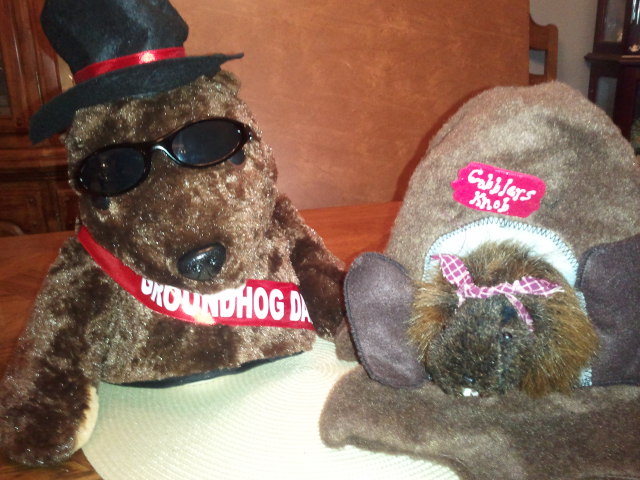
Happy Groundhog Day!  For over 225 years Phil has been the reigning prognosticator of Punxsutawney Pennsylvania perusing his property for signs of his shadow to predict the waning winter’s weather.

What began as an adaptation of Candlemas for the local farmers not too distantly removed from their German homeland now brings an estimated 30,000 people to the Pennsylvania home of Punxsutawney Phil for 4 days of planned events highlighted by the shadow sighting on national news broadcast across our homeland. 

Now here we could tell you all the different things one can do in Phil’s little hamlet.  Who will be playing, singing, dancing, and crafting.  We could guess how many television cameras will be in use.  We could compare the last 2, 5, 10, 25, 100, 150, or 200 predictions and the actual results.  We could talk about the Punxsutawney Groundhog Club or The Inner Circle.  But really, you don’t need to hear from us if last year’s prediction was on the money or how much money the park vendors made. 

Nope, we’re just going to marvel at all that has become of our little rodent friend and all of his friends living in the sunny or shadowy mountains on the edge of the Allegheny National Forest.  Phil has his own official souvenir web-site.  The Inner Circle (those are the guys who pull him from the stump, we mean help him from his hollow) have an annual formal ball.  There are 60 chapters of the Groundhog Club from California to Florida and chapters in Canada, England, and Iraq.  There’s even an Internet chapter.  (The Bluegrass Chapter of Louisville, Kentucky was chartered on Feb. 2 2002, that’s 02-02-02.  There’s a lottery number waiting to be played!)  Other than the iconic “Groundhog Day” movie there isn’t much in the way of multimedia for our little friend but we did find 5 songs celebrating Groundhog Day including “Groundhog Blues” by John Lee Hooker. 

Unlike Candlemas in the 17th century we really don’t need Groundhog Day to tell us if we’re almost done with winter and can breathe a sigh of relief over our dwindling food and firewood supply or if the cold will stay with us for another 6 weeks and challenge our larder.  Groundhog Day in the 21st century is a time when grown men dress in formal attire and play with field animals, when people gather to figure out just how long Phil Conners (Bill Murray’s character in “Groundhog Day”) was stuck in Punxsutawney, when people get married in Phil’s Wedding Chapel  by the mayor of Punxsutawney (weddings on the half-hour, call ahead to get on the schedule), when it’s ok to be seen in public with a hat on your head that looks like a groundhog emerging from a tree stump.

It’s a time when it’s perfectly acceptable not to take yourself too seriously.  And we could probably use six more weeks of that.

Now, that’s what we think.  Really.  How ‘bout you?


We Hold These Truths

A word about this post:

We wrote this before Christmas amid the annual outcry over manger scenes in front of government buildings and wonderings if you had to say Happy Holidays not to get fired.  It was written more as history lesson than rant over Politics and Religion and we figured there were enough to fight that fight.  And who wanted a history lesson right before Christmas?  So we spent our time spending time together, enjoying friends and family members, humming Christmas carols, watching Christmas movies, thowing some change into a few red kettles, and generally living the spirit of the season. 

Then this week the local paper had a story about a Pennsylvania university that was offering discounts to its men’s and women’s basketball games.  Among these was a discount for those with a religious affiliation.  Actually the discount was extended to anyone belonging to a faith-based organization as part of the school’s “Faith and Family Night” promotion.  According to the paper, a university spokesperson explained that “fans could mention affiliation with any faith-based organization, not just churches, to get the discount.”  We imagine if you really wanted to go to a basketball game and were short a couple dollars for the ticket, you could just lie.  If you didn’t belong to a faith-based organization, you’d probably not think twice of it.

Opponents of creches, of discounts to church groups, of saying “Merry Christmas” during the Christmas season, and probably of sales of Easter bonnets during Easter sales always fall back on that so often misquoted document, the Constitution of the United States.  “It violates my First Amendment rights,” is a favorite excuse for bad behavior. 

So, we’re going to risk bad behavior of our own and present “We Hold These Truths” to our public.  It’s our way of saying we know what our rights are.  And so do the people who wrote to insure us those rights 225 years ago.  Please don’t trample them on your way to finding your rights.  (And yes, we know that “we hold these truths” comes form the Declaration of Independence, not the Constitution.  Technically our rights were insured by the Bill of Rights and not the Constitution either.  Humor us, ok?)

It is a very long post.  Regular readers know our posts already are pretty long and even compared to those posts of around 500 words, this one is a doozie!  At close to 2,000 words we hope we’ve said something thoughtful, intelligent, and meaningful.    And at the risk of making it even longer, we encourage you to comment on it, to re-blog it, to send a copy of it to your Congressman, to e-mail it to friends, to share it with your family, to share it with your local news outlet, or if you know one to share it with, share it with your favorite atheist.

And now, We Hold These Truths: 

———————————————————————————-

A bit before Christmas, a Michigan based organization of self-proclaimed atheists threatened to send busloads of its members from Wisconsin to a small town in Pennsylvania because that small town was planning on doing the unthinkable for the 50th-some time and erect a Christmas manger scene outside its municipal building.  The organization wrote, “It is unlawful for the state to erect this nativity scene on borough property thus singling out one religion.”  There was no word if that was written in Michigan or Wisconsin.  Nor was there word of which one of the many Christian religions was being singled out.  Now, halfway through January, that little town is still fighting that fight and is already looking ahead to Christmas 2012.

Just as the Christmas season was winding down the college basketball was moving into high gear.  There is a college not far from that Pennsylvania town that is offering a variety of discount nights including First Responders’ Night and Veterans’ Night.  Also among their special promotions is a discount night for those who belong to any faith-based organization.  It didn’t take long before there were new headlines throughout the Keystone State quoting an organization questioning the validity of that one.  Not because it singled out one religion but because it wasn’t fair to the basketball fans who are not religious and thus not eligible for a discount.  The opposing group didn’t say the same for those who are not veterans or first responders.  Apparently not being a veteran is something beyond most peoples’ control.

We hate to be so rude to so many people who are so protective of our Constitution, but, get a life!  (We said in our first blog we weren’t going to be politically correct – just plain correct.)  At the risk of being quite politically incorrect, here are the facts.  If we were you, we’d get a beverage, sit back, and hold on for the remainder of this post.  We will also warn you that the remainder of this post is more history lesson than rant.  If you appreciate intelligent and thoughtful discussions you should enjoy this. 

When our early lawmakers wrote the Constitution back in the summer of 1787 in Philadelphia, they had no idea they were creating controversy for future fellow Pennsylvanians.  They also had not planned on creating fodder for the trough of stupidity that nonsensical organizations like the dolts in Michigan and/or Wisconsin hide behind.  As much as everybody wants to say so, the Constitution of the United States says nothing about this oft-claimed separation of church and state.      

The confusion seems to have arisen not at the signing of the Constitution in September of 1787 but came as an afterthought to that document.  More than two years later, some states’ representatives still remembered the British violations of civil rights that drove even earlier representatives to unanimously pass the Declaration of Independence.   Thomas Jefferson, primary author of the Declaration of Independence, was not a member of the Congress that drafted and forwarded the Constitution to the states for ratification.  He was, however, a vocal critic of that group for their lack of specifying individual rights, rights that were significant in the writing of the Declaration.  And thus in September of 1789, the First Congress of the United States proposed 12 amendments to the Constitution to quiet those most concerned that the government had too much power and the rights of the individuals were not adequately addressed.  The first two proposed amendments as presented to the States were not ratified.  But the states ratified amendments 3 through 12 compiling the first ten amendments to the Constitution, now known as the Bill of Rights.

The first of those ten ratified amendments over the years has stood the test of time and rarely was questioned or opposed.  Only in the second half of the twentieth century did citizens whose rights were the very focus of the amendment’s authors did those citizens start plucking individual phrases to justify petty and personal opinion.  There are only 45 words in the First Amendment.  That is not too many to read and savor all at once.

“Congress shall make no law respecting an establishment of religion, or prohibiting the free exercise thereof; or abridging the freedom of speech, or of the press; or the right of the people peaceably to assemble, and to petition the Government for a redress of grievances.”

But since the Dolts of Michigan and others insist on tearing it apart word from word, we will examine it thought by thought.  The dolts and their brethren always pick on the first 10 words.  Most dolts can’t count past ten so that must be why they stop there.  “Congress shall make no law respecting an establishment of religion.”  Nobody ever quotes the next six words, “or prohibiting the free exercise thereof.”  Probably the “thereof” confuses them.  That’s the authors’ way of saying that they and future representatives to Congress won’t say how you will worship, and nobody in the government can stop you from worshipping.  There is nothing in those combined 16 words that says you are not allowed to worship, you will not worship, or that there is no support for you to worship.   Nor does it say that there might not be a multitude of ways to worship.  In fact, one can make the leap that the reason for the first ten words are to support a variety of ways to worship, a freedom the authors of the Constitution and their ancestries did not have under the foreign realms from which they fled.  Congree will not prohibit the free exercise of religion.  (We wanted to spell that out just in case there is a dolt out there and it is still confused over “thereof.”)

As long as we’re dissecting words written over 220 years ago we want to keep going.  There are, after all, only 29 of them left.  The First Amendment goes on to say that Congress will also make no law “abridging the freedom of speech, or of the press.”  They go together.  Even over two hundred years ago the authors recognized that the press was and is the enduring voice of the people.  They are the same and that is why it is written as a single clause.  Perhaps current members of the Fourth Estate should remember that when they are editorializing.  Perhaps they also should practice just “correct,” and reflect the thoughts and feelings and prayers of those who support the press and forget about being “politically correct” themselves.   The earliest publications of this country were quite politically incorrect by our standards yet they rallied their readers to the extent that we now have a country that will make no law abridging those freedoms.  Congress will not abridge the right to free speech or press.  Together.  One mind.  One voice.  The one voice of the many people. 

Congress will also not abridge “the right of the people peaceably to assemble and to petition the Government for a redress of grievances.”  The right to assemble goes along with peaceably.  You might prefer to call it peacefully.  Peaceful demonstration is how the dolts’ younger cousins would have you believe every protest begins.  No.  When demonstrators show up with clubs, pepper spray, guns, and the intent to use them if they are confronted by others with different views, peaceful has left the building.  The final phrase “to petition the Government for a redress of grievances” is colonial speak for “ask the Government to put right wrongs” or to “ask our representatives to review citizen rights for those the original authors missed.”  It doesn’t mean to sit in a park, refuse passage to people who are trying to get to work, turn over cars and trucks, throw rocks at policemen, and in general act like the animal version of a dolt.  It does mean to gather together, discuss how you’ve been wronged and how you would make it right for everybody.  With one voice of one mind you can then ask our assembled representatives to listen to us and make things right.  It’s a powerful concept, particularly if you can find an elected representative who understands the First Amendment.

Remember, the Four Freedoms are the Freedom OF Religion, Freedom OF Speech, Freedom FROM Want, and Freedom FROM Fear.  It just seems all backwards.  Protestors exercise their “rights” while instilling fear in everyone else.  Our government repeatedly bails out banks and manufacturers while allowing individuals to suffer 29% interest rates and retail prices that have no basis on the actual cost of goods.  Public comment periods to bills and government contracts are virtually non-existent but the idiot screaming down the block at 3 in the morning has a right to free speech especially if he’s the drug addicted son of the mayor.   And dolts are allowed to charter organizations specifically to support freedom FROM religion.  (By the way, among its several accepted definitions is that religion is characterized by a set of strongly-held beliefs that somebody lives by.  We contend that any group of people so concerned over getting its ideological point of view, its strongly held ideological point of view, to the extent that they are prepared to proselytize for it, is pretty much practicing a religion.  Think about it.)

Before we finish our little history lesson let’s step back a few years earlier, to the summer of 1776, again in the city of Philadelphia.  To the Declaration of Independence.  To that very short announcement that the former British colonies were indeed one new country, one that would fairly soon establish taxes and representation, and an army and navy, and a Bill of Rights.  Before those assembled got to the part about these truths being self-evident they first declared:

“When in the Course of human events, it becomes necessary for one people to dissolve the political bands which have connected them with another, and to assume among the powers of the earth, the separate and equal station to which the Laws of Nature and of Nature’s God entitle them, a decent respect to the opinions of mankind requires that they should declare the causes which impel them to the separation.” 

You couldn’t fool those colonists.  They knew who fixed them up.  They knew that the “powers of the earth” are granted by “Nature’s God.”  After that acknowledgement they moved on to:

“We hold these truths to be self-evident, that all men are created equal, that they are endowed by their Creator with certain unalienable Rights, that among these are Life, Liberty and the pursuit of Happiness.”

Somebody gave those colonists the idea that all of us are entitled to live our lives, to live them by the four freedoms, and to be happy while we do it.  It certainly wasn’t Thomas Jefferson or John Hancock.  It wasn’t George Washington or Benjamin Franklin.  It wasn’t even John Adams.  When you thank someone for your self-evident endowments you know who you’re going to thank.  We say it enough every day.  Thank God.

They may not want to believe it but even the dolts have God to thank.  Every time they take advantage of a Christmas sale each winter or an Easter Sale the following spring there’s a reason behind it.  It’s not Mr. Macy they have to thank for that great deal on a Play Station.  And we’re pretty sure they aren’t going up to their butcher and asking for a higher price on the spiral cut ham because there is no God.  No, they know the reason behind the deal. 

And what a deal it is.

Now, that’s what we think.  Really.  How ‘bout you?

(All passages from the Declaration of Independence, the Constitution of the United States, and the Bill of Rights are copied from transcripts of the originals including spelling, capitalization, and punctuation as it was then written.  Transcripts reviewed at the National Archives website, www.archives.com.  Read about these documents at “The Charters of Freedom,” http://www.archives.gov/exhibits/charters/.)
 

Be It Resolved

Today is January 2, the day resolutions die.  It might be more effective to make annual New Year’s Indecisions.  January 2.  It used to be the start of white sales.  Then they got pushed deeper into January and we’re not terribly sure anybody even still has white sales as we once knew them.  So even that inauspicious occasion has deserted the second day of the year.  Deserted it, just like all those resolutions. 

And why shouldn’t’ they.  Be real people, January is a terrible time to start a new year.  There is no astronomical occurrence that coincides with it.  There is no historical or pre-historical event that occurs with it.  It’s only claim is that it falls a week after Christmas and with most workers getting a couple days off for each of the holidays, if one was so inclined one can manage to take a whole week off without burning a whole week’s worth of vacation days. 

Yes, the only thing New Year’s Day is really known for is for continuing the stress of the holiday period.  We’re already overwhelmed with traditional foods and customs of one holiday and now we’re tossing in a whole different set of superstitions and menu restrictions to heighten our anxiety. What can we eat?  What can’t we eat?  Is the first person through the door carrying the right kind of bread with him?  Is the first person through the door a him?  Donuts, pretzels, or grapes?  Should the host drink first?  Do we need more gifts?  Which way is the wind blowing?  And on top of all that you want resolutions, too?  Yeah, right.

If New Year’s Day came later in the year, perhaps when the days are getting warmer and flowers are starting to bloom, then we can come up with some good resolutions.  Come see us when we’re not standing knee deep in used gift boxes trying to remember if they are recyclable, reorganizing our closets to make way for this winter’s post-holiday sizes, cleaning out the refrigerator of all the traditional holiday foods that everybody wanted but nobody ate.  Ask us to set goals when Mother Nature is setting some of hers, not when Old Man Winter is threatening to make a comeback from an overly mild December.

The ideal time for New Year’s would be late March, just about when spring is springing.  It’s far enough away from Valentine’s Day and Easter that we can use a holiday then.  The long depressing nights are over so our resolutions can be positive and begin with “we resolve that we will do this” like the start of a real goal rather than “we will never again do that” like the opening for a bad excuse.  Actually, up until a couple hundred years on the BC side of year counting, the beginning of the year was celebrated at the Vernal Equinox.  It wasn’t until the Ancient Romans with their penchant for tinkering with the calendar pushed it around to where it is today.

So our resolution for this year is to make our resolutions this spring.  Come see us then, but make sure you have a loaf of bread, a piece of coal, and a bag of money.

Now, that’s what we think.  Really.  How ‘bout you?


Say What?

Should old acquaintances be forgot?  Depends on the acquaintance and if he – or she – is old, long, and sighs.

Not only is it bad enough that New Year’s Eve comes at the end of a year, a most traumatic time for many, usually the last we hear of it is sung to a song written a couple hundred years ago in a language not many understand derived from poems written a couple hundred years earlier still in a language fewer use.  But sing it we do.  Even if we don’t have a clue to what we’re singing.

Somewhere, sometime, somebody translated most of the song.  We don’t know how accurate the translation is but we’ve been singing it that way since Guy Lombardo led his Pennsylvanians into the New Year that was 1930.  The Scottish poet Robert Burns wrote the lyrics as we know them in 1788.  He wrote more 500 poems and this is the one we remember at least once a year.  His inspiration may or may not have come from even earlier songs and poems dating to the 1500s.  Those earlier songs would seem to have or have not themselves inspired by yet even older Scottish folk songs of love and friendship.  It’s odd that even those whose careers rely on interpreting literature can’t agree on what the words mean.  The version Burns put to paper appears to be of friends recently parted.  Some say the lyrics refer to battles fought for king and country and some for God and honor.  Some have interpreted them to speak of a bond among men and some to a relationship between a man and a woman.  And those are of the lyrics we understand.

And no wonder there is confusion.  There’s not even consensus of what the title means.  We tried to research what those three little words really are and what they really mean.  The problem with “auld lang syne” is that it sounds suspiciously like English so most people feel they know what the words are and what they mean.  Odd long sign.  All sung high.  Old dang sign.  Old long high.  Odd dang high.  The first four references we checked gave us four different translations:  old long ago, time long past, old times’ sake, and times gone by.  So we gave up.  They mean whatever you want them to mean. 

We take them to mean that one should remember the year just ending and wish every friendship grows a year older by the end of next year.  The memory of every moment spent is a gift for the moments yet to come.  Every day gone by is an opportunity to welcome a new day.

Should old acquaintance be forgot? 
Oh dear let’s never mind. 
We’ll beg a cup the kind you brought
and pay you back some other time.

Hey, Happy New Year!

Now, that’s what we think.  Really.  How ‘bout you?