Doomed to repeat what you never learned

Two days ago we marked the 80th anniversary of the attack on Pearl Harbor which ushered the United States into World War II, which you remember was the war after “The War to End all Wars.” Or maybe not. I was speaking with a friend that day (the day two days ago, not 80 years ago) and happened to mention I was watching a documentary on the Pearl Harbor of before the attack. The response I got was, “Oh, I’m not into that stuff. I guess I’ve never been interested. In school we didn’t talk about anything that happened before 1960.” This is not a young person saying this. I wanted to say back, “Uh, YOU happened before 1960.” Instead, I thought I’d take all of you on a little history lesson. Just in case.

On Sunday, December 7, 1941, the Japanese Imperial Navy launched 350 carrier-based aircraft and conducted an air strike on the U. S. naval base at Pearl Harbor outside Honolulu, and at Navy and Army Air Corps airfields at Kaneohe, Hickam, Ewa, Bellows and Wheeler. More than 2,400 Americans were killed and over 1,100 wounded. Twenty-one ships of the Pacific Fleet had been sunk or damaged, and 75 percent of the planes at the surrounding airfields were damaged or destroyed.

Many people think the attacks on Hawaii were the closest that ever came to mainland USA but in fact, there were four other Japanese attacks and one German incursion onto American soil. Japanese submarines launched missile attacks on the Ellwood Oil Field outside Santa Barbara, California and on Fort Stevens, Oregon, both with minimal damage. Oregon was also the site of aerial bombing when the wooded area at Brookings, Oregon was targeted with incendiary bombs, again inflicting little damage. In 1944 and 1945, the Japanese launched high altitude balloons carried across the Pacific at 30,000 feet on the jet stream. Bombs were timed to drop three days after launching with the hopes they would be over some city or wooded area that would be set on fire by the fallen devices. Over 9,000 such balloons were launched but less than 350 made it across the Pacific, some remarkably as far east as Michigan. The only fatalities were a woman and five children in Oregon. (Oregon had it rough.) Their deaths are considered the only combat casualties to occur on U.S. soil excluding territories during World War II. The largest German incursion onto American soil occurred when two 4 man teams of Nazi saboteurs landed, one in New York and one in Florida, with orders to attack transport hubs, power plants and industrial facilities. No attacks were ever confirmed to this group before they were captured and tried for espionage. In addition to these attacks on American soil, at least 10 ships were sunk by the German navy operating in American waters.

So, that’s enough battle history. If you can’t grasp the pain inflicted on the thousands of people in the then Territory of Hawaii including 68 civilian deaths and the six casualties in Oregon, you can assume it was worse than vaccinated.

Those Americans lucky enough to not be among the 16 million and some sent to war, were subject to terrific life changes. Virtually everyone worked, and almost all work targeted the war effort. Between 1942 and 1945, less than 150 new cars were sold in the United States. No new tires were available so if you were fortunate to have a car and some gas ration coupons and could go anywhere but were then unfortunate enough to have a flat tire, you weren’t going anywhere. But if you did go anywhere, you went there at a national speed limit of 35mph. In addition to gasoline, fuel oil, coal, firewood, butter, sugar, meat, milk (canned milk), shoes, nylon, and silk were among products rationed to be diverted to the military. War also disrupted trade, limiting the availability of some products, and controlling prices of other. To satisfy the war metal needs, basements, backyards, and attics were stripped of old cars, bed frames, and kitchen utensils.

Maybe you want to take a minute and re-read that paragraph in between complaining that you can’t find ANYTHING you’re looking for this Christmas and that it is taking SOOOOOO long to get the little you can find.

Still, most Americans were lucky during World War II. The daily bombing felt by England happened thousands of miles away, the mass executions of Italian and French resistance fighters were farther still. At least three million Chinese were enslaved to work for the Japanese during the war. Never forget the six million Jews who were victims of the Nazis. Also never forget the other casualties of the planned annihilation of “inferiors.” It’s been estimated as many as 17 million civilians died either as a result of Nazi ideological policies. In addition to the 6 million Jews killed during the Holocaust and an additional 6 million ethnic Poles and other Slavs, and Roma were killed in death camps or by mass shootings, and so also were homosexuals, religious, and other minorities similarly dispatched. On the other side of the world, almost 200,000 Japanese civilians were killed at Hiroshima and Nagasaki with at least as many injured. It has been estimated that of the 75 million who were killed in battle during World War II, 40 million were civilians. I said most American civilians were lucky. Not all. About 100,000 Japanese, and about 14,000 German and Italian citizens were interned by the U.S. In case you are wondering, Canada, our “nice” neighbors to the north, had a similar program.

Remember these numbers the next time you want to complain your rights are being trampled when you’re asked to wear a mask or get a shot.

So that’s enough for the non-battle history of WWII. And I even got my couple digs in. Wow, I wonder what kind of world we might be living in if they did talk about some of the history that happened before 1960. Maybe I wouldn’t have to dig so deep.

Sorry it couldn’t have been a happier post so close to Christmas. I guess 80 years ago those people on Oahu thought the same thing. Let’s try to remember these things on days other than remembrance days. Please? Thank you.

(sorry, no cute picture today either)
No Taboo On Tenderness

Once again I had a hard time deciding what thoughts to put out to the interworld. I had what I thought an absolutely timely and terrific piece and then all sorts of things came up from politically correcting toys that have no business being the subject of political correctness to speeches espousing incorrectness by people who have no business in politics. Wedged in between were musings on the Golden Globes, the Grammy Awards, and long wait for this year’s Oscars. Then if that wasn’t enough, I’ve been without a phone for the entire weekend which demonstrated how little difference it made in my life but also gave me a brief respite from the onslaught of what has become the extended car warranty spam/scam/abomination.

In the end I decided to go with my first thought even though I had to think so many times before I got there. That first thought was to join the world in celebrating March as Women in History month. There are so many women in history we can make note of, your location, profession, career, passion, and cultural background undoubtedly coloring your idea of the most significant women in history. Marie Curie, Marie Antoinette, Clara Barton, Clara Bow, Cleopatra, Cleo Wade, Sandra Day O’Connor, Doris Day, Sandra Oh; Eve, Sarah, Esther, and Mary. From Lucy to Siri women are history.

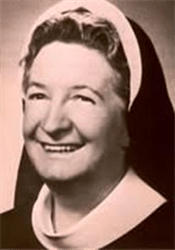
gonzales_duffyThe women in our own histories will always be the most important women in our lives. Our mothers and grandmothers, aunts and honorary aunts, teachers, coaches, students, and teammates. And for almost everybody, there is that one person you did not even realize would become a part of your history yet found a way to be part of much of your life without actually being there. For me that woman is Mary Gonzales Duffy, RSM.
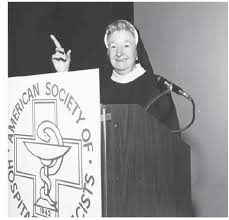
Sister Gonzales was a Religious Sister of Mercy. She was already a force in hospital pharmacist when I opened the mail and dug out my pharmacy intern certificate in 1975. If you have ever been a patient in a hospital and received a drug while you were there you benefited from some contribution of Sister. Sister Gonzales was one of those women who did not contribute to the history of pharmacy, she is the history of pharmacy, particularly hospital pharmacy. In 1962 working with the Mercy Hospital of Pittsburgh and Duquesne University School of Pharmacy she established the first postgraduate, academic residency in Hospital Pharmacy. She formalized drug information services, unit dose distribution methods, and pharmacy consultation services. In 1978 she was elected the first woman president of the American Society of Hospital Pharmacists (now American Society of Health System Pharmacists). That same year she was honored by Duquesne University at their centennial celebration as one of the top 100 alumni.

More than just a collection of her accomplishments in hospital pharmacy, Sister’s legacy reflects her gentleness and respect for those she served, as a pharmacist, as a nun, as a complete person. Sister was still working during my undergraduate years at Duquesne. Even when she received the Harvey A. K. Whitney Award, what is considered hospital pharmacy’s most prestigious award, in 1971, she was just Sister in the pharmacy moving it from a “service of things to a service of people.” Important women in hospital pharmacy are not uncommon, nor is acknowledging them. By the time Sister received her honor in 1971 she was in a long list of women so recognized going to 1953 in an award established just 3 years earlier. Still, she is the one I remember, the one who taught at the school where I learned, who lead the first hospital pharmacy I saw from inside its walls, the one who encouraged me and other young white coated future pharmacists to serve from the outside those walls.

Sister Gonzales closed her Whitney lecture with, “There are some in our modern society who claim we live in an age of insensitivity. Perhaps we do, but I hope not. There should be no taboo on tenderness. … May we be mindful of the fact that our Creator, who has placed us here on earth to do a work, touches the world mainly through the ministration of human services. We labor in an atmosphere where frequently good must battle evil, where some must suffer and die. May it be our happy task to ease the ways of all those for whom we care. May we be brought to the realization that true happiness is found in the knowledge that a job assigned to us here and at this point in time has been a job well done.”

Hers was a job done well, her job as a pharmacist, as a teacher, as a religious, as a part of history.

SrGonzales

You’ve Got a Friend in the Pharmacy

Tomorrow is a special day for me. Almost as special as Groundhog Day (and if you read this blog for any of the last 8 Groundhog Days you know how special that day is). January 12 is National Pharmacists Day. It’s special to me because even though you might think I could make a decent living on the goofy blog circuit I actually have a professional side to me and for over 40 years have hung a hunk of paper from the state’s board of pharmacy declaring me to be one of them. Pharmacists not groundhogs.

National Pharmacists Day is an opportunity to recognize all pharmacists for their contributions to the nation’s health and health care systems throughout the country regardless of their practice settings or specialties. Yes pharmacists work in a variety of health care settings and do sit for specialty boards in a variety of conversations from psychopharmacology to eldercare.

Pharmacists trace the root of the profession to ancient Egyptian, Greek, and Roman civilizations. Recipes for remedies have been found on papyri dating to the 15th century BC. In the 1st century AD, the Greek physician Dioscorides wrote his five volume textbook on the practice of medicine and the use of medical substances and remedies. Pharmacy and medical students may more readily recognize its Latin translation De Materia Medica. It would another 700 year though until individuals took on specific roles of preparation and dispensing of medicaments that we associate with the specialty of pharmacy when the Taihō Code defined this role in 701 at the end of Japan’s Asuka Period. The roles of pharmacists and physicians would sometimes separate and sometimes blur through the first half of the second millennium. In 1683 the city council of Bruges formally separated the practices and passed an ordinance forbidding physicians from filling medication orders for their patients.

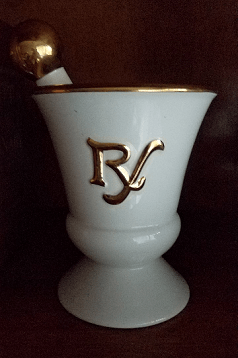
MortarBeforeIn the United States, Benjamin Franklin is credited for creating an autonomous apothecary within the Pennsylvania Hospital which opened in 1754 in Philadelphia. Although apothecaries were operating in the North American colonies, the pharmacist physician separation was not the standard practice as it was becoming common in Europe and England. Franklin’s insistence on the establishment of a separate service for the hospital was seen as an opportunity for drug research and development as well as to manage and dispense a fragile inventory.
Since 1754 pharmacists have taken more diverse roles, formally specialized, led development, and revolutionized education. Still the pharmacist is a dispenser. Whether of medications or information, whether to ambulatory patients, hospital staff, nursing home residents, fledgling students, or even to the International Space Station, pharmacists’ role is to give. Pharmacists embrace that role regardless of where they practice and continue to hone their skills and define their roles.

If you should happen to cross paths with a pharmacist tomorrow, join the dozens of people who even know this special day exists and wish him or her a Happy National Pharmacist Day!

Reach Out But Don’t Touch Someone

I saw this posted on Instagram last week and I was certain that had they had more than this in 1918 we would still be in the throes of the Spanish Flu pandemic although by now it would be epidemic because only in the U.S. would there still be people claiming “it’s going to go away.”
 20200718_192656
 
Imagine being able to share your opinions with only the closest of friends and family. It had to be with only those closest to you or you’d be broke long before your mask wore out. In 1918 when this ad was published*, although local service was only $1.50 a month, long distance was pricey, and long distance started not that far away. A cross country call ran about $5 per minute, cross state a little less than $2, and cross town, as much as 15 cents per minute. All in a time when the average 3 bedroom apartment was renting for $10 a month and a laborer was clearing $5 a day when a day’s work was available. 
 
There was no hue and cry over masks, isolation, soap shortages, or whether college football will be played this fall. Well, they may have been huing and/or crying but you kept it to yourself rather than passing yourself off as some sort of an expert because you read something in the Evening Star. (Although in fairness to this pandemic’s questionable coverage, that of 100 years ago was also often sparse, conjecture laden, contradictory, or all three.) (And then some.) (But then 1920 was also a Presidential election year so why should they have expected any less.) (Or more.)
 
There’s a particular hue being cried in our neck of the woods. A local amusement park is being sued because it is requiring all patrons to be masked at all times and on all rides, the exceptions being in their food venues while one is eating. The suit is brought by the parent of a child with sensory challenges and cannot wear a mask and the prohibition to entry without one violates to his rights. I don’t claim to be a Constitutional lawyer but my cursory review of the document didn’t reveal reference to the freedom of rollercoastering. Perhaps she’s hanging her mask on the line “life, liberty, and the pursuit of happiness” from the Declaration of Independence. The suit led by a mother who states she also has anxiety and cannot wear a mask had gathered the support of several other families and seeks compensatory and punitive damages for pain, suffering, anxiety, humiliation, emotional distress, and “the loss of the ordinary pleasures of life.” 
 
Silly me, I always thought the ordinary pleasures of life were music, reading, sitting under a tree on a sunny day, friends, food, and chasing dreams never meant to be caught. I suppose I should call my lawyer for further clarification. Fortunately it’s not long distance. 
 _____
*The person who originally posted this noted it was an actual ad from 1918 and I have no reason to doubt her, she not being one prone to hype, hysteria, or hyperbole**. However, that phone looks more like what was most common after 1920. But then on the other however, it is an ad from a telephone company so they would likely illustrate it with the most cutting edge equipment they have. You don’t see T-Mobile pushing iPhone 6’s.
 
**Okay, I have to ask this, what do you think about hype and hyperbole? In the dictionary, “hype” in the sense of extravagant promotion includes it first entered the English language in 1920 from the United States but with no etymological origin, or more often, “origin unknown.” I’m thinking it came about when fast patter was taking hold in informal speech and was most likely just a shortened version of hyperbole, which was convenient because it shortened the word dramatically and important because it shortened a word most people tend to either misspell or mispronounce. 
 
***You can stop looking for three asterisks in the post body, there isn’t one. Well, actually there is one asterisk but there isn’t one instance of 3. Anyway…speaking of misspellings, I had a heck of a time getting spellcheck to let me keep “throes” in the first paragraph. It insisted I really meant to type “throws” or “thrones” and would not take my word for it that not only did indeed I want “throes” I want it added to the dictionary. This from a program that has no problem adding words I legitimately misspelled and then have to go through Tartarus**** and back to remove. 
 
****That it knows!
 

Still Singing

A, B, C, D, E, F, G…
 
Happy birthday to me,
Happy birthday to me, …
 
Karma, karma, karma chameleon…
 
If I were a rich man, 
Daidle deedle daidle
Daidle daidle deedle daidle dumb.
All day long I’d biddy-biddy-bum,

If I were a wealthy man.

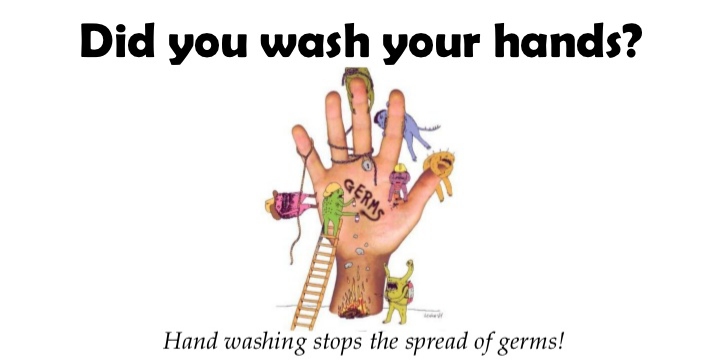
Are you still singing while you wash your hands? Are you still washing your hands? It’s a valid question. Mankind in general is not known for neither patience nor perseverance and washing your hands for a full 20 seconds every time you go to the sink takes both in quantities not many of us have. And it’s only been a few weeks. You should get used to it.  Even in the absence of a pandemic you should get used to it but I’m thinking we are probably in for a longer ride than just a few weeks. Or even months.
..
Do you realize this isn’t the first pandemic to hit the world in the first quarter of a century? Let’s review:
  • 20th century, 1918-1920, Spanish Flu, 50 million dead
  • 19th century, 1817-1824, Cholera, 25 million dead
  • 18th century,  1710, Smallpox, 8 million dead
  • 17th century, 1603-1685. Plague, 3 million dead
  • 16th century, 1520, Smallpox, 56 million dead
  • 15th century (Quiet, but there weren’t that many people left.)
  • 14th century, Plague, 1330 – 1353, 200 million dead!

Okay, so I cheated on the 14th century but I bet the Black Death as it is so famously known had its actual beginnings before 1325. You don’t just wipe out 60% of the population without a running start. And there were others...

Except for the two smallpox outbreaks do you notice something. None look like they were over in just a few weeks. You can tell by the way they stretch over years. One over an almost entire century. I don’t know how much a factor it will be in minimizing our duration, but sticking to those 20 second handwashings along with the social distancing and otherwise minimizing contact will be a positive factor. I’m just not sure if we can call it a possible factor. Like I said, patience and perseverance aren’t our strong suits.
..
Look at the most recent respiratory pandemics, all post 1950 so they are all within some of our lifetimes and all within the ages of mass communication, modern medicine, and soap. The Asian Flu pandemic of 1957-1958 killed 1.1 million people worldwide. The Hong Kong Flu of 1968-1970 was responsible for 1 million deaths. The Swine Flu pandemic hit from 2009-2010 and killed approximately 250,000 people. (As of April 7 COVID-19 deaths worldwide total about 75,000. COVID-19 was first reported in December 2019, noted a worldwide public health emergency by the World Health Organization on 30 January 2020 and then declared a pandemic on 11 March.) All of these stretched over at least 2 years. Viruses are sneaky little devils and they hide out well.
..
I would like to say at least the death totals are going down but the latest numbers have COVID-19 responsible for a third of the number of deaths of the Swine Flu in less than 4 months.
..
Next week I’ll post another more lighthearted take on something happening around me but for now, let’s get back to singing those songs, staying in, and, particularly now when every worldwide religion is celebrating some holiday, praying if you got them.
..
Alright, altogether now:
Wash, wash, wash your hands.
Scrub them in the stream
Vigorously, vigorously, vigorously, vigorously.
Ain’t life just a dream?
(Repeat)
..
20200407_190745
5ff939b4cfc60c492670d8b758d99eb2

More Lessons on Ice

When they were picking teams for dodge ball in the playground behind the school, were you one of the last to go? OK, clearly I’m old. You can tell by the references to dodge ball, playground, and the picking of teams for any activity not associated with trivia night at the bar. Even if you are too young to remember these, or too savvy to acknowledge them, you probably have heard of such things as being “picked last in grade school for..” in many episodes of The Big Bang Theory. And you know it didn’t get them down. They all now make lots of money and are really big stars. I’m sorry, I’m mixing real life with fantasy.

But somewhere being unwanted and reaching a modicum of pinnacle-ness of success is happening right here in North American reality. Those are the NHL Vegas Golden Knights. The first expansion team to reach the Stanley Cup Final and proof once again that all you need to know to survive and succeed you can learn from hockey.

Ok, first things first. I said the first expansion team to the reach the final round and you keep hearing in the sports reports that they are the second. Technically, the St. Louis Blues reached the final in their inaugural year but only because in 1967 the NHL decided to make one conference out of all six expansion teams and the other one out of the existing six teams, thereby guaranteeing an expansion team a spot in the finals. Five of the six “Eastern Division” existing teams finished the season with more points than any of the six expansion “Western Division” teams and the Montreal Canadiens swept the final round in four games.

VGN

Vegas Golden Knights

Enough of history though. Back to the future when the Golden Knights will be the first expansion team to get to the Stanley Cup Final by winning their way there. With a team made up of a bunch of guys nobody wanted. When the expansion draft that stocked the Vegas team with players took place last year, each existing team was allowed to protect 10 or 12 players depending on how many offense versus defense skaters were included on the protected list and that included a goaltender. Each NHL team can dress 24 players (usually 22 skaters and 2 goaltenders) per game. So the existing teams could protect up to half of who they would put on the ice for a typical game. And Vegas could select one of the remaining “bottom half” talent.

And out of this group of players not wanted by anybody else, players who call themselves the “Golden Misfits,” skated a team who finished with the fifth most points, won the fourth most games, and scored the third most goals of any of the 31 teams in the league. And they are about to begin the fourth and final round of the Stanley Cup Tournament which this year will determine if misfits is synonymous with champion.

Moral of the story? Being picked last for dodge ball isn’t the end of the world. Don’t treat it like it is.


A Date That Will Live

The day that will live in infamy is becoming forgotten in the parts of the world that knew of it to begin with. The 2400 killed in the attack and the 400,000 Americans who died after the U.S. entered World War II, did not perish so others can live in oblivion.

While we’re good at commemorating things we’re also good at forgetting the impact those things had on the people who lived through them and why they took the positions they did. The service men and women who died on December 7, 1941 didn’t know they were putting their lives in jeopardy when shortly after dawn 414 planes rained terror on the American fleet harbored 50 miles west of Honolulu.

There was no U.S. involvement in the war in August 1939 when many of the sailors and soldiers enlisted who then found themselves on Oahu twenty-eight months later. There were world issues but they weren’t entering the service knowing they would be destined for the front lines. They made a decision to serve knowing the country needed individuals willing to be ready on any day to go from “training” to “executing,” from active duty to actively doing, probably with no warning.

On December 8, Franklin Roosevelt addressed a joint session of Congress opening his remarks with the now famous, “Yesterday, December 7, 1941—a date which will live in infamy—the United States of America was suddenly and deliberately attacked by naval and air forces of the Empire of Japan.” Those words get quoted at least once a year, every year, a day shy of the anniversary of their first utterance as we remember the event that thrust thousands of so many of enlistees onto the front line.

PearlHarbor

Source: History.com

President Roosevelt’s words that came after the famous ones are often lost to history. “No matter how long it may take us to overcome this premeditated invasion, the American people in their righteous might will win through to absolute victory. I believe I interpret the will of the Congress and of the people when I assert that we will not only defend ourselves to the uttermost, but will make very certain that this form of treachery shall never endanger us again.”

That last phrase again was, “…make very certain that this form of treachery shall never endanger us again.” Unfortunately it did. Almost 60 years later almost the same number of people were killed at 3 sites on September 11, 2001 when 4 planes took aim on America.

So if today you find yourself calling today’s date one that will live in infamy, remember to also say to yourself, “Those who cannot remember the past are condemned to repeat it,” and give today a little life.


Allow Me to Introduce Myself

You’d think after running into somebody five hundred times you’d probably know him pretty well. If you’ve read every post I’ve uploaded you would have gotten 500 pieces of my mind, and as I look back at some of them, there isn’t that much there to really let you know who I am. Before I go on, let me say that if you’ve read every post I’ve ever uploaded you might be that person out there who actually has more time on his or her hands than I do. We may have to talk about that.

Five hundred. That sounds like a lot, doesn’t it? Certainly it’s not in the same league as 19 trillion as in the U. S. National Debt, 9 billion as in Apple’s 2016 fourth quarter net income, or even 32 million as in Hillary’s net worth. Still, if somebody offered me 500 – as in dollars – I’d be considering just what unnatural act I’d be willing to consider for such a payoff. But the five hundred I’m talking about isn’t any form of currency. No, it’s more like those 500 meetings from the first paragraph. It’s the 500 posts that I’ve uploaded to the Real Reality Show Blog since its debut on November 7, 2011.

Wait a minute. I see you. You’re number crunching. Five hundred posts in a five years and two months. Plus a few days. That’s not so many. Some people post something every day. Some people post more than one something every day. I might have that kind of time but I’m not that kind of ambitious. I figured when I started this that a couple of times a week would be plenty for anybody to hear from me. After all, the intent of this was to demonstrate to the world what reality really looks like to normal people. And back then I was leading a fairly normal life.

So twice a week seemed to be plenty. Yet somehow, even posting twice a week for over five years I can honestly say that if I didn’t know who I was before I read any of these ramblings I wouldn’t know that much about me after. Yeah, I like pizza, hockey, and maple syrup. I hate fine print on TV ads, people who insist on bringing their three-suiter suitcase and then continue to insist that it will fit in the overhead compartment, and waiting in line to be seated at restaurants. But who am I? You know I’m male, I live somewhere north of the Mason Dixon line, I’m past middle age unless I get to one hundred (I’m holding out for that), and I had a happy life and enjoyed poking fun at it up to about three years ago when life poked back and hit me with a still ongoing frenzy of medical issues. But outside of that, who am I?chefman

I’m probably you. You see, although this never intended to be an anonymous blog it sort of ended up that way. At least sort of. But that was ok. I wanted it to be a reflection of what everybody is. Whether man or woman, boy or girl, young or old, or whatever you want yourself to be of any of the above.  Whether American, Canadian, British, German, Australian, Indian, Italian, Vietnamese, Brazilian, or from anywhere else readers have found their way from, this was supposed to be so you could see yourself in that post. I might have put the idea out there but they all have been pretty universal ideas. Everything from the spirit of sportsmanship in the Olympics to using time travel to eliminate crowding leftovers in your refrigerator.

Every other milestone I’ve hit I’ve spent the entire post assembling links to my favorite posts of that particular achievement. I looked back over the most recent 100 posts and found that I kind of like them all. They’ve all come at a pretty stressful but still very gratifying time of my life. They might be a little more revealing than the 400 that came before them but they still can be seen through anybody’s eyes. Maybe even yours. So instead of me telling you which are my favorites, I invite you to keep scrolling through to find and read, or hopefully to re-read, your favorites. If I did it right, each time I posted my thoughts there was enough universality in them to stimulate some of yours too.

Will I get around to writing another 500 posts? As long as someone keeps reading them I suppose I’ll keep posting them. And since I insist on reading each one each time after it’s posted I guess I’m stuck with it. If you’d like to continue along with me, feel free. It would be really nice of you. I’m glad we met.

That’s what I think. Really. How ‘bout you?


It’s ____ (8 letters)

It’s the first day of winter, the first of summer for those of you south of the Equator. That makes it the shortest day of the year, or the longest again for those in the southern hemisphere. And that’s good news! The days are going to get longer and back to consistently warm and pleasant. Or bad news and the days will be getter shorter and colder. It’s like a tale of two cities, or worlds. And it’s all very puzzling.

And that reminds me…today is also International Crossword Puzzle Day! (How’s that for a cheesy segue?)  (Sometimes you really do get what you pay for.)

Crossword Puzzle Day, December 21, the 102nd anniversary of the first publication of what would soon become a worldwide fascination with filling in little squares on a rectangular grid based on sometimes obvious, sometimes cryptic clues in the morning paper over morning coffee sometimes wishing it was something much stronger in that cup.

Crossword puzzles are pretty universal. Everybody knows of them, almost everybody has completed at least one of them, and a whole lot of somebodies work at one or more of them just about every day. Crossword puzzles sharpen the mind, improve vocabulary, and provide bragging rights for the nerdier ones of us out here.

I had done a puzzle or two here or there usually to relieve boredom perhaps on a flight when I had forgotten a book and was tired of paging through the in-flight catalog. Then I ended up in the hospital.  When I got to the point that I was looking forward to watching The Price is Right I knew that I was in deep doodoo. That’s when my daughter downloaded a crossword puzzle app for my tablet. Since then I have acrossed and downed my way back to mental health.

I still do a puzzle a day and my mind is sharp, my vocabulary adequate, and I’m just as nerdy as always and darned proud of it. Even if I don’t know the value of today’s shopper’s showcase.

That’s what I think. Really. How ‘bout you?

Want to work on that first crossword puzzle. To see it and read a history of crossword puzzles click here to read Tiffany Crawford’s article on the 100th Anniversary of the Crossword Puzzle in 2013 in the Vancouver Sun.
http://www.vancouversun.com/life/This+History+December+1913/9311790/story.html