Happy Christmas to All

Merry Christmas to all,
and to all a good start for
a healthy, happy new year!

Buon Natale

Frohe Weihnachten

Veselé Vánoce

Joyeux Noël

Nollaig Shona

Priecīgus Ziemassvētkus

Feliz Navidad

Hyvää Joulua

Boldog Karácsonyt

Feliz Natal

Nadolig Llawen

Mutlu Noeller

Geseënde Kersfees

Selamat Hari Natal

Linksmų Kalėdų

Gëzuar Krishtlindjet

Sretan Božić

Glædelig jul

Maligayang Pasko

Häid jõule

Wesołych Świąt

Καλά Χριστούγεννα

Lorem Nativitatis

Merry Christmas!


Our gift from ROAMcare to you is finding 7 gifts that make the best re-gifts. Read It’s Better to Re-Give here.


labefana

“Happy Holidays,” he said.

In Miracle on 34th Street Santa Claus declares, “Christmas is not just a day, it’s a state of mind.”
 
I think he was absolutely right. And it’s not just Christmas. It is Christmas, Hanukkah, Kwanzaa, Yule, Saturnalia, or any of another dozen religious and secular holidays. The honored guest may differ but the driving force is the same in all: a celebration of life. Maybe new life, maybe preserved life, maybe life’s good health, or maybe the emergence of life. Life, common to all.
 
The fact that Christmas gets the bulk of recognition in the United States certainly colors the way Americans greet and celebrate with each other come late December. Being Americans we also go out of our way to inform the world in what somebody is sure are no uncertain words that we don’t play favorites, every one is equal, and if we wish you a Merry Christmas we really mean happy whatever you choose to celebrate today, this week, or this month.
 
Um, sorry, but no we don’t. We really mean Merry Christmas. Okay, I really mean Merry Christmas. But I don’t mean it in a mean way. You see I know how to wish a Merry Christmas to you. I don’t know how to wish you a anything else. When I wish you my Merry Christmas I wish you the peace and joy of the season. In my season that peace and joy is manifest in new life. 
 
20191222_214028Peace and joy. Because I don’t celebrate Hanukkah or Kwanzaa, although I know the words I don’t know their meanings to the celebrants of those words. But I know if they were to greet me with words customary to their celebrations that whatever the words would be there would be an underlying message of peace and joy, continued good health and a happy life. And I would be grateful for that wish.
 
Over the years the winter festivals have caused considerable consternation but have also been the source of considerable moments of peace. Even as wars raged there were moments when hostilities abated and peace fell even if not with much joy. It would be a great advancement to life if we could spend less time concentrating on the words and more time on the message.
 
Peace and joy to you however you find it, today and forever in your state of mind.
 

Color My World

First the good news. I’m out of the hospital. Now the bad news. We are in a color rut.

While I was in the hospital my daughter would bring get well cards that popped up in either of our mailboxes. I don’t know about anybody else but I have hard time with cards in the hospital. There’s so little room to begin with and what space is there is loaded with stuff. Hospital stuff. Bags and bottles, water and tissues, and those funny machines you breathe in on to keep you from getting pneumonia. But it was nice to see them, read them, and call the well wishers when I had a few moments. But the cards went back home so they would not be lost or thrown away.

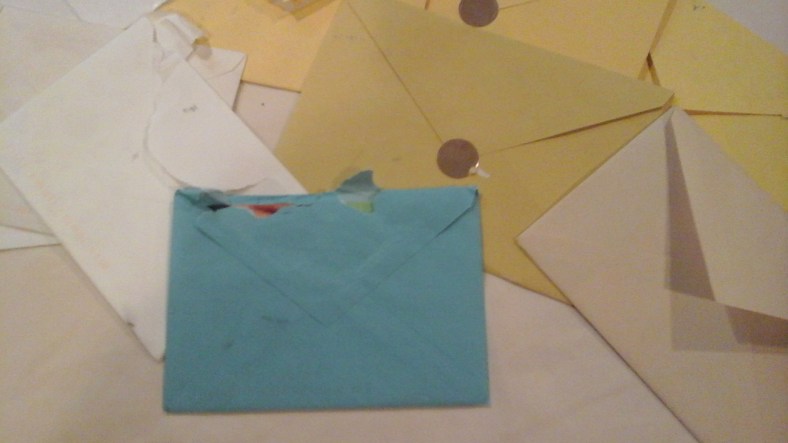
When I got home I had a chance to take them all out and really read them and the notes so many had added. Then my daughter noticed it. “Are they color coding greeting cards?” She had observed, and observed correctly, that the vast majority of the get well cards were contained in yellow or some shade of yellow envelopes. There were also about half as many white, two brown, and one lowly blue card cover.

20190617_150159

Naturally this led to other occasions and what is used to wrap those greetings. Some were easy and unanimous (although with only two of us participating in the survey, unanimity was hardly conclusive). Envelopes for St. Patrick’s Day cards while we aren’t certain why they exist exist in green, usually swaddling a card portraying a drunken cartoon leprechaun or somebody presumably more than a little tipsy wearing beer goggles. Yellow envelopes when not paired with get well cards wrap themselves around Easter cards. Valentines come with red envelopes, Hanukkah cards are festooned in blue, First Communion, Confirmation, and Wedding cards get white envelopes, and Halloween cards, which confound us as much as St. Patrick’s Day cards, are distributed with orange envelopes. And although we’d think a black envelope for a sympathy card could catch on, they always seem to be in a plain white wrapper.

Some cards have standard colors but more than one. Christmas cards can be counted on the be in red or white envelopes with an odd green cover tossed in now and then. Thanksgiving is usually celebrated in brown or other earth tone shade although an orange envelope apparently left over from Halloween may pop up. Baby shower cards have the predictable pink or blue or the unpredictable white enclosure.

And some cards make no sense at all. Although you can almost count on a Mother’s Day card being in a pink envelope, a Father’s Day card might be in almost any color cover. And birthday cards exist with a rainbow of choices of envelope color.

I suppose somehow it all makes sense and although it’s rather formulaic it’s the system we’ve gotten used to. My question is who responsible and if I want to corner the market on Waffle Iron Day cards (which is coming up on May 29) do I have to submit an envelope color proposal before I willy nilly make them maple syrup amber?


Looking Good

I’m going to do something today that I usually don’t. I’m ranting. Well…not exactly ranting. A rant implies wild and impassioned speech. I may be passionate about a bunch of stuff but I’m not wild. I’m not even undomesticated. So I’m not exactly ranting but I am upset. Maybe even a little annoyed.

I just read a post – no, that’s not true either – I just read two-thirds of a post, supposedly to make me, as one with a chronic illness, feel magnanimous towards those who have the nerve to say to me,  “You look good.”  Apparently before I had the benefit of the sensitivity of whoever wrote that drivel, err…. that post, I was supposed to be bothered, irked, and/or insulted by that comment. Really?!?

Yes, I have a chronic condition. Three actually. If you’ve read this for a time you know I have kidney disease and am on dialysis (and the specific target of the aforementioned post). I am also told that I am a cancer survivor though one really never survives as much as finds a way to eliminate its immediate danger. For me that meant the physical removal of the cancer and along with it two and parts of third internal organ while now still learning how to live without otherwise vital body parts. The third is a one of those rare diseases that is so rare you don’t even get to see commercials on TV for drugs that might or not might not improve my chance at a normal life. Instead that one has been kept at bay for 15 years or so by a relatively dangerous drug regimen that probably helped me join the ranks of the first two chronic conditions that I mentioned but at least it kept me alive long enough to develop them. Anyway, when someone tells me that I look good I say thank you. Apparently I’ve been doing that wrong.

If I read the part of the article that I read correctly, I read that first I should consider that the person who is telling me how wonderful I appear doesn’t mean anything insensitive by it. He or she probably doesn’t know how painful and depressing my ailment is. Ailments are. Next I should consider exactly how well I know this person. Perhaps some people are mistaking my healthy appearance for a healthy appearance because they don’t know the full extent of my painful and depressing ailment. Or ailments. Then I should thank them for their thoughtfulness but gently remind them how painful and depressing my ailment really is. Are. Is. I’m not sure what I’m supposed to do after that because that’s when I threw my tablet across the room. (After making sure I was aiming it at a very soft pillow. I might have been annoyed but I’m not crazy.) (Not even wild.)

So, since I was unable to finish that drivel, err…. that post, let me tell you how to respond when someone comes up to you, whether or not you have a chronic condition, and whether or not he or she does, and says, “You look good.”  Say thank you and repay the compliment.

By that way, you’re looking pretty good. Have a nice day.

The Hi Guys

“’S’up.” “Hey” A nod up. Then another. One went east, one west. And the world kept turning. Thanks in part to the Hi Guys.

The Hi Guys are those guys (generically speaking of course – guys, gals, hims, hers, undecideds, too young to tell, too old to matter, too desperate to care – all of those) those guys are the guys that nod a “hello” to a perfect stranger one meets walking down the road, crossing a lobby, waiting for an elevator, or standing in front of or behind in a really long, really slow line – or on the line if that’s your geographic preference.

HiGuys

Drawing by me. Can’t you tell?

It’s just a nod, a recognition that says “Hey, you too are human and we are all part of a team and I recognize your contribution even if I don’t know you, don’t care if I ever know you, might never see you again, and will be just as happy if I do or if I don’t.” Sometimes that’s really hard to do. It’s easy to give that little finger wave over the steering wheel when you see a neighbor taking the dog for a walk along your own street on your way to work in the morning. But to acknowledge a total stranger, no, more than that, to show value to a total stranger is quite another.

Think of the number of times you run across somebody you don’t know versus the number you do of the number you do. (It might be awkward but if you parse that sentence you’ll see it works. Just like the Hi Guys!) An Oxford University study (Oxford, really) confirmed that the human brain can manage only 150 friendships. A simple “Hey, how ya doin’?” can expand your circle to unknown numbers. And make you smile at the same time.

Remember when you were a baby – probably not but you probably have seen babies. When a baby smiles at someone and makes that baby gurgle that only babies can make, everybody smiles back. Even me, and I’m usually fairly grouchy. So if a baby, who probably doesn’t understand that the world needs a little help to keep turning, can make a total stranger smile and feel good even for just a second or two, you can do it also.

So, keep the world turning. Become a Hi Guy*!

That’s what I think. Really. How ’bout you?

*I thought of this a couple of days ago when I was running into the store and stopped at the entrance to let a fellow carrying a double armload of grocery bags come out of the doorway before I went in. I didn’t expect a thank you for anything since I didn’t do anything. The door was automatic and wide enough for both of us.  As I passed him on my way through I did my usual nod and said something like hi or h’lo (the local equivalent of hello). He paused and sort of half-turned and said back to me, “Hey. Thanks.” And smiled. A real smile. I thought to myself, wow, somebody really does pay attention to that half-grunt I make now and then. That could be blog-worthy. Well, after I wrote this I thought I’d do a quick search for “Hi Guy.” I don’t know why, I just did. Maybe because I’m getting sort of up there in years and things sometime mean different things now than then. And sure enough I found something. My go to for stuff like this, the Urban Dictionary, defines “Hi Guy” pretty succinctly as a salutation to a man or woman. Clean enough for my purpose. Then I went one step further and plugged it into Google. There I found a link to “Lingomash” pronouncing that my Hi Guy in slang means “(1)Excl. When something outrages (sic) or unusual occurs. (2)Excl. When you don’t agree with one’s actions.“ Well that’s not right at all. Since I don’t have anything else to write about I’m going to ask that if you know “Hi Guy” as this completely antithetical twist to what I just wrote, could you please not tell anybody else. Thanks.

Oh, and one more thing. Some of you might remember “Hi, guy!” from the Right Guard commercials of the 1970s when two guys share a medicine cabinet and every morning they “bump into” each other in the bathroom. They were great. One guy would open the cabinet on his side of the wall and the other would be there and he bursts out with “Hi, guy!” It went on for years and the actor (Chuck McCann, an already well established actor) became known as the Right Guard Hi Guy. Except that in the very first commercial of the series he never said “Hi, guy.” If you should be wondering, here’s a link to it. Hi Guy.  (by Genius via YouTube)

I just realized my “post script” is longer than “letter.” I should stop now. In fact, I will. Really.