It will be hockey nights in just a couple more. NHL hockey returns October 3. In recognition of this momentous occasion I’m repeating one of my favorite posts, “Everything I Know About Being a Gentleman I Learned From Hockey.” Why? Because everything I learned about being a gentleman I learned from hockey, that’s why. If only politicians watched more hockey.
So, from November 2016, I give you…
When I was at the hockey game this weekend I got to thinking how much as a society we can learn from hockey. Yes, the sport that is the butt of the joke “I went to a fight last night and a hockey game broke out,” is the same sport that can be our pattern for good behavior.
Stay with me for a minute or two and think about this. It started at the singing of the national anthem. I’ve been to many hockey, baseball, football, and soccer games. Only at the hockey games have I ever been in an arena filled with people actually singing along. Only at the hockey games are all of the players reverent to the tradition of honoring the country where they just happen to be playing even though they come from around the world – Canada, Russia, Germany, Sweden, Finland, even a few Americans.
A decent dose of nationalism notwithstanding, hockey has much to offer the gentility. Even those fights. Or rather any infraction. If a player breaks the rules he is personally penalized for it. Ground isn’t given or relinquished like on a battlefield, free throws or kicks aren’t awarded to the aggrieved party like victors in a tort battle. Nope, if you do something wrong you pay the consequences and are removed from play for a specified period in segregation from the rest of your teammates. No challenges, no arguments, no time off for good behavior. Do the crime. Pay the time. In the penalty box. Try doing that to a school child who bullies and you’ll have some civil liberty group claiming you’re hurting the bully by singling him out.
Hockey is good at singling out people but in a good way. At last Saturday’s game the opposing team has two members who had previously played for the home team. During a short break in the action a short montage of those two players was shown on the scoreboard screens and they were welcomed back by the PA announcer. And were cheered and applauded by the fans in attendance. There weren’t seen as “the enemy.” Rather they were friends who had moved away to take another job and were greeted as friends back for a day.
While play is going on in a hockey game play goes on in a hockey game. Only if the puck is shot outside the playing ice, at a rules infraction, or after a goal is scored does play stop. Otherwise, the clock keeps moving and play continues. Much like life. If you’re lucky you might get to ask for one time out but mostly you’re at the mercy of the march of time. Play begins. After a while play ends. If you play well between them, you’ll be ok.
The point of hockey is to score goals. Sometimes goals are scored ridiculously easily, sometimes goals seem to be scored only because of divine intervention. Most times, goals are a result of working together, paying attention to details, and wanting to score more than the opposing team wants to stop you from scoring. There is no rule that says after one team scores the other team gets to try. It all goes back to center ice and starts out with a random drop of the puck. If the team that just scored controls the puck and immediately scores again, oh well.
Since we’re talking about scoring, the rules of hockey recognize that it takes more than an individual to score goals. Hockey is the only sport where players are equally recognized not just for scoring goals but for assisting others who score goals. Maybe you should remember that the next time someone at work says you’ve done a good job.
 The ultimate good job is winning the championship. The NHL hockey championship tournament is a grueling event. After an 82 game regular season, the top 16 teams (8 from each conference) play a four round best of seven elimination tournament. It takes twenty winning games to win the championship. That’s nearly 25% as long as the regular season. It could take as long as 28 games to play to the finish. That’s like playing another third of a season. After each round only one team moves on. And for each round, every year, for as many years as the tournament has ever been played, and for as many years as the tournament will ever be played, when that one team wins that fourth game and is ready to move on, they and the team whose season has ended meet at center ice and every player on each team shakes the hand of his opponent player and coach, wishing them well as they move on and thanking them for a game well played. No gloating. No whining. No whimpering. Only accepting.
So you go to a fight and a hockey game breaks out. It could be a lot worse.
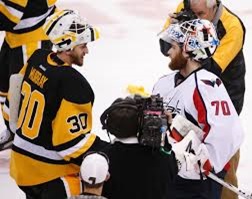 The ultimate good job is winning the championship. The NHL hockey championship tournament is a grueling event. After an 82 game regular season, the top 16 teams (8 from each conference) play a four round best of seven elimination tournament. It takes twenty winning games to win the championship. That’s nearly 25% as long as the regular season. It could take as long as 28 games to play to the finish. That’s like playing another third of a season. After each round only one team moves on. And for each round, every year, for as many years as the tournament has ever been played, and for as many years as the tournament will ever be played, when that one team wins that fourth game and is ready to move on, they and the team whose season has ended meet at center ice and every player on each team shakes the hand of his opponent player and coach, wishing them well as they move on and thanking them for a game well played. No gloating. No whining. No whimpering. Only accepting.
 The Real Reality Show Blog