Nickel and Diming the Penny Pinchers

I didn’t believe it. There was no reason to doubt her, but when my daughter told me there is a difference in English muffin prices I didn’t believe her.

Specifically, we were talking about Thomas’ English Muffins in your basic grocery six pack, the goto English muffin for both of us. When we feel like splurging. C’mon! Thomas’ are expensive for just a little something extra when you don’t want plain toast for breakfast. I found a store brand that was mighty tasty for less than half what the Thomas brand runs in our neck of the woods. Over two dollars less. “In fact,” I said, “They’re two and a quarter cheaper.” And that started it.

She explained to me that what I found was indeed $2.25 less than the PLAIN Thomas muffin. (In fact, it was $2.27 but why quibble over a couple pennies when so many countries are no longer even minting penny equivalents of their coinage. I’m still not sure why the American monetary police insist on continuing to print $1 bills, the paper equivalent of useless money. But, that’s a different post for a different day.) I tried to beg to differ but you can’t beg in front if your own child so I just differed with a simple “Nuh uh.”

She went on to say she was certain the wheat, raisin, oat bran, super duty extra protein, and seasonal limited editions are all increasingly increasing in suggested retail prices (that for grocery stores is the retail price or why have door buster savings every week?) ranging from $4.26 for plain to $5 and change for double protein. I still resisted based on the logic that all of my Cheapo Brand Muffin were $1.99 across the board from normal to off brand bran. Since it wasn’t greatly affecting my savings or her inheritance we left it as a supermarket curiosity. One of millions down every aisle.

You know I couldn’t leave it there though, could I. No. If I did, we’d have no post today. So the next time I was at the store I wandered down the English muffin aisle, and I didn’t even need English muffins. (Talk about being dedicated to my blog readers.) I find my bargain basement brand right there on the bottom shelf where all off brands belong, each iteration bearing the shelf tag $1.99. Above them, strategically placed at eye level was the Thomas English Muffin lineup. And under the plain muffin was the shelf tag with the not on sale price of $4.26. And next to those, the wheat muffins priced at $4.28, and so on to the Double Oatmeal Protein at $5.38. Who would have thought it?

While I was there, I thought I’d treat myself and pick up a pack of the cheapos. Wheat. If I was going to save I may as well splurge on it. Or whatever is the word for when you intentionally save more. The next morning I was preparing breakfast and thought I deserved more than toast and reached for an English muffin. Even though I still had a couple of plain muffins I opted for wheat and cracked open the new package. Take that Thomas muffin people! Try and gouge me just because I want wheat. I don’t think so!

As I was splitting it I had that feeling that something wasn’t right. It didn’t feel right. Not the feeling. The muffin. It seemed to not fit my hand right. It felt … small. I shrugged it off and continued splitting. I dropped the halves into the toaster and turned to tend to—- Wait! The toaster! Those are really low in the toaster. What’s wrong with the toaster? Yes, you got it. There was nothing wrong with the toaster. It was that muffin. That blasted, small muffin.

I took out another wheat muffin and one of my remaining plain guys.
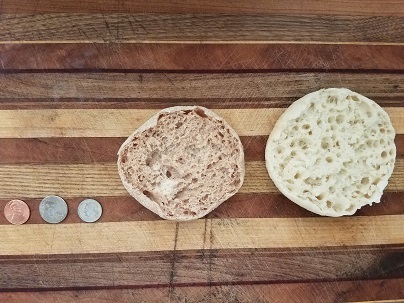
Muffins

Side by side there was no mistaking it. The wheat muffin was smaller. And judging by how much, I’d say more than two cents worth smaller.

I feel so violated.


More things that make us go “Hmm”

These were some of the things overheard or read over the last week that made us go hmm. 

An article released by the Washington Post discussed the rise of non-dairy milk products.  We’re not so certain you can call soy “milk” a milk product but we suppose it sounds better than “plant-based, non-dairy dairy-substitute beverage.”  Anyway, in this article, the author contends that the plant-based products are the fastest growing segment of the dairy beverage industry segment.  In two years it has doubled its market share.  If you continued to read and did a little extra research you would find out that plant-based, non-dairy dairy-substitute beverages’ market share rose from 3% to 6%, a 100% increase.  Of course it’s the fastest growing segment.  It’s the only growing segment.  Every other beverage has already been at the top for a few generations.  If dairy-cow milk products rose a modest 10%, that would make milk’s market share 104%, clearly impossible.  Anything other than milk, the cow-type, is going to be the fastest growing segment.  Hmm.

That same article postulated why the plant-based, non-dairy dairy-substitute beverage was growing at such a phenomenal rate.  Because it tastes good.  Actually it’s not the plant-based, non-dairy dairy-substitute beverage that tastes good; it’s the flavored, plant-based, non-dairy dairy-substitute beverage that tastes good.  We’re pretty certain that if you took the vanilla flavor out of the soy “milk,” it would taste much like a hot and sour soup without the hot or sour.  Hmm.

While reaching for a gallon of milk (cow-based), He of We overheard a man on his cell phone while standing in front of the creams, half-and-half, buttermilk, and other milk products at the store.  “Are you sure 8 ounces is a cup?” he was saying.  “There isn’t anything on the carton that says so.  Maybe I should get a big carton.”  A pause.  “Well if you say so, but if you run out don’t expect me to come back out here for more heavy cream just because you’re too stubborn to admit that 8 ounces might not be a cup.” Hmm.

Further on down the aisle, He was at the deli counter and asked for a half pound of Colby cheese.  The counterperson plopped some slices on the scale and it registered 0.45 pound.  “Is that close enough” asked the cheese seller or do you want me to take a slice off?”  Hmm.

In the television news there was a story about the rising cost of cooking out. Actually, it was about the rising cost of the food most of us put on the grill, that is, beef and pork. The story mentioned that the rising costs of beef and pork could increase the cost of a backyard cook out by as much as 20% from last year.   They made no mention of the relative cost of charcoal or bottled propane. They did suggest that to keep the cost of cooking out down we should consider not cooking out as much. We’re not certain because we aren’t the ones important enough to be on television, but it seems that if the cost of hamburger meat used to grill a burger outside went up, it also went up if you use it to broil that same hamburger inside. Hmm.

This one was heard on a radio commercial for vodka. It claimed that the advertised product is gluten free. Of course it is. The Academy of Nutrition and Dietetics advices that all distilled spirits are gluten-free. It also seems to us that if you’re really required to worry about the gluten content of anything, who would be one diagnosed with celiac disease, you’re probably not going to be drinking much vodka, with or without gluten. Hmm.

We know that you can believe everything you read on the Internet (just ask anyone who works for the Internet). We suppose that goes for TV, radio, and newspapers, too. Hmm, we’ll get back to you about supermarkets.

Now that’s what we think. Really. How ‘bout you.


Eat the Chicken

Sometimes you run across a story that just won’t quit.  Such is the news that hamburger is soon to be as expensive as steak.  Over the past month we’ve seen this story in the local evening news, the morning news, the weekend news, the national morning news, the Internet news, and in two newspapers.  We’ve even heard it on the radio.  We’re guessing it’s getting close to the time that our next burger will require a home equity loan.  Maybe we should start from the beginning.

The news media and/or the cattle industry started priming us to expect higher beef prices last summer.  The drought, which may or may not have already happened, was resulting in less prime grazing land and thus smaller, lighter beef cattle. Eventually that morphed into farmers were keeping less cattle so those that were grazing would be well fed.  By the end of the year, as the well fed cattle made it to market, they weren’t as fattened up as they should have been and they sold off for less than expected.  And that meant that our consumer prices had to go up to make the differences.  In a nutshell.

Prices go up, prices go down.  We know that when one is dealing with food that itself has to eat before it becomes food, whether livestock or agri-stock, variables such as the weather will create variables in the ultimate market price.  Pigs went through the same pattern last year and that is why we now have $4.00-$5.00 per pound bacon.  It doesn’t explain why the price of pork chops remained essentially unchanged.  After all, it is the same pig.

Back to the cow.  The most popular cut of beef is not cut but ground.  Whether ground chuck, round, or mixed source, whether 85%, 93%, or 97% lean, Americans buy more ground beef than in any recognizable cut.  Thus the headlines that hamburger is soon to as expensive as steak.  Nobody said all beef prices are going up, just that ground beef is following the trail blazed by bacon.  This makes us wonder once again that it is all the same cow, or steer, or whatever.  How long before pot roast is out of reach of the average American family?  Will filet mignon no longer be the center point of a celebratory dinner, giving way to Salisbury Steak?

Not to be outdone by the western cattle farmer, the eastern dairy cow farmer has now announced that due to our most recent bouts of inclement weather, the dairy industry is faced with less nourished dairy cows and we should expect a gallon of white milk to soon rival the price of a good white wine.  Here too, less water means fewer cows and fewer cows mean less milk and nobody has suggested that butter, cheese, or Klondikes will also experience a sudden price increase.  Only with the most common cow product will the dairy industry be milking the public.  (Sorry.)

I suppose we’ll just have to wait things out.  In the meantime have a breakfast of pricey bacon with a glass of pricey milk, a lunch of a pricey hamburger with a pricey milkshake, all wrapped up with a dinner of a pricey meatloaf and a cheap bottle of wine.

Or, we could have chicken.  Seems the weather hasn’t bothered the poultry group much.  Yet.  But then, what’s it cost to feed them anyway, chicken feed?

Now, that’s what we think. Really. How ‘bout you?