Some time ago in the not too terribly distant past but distant enough that a gentle reminder wouldn’t be out of the question, I posted an entry that began with a one-sided discussion about spam e-mail although that wasn’t the focus of the post. Likewise, this one will start with spam – emails and others.
At least once a day I check the spam email folder and more days than not I find an email in there that is definitely not spam. I often wonder how they determine what can and can’t be let through when I also, and usually on the same days, wonder how they determined an email that got to my inbox was let through. What was it about my mechanic’s email reminding me to bring my car in for service that made it suspicious enough to be shuttled into the Junk folder yet the one to me from me declaring I could “lose 61 pounds in 4 weeks” seemed perfectly normal and allowed admittance to the safety of the Inbox? (And why 61 pounds? Did 60 sound too unbelievable?) But I didn’t start this to discuss what got into the Junk folder. But while I’m here . . .
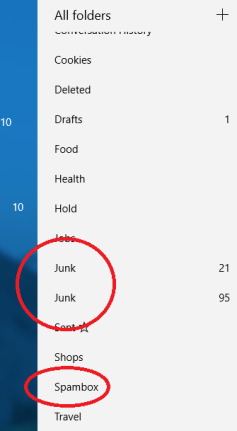 Is it just the email clients I use, and there are 4 of them (the laptop, desktop, tablet, and phone all use different applications to access my email), or does everybody have multiple junk and spam folders to hold undesirable dispatches? Mine has Junk, Junk, Spam, sometimes Spambox, and sometimes Junk Mail, and always at least three of them. How do they decide? And who are they anyway?
Speaking of They, who are they who decides what gets to be called a virus. My anti-virus program pops up at least once a day to remind me of additional services it can provide – for an additional fee. If it was a phone call it would be routed to the “Silenced” folder as a possible spam call by the phone’s version of a Junk folder. (And speaking of viruses, even though we weren’t really, why is virus bad when you’re talking about computers but viral is good? Who makes this stuff up?) Naturally the same thing happens with the phone’s spam filter as the email. Perfectly innocent calls like the automated reminder from the doctor’s office gets tagged as possible spam and silenced while three different people expressing their concern that my car warranty has expired are let through. At least the phone and email “blockers” don’t cost me an annual fee to be wrong.
 But do you want to know what really annoys me about all this? Spam. It’s rendered SPAM as an undesirable. SPAM as in Special Processed American Meat by the Hormel Corporation. Since 1937, SPAM has had its haters too but more lovers for sure. By the way, SPAM does not stand for Special Processed American Meat. That was a sobriquet given it during WWII by non-American troops treated to the canned delicacy. SPAM is actually a portmanteau of Spiced Ham although it is available in a variety of flavors, even (ugh) pumpkin spice.
There have been a billion recipes written for SPAM and a million cookbooks to hold them. (Too hyperbolic? Well, there are a lot!) There is even an annual SPAM cooking competition. At least there was until the pandemic forced its cancellation last year. The point is SPAM is an unexpectedly wonderful American treasure. Naturally we should confuse it with spam, a expectedly awful pile of junk.
 It’s a good thing there aren’t any filters in the canned meat section of the supermarket. If there were, we’d be reduced to eating . . .
. . . canned whole chicken?
Now that’s some spam!


 The Real Reality Show Blog