Are you a recycler? There are recyclers and then there are re-recyclers. And don’t forget the upcyclers. I might be a little of all but mostly I’m a re-recycler. That’s where I’m doing my most to save the planet. Actually, if I’m going to be really, super honest, that’s where I’m doing my most to save a few bucks, the planet comes along for the ride. Let me explain.
Recycling is what we do with our blue bins and our bottles and cans and papers and cardboard. If you’re lucky enough to live somewhere where the recycling agent accepts glass, plastic, carboard, and paper you’ve got it made because that’s the most of it anyway right. Once a quarter some organization will have a program that will accept your extruded polystyrene, household chemicals, and electronics, but if you stick to the four basic food groups, er, if you stick to the big four, as far as I’m concerned, you’re doing your part. ‘Nuff said on that.
Upcyclers are the creatives of the recycling world. They can look at a TV stand, a stained chunk of kitchen tile, and a garden hose and say “Gee that would make a great a wet bar” and do it, and add an integrated wine rack, wine and beer coolers, and cheese platter with a well for a fondu pot and skewer storage. Damn they’re good.
I fall in between. I’m a re-recycler. I’ll find an old TV stand and turn it into a different color TV stand. I believe recycling doesn’t stop at getting rid of stuff from your home but not putting it in the trash. It’s donating it to charity run thrift stores, consigning it to second hand shops, or giving it away through neighborhood apps, Facebook groups, web communities, or the old stick it on the curb with a “free to a good home” sign. Then when somebody like me needs a new stand for his toaster oven, or a new toaster oven, he’s likely to shop first at the thrift store to see what can be given a new life.
 I thought of all this last week when my daughter asked me if I’d like a stand to hold my herb pots in the kitchen, she found one on the curb. My first thought was “damn I’m glad that apple didn’t fall far from its tree.” My second thought was to run right over there and get it.
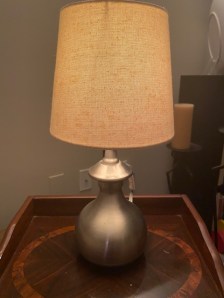
A lot of stuff that people don’t want still has lots of life left. Usually just a little cleaner is all it takes to have them looking good enough for company. Right now I have several kitchen small appliances, a mug holder, a table lamp in the living room, a floor lamp in my office, the stand for my keyboard, a small bookcase, and the office worktable courtesy of several thrift stores, and a roll of sound insulation that I’m working into a podcast booth that I found in front of one of the buildings here marked “free if you want it.” A couple old favorites of mine at the house were an arbor made from an old brass headboard and an end table for the sunroom fashioned out of 4 shutters and some plywood leftover from an old project. When I get tired of these or almost anything else, I make a drop-off trip to the local charity.
Re-recycling may not for everybody. Out and out upcycling is beyond a lot of people’s capabilities, certainly mine. But providing the raw material isn’t. The next time you have a TV cart or a garden hose that you don’t want anymore, donate it to a thrift shop, or put it out with a sign for somebody to take. Don’t jus throw them away. There could be a wet bar out there waiting to happen that just needs a little help from you.
 Many posters, PSAs, and other communications will remind us that we have only one earth, we should take care of it. And we are getting better. In 1970, the year of the first Earth Day, there were actually two Earth Days. The first was celebrated on March 21 suggested by newspaper publisher and environmentalist John McConnell to the United Nations Educational, Scientific and Cultural Organization (UNESCO). Mr. McConnell became involved with environmental activities when he began manufacturing plastic and realized how much plastic was being discarded. He presented his vision of a worldwide holiday “to celebrate Earth’s life and beauty and to alert earthlings to the need for preserving and renewing the threatened ecological balances upon which all life on Earth depends,” at the 1969 UNESCO conference in San Francisco. His vision saw the holiday celebrated on the Vernal Equinox (the first day of Spring) symbolic of an equilibrium between man and the planet. Earth Day was first celebrated on March 20, 1970 by proclamation of the city of San Francisco. The following year UN Secretary General U Thant issued a proclamation declaring Earth Day thence to be celebrated on the Vernal Equinox.
 Clean air, clean water, and clean land deserve to be celebrated but not just one day a year. A few miles from my front door there is a county park with a hiking trail labelled on maps as the Rachel Carson Trail. Rachel Carson probably is known best for her 1962 book Silent Spring which questioned the “better living through chemicals” attitude of the time and warned of the dangers from the misuse of chemical pesticides. Many cite her book as the stepping off point for the environmental movement. But Ms. Carson was not an angry activist. She was a noted marine biologist and wrote three earlier books on sea life and marine activity, winning the 1952 National Book Award for nonfiction for The Sea Around Us. In 1935 after graduating from Pennsylvania College for Women (now Chatham University) in 1929 and receiving a Master degree in zoology from Johns Hopkins University in 1932, Ms. Carson was hired as a junior aquatic biologist at the US Bureau of Fisheries (which would later be reorganized as part of the US Fish and Wildlife Service) to write radio programs on marine life. She stayed with service, advancing steadily until she resigned in 1951 to write full time. Despite undergoing multiple operations from 1950 to 1960 for breast cancer, Ms. Carson continue to write and lecture until her death in 1964.
 The Real Reality Show Blog