Once upon a time I wrote a post and I said, “The English language is said to have close to a million words in it. I’m not sure who counted that but the most complete, or as they would put it unabridged dictionary of the English language, the Oxford English Dictionary, has about 620,000 words. But language doesn’t equal vocabulary. And vocabulary doesn’t equal language. The average educated English speaking person knows around 20,000 words and uses but about 2,000 words in a week of talking and writing.” There are some things those 600,000+ words just aren’t up to task when it comes to describing them. As in them, the things that need describing, not the things that are described. See, right there, that’s where 620,000 words are just not enough. We need more words! And here are some examples.
 Speaking of things that describe, we’ve been so busy lately so busy making up rules about pronouns to effectively represent people, that we’ve missed it completely that when it comes to things. When writing, or speaking or even texting (although I hesitate to include text message characters as representative of the English language), and reference is made to two objects introduced in the same sentence, in subsequent reference to one or both (or even more!) our current batch of pronouns is woefully inadequate. And we end up writing things like, “As in them, the things that need describing, not the things that are described.” We need a good shorthand way to refer to thing one and thing two through the duration of the missive.
 If I tell you to picture in your mind classic gray sweatpants, you know exactly what I mean. The picture in your mind is unambiguous. And you no doubt can fill in the rest of the catalog with several tops (long, short, and sans sleeves) and short versions of those pants. But what’s the stuff they are made of? We can describe it, but can we name it? Gray sweatsuit material is just too long. It’s usually cotton but to say, “it’s too warm today for long pants, I think I’ll exercise in my cotton shorts,” sounds like I’m headed to the gym in my underwear. Athletic wear is confused with athleisure which is just spandex you wear in the outside. Technically that gray stuff is a sort of flannel but if I say I plan to jog in my gray flannel suit, people will expect to see someone running down the street more formally attired than I’m comfortable running in. Nope, we need a new word for gray sweatsuit material and that’s that.
Body bathers, time for you to tell me what you call this: hmm, these: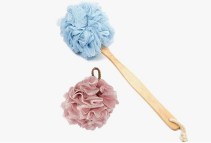
While you’re wondering what kind of trick question this is, I’ll speak to the others for a moment. I figure there are three kind of showerers/bathers. There are those who use something like that picture, there are those who use a wash cloth, and there are those (usually very macho men who smell not much better apres shower) who stand under the water, make some squealing type sounds while lathering up with just the soap (usually bar soap) and slapping or rubbing it in with their bare hands. You’re going to say, “But what about loofah users? That makes 4 kinds.” I don’t think there are any loofah users left in the world. They’ve all died out from fungal skin infections from not properly washing their loofahs, which by the way, are not represented in that first picture. The things in that picture are puffs, body puffs or so they are called if you were to look for them on the internet. These are not to be confused with powder puffs, steel wool puffs, or crab puffs. Nor actual loofahs. The point is, there too many puffs. We can’t just call anything that is puffy a puff. We need at least 4 new words added to the army of 600,000.

Actually, the real point is, I didn’t have anything to write about this week so I stretched things a bit. You might say, I published a piece of puff — but by no means, a puff piece!
 Did you on June 29 Earth completed a full rotation on its axis 1.59 milliseconds ahead of schedule? Time flies! We talked about that last week at www.roamcare.org? Get over there now and read what we had to say.
While you’re there, check out the rest of our site, then share us with your friends and family!


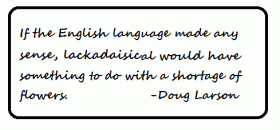 excerpt from I presume one of his favorite authors. I always read them. They often provide a glimpse into the authors mind at the time he or she was working on that piece. But it wasn’t until this time, this epigraph, that I really stopped to think about what I was reading. Not the metaphorical, the inside glimpse, etc., etc., etc. The actual. Why that the epigraph, those borrowed words, are indeed an epigraph.
 So that brings me back, do we need all those words? If they made sense I’d be happy to learn all 600,000 words. But so many of them don’t make any sense. Look at two of the ones that I mentioned: epigraph and paragraph. Both have “graph” and both are similar in that they are a group of words. But when I think of graph I think of a picture.
 And if that’s not enough, then we have to use words that we know don’t fit a particular situation because that’s the in way to speak and Heaven forbid we aren’t trendy. For example good can’t be good. Since the time when I was torturing my parents with popular vocabulary “good” has been groovy, cool, bad, righteous, divine, outstanding (emphasis on the out), epic, excellent, rad, sick, and ridiculous. But what did they expect? They’re the generation that came up with cat’s pajamas and bee’s knees. Unfreakin’ believable.
 The Real Reality Show Blog