Counting Chickens

As I write this, a few minutes before 4:00pm on May 28, it is a year to the minute that I was getting home from what I hoped would be my last dialysis session. In 12 hours, I would be waking up for a ride to the hospital to have a kidney transplanted into me from my sister. For months after the evaluation process identified her as a candidate and a date was set, the staff at the dialysis clinic would say to me, “it won’t be long now,” or “are you counting the days yet,” or similar words of what they certainly thought were ones of encouragement. I met each one with “I’m not counting any chickens” That last day I think I said, “thanks, you’ve all been nice enough to me you but I hope I never see you again.”

We’ve now made it to a minute after 4:00pm on May 28 and it is juat about a year to the minute that the phone rang with a call from the transplant surgeon’s office. “Doctor wants you to come in this evening so she can run a new CT scan and do as much site review as possible before you get to surgery.” Because of previous abdominal surgeries my insides did not conform to the textbook illustrations budding surgeons poured over in their early med school days. They didn’t even conform to the messy real life version most people walk around with that present to surgeons many years past the book learning phase. Even though I had been scanned and rayed and imaged from every imaginable angle (and 1 of 2 unimaginable) I saw her point. I called my chauffeur who doubles as may daughter on her days off and asked one of them to take me to the hospital. But I still wasn’t going to start counting any chickens.

You’ve read the tale. The operation was a success but the implant didn’t take. Nineteen days later I was finally discharged with instructions to resume dialysis. 

I never felt right at dialysis after that. Not mentally or emotionally not right but physically not right. In the best of times, and there are best of times in dialysis they just aren’t very good, one doesn’t feel right. It’s hard in the body and although it leaves you with sparkling clean blood (I used to refer to the dialysis unit as a bloodromat) it also leaves you with headaches, dizziness, tingking or numb extremities, a little bit of nausea, a lot of muscle cramps, and the need to sleep for 48 hours when you get to do it all over again. But this “not good” feeling was different. All of the above multiplied plus more and others and few etcetera. 

Discussions with the doctor led to new and different tests which led to yet another tale. The transplant didn’t work but I was getting better in spite of it and became one of the few who have successfully been discharge from chronic dialysis.

So, now on the eve of what would be my first kidneyversary celebrating a new normal I am celebrating 4 months of being relatively normally normal.

I still have blood drawn every couple of weeks and see the doctor every couple of months. I still watch my diet, my fluid intake, and my other medications. I still pray every morning and every night. But I don’t still go to dialysis. 

And I still don’t count chickens!

One other thing, my sister is still doing well also. Thanks Sis!


And now for some good news…

We interrupt today’s wailing and gnashing of teeth to bring you some good news.  Naturally there is a lead in.
 
I was sitting around on Saturday thinking of all the places I’d most not want to be. This is unusual because for the most part I think of the places I’d most want to be. Usually it involves water, sand, palm trees, a boat, and female companionship. Specific female companionship if you must be that nosey (or nebby as we would say here). But last Saturday the thought was of the least desirable place, even with the right companionship. Not surprisingly, the place I’d least like to have been on Saturday would be a dialysis clinic.
 
Let’s think about that for a minute, then we will move on to the news. My county as many other cities, counties, states, and countries, now has a shelter in place order. The rule is pretty simple, don’t go out unless staying in endangers your life. And don’t go anywhere if you are experiencing symptoms. For the everyday ordinary dialysis patient (or more appropriately the every other day ordinary dialysis patient) it’s a no brainer that staying in is more hazardous than going to the clinic. And the everyday ordinary dialysis clinic staffer needs no fewer brain cells to also conclude that staying home endangers lives. But it’s the second part that is difficult to reconcile. No matter how you might be feeling, that trip is one of life sustainability. You can’t get somebody to pick it up for you while they are at the store.
 
I was in a good place to think the last place I’d want to be is at a dialysis clinic, the extreme dedication of the staff and their love of their mission to serve a population defining the area between a rock and a hard place notwithstanding. I was in a good place because I was in my own livingroom recliner rather than the one I spent so many Saturdays in at the clinic. 
 
Yes, no dialysis. Okay, if you’ve been following along with me over the years you have a right to be confused. The last thing I wrote about my kidney health was that the transplant last summer did not take and I was back on dialysis. By the way, after still more scans and tests they are no closer at determining why the transplanted kidney clotted so rapidly and completely. But what they had noticed last fall was that my renal function lab tests were stabilizing. Then new questions arose. Everybody’s tests go up and down as function fluctuates, particularly in a patient like me whose renal dysfunction is induced by factors elsewhere in the body. But these were not fluctuating. They were improving. Steadily. 
 
Adjustments in treatment were made, ultimately pared down to only 2 three hour treatments per week, fully half of what a weekly treatment total had been not too long ago. Weeks went by and weekly labs continued to return surprisingly encouraging results. On January 23 I left the nephrologist’s office a free man, well perhaps more a dialysis parolee ordered weekly outpatient lab test and every other week appointments with a call-in on the off weeks. Last week after nearly two month of that routine I was given a appointment three months in the future. I had stabilized! At least for the near future. At that point I thought comfortable enough to tell somebody other than my daughter and sisters and you guys get elected.
 
There is no good reason that kidney function should improve. It’s not unheard of but it is rarer than correctly picking all five numbers plus the white ball. I’m crediting my reprieve to Someone Up There showing a particular kindness to me and expending a miracle on that.
 
I feel particularly grateful, the break coming at a time when going to dialysis could be just as life threatening as life preserving, and pray that the patients and staff at clinics around the world will be safe and free of all complications, even those not COVID-19 related. 
 
And I know now I have to figure out why me and what I am to do with this unexpected opportunity. Sitting around thinking of the places I’d rather not be is not it. I’ll keep you posted.
 
Now go wash your hands!
 

Happy

Don’t worry, be happy!

Orange is the New Gold

Sunday November 3 was the coldest Sunday since spring had sprung some 7 months earlier. And what was I getting ready for at 6:30 that morning? I was going for a walk, a Kidney Walk at of all places, the Pittsburgh Zoo.
 .
This particular Sunday stroll was in support of the National Kidney Foundation, and organization in support of kidney disease education, treatment, and support. Like so many other disease focused organizations, money raised by the NKF goes to research for treatment and to find a cure for kidney disease. But it also provides direct assistance to those suffering the disease right now by assisting patients, families, and caregivers through resources including health checks and screenings, drug discount programs, and peer support made possible by fundraising activities.
 .
Since I had begun chronic dialysis 3 years ago I recieved helped from the National Kidney Foundation but was never able to show my support for the organization. For the first time since my diagnosis my entire immediate family was able to register for the walk. The Kidney Walk does not carry an “entrance fee” nor a “suggested donation.” Your entry fee is your willingness to show support. Your donation is what you want to give or can raise from friends and family to support your personal cause. This year 2300 Pittsburgh walkers raised over $255,000 for those causes and I’m happy to report that my family was responsible for one of those thousands. Walkers included kidney transplant recipients, kidney donors, dialysis patients, care providers, and those many friends and family members on foot, in wheelchairs and strollers, with the help of canes and walkers, and even physically carried by others.
.
Unlike many others walking I was diagnosed without any of the classic risk factors or warning signs. The major risk factors for kidney disease are high blood pressure and diabetes; family history and obesity are also major contributors to that risk. Some of the common early warning signs include nausea and vomiting, irregular heartbeats, pain in the lower back, and shortness of breath. I had and still have none of those. My kidney disease is caused by complications from an autoimmune disease and was revealed through routine lab studies at regular checkups. Like many walkers I doubted I would ever find myself relying on dialysis for life or undergoing a kidney transplant. And most unfortunately like many other walkers I found myself both of those. Most fortunately though, my disease was discovered and I was able to join in the walk.
.
Orange was the color of the day at the zoo. Although kidney disease awareness is typically represented by a green ribbon, the National Kidney Foundation has adopted orange and black as the organization colors. Orange shirts, hoodies, caps, backpacks, and even baby strollers marched on a three mile trek among the animals at the Pittsburgh Zoo to bring awareness to chronic kidney disease, a disease that affects nearly 40 million American adults with another 200,000 diagnosed each year.  Over 800,000 of those patient are in end stage renal failure requiring dialysis or a kidney transplant.
.
To us it doesn’t matter what color was worn. The money raised is the gold at the end of the rainbow. 
.
.

We Tried

I wish I had a happier update to pass along but last Thursday we lost the kidney. We knew we were entering unfriendly waters, weren’t certain it was going to take and had the best team we could want, but the transplant was not meant to be. They all aren’t. Even something with a 97% chance of happening flawlessly has a 3% shot of not working at all. I suppose you could say the long shot came in. I can tell you what happened but people are still working on the why to go with it.

On the first implant, the donor kidney almost immediately picked up color indicating blood was flowing through it. By the following morning blood flow could not be detected and an ultrasound indicated a possible clot in the artery leading to new to me kidney. The decision was made to go back inside me, remove the kidney, clean things up, then return it. This is where we were at the most recent post.

For the next two days, various imaging tests indicated blood flow to be good, marginal, or inadequate – not consistently nor in that order any given time returning any of those results. But laboratory tests indicated an improved renal function. It raised questions. It can happen, in fact it’s not unusual that flow and function decrease or diverge in the first week after transplant. After a week though, results continued to show too much discrepancy between lab function and imaging. After much consultation and while considering risks versus benefits it was decided the only conclusive answer would be achieved by actually exploring the area and physically examining the kidney.

It was found that blood was flowing into the kidney but not through the kidney. The small veins inside the kidney were again clotted, turning the kidney into an anatomical water balloon. The danger of rupture resulting in peritonitis was too great and the kidney had to be removed.

Now that kidney is being examined by pathologists to try to determine the cause. Was there a defect in the kidney making it prone to clot, is there an undiscovered defect in my blood making it prone to clot, or was there a combination of immeasurable or unknown factors resulting in the clots.

The disappointment is huge but the potential is great. If there is something organically “wrong” with that kidney these events might have happened to it while it still resided in my sister potentially rupturing in her and causing her all sorts of untold problems. If there is a defect in my blood it could be that a potential life threatening condition might now be identified and treated. If there is a defect caused by the combination of my blood and her kidney it could that mean future donor and transplant candidates may undergo even more rigorous screening for compatibility.

Some consequences are more immediate. I continue to be hospitalized while I recover from these three operations. As an impatient I’ve received dialysis and my response here will aid in determining if upon discharge I return to dialysis at my pre-surgical order and schedule. My sister will continue her post-operative tests and appointments. I may not have been a successful recipient of her kidney but she was a quite successful donor and will now forever bear the scar of her sacrifice.

So the journey does not yet end. We’ve merely come to the inevitable fork in the road. It might be too early to tell which path to take or it might mean neither path is best but a whole new trail must be blazed. Something good will come from this. It might not be the result that we wanted but “good” and “want” are not guaranteed to overlap. Stay tuned.


Transplant Journey Posts

First Steps (Feb. 15, 2018)
The Next Step (March 15, 2018)
The Journey Continues (April 16, 2018)
More Steps (May 31, 2018)
Step 4: The List (July 12, 2018)
Step 1 Again…The Donor Perspective (Sept 6, 2018)
And The Wait Goes On (Oct. 18, 2018)
Caution: Rough Road Ahead (Nov. 19, 2018)
And The Wait Goes On (Jan. 24, 2019)
A Worldbeater of a Story (March 14, 2019)
Spare Part (May 22, 2019)

Close But No Cigar -Yet (June 2, 2019)

Other Related Posts

Walk This Way…or That (March 9, 2017)
Looking Good (May 18, 2017)
Technical Resistance (May 25, 2017)
Those Who Should Know Better (July 24, 2017)
Cramming for Finals (May 3, 2018)
Make Mine Rare. Or Not (Feb. 28, 2019)
Parts is Parts (May 6, 2019)

And The Wait Goes On

It’s time to bring you up to date with the kidney search. Okay, now you’re up to date.

Seriously, not much has happened since my last update other than the donor pool continues to march (swim?) (you know – pool, swim. okay, I’ll stop) toward completing all the required tests.

Actually, that is reportable. Three candidates are all moving along but are at different stages. One has completed all of the required steps and is waiting for the transplant group to review everything. One is awaiting a test date for the final step. One has one last test to complete before moving on to the final step.

So, everybody is through, near, or approaching the “final step.” What is it? It’s a CT Scan of the pelvic area including the kidneys and surrounding structure. If a candidate gets that far and nothing has derailed the process, the transplant surgeons will use the results of that scan to determine if the potential donated kidney exhibits any obvious defects that will disqualify the donor, which kidney would be harvested, and if the surgeon would need to consider any special procedures for retrieving the kidney.

So it’s been a while since they started the process and all are getting close to completing it without being disqualified. Yay! But it has been a long time, over five months, since that first phone interview. It’s not like in the movie where somebody holds up a sign at a hockey game that says “Need a kidney, Call me!” and the following scene they are being wheeled into the operating room.

What have I been doing while all this is going on? Other than my regular dialysis sessions, as I reported in my last Transplant Journey post I had a new fistula fashioned. Unfortunately, the central venous catheter that was placed so I could have dialysis until the fistula is healed, hopefully sometime next month, failed and I had to have a new one inserted the day after Christmas. I also hope to be able to report sometime next month that at least one potential donor has been cleared and we are awaiting a transplant date.

Until then we keep going on with our lives like nothing remarkable is going on. When you stop to think about it, other than I actually got basil to live indoors so far this winter, nothing remarkable has is going on. Yet.

——

Transplant Journey Posts

First Steps (Feb. 15, 2018)
The Next Step (March 15, 2018)
The Journey Continues (April 16, 2018)
More Steps (May 31, 2018)
Step 4: The List (July 12, 2018)
Step 1 Again…The Donor Perspective (Sept 6, 2018)
And The Wait Goes On (Oct. 18, 2018)
Caution: Rough Road Ahead (Nov. 19, 2018

Other Related Posts

Walk This Way…or That (March 9, 2017)
Looking Good (May 18, 2017)
Technical Resistance (May 25, 2017)
Those Who Should Know Better (July 24, 2017)
Cramming for Finals (May 3, 2018)


Caution: Rough Road Ahead

I don’t think I’ve ever started a post apologizing for not posting. As much as I find myself an interesting fellow I can’t imagine any of you (if there are any of you still reading) working yourself into a lather because I’ve deprived you of my drivel these many days. But that’s just it. It’s been many days. Many more than I’ve ever gone without posting unless I was unconscious in a hospital bed. That’s just plain rude so for that I apologize.

Technically though, I have been unconscious in a hospital bed but just for a couple of hours. And I’ve been awake on a hospital bed a few days but not any of them in a row. Let me start in the middle for you and maybe that will clear things up.

When we last left our kidney transplant journey there were potential donors being poked and prodded, tested and vetted. They still are but all are nearing their finish lines. Will any be found as able as they are willing? The best I can say is we’ll see.

Until then, dialysis continues to be the means by which my own, slightly overworked and underappreciated kidneys are given a hand doing what they used to do best. Smoothly is generally not a term used to describe how dialysis goes. And it isn’t. Three weeks ago at an anything but routine dialysis session (routine also not descriptive of the dialysis procedure) my fistula imploded. You remember my fistula. It’s a pair of blood vessels surgically connected then anchored just below the skin so the dialysis nurse can shove two needles about the size of ball point pen cartridges into the arm to get the blood to and from the dialysis machine. Repeated stabbings cause scarring and plaque to build up inside the fistula and about every six months the surgeon runs a catheter through my arm by which he can clean things up in there. There is a fairly descriptive description (which is truly the best kind of description you can have) along with a couple truly disgusting pictures (and when describing a fistula, disgusting is truly the best description you can make) in a post from earlier this year.

Even with careful maintenance, sometimes the fistula just fails. That’s what happened to mine on November 6 which just happened to be the day after the last day I posted anything. Coincidence? Umm, not really. After repeated attempts to get a needle seated properly in the fistula with nothing but resistance to show for it, the nurse declared my arm a no dialysis zone. Unfortunately that did not give me carte blanche to swap the dialysis recliner with a seat at the Chinese restaurant down the road although lunch would have been welcome since I rushed through breakfast in order to participate in the American election process. Instead I was able to swap that chair for a bed at the hospital outpatient surgery area and await an emergency clearing of the fistula.

To make a long story short (I realize I’ve already exceeded that marker but it sounds good and I rarely get to use that as an opening line), after two more attempts with equally poor results, everyone admitted that the fistula was no longer a viable and a temporary catheter was tunneled into the right external jugular vein. It was during that procedure I had my previously noted period of unconsciousness in a hospital bed. (I get to be awake during the cleaning procedure, known as a fistulagram, and can actually watch the progress. It’s fascinating stuff but I’d still rather see a Bond, James Bond movie any day of the week.)

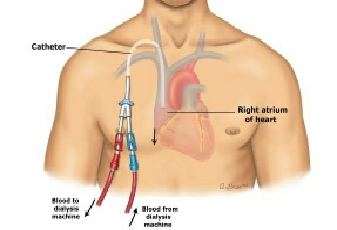
CVCThe unfortunate thing about dialysis catheters is that unlike say administration ports one might receive chemo through, they terminate outside the body and do so on a pair of tails. I’m posting a drawing so you can better see what I am trying to describe. (I could take a picture of my actual catheter but it’s not a selfie I’m anxious to snap and if you just type “dialysis catheter” into your favorite search engine you’ll get no end of new disgusting pictures to peruse at your leisure.) The part of the catheter inside floats and can actually be felt depending in where the tip resides at any particular moment. Reaching for anything higher than one’s shoulder, which given my modest height is anything off the counter, means moving the catheter around in there, also rather obviously noted. And because there is really no good way to anchor the outside tails, any movement or position change comes with a reminder that there is a part of you that isn’t really a part of you.

Fortunately I have the opportunity to be unconscious in a hospital bed again next Thursday when a new fistula will be fashioned into my other arm and I’ll get to have the catheter removed as soon as the new fistula completely heals and toughens enough for dialysis use. That shouldn’t be much after Ground Hog Day.

Just because I was having so much fun at the hospital, last Thursday when I was preparing to return to the world of blogging, I received a call from the dialysis center. The labs drawn earlier returned with a critically low calcium level endangering my health on any number of levels and I was instructed to return again to the hospital, this time to the emergency room where orders would be waiting to repeat the test and administer IV calcium if still returning a lower than normal level. It was, they did, and I got to recline on the sixth hospital bed (but conscious for five of them!) in 11 days.

And you thought getting on a transplant list was going to be boring between the listing and the planting.

Related Posts:

Transplant Journey Posts

First Steps (Feb. 15, 2018)
The Next Step (March 15, 2018)
The Journey Continues (April 16, 2018)
More Steps (May 31, 2018)
Step 4: The List (July 12, 2018)
Step 1 Again…The Donor Perspective (Sept 6, 2018)
And The Wait Goes On (Oct. 18, 2018)

Other Related Posts

Walk This Way…or That (March 9, 2017)
Looking Good (May 18, 2017)
Technical Resistance (May 25, 2017)
Those Who Should Know Better (July 24, 2017)
Cramming for Finals (May 3, 2018)


And The Wait Goes On

It’s been 6 months since I wrote the first post about the kidney transplant journey I’m on. Since then a lot of tests have been performed, a lot of blood and urine analyzed, a lot of x-rays and scans shot. Three months after that first post I reported I was officially placed in the list to await a transplant and if any willing and available volunteers could be evaluated for a potential live donor transplant.

Right now we’re still waiting for donor evaluations to be completed. It seems a long time but it really isn’t. Maybe to a chameleon but not to a human type person. Not even to a human type person waiting for a kidney transplant. With the possibility of waiting up to 5 years, 6 months is nothing, just 10% actually.

But it is long enough that now I’m thinking. Not good stuff all the time. Some of it is good. It’s amazing that of my 3 closest living relatives all three are willing to put themselves through this process. Then that gets me thinking would I for them? I’m sure. What about for a more distant relative…a cousin or cousin’s offspring,? How about a really, really close friend or child of a friend? What about a not so close friend? An acquaintance? A fellow church member or coworker? Stranger? Some people have said yes to all. Altruistically, I’d like to say sure I’d say yes to all. Realistically I know I wouldn’t. But where would the line be drawn? We know intentions are always better than actions but how close are the two when the reality is losing a major organ.

My driver’s license says “Yes I’m a donor. Feel free to use me. Um, but please wait till I’m gone and the only voice I have is this little plastic card.” Would I be willing to say “yes I’m a donor” while I can still speak those words? I suppose I already have. I mean, I’ve donated blood. Does that count? Does it count if I’m a true trypanophobe, which one has to get over if one is going to survive dialysis. (By the way, numbing creams and sprays really do help if you should be interested.) But donating blood isn’t like losing a body part. Blood grows back. Sort of. Kidneys don’t. No way.

Another thought that sporadically pops into my brain is a biblical question. God fearers learn that God not man determines life, thus the opposition to euthanasia and capital punishment. But the converse never seems to be debate. Churches are a main provider of support to transplant recipients even to the point of holding fundraisers to provide financial assistance. If God, not man determines life, is a transplant a means of man extending life? Or is it maintaining life to get the recipient to what would have been the natural ultimate endpoint?

I hope all these thoughts are just my mind doing its thing to fill the void left by the manic pace I underwent doing my evaluation and testing phase and it will quiet itself as it gets used to the waiting period. Maybe after it’s had its fill of playing ‘what if’ games it will settle down and think more productive thoughts like why shouldn’t Seattle get an NHL franchise.

—–

If you’d like to re-read all the posts in this thread as well as other related posts, I’ve put links to all of them on one page. Go here, to join the journey.

Related posts

First Steps (Feb. 15, 2018)
The Next Step (March 15, 2018)
The Journey Continues (April 16, 2018)
More Steps (May 31, 2018)
Step 4: The List (July 12, 2018)
Step 1 Again…The Donor Perspective

Step 1 Again…The Donor Perspective

Now that I’ve been added to the kidney transplant waiting list the hard work begins. Finding a donor. On one hand you can sit around, stay healthy, make sure the transplant center has your current contact information, and just wait. On the other hand, you can try to find a living donor and go through all new sorts of levels of stress.

My immediate family has dwindled to a pair of sisters and a daughter. That would not be a good hand to hold in poker. But all three have expressed interest in donating and that closes the odds. They decided they would go through the donor evaluation process before we would ask if we should look to others. All three are currently in the process but at different stages. Two have been determined to be acceptable matches, one still awaits those results, and none is anywhere near completing the battery of tests donor candidates face.

You remember all the examinations and tests I had to go through? If you don’t, type “kidney transplant” in the site search bar and refresh your memory. We’ll wait. … Ok, ready? Well, as the saying goes, you ain’t seen nothing yet!

Like mine, their first appointment was a phone interview, a few basic questions designed to screen for obvious exclusions like diabetes, untreated high blood pressure, or various cancers. Also like mine, their first on site appointment meant lots of tubes of blood, a chest x-ray, an EKG, and face to face interviews with a nephrologist, surgeon, nurse, social worker, and transplant coordinator. Unlike mine, theirs also includes a donor advocate who is also a previous donor.

Like my first appointment at the hospital they left with a handful of appointments for follow up tests. Unlike mine, theirs were unlike mine. Where mine were targeted to make certain I could sustain the rigors of the operation and maintain the required follow up to prevent rejection, potential donors are tested to make as certain as possible that they are as healthy as possible and will be able to withstand the rigors of life with a single kidney.

Potential organ donors must be at least 18 and not more than 70 years old. That’s quite a range and obviously an 18 year old is going to be and is going to expect a different level of health than a 70 year old. My potential donors are just shy of 29 and a little over 67 years old. The one in between just turned 56. Three different stages of life, three different batteries of tests. Any single test can exclude the person or become the focus of a follow-up test. Surprisingly the youngest has the biggest list of baseline tests. As she explained it, the reviewing nephrologist said a 48 year old who is healthy today has a pretty good chance of still being healthy in 20 years. He has already passed the age when chronic illnesses would have taken hold even if they aren’t obviously obvious. Being healthy today means less to the 28 year old and how she will be at 68, 58, or even 48 so her testing will be more in depth and her expected results more stringent to mitigate missing sign of problems that might develop in the future.

In all cases they are going to get the best physical they’ve ever received. And if they pass all the physical exams they even get to have a go with a psychiatrist.

That’s just in case you thought you were nuts giving away part of your body.

——

If you’d like to re-read all the posts in this thread as well as other related posts, I’ve put links to all of them on one page. Go here, to join the journey.

Related posts

First Steps (Feb. 15, 2018)
The Next Step (March 15, 2018)
The Journey Continues (April 16, 2018)
More Steps (May 31, 2018)
Step 4: The List (July 12, 2018)


My Day

I’ve never done a “day in my life” post and you should be thrilled. Unfortunately, all good things must end and your thrill just ended.

Today is not a just any old day in my life though. Today I went to the hospital. For the first 57 years of my life I never spent a night in a hospital unless I was working there. I never even had an outpatient procedure until I was 55. Wait. That’s not completely true. I was born in the fifties in the USA where childbirth was a minimum three day hospital stay. But after that, all my sleep was in my own bed or one of my choosing. Ok, that’s not 100% true either. There were some nights the U. S. Army insisted I spend away from my favorite pillow. But otherwise…

ADIL

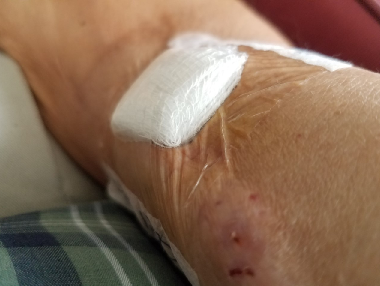
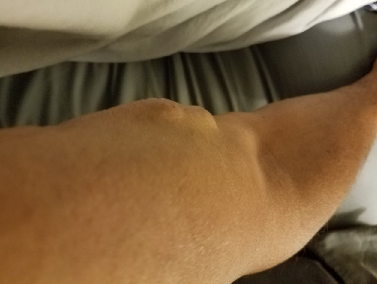
Back to today. Don’t worry. It won’t be that traumatic an event. We’re just going for a simple procedure to open the fistula used for my dialysis. A fistula is a piece of artery and one of vein sewn together and pulled to just under the skin so the dialysis nurse can more easily jam a pair of needles roughly the size of a ball point pen into it. With all the puncturing and high velocity blood flow, the inside of the fistula scars and it slowly narrows, raising the pressure of the blood flow through it, decreasing the efficiency of the dialysis treatment. To correct this, because my fistula is in my upper arm, the surgeon will cut a small hole and enter the vein just below the fistula and thread a catheter through the vein into the fistula. This will be tracked by a scanner mounted over my arm transmitting images to a monitor above me. Once the physician finds the narrowed space he’ll pass a balloon into the catheter, up to the fistula and inflate it, pushing the occlusion against the vessel wall. (If that sounds like what you’ve heard as coronary angioplasty that’s because it’s the same procedure except on a fistula rather than a coronary artery.) While all this is happening I’ll be half asleep making incoherent conversation with the surgeon. It’s ok. He’s a friend.

MPH

Breakfast

I woke up a little after 6 showered (no, no pictures there), dressed comfortably, and got breakfast. This morning’s breakfast was two mycophenolate capsules and a sip of water since I will be anesthetized to the point of being half asleep. About 8:30 my sister came to take me to the hospital. She will be my accompaniment for the day since I will be anesthetized to the point of being half asleep. Because we’re Italian she brought food.

Traffic was light and we got to the hospital a few minutes after nine for my 9:30 report time. The nice lady in registration breezed me through and sent me off to the outpatient department with a stop at the lab for a quick blood draw. We arrived in the outpatient department at 9:45. By 10:05 I was changed into a hospital gown (still no pictures), had vitals recorded, an IV started in my left wrist, and left to wait for someone from the cath lab to come get me at 11:30. This was a boring 85 minutes and I read the paper. Did I mention it was boring?


Fistula_Before

Before

At 11:40 I got picked up for the procedure I already described, it went off without a hitch, and I went back to my room in the outpatient department where they said I looked great, go home.

Fistula_After

After

We went home, had lunch (a late lunch since it was then 2:30) my sister went home and because we’re Italian, I gave her food. Then I sat down and wrote this.

You know what? These things are really dull. Who came up with this idea anyway? In case you’re wondering, I am now just wonderful and when I go back to dialysis I’ll have the smoothest flowing blood of anyone there.

And you heard it here first!

Step 4: The List

We are making progress. Tuesday afternoon I received a call from the transplant center at the hospital that the test results are in, the clearances have been reviewed, the committee has met, and I can now say I am officially sick enough to need a new kidney if one can be found for me. Have a seat, pour your favorite beverage, and I’ll tell you the next chapter of this story.

Saying I am sick enough for a transplant is really not accurate and was not the point of three months of testing. We knew the level of my sickness of those organs the first time they stuck a pair of needles into my arm, attached the other ends to a dialysis machine, and said it will get easier over time. They were, they still are, and it hasn’t yet so it probably won’t. It won’t.

The point of the tests, the examinations, and the reviews was to see if I am healthy and strong enough to withstand the surgery, recovery and follow-up to replace those pieces of mine that zipped right on passed middle age outpacing the rest of me to done for. And we discovered and now have documentation that I am. Er, healthy and strong (sort of), not yet done for.

Now we just have to find a replacement for those pesky, unproductive pods. Unlike other parts of me that have been unceremoniously replaced, there aren’t any replacements for a kidney other than another kidney. That means finding somebody who is done using his or hers or someone who is ready to part with one of the two that come as standard equipment in homo sapiens.

And now we come to the point of Step 4. The List. People, including me (well, I’m people too), refer to The List. There really is no single, all encompassing, first to last list. If you want to think of a list, it would more appropriate to think of each donated organ having its own list. When a person is accepted into the program and begins waiting for an organ, his or her matching criteria is placed into a database. When an organ becomes available, the organ’s criteria is compared to the database and all those people whose needs match the offered organ are retrieved. With some exceptions they are retrieved in the order they were entered into the system. Thus, The List for that organ.

There are exceptions to being positioned on the list from the order a person entered the system. Neonatal and pediatric patients are given some preference and people in need of a transplant who had earlier in their lives donated an organ receive placement preference.

When my blood was drawn in April at that first test in the transplant center, there were already over 114,000 people waiting for an organ transplant in the United States. When I became approved on Tuesday, 143 other people joined me being added to The List. About 95 transplants were performed that day and 20 people died waiting. The List grew by about 3,600 since April.

A recent poll revealed that 95% of people support organ donation but only 54% have ever signed up to be a donor. Unfortunately, only 3% of deaths result in actual available organs appropriate for transplantation. And so, the list grows. I could wait for 3 to 5 years until I make it to the top of an organ’s list.

There is a way off the list without dying or becoming too sick that a transplant’s benefits no longer outweigh the risks. The living donor. Kidneys and portions of livers can be donated by live individuals directed for a specific recipient. (Some people actually make altruistic donations that enter the general pool and are designated to a recipient as a deceased donor organ would be.) Under very rare circumstances, lung, pancreas and intestine live donations may be possible. Living uterus donations are undergoing clinical trials.

Living donors account for about a third of kidneys transplanted in the United States. Kidneys from live donors not only mean a faster transplant for the recipient but a more successful transplant.

Already four people have stepped forward and asked about making a living donation of a kidney for me. Their evaluations will begin next month and can take two to six months to complete. I’ll take you along that side trip as we make this stop on my journey. That way you’ll know what a potential living organ has to go through.

Just in case.

——

Related posts

First Steps (Feb. 15, 2018)
The Next Step (March 15, 2018)
The Journey Continues (April 16, 2018)
More Steps (May 31, 2018)