Name it!

Name that…

Did you ever wonder where some products get their names? Other than it looks like one, why should a Brillo pad be called a Brillo pad.

I started thinking about these one day in the shower when I took a close look at the shampoo bottle, proudly proclaiming it is made of five vitamins and oils. Oh, so that’s why, I said to myself. And from there I was off and running.

I’m all knowing when it comes to pharmaceutical brands, they being such a big part of my livelihood. There are many stories of drugs being named after researchers’ wife’s and children. Sometimes a glimpse of what they do or don’t do is hidden in the name. The first commercially available benzodiazepine, chlordiazepoxide was noted to not cause a loss of equilibrium at sun-sedation doses and that led Roche to name its brand of the drug, Librium. When they made it more potent and released diazepoxide a few years later, they capitalized on brand recognition of the “ium” ending, and as a nod to its use as a sedative, started it off with the Latin for “good night” and named it Valium.

But what of the thousands of products out there that seem to be related. Are they? I there a connection between Kleenex, Spandex, Tilex, and Pyrex? No, nor among the other 600 trademarked products needing in EX. It just sounds good.

Indeed, the letter X in a brand name is much sought after, as is Y and Z.  Pfizer pharmaceuticals hit the letter trifecta with its brand of the antibiotic linezolid when they branded it Zyvox.

A popular brand name construct is combining letters with numbers, ala 7Up or in the company name 3M. Sometimes it’s just shorthand as with 3M which started as Minnesota Mining and Manufacturing. Sometimes it means something even if nobody knows what as with 7Up. (The most popular theory is that it is from its original 7 ingredients and the bubbles go up.) Sometimes the alphanumeric text means something and all the world (except me) knows it like that shampoo. Figure out what it is? Yep. Alberto VO5, named for the five vitamins and oils in the formula. Now I just have to figure out who the heck this Alberto guy is.


Happiness experts say there is joy in being content with ourselves and not missing out in what others are doing. We say joy is not being happy we are not missing out on some part of life. We are joyful because we are taking part in it! We talked about that in the most recent Uplift post, Fearlessly Joyful.

070E8C48-9DC8-4E1C-B836-7073B40608B9


Memorably Forgettable

Enquiring minds want to know. You know that’s the actual what – quote, slogan, motto? Slogan. I think most people would say “Inquiring minds want to know” and it really doesn’t matter much what those minds want because both mean essentially the same thing. Typically people inquire on this side of the Atlantic and enquire on that, assuming you’re on the same side as I am and you’re not prone to paving your speech with Anglicisms. I’m not sure exactly what they do in Canada even though they would be with me on this side.

fingersI’ve used the inquiring minds line quite often over the years although I couldn’t tell you where it came from. My first thought was E. F. Hutton but at the same time I knew that wasn’t right. If wasn’t E. F. Hutton or the recently resurrected EF Hutton. That was “When E. F. Hutton talks, people listen.” They came up with that slogan about a year before they were forced to admit to an elaborated check chaining scheme (the corporate version of passing bad checks ) right before being bought up and disappearing into the investment miasma and setting the stage for an eventual rebirth without the periods.

But I digress. That shouldn’t surprise anyone. Enquiring minds was the brainchild of the National Enquirer, the American tabloid with the British name. I suppose regular readers of the Enquirer know that but they probably don’t know that tabloid was originally a trademarked layered tablet developed by the Burroughs Welcome drug company who sued for copyright infringement but lost for a reason I was never able to discover.

Often copyrighted names get sucked into the public domain because of a lack of attention to protecting them by their respective owners. Kleenex and Tylenol are two biggies that rarely get seen with their (r) or (c) or whatever it’s supposed to be to project the fact that there are particular brands of facial tissue and acetaminophen. Dumpster, aspirin, and thermos are just three of many that have already lost their letters. Maybe that’s what happened to tabloid although I don’t see the relationship between a gossip rag and a drug delivery system. I guess some things aren’t supposed to be understood.

Like who can understand how or why certain numbers are so memorable. Some things make sense in context – four horsemen, seven seas, twelve days of Christmas. But what about 8003253535. Let me put that another way.
8-0-0    3-2-5    3-5-3-5
Add a catchy little tune and you have the first toll free 800 phone number ever featured in an advertising campaign. And it still gets you the Sheraton reservation system fifty years later even though Sheraton is now part of a more diverse corporate family.

747100While Sheraton was revealing a new way to reserve a hotel room, Boeing was introducing a new way to get there. It might not have a catchy slogan or memorable phone number (at least I don’t know that it does) but what Boeing revealed that fall in 1968 has a memorable number of its own and quite an unmistakable profile, the 747.
So thanks to Boeing more people can get from here to there without walking. For generations, people have let their fingers do the walking. That famous symbol on the cover of so many yellow pages was never trademarked, nor was the term “yellow pages” so I can print them here with impunity. As far as I’m concerned, yellow pages have it all over enquiring minds even if you don’t need them look up the number to reserve a room at the Sheraton. I wonder why nobody ever got around to protecting it.

I guess they forgot.

Nickel and Diming the Penny Pinchers

I didn’t believe it. There was no reason to doubt her, but when my daughter told me there is a difference in English muffin prices I didn’t believe her.

Specifically, we were talking about Thomas’ English Muffins in your basic grocery six pack, the goto English muffin for both of us. When we feel like splurging. C’mon! Thomas’ are expensive for just a little something extra when you don’t want plain toast for breakfast. I found a store brand that was mighty tasty for less than half what the Thomas brand runs in our neck of the woods. Over two dollars less. “In fact,” I said, “They’re two and a quarter cheaper.” And that started it.

She explained to me that what I found was indeed $2.25 less than the PLAIN Thomas muffin. (In fact, it was $2.27 but why quibble over a couple pennies when so many countries are no longer even minting penny equivalents of their coinage. I’m still not sure why the American monetary police insist on continuing to print $1 bills, the paper equivalent of useless money. But, that’s a different post for a different day.) I tried to beg to differ but you can’t beg in front if your own child so I just differed with a simple “Nuh uh.”

She went on to say she was certain the wheat, raisin, oat bran, super duty extra protein, and seasonal limited editions are all increasingly increasing in suggested retail prices (that for grocery stores is the retail price or why have door buster savings every week?) ranging from $4.26 for plain to $5 and change for double protein. I still resisted based on the logic that all of my Cheapo Brand Muffin were $1.99 across the board from normal to off brand bran. Since it wasn’t greatly affecting my savings or her inheritance we left it as a supermarket curiosity. One of millions down every aisle.

You know I couldn’t leave it there though, could I. No. If I did, we’d have no post today. So the next time I was at the store I wandered down the English muffin aisle, and I didn’t even need English muffins. (Talk about being dedicated to my blog readers.) I find my bargain basement brand right there on the bottom shelf where all off brands belong, each iteration bearing the shelf tag $1.99. Above them, strategically placed at eye level was the Thomas English Muffin lineup. And under the plain muffin was the shelf tag with the not on sale price of $4.26. And next to those, the wheat muffins priced at $4.28, and so on to the Double Oatmeal Protein at $5.38. Who would have thought it?

While I was there, I thought I’d treat myself and pick up a pack of the cheapos. Wheat. If I was going to save I may as well splurge on it. Or whatever is the word for when you intentionally save more. The next morning I was preparing breakfast and thought I deserved more than toast and reached for an English muffin. Even though I still had a couple of plain muffins I opted for wheat and cracked open the new package. Take that Thomas muffin people! Try and gouge me just because I want wheat. I don’t think so!

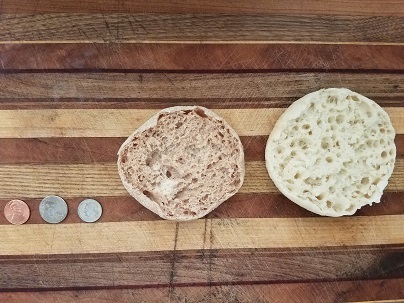
As I was splitting it I had that feeling that something wasn’t right. It didn’t feel right. Not the feeling. The muffin. It seemed to not fit my hand right. It felt … small. I shrugged it off and continued splitting. I dropped the halves into the toaster and turned to tend to—- Wait! The toaster! Those are really low in the toaster. What’s wrong with the toaster? Yes, you got it. There was nothing wrong with the toaster. It was that muffin. That blasted, small muffin.

I took out another wheat muffin and one of my remaining plain guys.

Muffins

Side by side there was no mistaking it. The wheat muffin was smaller. And judging by how much, I’d say more than two cents worth smaller.

I feel so violated.