Never Underestimate the Power of an Offspring

A while ago WD Fyfe posted “Stuff I’ve Learned from Literature,” a collection of life’s lessons from the pages of best sellers such as “never volunteer for anything” as taught by The Hunger Games. In a comment I added “never underestimate the power of a woman” learned from “anything by Ian Fleming” to which he replied, “Including Chitty Chitty Bang Bang.” Of course my reference to Ian Fleming was to the Bond Girls of the 007 franchise but the famous children’s story turned movie has several strong female characters. Perhaps a Fleming trait?
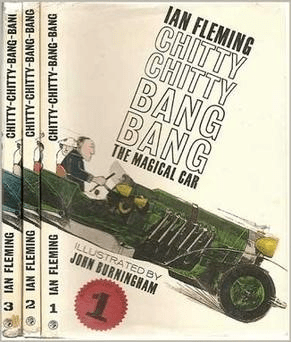
CCBBYou didn’t know that the author of sixteen Bond, James Bond spy novels tossed in one book about a magical car? He did. Published right between You Only Live Twice and The Man with the Golden Gun it was the last book he wrote. Based on bedtime stories he told his son Casper, he wrote as he convalesced from a heart attack from which he never fully recovered.

That got me thinking which as you know not only do I have the time for but is also rarely a good thing yet often results in a blog post. Thank you Bill.

So … the world is full of talented authors and more than a few of them are both quite well known and are parents. So how many of the well-known parents have favored their children with tales that themselves became well known in spite of the parent not being well known for authoring children’s books. I found three. Four if you stretch a point.

The second to come to mind and first in the “I didn’t know that” list is Mr. Fleming’ famous tale of the famous car. The first author famous for a child’s story harkening back to his child to come to mind but on the “but what else did he do” list is A. A. Milne. If before this summer’s film release you didn’t know Christopher Robin was indeed Christopher Robin Milne and Pooh, Piglet, Eeyore, Kanga, Roo, and Tigger were the younger Milne’s childhood toys, you do now. But before the poem featuring Winnie-the-Pooh appeared in When We Were Very Young, the elder Milne was known as a playwright.

Also on the list is one known more for penning songs. Kelly Clarkson, former “American Idol” winner and singer/songwriter has also published two children’s books inspired by and featuring her daughter River Rose. Though not yet classics, who knows what we might be saying about them in fifty years.

PatTheBunnyAfter extensive research spanning at least 30 minutes, the closest I could come to uncovering another author who was known for one thing but exploded on to the scene with a book inspired by an offspring is the historian Dorothy Kuhnhardt, author of the 1965 winner for longest title, Twenty Days: A Narrative in Text and Pictures of the Assassination of Abraham Lincoln and the Twenty Days and Nights That Followed–The Nation in Mourning, the Long Trip Home to Springfield. The book she wrote as her gift to her daughter is more succinctly titled Pat the Bunny. I say this is a bit of a stretch to my search because although Kuhnhardt was a legitimate historian and author, the books she is better known for are the children’s volumes which she was putting out before the first bunny was patted but the patting was going on before she wrote the first book. It’s all very confusing and probably doesn’t belong on the list but I liked the book both as readee and reader.

There are many well-known authors who have written children’s books but were they inspired by stories they told their own children? Google doesn’t know about any so I guess not. If you do, share, but be sure to tell Google too. Can you tell Google anything?


Stop, Thief!

I bought a book to read and when I read a book I start at the beginning. The very beginning. Prefaces, forwards, introductions acknowledgements, dedications. I also don’t finish until I get to the end if there should be an afterward. (After words?) If is written I will read it.

This particular book I bought, and after reading the forward I’m so glad I did. I say again, and will stress, I bought this book. With money. American made money in an American book store. Yes there are some bookstores left and I still frequent and patronize them.

I’m not in the habit of stealing books. At least I didn’t think so. Apparently this particular author thought differently. In his preface, his 22 page preface, he says, “what happens in libraries in the U.S. is a theft of services on the same scale as the enslavement of blacks.” A strong sentiment that. It was said, er printed, in reference to authors receiving a single royalty for each book bought by a library though lent to “everybody with a library card … twenty-six times in one year, fifty-two times in two years.” Personally I’m glad he expanded that thought just in case my ability to master multiplication failed me at that critical moment.

LibraryIs borrowing a book from a library stealing? I hadn’t thought about it. If it is I am guilty of it hundreds of times over. Of course many of those times were the first time I had read a particular author and it was that exposure that led me to buy hard or electronic copies of his or her other works. But theft of the first book is still theft I suppose. To that unnamed author I apologize and repent. I suppose I can send him a few bucks in restitution although I don’t recall ever borrowing one of his books from the library. In fact, I don’t think I ever saw one of his books in the library but that’s a different story.

He can use those dollars to pay for the paper he probably read at the diner, the magazine he perused at the doctor’s office, the cable fee for the game recap he watched at the barbershop, or the medical advice he asked me for at last year’s Fourth of July picnic. Ok, it wasn’t last year but that really did make a nice flow, don’t you think?

I suppose he was right in his criticism of the lending library system and he has the right to voice said criticism. And what better way. Really. In a book that somebody might have gotten out of library. That will teach them for sure. If they bothered to read the preface.

I have the right to be insulted by his criticism and to express my dismay at being insulted. I bought that book. At full retail. And waded through it even after I was so insulted 17 pages into it. I could have shown him and not finished the book (or even the preface since I still had 5 pages of that to get through) but to be honest I already paid for the book and he surely spent the royalty so why not get my money’s worth out of it.

Now if I can just figure out a way to get my money’s worth out of it.


Three on a Match

I just finished rereading a Phillip Marlowe mystery. Philip Marlowe is the hard boiled detective invented by Raymond Chandler in 1939 in the novel The Big Sleep. You might have seen Humphrey Bogart play Marlowe in the movie version. If you did, you saw a man do some serious detecting. And some serious smoking. Well, it was the time. Between the wars. A manly man. In a manly field. Doing a manly job. Smoking like a man.

Last week one of the movie channels replayed the 1985 film, St. Elmo’s Fire. A bunch of kids just out of college, working their entry level jobs, drinking their every level cocktails, loving and hating their entry level lives. And smoking. Wow, they smoked a lot in that picture. When they drank they smoked. When they partied, they smoked. When they drove, they smoked. When they danced, they smoked. When they attempted suicide, they smoked. When they thwarted suicide, they smoked. When they broke up they smoked. When they made up, they smoked. I don’t remember if they ever ate.

I mentioned a couple of posts ago that I had been watching Bond, James Bond movies during a month long marathon of the classic spy stories. One of the things about the early 1960s offerings that you might notice is how much they smoked. Everybody smoked. The spy, the counter spy, the henchmen, the femme fatale. Bond, James Bond. Everybody smoked. Some of Bond, James Bond’s best secret weapons were built into cigarette lighters. Others into cigarette cases. Some even into cigarettes.

NoSmokingFrom the 40s through the 60s to the 80s, everybody smoked. By the time we got to the 2000s people just stopped smoking. Movies today even have disclaimers at the end of the credits stating nobody, but nobody involved in the production of the just viewed movie got any financial, moral, or athletic support knowingly, unknowingly, or even accidentally from anybody, any corporation, or any organization supporting or even involved with the tobacco industry. Often the disclaimer is more prominent than the notice of what type of camera used to shoot the film and the union local responsible for driving the caterer from location site to location site.  In the most recent Bond, James Bond volumes nobody smokes. Not in the bars, not in the casinos, not on the stakeouts. Not just the spy and the supporting spy people. No body. No where. No Smoking. They must have all gone cold turkey.

Amazing the strides they made in 20 years. The Surgeon General would be proud of Mr. Bond, James Bond. Now if we could just get him to drive a little safer.


See the Movie, Read the Book

I do a lot of reading. I always did. Sometimes I go through a book in a day. Sometimes I’ll wait for the movie. Most times I’ll do both.

Sometime over the past week among the books I read was an oldie but goodie, Hopscotch by Brian Garfield. You might remember this international thriller from the 70s. Or you might remember the movie with Walter Matthau and Glenda Jackson from the 80s.  If you saw one or read the other without reading the one or seeing the other then you really don’t know both stories. Even though they have the same characters, the same general plot, and the book and the screenplay were both written by the same man, they aren’t the same story. Not that one was better than the other, just different.

A more recent example is Silver Linings Playbook, a 2008 New York Times best seller and debut novel from Matthew Quick, and an Academy Award winning movie from 2012 (Best Actress, Jennifer Lawrence). Again, if you just read the book you missed a great movie and if you just saw the movie you missed a terrific story. Both really good. And both really different.

Sometimes the differences between book and movie are very small, except they stop partway through. Sort of like the movie is an abridged version of the book. I first noticed it when Three Days of the Condor starring Robert Redford was released in 1975. A nifty spy thriller based on James Grady’s book, Six Days of the Condor. What happened to the other three days?

Redford pops up again in my list of movies that “follow the book closely enough but not necessarily enough of the book” when he starred in this year’s “Walk in the Woods” movie adaptation of Bill Bryson’s 1998 book of the same name. Just like the condor’s missing three days, this movie is missing half of his trek along the Appalachian Trail. What’s there is fairly close to the book (even though the characters on the screen seem to have aged the 17 years between book and movie release), it’s just that the whole book isn’t represented on the screen.

People or studios buy rights and get to do what they will with them. Most often they end up with a pretty good visual representation of the book or play or whatever it is that they bought. There are times when there’s nothing in common but fortunately those aren’t all that common. And every now and then they end up with a really great story that seems familiar but might be more of a sequel to the native version than an adaptation. And that’s not so bad. That way you can still read the book, or see the movie, and not always know how it ends.

That’s what I think. Really. How ‘bout you?

The Best Best-Seller That I Never Read

The other day I was looking up the best selling books of all time – because I have that kind of time – and found some interesting stuff.  I think it started because I received a mailer from the city’s summer stock theater that the Man of La Mancha would be opening soon.  That sparked something in my head about Don Quixote being the best selling book ever.

Upon researching it, I found out that Don Quixote indeed is considered to be the best best-seller of ever. This classic was first published in the 1600s, the early 1600s, when there was no Internet to track sales so some of this might be conjecture on the part of whoever (whomever?) came up with the list. The estimate is that over 500 million (that’s half a billion!) copies have been sold. Since it occupies the Number One spot on several such lists, it must be a fairly reliable estimate.

There are some classics that take residence in the Top Ten of book selling lists. Titles everyone knows like A Tale of Two Cities, Lord of the Rings, and The Little Prince. And there are a couple that everyone knows but wouldn’t think they would be among the best selling of the best-sellers.  Agatha Christie is often mentioned as the world’s best selling author. She sold over two billion copies of her books but then she wrote 85 of them. One cracked the Top Ten and that was And Then There Were None selling about 100 million. An author just missing the top ten of authors coming in at number 11 and having published only 11 volumes is J. K. Rowling.  All seven of her Harry Potter installments meet in most lists’ top 25 best-selling books and they are still selling.  But the first of the series, Harry Potter and the Sorcerer’s Stone, hits most lists’ Top Five at 107 million copies sold.

It was fascinating to read about all of these most successful books and the authors who wrote them.  I spent hours reading the stories behind the stories. I had to pick a floor so I stopped when I saw books that sold less than 50 million copies. Excluding religious, text, and reference books there are thirty-five books that have sold at least that many.  There is no pattern, no magic formula. They are adventures, mysteries, romance, children’s, and fantasy. The only thing these books have in common is that they all hit a common chord in the world’s readers, some literally for centuries.

The other thing they have in common is I haven’t read many of them. Ok, of the 35 best-selling books of all time I haven’t read 33 of them.  And I thought I was a big reader.  I better go pick out another pair of reading glasses. I might be busy this summer.

Now, that’s what I think. Really. How ‘bout you?

Now they’re really making things up, really

Lately I’ve been thinking about food a lot.  Just look at some of my most recent posts. Soup, kale,eggrolls. Soup is pretty straightforward. A few posts ago I talked about “them” making up new foods like chia seeds. I got to thinking about more made up stuff when I saw a Taco Bell commercial for a “Doubledilla.” Restaurants, particularly fast food restaurants have a long history of making up stuff. There were no McMuffins before there were McDonalds. But I found a group who are really making up stuff in or for or around the kitchen. Novelists. Yes, those people whose jobs are to make up stuff. And they have taken to food like a nutritionist takes to quinoa.

Many years ago, in a whole different century, I encountered my first food related novel – Someone Is Killing the Great Chefs of Europe by Nan and Ivan Lyons. Now this isn’t your classic mystery or (my favorite) a hard boiled crime story. But it has murders in it so that was good enough for me to pluck it off the bookstore shelf. It was also on clearance, is relatively short for a quick weekend read, and it looked pretty fun based on the backflap synopsis. So I bit. And I still go back and read it today.

Since then, whenever I’ve needed a break from gritty crime and mayhem I’ll crack open a fun, lighthearted food mystery ala Joann Fluke or Chris Cavender. Silly stories you don’t have to concentrate hard on and usually figure out whodunnit somewhere around page 6.

I recently (and finally) slogged my way through Dan Brown’s latest. After several hundred pages of dashing across Florence I needed fluff. So I went off in the search of The Marshmallow Fluff Murders or something similar. Boy did I find similar!

As I was perusing the B&N catalog I found some of the most remarkably titled tomes. I don’t know how good any of the books are but the names are wonderful. We have Battered to Death, All the President’s Menus, As Gouda as Dead, Basil Instinct, Bread on Arrival, and about a hundred other bad puns masquerading as book titles. (Yes, you can really search using the phrase “Foodie Mysteries.”)

There once was a day when if I wanted to mix meals with murder I had to read Robert B. Parker’s “Spenser” mysteries. It seemed at least once every 10 or so chapters our hero would cogitate over his most recent discovery while fixing dinner. And Mr. Parker worked great detail into those fixings.

But today, we have our “Foodie Mysteries” and I don’t dare Roux the Day that I discovered them.

That’s what I think. How ’bout you?

Everything Old Is New Again

It’s that most wonderful time of the year again.  Well, it’s that time of the year again.  That time when every department store has a CD player in the shape of a 1950s jukebox, every home improvement store has next to the high tech LED lights those big C-3 bulbs, and every video department has “Miracle on 34th Street,” “It’s a Wonderful Life” and “Frosty the Snowman.”  Yes, it’s retro time!

Retro is an interesting concept.  Can’t come up with an original idea?  Retro it!  Can’t come up with a winning idea?  Retro it!  Can’t come up with any idea that won’t get you fired before the holiday breaks?  Retro it!  And quite often it works.

There truly is more right than wrong when it comes to retro.  Consider these.  Look at all of the retro car designs that have hit the road in the past few years.  The underpinnings were new but the looks from the Chevy HHR to the Ford Mustang were based on clear winners from the past.

Check out some of the most recent movies to hit the big screens.  “Walk Among the Tombstones” released a couple of months ago is based on a Lawrence Block novel published in 1992.  The Bond flick “Casino Royale” from 2006 was written in 1967.  The upcoming “Imitation Game” is based on the 1983 publication The Enigma.

Entire television networks have been built around classic television shows from the 50s, 60s, and 70s.    Feel free to consider this as retro-programming.  Sometimes the networks will even run original commercials with the shows.  Now that’s retro!

Fashion, furniture, and architecture are rediscovering styles from a generation or two past.  Classic art is experiencing a resurgence in galleries and at auctions.  Even food is going retro.  The hottest meat in town is buffalo – that would be burgers, not wings.  And they are being sold out of trucks a la Mr. Softee.  Modern is taking some time off so we can appreciate what was.

Obviously there is much more right with retro than there is wrong.  It’s the seasonal stuff that one sees in catalogs and weekly ad flyers that give retro a certain queasiness.  You can’t even make a cheap imported CD player look like a classic jukebox let alone create the feel of a 1950s diner in your family room just because now you can play Lady Gaga in a plastic box with an arched top and blinking lights.  So let’s leave the retro to those who know what they are doing and how to develop it for today’s markets.

Now if you really want to gift your favorite bloggers with a 1950s style jukebox, type “Jukebox for sale” into your favorite search engine. Skip the results that start with “CD” and peruse the remaining offerings.  There’s a corner in the family room ready to go.

Now that’s what we think. Really. How ‘bout you.


Year of the Book

If you are Chinese or eat at a lot of Chinese restaurants then you know that this is the Year of the Horse.  On the other hand, if you like to curl up in a corner next to a crackling fire with one of our favorite pastimes then you know this is the Year of the Book.

 Books are getting to be strange things.  Not the New York Times best sellers, which as far as we can tell is every book that is ever released.   And not the autobiographies of every politician, actor, singer, and fashion designer, which a far as we can tell as long as there are ghost writers willing to be paid for pretending to be someone else there will always be autobiographies of those never heard of before their autobiographies came out.  No, those books aren’t strange.  Well, they are but they have always been so there’s not much new there.

Books are getting to be strange things because they keep on showing up at book stores that the Internet pundits have said would all be disappearing this year for the past five years.  Even among the virtual market flood with e-readers, tablets, and reader apps for smart phones (one has to be pretty desperate to try to read an entire book on a phone), books, real books with actual covers and pages are still being bought enough that there are still bookstores even after the Internet pundits said there shouldn’t be.

When recently asked on a news show, authors and critics alike preferred a real book to read even though those polled had reader devices also.  There is no question that the e-reader is the frequent traveler’s best friend for reading material.  With hundreds of books available on a single unit, one never has to worry what genre to read this evening.  Packing one e-reader is certainly much more convenient than packing a modest 3 or 4 books.  But for sitting in comfy chair next to a crackling fire there is nothing like the feel, the smell, and the heft of a real hard cover book.

Some books you just can’t replace electronically.  The best selling book of all time is still the Bible in all its various versions.  Something you never see is an abridged Bible.  We suppose the Eight Commandments just doesn’t have the same ring as the original.  Though one may not find an abridged Bible they do get smaller and smaller.  Smaller type and thinner pages have taken pounds off the venerable tome.

Everybody should have a couple of classics.  Even if you don’t opt for the leather binding you’ll be hard pressed to really enjoy the art of reading a classic Twain, Poe, or one of the Bronte sisters in an electronic reader.

Other books that aren’t going anywhere electronically are the Idiot’s Guide and the For Dummies series.  These are still going great guns.  We figure it’s because they are easy to hide when company is coming over.  In a reader they are there for all to see.  There are so many of them and more keep coming out every year.  We wouldn’t be surprised if there isn’t an Idiot’s Guide to e-Readers.  Soon we expect to see an Idiot’s Guide for Dummies.

One book that seems to have been lost to modern technology is the road atlas.  It wasn’t too many years ago that half of all cars had one shoved under a seat, tucked into a seat back pocket, or tossed into the trunk.  Now with GPS units, GPS phone apps, and turn-by-turn directions from satellite provides the atlas is becoming extinct.  Yet if you just want an idea of a couple different ways to get from New York to Miami it’s difficult to think of a more useful book.

So there you have it, our Year of the Book.  And regardless of what the Internet pundits have to say, we expect many more years to follow.

That’s what we think.  Really.  How ’bout you?