Based on a story by…

I don’t know why but last weekend I was thinking about Raymond Chandler, Ernest Hemingway, William Faulkner, F. Scott Fitzgerald, and Alfred Hitchcock. Not necessarily in that order. As I’ve written before, I don’t know why I think the things I do, but I do and that is enough to make me think, and then think that I’d rather not want to think about it.

It all started with me re-reading The Curious Case of Benjamin Button which got me thinking about how a movie and a book can be so different. A movie and a 600 page novel, an epic, the proverbial tome may differ because who could get all that detail into a movie people would be willing to sit through, except perhaps Gone With the Wind, but that has its own problems. But with Ben, or BB as I like to call him, that’s a short story, and still Eric Roth managed to write a 2-1/2 hour movie based on a tale that took me a fifth of that time to read, with a bathroom break thrown in. How did he do that! The answer is, he didn’t. Roth and story writing partner Robin Swicord wrote a different story with a title and a character of the same name. It’s a good movie. It’s a good short story. They just aren’t the same. And that’s been going on pretty much since we’ve had movies.

William Faulkner’s 1944 treatment of Hemingway’s To Have and Have Not does the same thing. A character or two are mentioned in both book and movie, and those plus the title are the total of what remains of the story the movie was based on. Now the 1950 adaption, “The Breaking Point,” by screenwriter Ranald MacDougall is much closer to the Hemingway classic. It’s on a different ocean and there’s an extra couple of characters, but it’s recognizable as being a story based on. But does that make it better than the 1944 classic or just different?

You can’t say that Faulkner, who was no slouch in the book writing department, was flexing his writing muscles, because he quite faithfully followed Chandler’s The Big Sleep, changing only what needed changed to make the movie acceptable to those who moderated the 1946 version of the production code (and to make it acceptable to those who wanted to see Bogart and Bacall become Bogart and Bacall). Perhaps that is why when Chandler took to the task of writing the screenplay to Patricia Highsmith’s Strangers on a Train, he stayed as close as he could to the original story. Oh wait, you’re going to say, they aren’t close at all. You might even say in the movie, the strangers are on an entirely different track than the one the train chugs along on in the psychologically thrilling novel. The “Strangers” presented by Alfred Hitchcock that we see is not the version Chandler wrote. That script ran afoul of the censors (and to a large extent, of Alfred) and was almost entirely rewritten by Czenzi Ormomde. 

When Chandler and co-screenwriter Billy Wilder adapted James M. Cain’s Double Indemnity, they took much liberty with the original story, changing names and timelines, and most radically, they added a new character, the insurance investigator, which created a completely different story.  

“Double Indemnity” and “Strangers on a Train,” a double dose of two books, two movies, four stories, none of them bad but none of them based on any other. So maybe when you have great writers adapting great works of writing, you will get great results, just not always recognizable as the story they are based on. 

Now let’s talk about what Leon Uris and Dalton Trumbo did with “The Exodus.”
Blog Art (26)


Blog Art (25)Everybody is more engaged and more fun to be around when they feel valued, and they feel most valued when they are treated like people. Read why we say good manners never go out of style at www.roamcare.org. While you’re there, check out the rest of our site, then share us with your friends and family!


Never Underestimate the Power of an Offspring

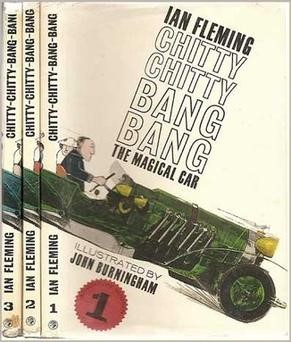
A while ago WD Fyfe posted “Stuff I’ve Learned from Literature,” a collection of life’s lessons from the pages of best sellers such as “never volunteer for anything” as taught by The Hunger Games. In a comment I added “never underestimate the power of a woman” learned from “anything by Ian Fleming” to which he replied, “Including Chitty Chitty Bang Bang.” Of course my reference to Ian Fleming was to the Bond Girls of the 007 franchise but the famous children’s story turned movie has several strong female characters. Perhaps a Fleming trait?

CCBBYou didn’t know that the author of sixteen Bond, James Bond spy novels tossed in one book about a magical car? He did. Published right between You Only Live Twice and The Man with the Golden Gun it was the last book he wrote. Based on bedtime stories he told his son Casper, he wrote as he convalesced from a heart attack from which he never fully recovered.

That got me thinking which as you know not only do I have the time for but is also rarely a good thing yet often results in a blog post. Thank you Bill.

So … the world is full of talented authors and more than a few of them are both quite well known and are parents. So how many of the well-known parents have favored their children with tales that themselves became well known in spite of the parent not being well known for authoring children’s books. I found three. Four if you stretch a point.

The second to come to mind and first in the “I didn’t know that” list is Mr. Fleming’ famous tale of the famous car. The first author famous for a child’s story harkening back to his child to come to mind but on the “but what else did he do” list is A. A. Milne. If before this summer’s film release you didn’t know Christopher Robin was indeed Christopher Robin Milne and Pooh, Piglet, Eeyore, Kanga, Roo, and Tigger were the younger Milne’s childhood toys, you do now. But before the poem featuring Winnie-the-Pooh appeared in When We Were Very Young, the elder Milne was known as a playwright.

Also on the list is one known more for penning songs. Kelly Clarkson, former “American Idol” winner and singer/songwriter has also published two children’s books inspired by and featuring her daughter River Rose. Though not yet classics, who knows what we might be saying about them in fifty years.

PatTheBunnyAfter extensive research spanning at least 30 minutes, the closest I could come to uncovering another author who was known for one thing but exploded on to the scene with a book inspired by an offspring is the historian Dorothy Kuhnhardt, author of the 1965 winner for longest title, Twenty Days: A Narrative in Text and Pictures of the Assassination of Abraham Lincoln and the Twenty Days and Nights That Followed–The Nation in Mourning, the Long Trip Home to Springfield. The book she wrote as her gift to her daughter is more succinctly titled Pat the Bunny. I say this is a bit of a stretch to my search because although Kuhnhardt was a legitimate historian and author, the books she is better known for are the children’s volumes which she was putting out before the first bunny was patted but the patting was going on before she wrote the first book. It’s all very confusing and probably doesn’t belong on the list but I liked the book both as readee and reader.
There are many well-known authors who have written children’s books but were they inspired by stories they told their own children? Google doesn’t know about any so I guess not. If you do, share, but be sure to tell Google too. Can you tell Google anything?


Stop, Thief!

I bought a book to read and when I read a book I start at the beginning. The very beginning. Prefaces, forwards, introductions acknowledgements, dedications. I also don’t finish until I get to the end if there should be an afterward. (After words?) If is written I will read it.

This particular book I bought, and after reading the forward I’m so glad I did. I say again, and will stress, I bought this book. With money. American made money in an American book store. Yes there are some bookstores left and I still frequent and patronize them.

I’m not in the habit of stealing books. At least I didn’t think so. Apparently this particular author thought differently. In his preface, his 22 page preface, he says, “what happens in libraries in the U.S. is a theft of services on the same scale as the enslavement of blacks.” A strong sentiment that. It was said, er printed, in reference to authors receiving a single royalty for each book bought by a library though lent to “everybody with a library card … twenty-six times in one year, fifty-two times in two years.” Personally I’m glad he expanded that thought just in case my ability to master multiplication failed me at that critical moment.

LibraryIs borrowing a book from a library stealing? I hadn’t thought about it. If it is I am guilty of it hundreds of times over. Of course many of those times were the first time I had read a particular author and it was that exposure that led me to buy hard or electronic copies of his or her other works. But theft of the first book is still theft I suppose. To that unnamed author I apologize and repent. I suppose I can send him a few bucks in restitution although I don’t recall ever borrowing one of his books from the library. In fact, I don’t think I ever saw one of his books in the library but that’s a different story.

He can use those dollars to pay for the paper he probably read at the diner, the magazine he perused at the doctor’s office, the cable fee for the game recap he watched at the barbershop, or the medical advice he asked me for at last year’s Fourth of July picnic. Ok, it wasn’t last year but that really did make a nice flow, don’t you think?

I suppose he was right in his criticism of the lending library system and he has the right to voice said criticism. And what better way. Really. In a book that somebody might have gotten out of library. That will teach them for sure. If they bothered to read the preface.

I have the right to be insulted by his criticism and to express my dismay at being insulted. I bought that book. At full retail. And waded through it even after I was so insulted 17 pages into it. I could have shown him and not finished the book (or even the preface since I still had 5 pages of that to get through) but to be honest I already paid for the book and he surely spent the royalty so why not get my money’s worth out of it.

Now if I can just figure out a way to get my money’s worth out of it.


The Best Best-Seller That I Never Read

The other day I was looking up the best selling books of all time – because I have that kind of time – and found some interesting stuff.  I think it started because I received a mailer from the city’s summer stock theater that the Man of La Mancha would be opening soon.  That sparked something in my head about Don Quixote being the best selling book ever.

Upon researching it, I found out that Don Quixote indeed is considered to be the best best-seller of ever. This classic was first published in the 1600s, the early 1600s, when there was no Internet to track sales so some of this might be conjecture on the part of whoever (whomever?) came up with the list. The estimate is that over 500 million (that’s half a billion!) copies have been sold. Since it occupies the Number One spot on several such lists, it must be a fairly reliable estimate.

There are some classics that take residence in the Top Ten of book selling lists. Titles everyone knows like A Tale of Two Cities, Lord of the Rings, and The Little Prince. And there are a couple that everyone knows but wouldn’t think they would be among the best selling of the best-sellers.  Agatha Christie is often mentioned as the world’s best selling author. She sold over two billion copies of her books but then she wrote 85 of them. One cracked the Top Ten and that was And Then There Were None selling about 100 million. An author just missing the top ten of authors coming in at number 11 and having published only 11 volumes is J. K. Rowling.  All seven of her Harry Potter installments meet in most lists’ top 25 best-selling books and they are still selling.  But the first of the series, Harry Potter and the Sorcerer’s Stone, hits most lists’ Top Five at 107 million copies sold.

It was fascinating to read about all of these most successful books and the authors who wrote them.  I spent hours reading the stories behind the stories. I had to pick a floor so I stopped when I saw books that sold less than 50 million copies. Excluding religious, text, and reference books there are thirty-five books that have sold at least that many.  There is no pattern, no magic formula. They are adventures, mysteries, romance, children’s, and fantasy. The only thing these books have in common is that they all hit a common chord in the world’s readers, some literally for centuries.

The other thing they have in common is I haven’t read many of them. Ok, of the 35 best-selling books of all time I haven’t read 33 of them.  And I thought I was a big reader.  I better go pick out another pair of reading glasses. I might be busy this summer.

Now, that’s what I think. Really. How ‘bout you?