The polarizing of America

At a time when most everybody in America is lining up, taking sides for the next us versus them battle, I read an interesting article last week that posits America is not as divided as some who may be benefiting from division would have you think. Joseph Ratliff, an editor at Allsides.com opened with a critique of a Washington Post article reviewing a recent survey of American priorities for education. (“How Media Bias Makes Polarization Appear Worse Than It Actually Is,” allsides.com, Apr 6, 2022) The gist of Mr. Ratliff’s commentary was although the Post headline “Democrats want to teach kids sex education. Republicans want to teach them patriotism” and lede highlighted significant differences on two education initiatives noted in the survey, it buried the striking agreement on 10 other initiatives, including respect for people of different races, languages besides English, and independent thinking.

Why is the division between the two controversial initiatives emphasized rather than the 10 that the ideological groups agree on? Because conflict sales. It may be healthier for the country and its populace that to note there is more consensus and commonality than discord and disagreement among Americans, but it is healthier for a new outlet’s bottom line to focus on the disparities, People pay more attention to news that can adversely affect them than positive reports. But people also want to know that others are even more adversely affected. This is reinforced in the “us versus them” manner of reporting, establishing clear lines between us and them so the outlet can rely on a consistent audience to present to its advertisers, sponsors, and contributors. By manipulating the importance of datasets and presenting what they feel is of importance to its consumers. outlets can honestly say they are not manipulating the data, only reporting it, although not necessarily all of it or not all of it until after the average reader/listening/surfer has reached his or her attention span limit.

The media has been able to take advantage of the average American to be unaware of much outside his or her own social network. An unawareness that has also been exploited by social media’s algorithms. This unawareness was described in detail in a report of a pair of surveys conducting in January of this year by YouGovAmerica. (“From millionaires to Muslims, small subgroups of the population seem much larger to many Americans,” yougov.com, Mar 15, 2022) When people’s average perceptions of group sizes are compared to actual population estimates, Americans tend to vastly overestimate the size of minority groups, but underestimate the size of majority groups. For example, people surveyed estimated that 19% of Americans make more than $500,000 per year when the actual is 1%, that 24% of Americans are gay, lesbian or bisexual when the actual percentage are 3, 3, and 4% respectively, that 37% of Americans are military veterans and the actual is 6%, and that 52% of Americans own a gun and the actual is 32%. Similar findings were noted for ethnic and religious minorities. However, when groups are clearly in the majority, Americans underestimate. Those surveyed estimated 49% of Americans own their house and the actual is 65%, that 61% of Americans have flown on a plane and the actual is 88%, and they estimated that 68% of Americans have a high school diploma or equivalent when the actual is 89%. It is important to recognize that Americans by and large cannot determine what is and is not prevalent because if the public cannot make that determination, the media can more easily skew reporting and maintain the polarization that benefits them.

they is so wrong (1)

How do we avoid becoming pigeonholed by media influencers. Always read complete articles rather than just the headline or highlight. If you see a blurb on social media, go to the full article cited in the post and if a full article is not cited, consider the information suspect. And know your own susceptibility to misunderstanding. I recommend you review the YouGov survey results and see how you estimate common standards). The survey explored how people estimated groups in family, religion, ethnicity, sexual orientation, politics, income, and education.  Actual percentages were determined based on information from the U.S. Census Bureau, the Bureau of Labor Statistics, and the results of well-established polling firms.

Don’t be stuck on one side of “us versus them” when the middle group is actually where you will likely find most of your neighbors.

Happy American Day

Happy Fourth of July! I say that as opposed to Happy Independence Day to my fellow Americans because although I am certain that today is July 4 I’m not sure if we weren’t supposed to celebrate our independence yesterday, thus insuring the federal employees their well deserved three day weekend, because what good is getting a holiday off if it is a scheduled day off anyway. And as everybody knows even though Congress decided to send King George our intent to be so on this day in 1776, we really didn’t become independent from the Crown until October 19, 1781.
 
So…Happy Something! Happy Saturday if nothing else. I don’t normally post on Saturdays, in fact I think it was more than 8 years ago that I last did this but these are not normal times. This is a particularly not normal American Independence Day weekend with so many Americans taking their freedom to task as opposed to taking it for granted which would make this a particularly normal American Independence Day weekend.
 
continentalflagI can’t say with certainty so somebody please correct me if I misspeak but I feel certain that America is the only nation that qualifies its citizens. We claim we want to be equal. We protest for equality. We write letters and poorly articulated social mode posts demanding equality. And then we differentiate. We have African Americans, Asian Americans, Indigenous Americans, Mexican Americans. Other ethnic groups celebrate being German, Irish, or Polish American. Yet it’s only a small portion of Americans who ever lived anywhere other than America. I guess they would be American Americans. A friend of mine emigrated from Vietnam to Canada before immigrating to the U.S.. Does that make her Asian American or Canadian American? Was she an Asian Canadian before. Are there African Canadians or Scandinavian Canadians? What goes on in the rest of the world? As the son of Italian Americans here, if I relocate to my homeland in the mountains facing the Adriatic would I be an American Italian there?

 
I have a hunch the labels are mostly assigned by those outside the ethnicities to track how well they (the assigners) do something in their mind “special” for one of the assigned. Not ever having been assigned (European American is not an option) I can’t say if they (the assigned) really care much. Maybe it’s more important to be treated respectfully than being called by the “proper” term and still treated like an object to be used for effect.
 
There have been a multitude of posts on social media declaring “This Fourth of July act like an American!” It’s not a horrible idea you know. For all its faults and flaws America, actually Americans do a credible job living up to the standards envisioned 250 years ago. (Yeah, yeah, it’s only been 244. Actually its only been 239 (1781, remember) but it took a few years even back then to get up to speed.) When nobody is watching we typically do the right things. We mostly honor our families, we support the local businesses, we get out to help our neighbors who might have trouble shopping or cleaning or are just lonely. And most of us mostly do that for most anybody without checking IDs or birth certificates. Acting like an American is pretty much like acting human, like the rest of the world. So I too will say, this Fourth of July act like an American! But might I humbly suggest we act that way the other days of the year too.
 
Happy First Saturday of July!
 
 
860_fireworks_banner_4MB

Just the Facts Ma’am

Welcome to Columbus Day 2019! The holiday everyone loves to hate!!! Personally I’m not thrilled with any holiday outside of Christmas, Easter, Thanksgiving, and the Fourth of July. All the others are just excuses for anybody who works for the government to get an extra day off.
.
Columbus Day is also the holiday everyone loves to demonstrate their knowledge of “the facts.”
  • Christopher Columbus didn’t discover America, Amerigo Vespucci discovered it, that’s why we call it America.
  • Christopher Columbus didn’t discover America, Leif Erikson discovered it 500 years before either of those Europeans.
  • Nobody discovered America, there were already people living here!
  • Columbus was a criminal, slave trader, tyrant, and probably didn’t like dogs.
All sort of true (except maybe about the dogs) and all sort of not true, or at least inaccurate. If you’re looking for who actually first landed on the American mainland, whether North, South, or Central, that probably was John Cabot (surprise!) who landed in modern Canada in 1497. Columbus didn’t reach the South American mainland until his third voyage in 1499, and Vespucci landed in South America in 1500. Although the Vikings were known to have reached what is now Greenland as early as before 1100 their presence on mainland America has not been clearly documented before the 16th century. Columbus’s crimes are well-documented, but in 15th century Europe everybody who ran afoul of royalty would be accused and convicted of something, many of those some things quite routine for the rest of the populace.
.
20191014_152221The “fact” most people seem to get the most mileage from is that Columbus could not have discovered America because there were already people living here. Again true, there were people living here, but then not true because that’s not what a discovery is. That would be like saying Neil Armstrong discovered the Moon because when he landed on it there were no people there. Of course the discovery of the Moon happened hundreds of thousands of years ago when the first eyes looked to the sky one night and saw a a big round, bright object. It isn’t whether people were here or not, it was a discovery for the Europeans because they did not know that this “it” was here. That discovery led to greatest period of trade and colonization that the world had seen yet or since.
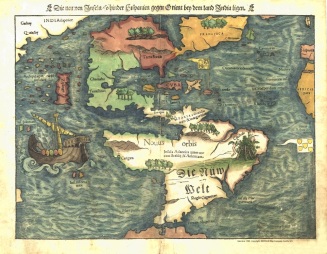
.
But of all the facts, suppositions, non facts, and inaccuracies, the one of most importance today is this – you can stop wondering when the mail is going to come.
.

Happy Birthday America!

Hey, if people can have Christmas in July, I can celebrate the Fourth of July in January. Particularly since it belongs here. Now.

January 14, 1784, the United States of America was established as a sovereign power. It was then the Continental Congress ratified the Treaty of Paris ending the war with Great Britain. Officially today is known as Ratification Day. It’s probably celebrated as little as it is because so few Americans understand the concept of, or quite possibly even the word, ratification. If you’re not sure, don’t look it up in an on line dictionary. There you will find “the act of ratifying.” Useful, no? How about “the action of giving formal consent to a treaty, contract, or agreement, making it officially valid.” Better!

continentalflagWhat happened on July 4, 1776 was like America standing in the middle of the school yard shouting “I am the greatest!” What happened seven and a half years later was everybody else agreeing with them. (Us?) Sort of.

Seven and a half years is a long time for peace to be recognized. That because it wasn’t. Just because the U.S. declared itself independent in 1776 nobody was going to just take their word for it. (Our word?) King George wasn’t convinced and he kept sending troops to North America to convince them. (Us?) It wasn’t until September 1783 that peace was negotiated between the colonies and the crown, officially ending the American Revolution and recognizing the United States of America as an independent country. The treaty was negotiated in Paris and required the ratification of at least nine of thirteen states, a two-thirds majority, when Congress next met in January. Representatives from nine states attended and unanimously approved the treaty, ending the war and constituting the nation.

The proclamation went:

By the United States in Congress assembled, a proclamation: Whereas definitive articles of peace and friendship, between the United States of America and His Britannic Majesty, were concluded and signed at Paris, on the 3rd day of September 1783 … we have thought proper by these presents, to notify the premises to all the good citizens of these United States …
Given under the seal of the United States, witness His Excellency Thomas Mifflin, our president, at Annapolis, this fourteenth day of January, in the year of our Lord one thousand seven hundred and eighty-four.

Wait, wait! Who is this Thomas Mifflin guy and why are they calling him president instead of George Washington. Thomas Mifflin was President of the Continental Congress, just like John Hancock was eight years earlier when Congress was working on that declaration thingy. George wasn’t elected president of the country until some five years later that year when the constitution was ratified calling call for a president of the country to preside over it. (Apologies to on-line dictionaries everywhere.). That’s a post for a different day.

But for today…happy birthday America! Now, who has the cake?


A Date That Will Live

The day that will live in infamy is becoming forgotten in the parts of the world that knew of it to begin with. The 2400 killed in the attack and the 400,000 Americans who died after the U.S. entered World War II, did not perish so others can live in oblivion.

While we’re good at commemorating things we’re also good at forgetting the impact those things had on the people who lived through them and why they took the positions they did. The service men and women who died on December 7, 1941 didn’t know they were putting their lives in jeopardy when shortly after dawn 414 planes rained terror on the American fleet harbored 50 miles west of Honolulu.

There was no U.S. involvement in the war in August 1939 when many of the sailors and soldiers enlisted who then found themselves on Oahu twenty-eight months later. There were world issues but they weren’t entering the service knowing they would be destined for the front lines. They made a decision to serve knowing the country needed individuals willing to be ready on any day to go from “training” to “executing,” from active duty to actively doing, probably with no warning.

On December 8, Franklin Roosevelt addressed a joint session of Congress opening his remarks with the now famous, “Yesterday, December 7, 1941—a date which will live in infamy—the United States of America was suddenly and deliberately attacked by naval and air forces of the Empire of Japan.” Those words get quoted at least once a year, every year, a day shy of the anniversary of their first utterance as we remember the event that thrust thousands of so many of enlistees onto the front line.

PearlHarbor

Source: History.com

President Roosevelt’s words that came after the famous ones are often lost to history. “No matter how long it may take us to overcome this premeditated invasion, the American people in their righteous might will win through to absolute victory. I believe I interpret the will of the Congress and of the people when I assert that we will not only defend ourselves to the uttermost, but will make very certain that this form of treachery shall never endanger us again.”

That last phrase again was, “…make very certain that this form of treachery shall never endanger us again.” Unfortunately it did. Almost 60 years later almost the same number of people were killed at 3 sites on September 11, 2001 when 4 planes took aim on America.

So if today you find yourself calling today’s date one that will live in infamy, remember to also say to yourself, “Those who cannot remember the past are condemned to repeat it,” and give today a little life.


Finding America

Happy Columbus Day. Sort of. Traditionally in the United States Columbus Day was established on October 12 commemorating the day when Columbus landed on what is now San Salvador in the Bahamas. But then the greater American tradition of moving as many holidays to a Monday to create 3 day weekends overwhelmed the quaintness of memorializing an event on the date the event happened so we are celebrating it on the second Monday of October, October 10 this year, instead.

Now we can contrast that with the traditionally traditional argument that we shouldn’t be celebrating a Columbus Day at all, on a Monday or a twelfth day, or an any day. We should instead recognize the contribution of Leif Erikson who landed on what is now Newfoundland almost 500 years before Columbus made his pitch to Ferdinand and Isabella. To that end we have Leif Erikson Day celebrated on October 9, every year. Nobody really knows exacnewworldtly when Leif wandered past Baffin Island so somebody picked that date because it is the day an organized group of Scandinavian immigrants reached New York City in 1895.

One thing that is certain is that even though Columbus made 4 trips from Europe to “The New World,” the only time he actually landed on continental soil he was somewhere around modern day Honduras, fairly far from Washington D.C. where all the fuss about what day to celebrate emanates. On at least two of those voyages, the first and the fourth, his expressed intent was to land on land bearing resemblance to Asia or India. On the second and third voyages he at least partly intended to colonize the islands he had previously visited. None of the four were huge successes but he did well enough to warrant all federal employees getting an extra day off and have a city in Ohio named after him, all from a country within whose border he never trod.

A bit less certain is if Leif even meant to sail past Baffin Island. Leif was the second son of Erik the Red, who established a settlement on Greenland in 980. We don’t know if he was born there or on Iceland from where the family moved, perhaps urgently. Around 1000, Leif Erikson sailed from Greenland to Norway, hung out with King Olaf I for a while, converted to Christianity, and was to return to Greenland to spread the new faith. Many believe that Erikson’s landing on the north coast of Newfoundland was due to missing Greenland on that return. Whether he missed it or intentionally detoured his return to find new lands for subsequent explorers, he eventually made it to the settlement on Greenland and never returned to the continent. But that one stop made him the darling of anti-Columbian agitators and gets him a day of observance and a presidential proclamation every year, all from a country within whose border he never trod.

Continuing to contrast, it can be argued that it’s inappropriate to recognize anybody’s discovery of America since there were already people living here. How they got here is somewhat fuzzy due to the lack of record keeping from 10,000 years ago but they came from Siberia, Australia, or the Middle East depending on your source and/or obsession.

Then again…archeologists can deduce American societal findings dating earlier than the 25,000 years ago that migration would have been practical and there are indeed native cultural formations.It could be that those who place original settlements in America to a time the world began its exit from the most recent ice age (and the beginning of global warming?) may be the ones who should get an extra day off in October.

Whatever camp you belong to, don’t look for mail this morning.

That’s what I think. Really. How ‘bout you?

The Road Un-Traveled

Boy the United States is a big place. I realized that when it hit me that the farthest I have ever traveled to get somewhere didn’t even get me out of the country. In fact, I had traveled farther more times when I hadn’t left the country than when I had gotten outside its borders. That’s a big place.

Becauseworld I have that kind of time, I took a few minutes over the weekend to figure this out. The greatest distance I’ve traveled from home to somewhere is a few miles over 2,500. That didn’t even get me completely across the country

I’m not complaining about any of this. I think Americans sometimes forget how close other countries can be to each other and how much of a challenge that might sometimes be. We can go pretty far and still be in a part of the  world where people speak the same language, eat the same food, and respect the same routines. We may have come from different places but we have a sameness that is quite comforting. If you live in the middle of the United States you have a long way to go before you leave home. But if you live in the middle of Europe, you’re never more than a day away from a different world, often from several different worlds.

Sometimes I envy a European version of me who can step across borders and immerse himself in other cultures as easily as I travel from state to state seeing few changes other than the colors of the license plates. While we take pride in our backgrounds and traditions it’s very likely the customs we observe in our families and friends may be our only exposure to different cultures. From generation to generation our ways of life mingle and meld becoming even less different. Other times I recognize how wonderful it is that I can sample fairly authentic foods and dances, customs and costumes of so many nationalities just by visiting nearby nationality days celebrations.

Yep, the US is a big place. It’s not the only one of course. Canada, Russia, China, India, Australia, and Brazil are all big with lots of space from end to end. Iceland isn’t so big but it’s so isolated that it’s still a trip to get anywhere else. And then Greenland is big and isolated.

I suppose this like many other things in my life if I could change I probably wouldn’t. I may not get to see a different country every time I want to take a trip somewhere but then I haven’t had to add any pages to my passport.

That’s what I think. Really. How ‘bout you?