Stop, Thief!

I bought a book to read and when I read a book I start at the beginning. The very beginning. Prefaces, forwards, introductions acknowledgements, dedications. I also don’t finish until I get to the end if there should be an afterward. (After words?) If is written I will read it.

This particular book I bought, and after reading the forward I’m so glad I did. I say again, and will stress, I bought this book. With money. American made money in an American book store. Yes there are some bookstores left and I still frequent and patronize them.

I’m not in the habit of stealing books. At least I didn’t think so. Apparently this particular author thought differently. In his preface, his 22 page preface, he says, “what happens in libraries in the U.S. is a theft of services on the same scale as the enslavement of blacks.” A strong sentiment that. It was said, er printed, in reference to authors receiving a single royalty for each book bought by a library though lent to “everybody with a library card … twenty-six times in one year, fifty-two times in two years.” Personally I’m glad he expanded that thought just in case my ability to master multiplication failed me at that critical moment.

LibraryIs borrowing a book from a library stealing? I hadn’t thought about it. If it is I am guilty of it hundreds of times over. Of course many of those times were the first time I had read a particular author and it was that exposure that led me to buy hard or electronic copies of his or her other works. But theft of the first book is still theft I suppose. To that unnamed author I apologize and repent. I suppose I can send him a few bucks in restitution although I don’t recall ever borrowing one of his books from the library. In fact, I don’t think I ever saw one of his books in the library but that’s a different story.

He can use those dollars to pay for the paper he probably read at the diner, the magazine he perused at the doctor’s office, the cable fee for the game recap he watched at the barbershop, or the medical advice he asked me for at last year’s Fourth of July picnic. Ok, it wasn’t last year but that really did make a nice flow, don’t you think?

I suppose he was right in his criticism of the lending library system and he has the right to voice said criticism. And what better way. Really. In a book that somebody might have gotten out of library. That will teach them for sure. If they bothered to read the preface.

I have the right to be insulted by his criticism and to express my dismay at being insulted. I bought that book. At full retail. And waded through it even after I was so insulted 17 pages into it. I could have shown him and not finished the book (or even the preface since I still had 5 pages of that to get through) but to be honest I already paid for the book and he surely spent the royalty so why not get my money’s worth out of it.

Now if I can just figure out a way to get my money’s worth out of it.


Shop With An Opp, Err, App

Just one blog post ago I said how sometimes I can appreciate some mobile based applications like the daily paper. Sometimes I am quite content with the old fashion ways like the Sunday paper. Today I tried a new phone app and I might not ever go back to my previous routine. Today I shopped, scanned, and bagged my way through the grocery store.

Ok, I know some of you are already saying that you don’t even want to use the self-checkout. “If I wanted to check out groceries I would have gotten a job at the grocery store!” and “I don’t see anybody giving out discounts for doing their job!” are just a couple of the reasons I’ve heard people give for not embracing self-checkout. Sometimes while in line for self-checkout. And that’s fine. As far as I know, no store has demanded that you have to check yourself out. At least not ones with a brick and mortar presence. They still have cashiers manning the scanner and till and you are welcome to use those lanes if you want somebody else to do the hard work.

I sometimes had problems with self-checkout at the grocery store. Often it was because of a person attempting to use the self-checkout who had difficulty completing the basic “pass bar code over scanner, put on belt or in bag” motion. Rarely was it the technology itself although the express, 12 items or less, self-checkout registers never understood that I wanted to use my own bag even though they gave me that option at the start of the process. A human was always able to provide some intervention and I moved right along.

The “Scan, Pay, and Go” option as my local market has dubbed the service, cuts the most annoying of the limitations of the self-checkout and still gives me the opportunity to shop in non-contact bliss. The process is simple. You download an app to your smart phone or use a provided hand held scanner. Instead of just placing an item into your cart, you scan the product’s bar code and put it into bag in your cart. And you continue through the store completing your shopping list like so. For security reasons you don’t put any payment information into the app and you pay at the end of the shopping experience. At the checkout area you proceed to an area just for the “Scan, Pay, and Go” crowd and scan the bar code on to the checkout stand which retrieves your order. You are given the option to redeem coupons and select payment method, then off you go.

It might not be for everybody. Some people might want even more automation. But for an old guy like me, it’s nice to have done something relevant to the 21st century. Finally.

I can’t wait till next week’s shipping trip.


Just Because You Can

This morning Best Buy announced they will no longer sell CDs in their stores. Vinyl yes, polycarbonate no. Apparently those who had normally opted for the shiny discs are now more likely to download or stream music to their hand held devices.

Last week the local paper announced that in August they will be dropping the print version of the paper from seven days a week to five. Apparently everybody wants their news electronically. This particular paper has not only its news website but two different apps for reading on mobile devices.

When Apple told us they had just the thing for that (with their trademarked and copywrited slogan (copywrit? copywrote?)), did they know they would release an app to reduce mobile dependency 9 years later? In fact, their app for that is only the latest in a string of such aids to reduce our electronic jonesing.

No, I’m not going to embark on a rampage decrying the ever presence of mobile devices in people’s hands. For the most part, I personally would rather hold a paper in my hands for perusal, especially now that they’ve resolved the inky finger problem, and though I never really got the hang of transferring a song from “somewhere out there” to what I still call “the phone,” I think we’ve done well in miniaturizing and availing technology to the masses. Even I am more likely to read the morning paper on my tablet out on the patio and I actually have a collection of favorites in my music folder in “the phone” (thanks to the daughter’s doing). Still, there are some things that shouldn’t completely replace the older hard copy iterations.

TriptikFor example, if you have a cell phone any less than say six years old you likely have a GPS mapping program at your fingertips. When I was traveling for work I appreciated my locating and traffic apps. I’d step out of an airport that looked quite like the airport I departed from, got into a rental car that look quite like the one I returned in a city earlier, and navigate to a hospital that looked suspiciously like one I visited the previous day on roads that held no resemblance to anywhere I’d even been. Yet I never got lost. My “phone” always knew where I was and which way to go.

But even knowing exactly where I was I never had a sense of roughly where I was. Years ago I’d use AAA “Triptiks” to navigate to a specific place. They were flip chart looking collections of mini-maps that specified your travel along highlighted roads. But I also always had my guidebooks and atlas so that at stops I could get a feel for what lay beyond the margins of the designated route. How else could you know that the world’s largest ball of twine was just 50 miles around the next bend, a drop in the mileage bucket when you’re already 1800 miles from home? You don’t get that from GPS.

So although I hope atlases never go away and that I’ll always have a CD player in my car so I have something to listen to while I search for the second largest cactus shaped like a tea pot, I can still appreciate the electronic versions. Now if only the proponents of those would please leave my paper and plastic alone we can live together in peace.


Nay Nee, I Say

I once toyed with the idea of changing the blog name to better represent who I am. But I was concerned how some to whose blogs I subscribe would take receiving an email from WordPress saying “Congratulations, A Single White Male is now following you.” And then there’s that whole “weren’t you something else before” thing to deal with.

Myanmar doesn’t have that problem. In fact, it is because of that country that I thought of this at all. One scarcely ever hears reference to Myanmar that it isn’t immediately followed by “formerly known as Burma.” Indeed it is. And indeed even WordPress refers to it as “Myanmar (Burma)” in its statistics reports. It’s been a fairly recent change but not much more recent than Bangladesh, Belize, or Zimbabwe and not as recent as Cambodia and Somalia yet you never hear their “formerly known as” designations.

MyanmarIt all came to my attention as I was reading a book. A minor character working as a data miner (legally and legitimately) had completed a project. As he submitted it he told the recipient to be sure to call him, don’t email him, with any questions because he will be leaving for vacation to Southeast Asia in the morning and won’t be bringing his laptop. He explains that it is very difficult to bring electronics into Myanmar “which you may know as Burma.” First of all, who talks that way? And secondly, for a character appearing on only seven pages of a 460 page novel, he’s being pretty cheeky taking that tone, wouldn’t you say?

It seems that we’ve been double designating Myanmar as that place formerly known as Burma since it barely stopped being known as Burma. I refer you to the 1996 episode of Seinfeld when J. Peterman escapes his world to, in his words (word?) “Burma.” He tells Elaine “You most likely know it as Myanmar, but it will always be Burma to me.” Admittedly, this makes finding Myanmar on a map easier if you haven’t updated your Google Maps since 1989. By that same token though, it would be handy if we started calling Mumbai formerly known as Bombay or St. Petersburg formerly known as Leningrad formerly known as Petrograd formerly known as St. Petersburg. Ok, maybe that one might not be so easy.

I think if you’re going to change your name, just do it and let every else figure out who or what you were before.

If you have an opinion I’d love to hear it in the comments. If I don’t respond right away, don’t fret over that. I might take a few days off and see a play or two and maybe do some shopping in New York City.

Formerly known as New Amsterdam.


Summer, Santa, and Selfies

MeWelcome to Selfie Day 2018. I’m not sure if it’s a National or International Selfie Day. I guess wherever there are cameras, err phones, and selfie worthy backgrounds, err phones, people can celebrate.

Personally I think we would be better off celebrating Half Christmas than Selfie Day. Even though marketing people are very up on doing Christmas in July specials that’s only because nothing else is happening in late July. But if you really wanted a hot celebration (Southern Hemisphere inhabitants understandably forgiven for minimal enthusiasm over the summer Christmas thing in general), now is the time, well, in 4 days is the time for summer Christmas. That’s when it’s really halfway betwixt last Christmas and next. Just because American mattress sellers and used car dealers are wrapping up the Banner Flag Day Specials and putting their Hot Fourth of July Sales on deck is no reason to ignore a natural not made up reason to celebrate.

But since we do relish made up reasons to be as selfish as we can, we instead have Selfie Day 2018. When you can mug for all the world and make it look like an almost natural thing to do.

Happy You! And did I mention Happy Summer?

The Almost Open

Picture this. It’s late on a Sunday afternoon. You’re full from too much Father’s Day celebratory luncheon, it’s too hot to take a walk, it’s even too hot to go swimming, and you’re not in the mood to read. You just want to sit. If it was 40 years ago you’d do your imitation of a couch potato.

Then you remember, even though it’s not your sport, you know this is that weekend. The Weekend. The weekend that gets capitalized   The one with the biggest names, the longest drives, the finesse when it’s needed, the trophy, the payoff. The U. S. Open.

Of badminton.

USABadmintonI didn’t set out to watch the U.S. Open of Badminton. I didn’t set out to watch the U. S. Open of Golf. (That’s the one you were thinking of, wasn’t it?) I wasn’t in the mood to do anything so I sat in my chair. (Yes, I have a “my chair.” Every male over the age of 40 has a “my chair.”) And after sitting therein (thereon?) (there?) for some time, I decided I needed to do something other than just sit. So I reached for the remote and remembered about that golf thingie. But I didn’t know what station was carrying it so I pushed the button with the picture of the microphone and said “U S Open” (I might have said it with the periods after the “U” and the “S” but I didn’t hear them so I’m not including them here) figuring it would take me to that golf thingie. Instead it brought up a screen for me to clarify which “U. S. Open” (I saw the periods on the screen so I am including them here). Who knew?

Since I was given a choice, I picked badminton. Wow. It’s not your backyard after picnic probably most played on Father’s Day badminton. First of all they use a real court with real poles holding up a real net. We always had to hold up one end of the net with the clothesline pole and make the sidewalk to the tool shed one back boundary and the hedges with the red berries you’re not allowed to eat the other. The other thing is they had a lot of shuttlecocks. We had three. One was stuck in the gutter and would remain there forever. One we couldn’t use in case we lost the one we were using. They certainly didn’t need a lot of shuttlecocks. I watched them for several sets and they never once flung the one in play out of anyone’s reach.

That’s another thing. They played it sets. And kept score. Even though the court looks like a 3/4 scale tennis court the scoring is more like table tennis. Unlike tennis, or golf for that matter, the crowd is obviously into the competition. Tennis and golf spectators might be into their respective competitions but you could never tell. Everybody at those events is so reserved. Even the TV announcers whisper. Not in badminton. These fans cheer their favorites, they scream their approval at a diving save, and they openly applaud a well-placed lob. When the contestants entered the arena it could have been 1974 with Muhammed Ali and Joe Frazier coming down the aisle at Madison Square Garden. The lights, the music, the cheers! They don’t do that at Wimbledon.

Overall, it was a good way to spend a late afternoon. I’m not sure that I’ll track the progress of the world class badminton players on their March to the Olympics (yes, it is), but if I’m not doing anything next Sunday, I have an alternate to watching golf.


Sun, Sun, Sunny Days

We are having some sunny, sunny, sunny days. Days meant for the liberal use of SPF 50. Or higher even?

Controversy of controversies, people are arguing about sun screen! Fifty years ago if we wanted sunscreen we wore hats and long sleeve shirts outdoors. Did you think those baseball uniforms were just a fashion statement? If you slathered anything on your skin it was most likely a splash of Coppertone or Sea & Ski hoping for a deep, dark tan rather than hoping to not get skin cancer.

Today, everybody knows of the dangers of overexposure to the sun and the significant health consequences that go beyond cosmetic considerations. But still people question. For some reason, all countries don’t use the same rating system for sunscreens but most people recognize the SPF ratings even if they all don’t know what those numbers mean. Like nutrition and politics, many people are content to get their skin protection news and information from late night TV and underemployed comedians.

It’s been established that SPF 15 blocks 93% of UF-A rays, those rays that are responsible for skin damage including melanoma. Does SPF 30 protect the skin from twice as many sun rays? Yes and no. The companies that don’t make products with higher SPF ratings will tell you that you can’t block more than 100% of anything. And darned if they aren’t true. And they continued to be true until they came up with their own SPF 30 which blocks 97% of those rays or an SPF 50 product blocking 98%. Let’s review. A jump in 15 SPFs increases the protection by 4% then the next 20 of those SPFs got us just another 1%. So where does that leave the new SPF 100 with its mammoth leap of 50 SPF thingies?

Instead, let’s look at what those SPF numbers are. Although you can quantify how much blockage they impart, that number on your sunscreen bottle isn’t a reflection of sun blocking. It’s actually the Sun Protection Factor or an estimation of how long you can stay exposed to the sun. An SPF 15 sunscreen means you can be in the sun for 15 minutes before you experience the damage unprotected skin experiences in one minute. SPF 30 gives you 30 minutes of exposure before seeing that damage, and so on.

You don’t double the amount of sun blocked by doubling the SPF but you double the time you can be in the sun without incurring the amount of damage your skin will experience. Or before having to reapply to extend that time.

CoppertoneOh, another thing about sunscreens. Those SPF numbers were calculated based on exposure to UV-A rays, the ones that cause potential skin cancers and other damage. Old fashioned sun burn is caused by UV-B rays. Not to worry though. Find a sunscreen that says it is “broad spectrum” and protects against both.
Umm, until you get wet. Then, you probably want to reapply regardless if how long it’s been since you last slathered.

We now return you to your regular program. Or to the sun porch.


Do Unto Others…Proudly

Oh the Golden Rule. Do unto others as you would have them do unto you. Simplified, love your neighbor as yourself. I love me unconditionally, or as Fred Rogers would be happy to hear, just the way I am. I don’t always like me but I do love me. Mr. Rogers would like it if I liked me just the way I am but if I want to be golden about it, at least I am hitting the loving requirement. And by extension, I love you also.

Clearly a lot of people in the world don’t love each other, but lately there have been a lot of people ignoring Mr. Rogers exhortation to even “like you just the way you are.” Not only that but people are taking exception with anybody who doesn’t even think like they do. Forget “like you just the way you are,” the world is taking the stance “it’s my way or the highway” and telling others to hit the road.

We are getting deep into Gay Pride Month and I have a story you can use to improve your Gay, Race, Ability, Origin, or Any Other Variable score. Fans of Mr. Rogers know he had a variety of residents of and visitors to his Neighborhood. Some of these even non-viewers recognize like Mr. McFeely, King Friday XIII, and Daniel Tiger. Others are not so universally recognized like Handyman Negri, Chef Brocket, and Officer Clemmons.

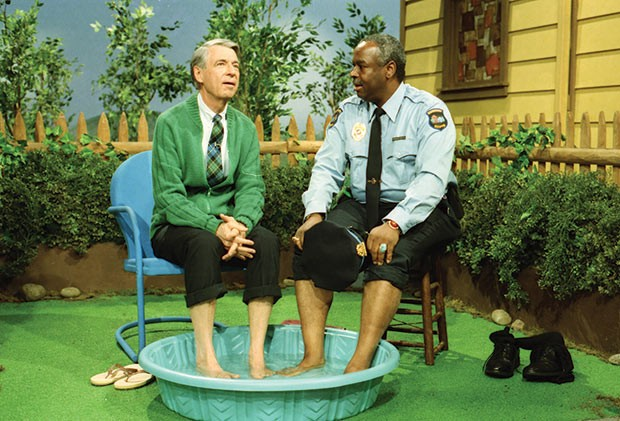
Francois Clemmons was a gay, black man in 1969. Neither was a popular modifier in 1960s America. But only one was evident. Regardless of his sexual orientation, Officer Clemmons was obviously African American. In an early episode in 1969, Mr. Rogers and Officer Clemmons meet outside in the summer heat and sit together, cooling their feet in a child’s plastic wading pool. A black man and white man in the same pool were almost unheard of in 1969. Yet together they sat. In his final appearance on the show 24 years later, Mr. Rogers and Officer Clemmons cooled their feet in the pool again. It wasn’t as unusual by 1993. The physical difference had become the non-issue for many besides Fred Rogers.

That Francois Clemmons was gay never made the airwaves. Neither did his religion, political party affiliation, or college alma mater. These were differences that didn’t matter. Mr. Rogers liked Officer Clemmons, and Fred liked Francois, just the way he was. He also never mentioned that Officer Clemmons was of a different race. Had it not been visibly noticeable, nobody would have thought it was odd that they shared a moment with their feet in the pool together by the way Mr. Rogers treated and spoke with Officer Clemmons. They would have been just two friends who liked each other. Just the way they were.

We have a hard enough time accepting people who look different to us. Do we really have to add to the difficulties by going out of our ways to find differences to dislike that we can’t even see?

This month, and next, and the one after that, when you run across somebody who you might think is a little different than you are, instead of going out of your way to tell him or her to hit the road, go out of your way and say, “Hi Neighbor. I like you just the way you are.”

To hear Francois Clemmons talk about his experience in the Neighborhood, click here.

RogersClemmons

Photo John Beale (Pittsburgh City Paper)

Tactical Sandals and Assault CEOs

I don’t know what it is about weekends but I get the strangest emails and see the oddest posts between Friday afternoon and Sunday morning.

For example, an email from Friday touted this season’s best hiking sandals. I don’t know why I was getting an email encouraging me to buy women’s clothes but after I got over that bit of incredulity I was left wondering if the purveyors were actually serious about encouraging anybody with the intent of setting off on say the Appalachian Trail to do it in sandals. Or were they using term “hiking” in a more poetic sense as in trekking from Sak’s to Nordstrom.

If you’ve watched any cable channel in the last month you’ve seen a spate of advertising for “tactical” sunglasses. “Tactical” must mean something new and different for the 21st century. I learned that it meant something used to gain a desired advantage or outcome particularly in military applications. Recalling my own years in the military (admittedly in that other century that brought me those vocabulary lessons which included my working definition of tactical) I know I never had a briefing on the correct eyewear for a particular campaign, drill, or exercise. Yet it was just last Saturday that I saw a banner ad march across my screen warning me not to be taken in by imposters, these are the tactical sunglasses our heroes are wearing. Oh, and if I act now I would get a free tactical flashlight. Just pay a separate fee.

This one isn’t so care free. If you didn’t see it, the weekend news included an article about a Chicago firefighter who was cited for not securing a firearm and having an assault type rifle within the city limits when his 14 year old daughter posted a picture of herself holding the weapon on Snapchat captioned “Don’t worry, I won’t shoot up Lane,” referring to Chicago’s Lane Tech College Prep High School. It seemed a straightforward enough news story until America got hold of it. Comments to the online article ran from “they have nothing better to do than arrest 14 year olds,” and “all your cities are cesspools,” to “it’s not illegal for a child to hold a gun,” and “in all fairness the firefighter is probably white.” I’m sure none of that was what I had envisioned as protecting either our First and Second Amendments or any other rights when I volunteered for the military back in that different century. But then, I didn’t get the class on the tactical sunglasses either so what do I know.  By the way, none of the commenters questioned why the young lady was either threatening a high school or who misled her about what constitutes online humor.

I guess this was news earlier in the week but I didn’t see it until Saturday. Apparently there is a regulation that requires CEOs to declare their salaries in terms of percentage of the average worker of their company. Without going into all the details, the average CEO makes about 17 times what the average worker does. We know some CEOs make millions of dollars but the average CEO salary is $730,000. We also know that hundreds of thousands of people make minimum wage but the average salary in the US is around $43,000. We further know the average company president (there are a lot more of them than CEOs) is making $147,000 a year. Now nobody asked me but I got curious. How much does the average union president make compared to his or her rank and file. A 2017 survey of union presidents revealed 22 of them made over $400,000 in 2016 with an average salary of slightly more than $300,000. Oddly enough it was difficult to find an accurate average salary of American union laborers. The most recent number I found was from 2014 and that was $950 a week or about $49,400 per year. Like I said, nobody asked but I was interested.

This is a good one. It’s always challenging when I get to talk with my cable and Internet provider. Sunday my service went out. It was working fine until … well, let me start at the beginning. In Saturday’s paper (you do still read your local paper, don’t you?) I read an article about a widespread computer virus that was discovered and neutralized by whomever (whoever?) tracks these sorts of things. This particular thing was affecting not computers but modems and routers. Apparently a simple reset of your modem is enough to protect or free your equipment from this virus. I read this at dialysis and was a few miles away from my modem but I made that mental note to do just that when I got home. Of course I forgot. When I finally remembered on Sunday, I managed to reset my modem just as a major system outage was occurring. When my modem did not go back on line I panicked thinking I activated the virus and would never be able to go on line again and would never be able to buy those hiking sandals that would best show off my calves or those tactical sunglasses with free bonus tactical flashlight. To make a long story short (I know, too late), I called my provider and got a recorded message describing the extent of the outage and that service would be restored in a few hours. If I wanted to follow the progress I could do so at their website. Hmmm.

I don’t know what it is about weekends.


Step 3B – More Tests

It’s been a while since I brought you a transplant update so I thought I should get at that knowing that without one soon, your days just wouldn’t be the same.

I haven’t done an update for a while because I’m still in the midst of the tests. You’ll recall the evaluation process started with a series of exams and some “simple” diagnostics – labs, x-rays, EKG, and sonogram. Those were all done in a single visit to the transplant unit at the hospital. More in depth testing was ordered and those are a previously alluded to cardiac stress test, an echocardiogram, a CT scan of the abdomen and pelvis, and a colonoscopy. They should have all been completed by now but the physician doing the colonoscopy had to postpone so that is now scheduled next week. After that I have to secure a medical clearance from my urologist to go with the clearances already secured from the dermatologist and rheumatologist.

You might ask why they need all these tests and clearances and that’s why I’m here. At least for this post. The initial tests determined suitability to undergo the actual operation. For any surgery, a patient will be ordered an initial exam and basic labs, chest x-ray, and EKG. Usually those labs include chemistries and blood studies to see how the body is processing, and the exam is done by the surgeon or a PCP to get an idea of the patient’s general health.

The initial transplant lab tests included the basics but added blood and tissue typing to determine what to look for in a donor organ and some specific tests to exclude the possible or potential exposure to hepatitis, pneumonia, tuberculosis, or cytomegalovirus. These would not exclude a patient from transplant but might indicate additional tests or precautions, or possible vaccines or treatments, may be required.

The more in-depth testing of the echocardiogram and stress test are necessary not only to determine if the patient will be able to withstand the rigors of major surgery but also the aftercare which will be complicated by a drug regimen including immunosuppressants and corticosteroids. The colonoscopy is necessary to detect the presence of any cancers not noted by other tests or reviews which might exclude a patient from consideration.

The medical clearances are specific to each patient’s history. The initial referral must come from a nephrologist or kidney specialist. Nephrology is the specialty involved with the patients already ongoing dialysis treatments so that physician is most able to tell if there would be a possible benefit to considering a transplant and the urgency if so considered.

Every potential transplant patient is also required to have a dermatology clearance. This seemingly unrelated specialty clearance might sound an odd requirement. The immunosuppressive drugs used for life after transplant are associated with the possible development of skin cancers. The dermatologist can establish if the patient already is at risk or has melanoma activity and can further establish a baseline survey to be used as a control for future annual examinations. In my case the dermatology consult was of more significance because I am already being treated with immunosuppressants for the Wegener’s Granulomatosis (now called Granulomatosis with Polyangiitis (GPA) (and we already talked about my feelings on that bit of nomenclature)) that is the apparent cause of my renal failure.

Wegener’s is also responsible for my requirement to have a rheumatology clearance. As a vasculitis, rheumatologists are the most common specialists to be consulted on Wegener’s as are many other autoimmune diseases such as Lupus or Crohn’s Disease. A target organ of Wegener’s is the kidney, especially true in my particular case, so the clearance is required to establish that the disease is not in an active state that would place the donated organ at the same risk of failure as the present. Other organs affected by Wegener’s include lungs, sinuses, and the general vascular system, so active disease would impact the surgery and aftercare even in the absence of kidney involvement.

A urology clearance is also specific to my case because of my medical history having had bladder cancer. That was treated by the removal and subsequent replacement of my natural bladder. I was diagnosed with bladder cancer in 2012. After several attempts of excision of the tumors which all resulted in recurrence we made the decision to remove the bladder completely. This would mean some artificial means of holding liquid waste that typically is done by that unsung organ.  Because I was quite young at the time (only 57, and yes, that is young!) we elected to have a new bladder created, appropriately called a neobladder in the medical world, which the urologist fashioned out of a piece of my ileum. That is the final part of the small intestines that connects the small and large intestines. Long story short, it required a very extensive operation and a lot of “re-plumbing.” The urology clearance will confirm there has been no recurrence of the cancer and that all the pieces are still functioning as they should be and are in the places where they should be and the most appropriate locations for the placement and connection for a donor kidney. The specific requirement for my abdominal/pelvic CT scan will aid him in his part of the evaluation.

And that, in not too brief but actually quite brief discussion is why I am still going through all my evaluation tests. I know, your next question is doesn’t that seem to be too long and too involved for a transplant? And right on the heels of that you might ask but aren’t transplants life and death type operations, why such a long wait for these people?

To the first if those I agree it’s taking a while but no, I don’t think it is too long. Certainly you want to be thorough in evaluating the ability of the patient (remember, that’s me) to get through the operation and that you don’t end up with a successful operation but a dead patient (again, me). So I don’t mind everybody taking their time and getting things right.

And to the question aren’t transplants life and death and you don’t want to take forever with this, I say yes and no. In the case of a kidney transplant there is an alternative treatment to End Stage Renal Disease (ESRD). That is dialysis. Of course a transplant will result in a more natural and often longer life, but dialysis, for all its flaws (enough flaws to keep an entire blog running for a good long while) will keep a kidney patient alive. Like a patient waiting for a heart transplant, if I don’t get a transplant I will probably eventually die from my disease. Unlike a waiting heart transplant patient, I can’t mark that inevitability on my calendar. All transplants can mean the difference between life and death but when you consider sustainable alternatives, for some like a heart, liver, or lung patient, a transplant is more urgent than others like maybe the waiting kidney or pancreas transplant patient.

And so the journey continues, albeit slowly. And my thanks to you for coming along also continues. So please, stay tuned.


Related posts

First Steps (Feb. 15, 2018)
The Next Step (March 15, 2018)
The Journey Continues (April 16, 2018)