Buddy can you spare a billion

One of the annoyances of being addicted to 70 and 80 year old movies (and older even), is having to translate certain period references to their twenty-first century equivalents, most notably (at least for this discussion), is money. As in, the value of money.

An obvious fact of money is that money of this year is almost always going to be worth less than money next year. (Eventually it will likely become worthless but that is a discussion for a different day.) The point being, when someone in a movie made in 1933 tosses down a dollar coin in payment for a meatloaf dinner, pie, and coffee – and gets change(!) you instinctively know money went a lot farther then. (Further?) (Whatever). Those aren’t so bothersome. But when someone says something like, “I want to put $1,000 down on Nag #1 to win in the third race,” I get to wondering, just how much is that guy gambling.

I did some research, and I found out that $1,000 American dollars in 1933, when adjusted for inflation is the rough equivalent of $24,000-$27,000 today (depending on whose rate of inflation you want to apply. So our erstwhile horse race lover is splurging with let’s say $25,000 on his horse race.

Some of the more criminal endeavors in the so called gilded age were really up there. A garden variety kidnapping when the perpetrators then demand “$50,000 or youse’ll never see da brat again,” are looking for a payout of $1.25 million of today’s dollar bills. (In December 2024 a cryptocurrency executive was kidnapped and returned after a ransom of $1 million was paid so maybe that’s not so far off.) (I wonder if those guys got money or crypto for their ransom???) (Anyway…)

In the 1930s, the richest man in the world was John D. Rockefeller. Topping out at about $1.4 billion 1934 dollars, making him worth $35 billion dollars today. Some would pooh pooh that trifling amount. Today’s richest of the rich are worth over $200 billion dollars, except they aren’t. A billionaire in the 1930s had a billion dollars in dollars. True, some of that might be in the value of their business (in Rockefeller’s case, Standard Oil), but their businesses were worth their values in real dollars. Today’s wealth is more a standard of leverage than liquidity. If John D. wanted to buy the New York Times for $20 million dollars, he would have gone to the bank, taken out $20 million dollars (or maybe he’d get it out of his change jar at home), and paid Adolf Ochs $20 million dollars. (He didn’t do that and probably missed out on a great deal because newspapers were a dime a dozen during the depression years.) Today if someone wanted to buy say Twitter, they’d be lots of stocks transferred and “financial considerations” made but nobody ends up with real folding money to put in their wallets.

The other thing about the difference between 90 years of inflation is that not only has inflation devalued the dollar. So called market adjustments must also be taking into consideration to really determine the purchasing power of a dollar is. Remember those $25,000 dollars oof today’s money that would buy you 1,000 of 1933 dollars. You need about 2&1/2 times that much to buy what $1,000 would buy in 1933. The actual spend equivalent of $1,000 1933 dollars in about $62,000 today.

Put another way, in 1933 the average income was $1,300 per year. The average house cost $5,700 or 4.4 times the annual average income. In 2024, the average U.S. income was $62,000, the average house cost $520,000 or 8.4 times the average annual income. We are actually making more money but getting less spending power. By inflation only, that average $1,300 dollars is about $32,000 today but the average income is almost twice that. By calculating for inflation alone, that $5,700 house should cost $140,000 today. The house price rose 3.4 times higher than the rate of inflation.

Remember those numbers when you read in this morning’s paper that your Senators approved the Big Bastardly Bill taking even more of your money away. I’m sorry, any billionaires reading please, please ignore that last statement. You’re going to get to keep 38% more than you did last year. Everybody else go out for dinner this year. After next year’s tax bill you probably can’t afford meatloaf, pie, and coffee all in one meal.

Who do you think you are

Recently I’ve been thinking about relationships. Someone dropped a “like” on an older post, “Golden Oldies” as a matter of fact, and it reminded me that I had said the longest relationship I’ve had in my adult life (which itself is pretty damn long) has been with my little roadster. I’ve used that line a few times in blogs posts. I’ve used it a few times in speeches. It’s true you know. That has been my longest relationship outside of family, although now she’s more like family than some family.

Lots of relationships, even the short ones, can become more like family than some family. My partner at ROAMcare is more family than friend, and I can think of another 2 or 3 friends who fit in that category. Along the same line of thought, some acquaintances turn into friends when they really have no good reason to have done so.

I’m not sure where to put those we come across in the blogging world. The ones we connect with are more than just fellow bloggerets. Some we may have actually made our acquaintance with though I would think they are more than acquaintances. I’ve never met another from the blogging world although quite a few have made an impact on me.

In a post about a week ago I quoted Kurt Vonnegut. “We need gangs,” Vonnegut said, “I tell people to formulate a little gang. And, you know, you love each other.” The comments made it clear that here too is a gang. Perhaps that’s how we identify. As gang members.

One of the first of our gang I ran across was Bill Fyfe. Author. Correspondent. Canadian. We’d converse by email, an occasional postal correspondence, and by comments. Nice guy. Bill died a few years ago. His site, WD Fyfe is still active. Three or so years ago I was entered in a Toastmasters’ contest, and I needed a character for a narrative speech. So now in addition to his books and still active site, he is memorialized in a speech on YouTube.

Gang member? Acquaintance? Friend? Other? I don’t know what we are. All of us. There is something that somehow attracted us to each other. Of the 1600 or so” followers,” why is it that there is only a good handful I can call, if I were to call them anything, my gang member friends. That seems a good enough compromise.

In this week’s Uplift we tossed out the idea that one of our needs as fellow humans is to connect with other humans, often other humans who are nothing like us. Check out Opposites Attract and see if you don’t agree.

Different Strokes

Sometimes I think a lot about these posts and sometimes, okay most of the time, I just spout out whatever is ready to fall out of my brain into the virtual paper. Such a contrast to the work with the Uplift blog. We may have 3 or 4 of those written several weeks before posting. Still, it’s not unusual for some new things to be added closer to publish date. Also, still, it’s not usual that even after reading and re-reading it over and over, we miss an obvious typo or error in fact, last last week when we messed up on Juneteenth’s date. That’s not true, we know exactly the correct date. We mis-read the calendar.

All that is sort of a preface to this week’s post over there. It’s on how not only do we need others to reach our maximum humanity, sometimes, in fact often, we need some of those in our circle to be our opposites. Hold that thought and now add this. Over the weekend I saw a short video done by a record producer and why he thinks “God Only Knows” is the perfect song.

Now that I have you completely confused, let me explain.

We can all agree “God Only Knows” is a perfect song. Intricate harmonies, unique orchestration, surprising use of the French horn, recognizable but subtle baseline. But what makes all those things so memorable, so perfectly memorable, is that each component of the song – intro, verse, bridge, tag – has something that doesn’t belong. An odd inversion, a baseline off key to the melody, a raised fourth. Things that shouldn’t be there. If you take them away, it turns boring, just another song, another forgettable song.

The point is that we need the contrary pieces in life. We need the balance, the roundness, the fullness, that diverse thinking and background, and aspirations bring to our lives.

I could have changed this week’s Uplift to include some of that and between now and then I might, but I know you guys appreciate my weirder comparisons, so I figured this was a better thing to put out into the blogosphere here. So I did. But don’t forget to stop by the ROAMcare site this Wednesday to see the more conventional comparisons.

Short, true. Better than what I might have written considering what the indiot-in-chief has been doing this week. True again. You’re welcome.

Do as you say

Today we celebrate Juneteenth in America, federal holiday celebrated to commemorate the ending of slavery in the United States. You would correct in thinking that would be a significant milestone to be commemorated throughout our existence, the country being established on the principal that “all men are created equal.”

That’s how this week’s Uplift started. It seems right and wrong all at the same time. Right because even though it came 90 years after those words were written but Jefferson and friends, the US government finally applied them to all people. Wrong because it took another 156 years before the government recognized the application of “all men” to all. Even worse is now, another 4 years down the road and the government is retreated on those words. Now that the people seem to have accepted all people as worthy of the equality afforded to “all men” (well, most of the people seem to have accepted it), the bigot-in-chief and his henchmen people are doing all they can to claw back those words and reapply them only to those pledging fealty.

its not a very happy thought so let me hold on to that and allow you to remember the celebration today truly is. Never again should we allow any people, individually or collectively, to be held subservient to others. We don’t have to like everyone we run across over the course of a lifetime. But we should love them. Love the, as we love ourselves.

You can make a difference. Remember, you don’t have to be perfect. You just have to care.

All Gung Ho, err Gang Ho!

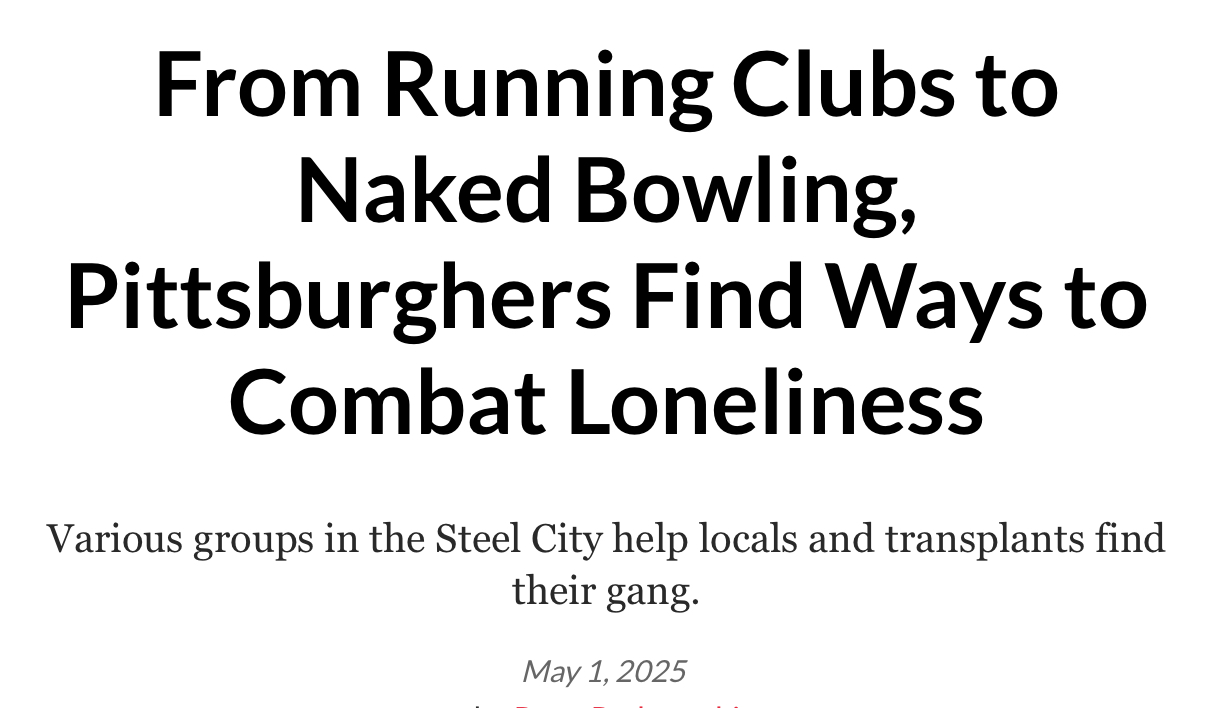
I was going through some articles I’ve saved and and ran across one from the Pittsburgh Magazine website from this May. The headline intrigued. Enough so that I saved the article to my reading list but not so intrigued that I actually read it. The headline in question…

From Running Clubs to Naked Bowling, Pittsburghers Find Ways to Combat Loneliness.

I used to bowl a lot and I recall feeling naked if I wasn’t wearing an official bowling shirt, but I don’t think that was where this article was going. Curiosity finally overcame inertia and I decided to take a look at the words that came after those first dozen.

It was after the mention of the city’s Flood Club (which every city with three rivers running through its downtown should have) I came across this:

“We need gangs,” the novelist Kurt Vonnegut once said. Decades of research suggest he was right: In any given year, positive social connections can slash our chance of dying by roughly 50%. Without them, our risk of heart disease, depression and other ailments spike — health effects that Dr. Vivek Murthy, the nation’s former surgeon general, compares to smoking up to 15 cigarettes a day.

“So yes,” said Vonnegut, “I tell people to formulate a little gang. And, you know, you love each other.”

Naked bowling, the 1936 St. Patricks Day flood, and now gangs. I want to say one of these things is not like the other but really, none of these things is like anything else. I was intrigued-er.

The article went on to say many of the same things we’ve said in our ROAMcare Uplift posts, only like how a professional would write them. People need people. And it went on to detail several third spaces where people needing people gather. Exercise clubs, activity clubs, sports clubs, even a naked bowling league.

The author talked about people needing and finding their people “in gangs of music lovers, movie lovers and lovers of Non-Boring Books. They’re craft-beer lovers and Sick of Drinking Millennials, Nerdy Ladies and Explorer Chicks, Toastmasters and introverts.” Wait. Toastmasters.

Not too long ago I was at a Toastmasters district level meeting. Over the course of this meeting (and just about any Toastmaster meeting beyond one’s home club), the question was asked “why do you continue being a Toastmaster?” I’ve heard many, many long-term Toastmasters answer that question and never have I heard one say, “so I can speak better,” or “so I can become a better leader,” even though those are both in our clubs’ missions.

The most common reason members hang around Toastmasters is because we meet, and associate with, and enjoy the company of others we’d never otherwise spend time with. My personal home club has members who are in finance, engineering, medical research, and restaurant management. They are self-employed, unemployed, semi-employed. They are from figuratively around the block and literally from around the world. There is a tutor, a screenwriter, an author, an investment broker, and one of me. And twice a month we get together and talk about everything but what we do.

We found what Vonnegut said we should look for. Our gang. A gang where we love each other and love being with each other for a half dozen hours a month. Gang ho!


Summertime in the city

Greetings buddy bloggers, blogging buddies, responsible readers, and children of all ages. I missed yesterday. The last two days have been whirlwind days for me with more than the usual appointments, commitments, and after dinner mints. But not to fear, I am alive a well. Wonders truly do never cease.

Over in the ROAMcare site, this weekly uplift took a swipe at bad behavior and defending oneself against it. Summer heat seems to bring out the worst in the worst of us. The best of us have to be on guard. Check it out.

The big news is ROAMcare’s Flashback Friday brings back an old favorite, here and there… in fact it is the most widely read Uplift post… Middle Seat Hump Syndrome. Flashback Friday is a ROAMcare subscriber “exclusive” but this is just too good not to share with everybody.  

The post was first published in June of 2021. We were just rounding the corner from the pandemic back to normal. If you can forgive the couple lines that address the Covid years, we think you will find a lot still right with the thoughts that gave rise to the Middle Seat Hump Syndrome.

And don’t forget, it’s National Donut Day. Make it an especially sticky one! 

See a penny, pick it up

Last week I was called a friend just to chat and the opening line I used was, “HI, what’s new.” “I’m sorting pennies while I still can. I haven’t found any good ones yet.” This was actually the second time in a few months our conversation started thus. Thusly? Started like that.

Last weeks news that the US Mint is officially out of the penny minting business has people across the country breaking into piggy banks looking for elusive billion dollar pennies.

Way way way back, I wrote a post about a someone who paid $1.38 million dollars for a penny. People complain when scalpers ticket brokers charge more than face value for tickets. Nobody said anything about the guy who paid $1,379,999.99 over face for a penny. Okay, so it was minted in 1793, but it’s still just a penny, right?

The chance of you pulling another 1793 penny from your safe deposit piglet is so rare it ain’t gonna happen. The chance off pulling an illusive 1943 or 1943-D penny worth a paltry $1.00 million is close too it ain’t gonna happen either. But digging up a pre-1982 penny is possible. Not probable but possible. In theory, a pre-1982 penny, thanks to its near (95%) all copper makeup, is worth at least three cents.

But is it? Copper is currently trading at about $.01 per gram, those older pennies weigh 3 grams, so they contain about three times their face value in copper metal. Except they aren’t worth 3 cents because as legal tender, it is illegal to melt down coins for their metal weight value.

It has been said the value of any object is how much somebody is willing to pay for it, yet its worth is how much somebody wants for it. Rarely are worth and value equal. If our collections actually cost what we feel they are worth, they would far exceed most people’s ability to pay for them, thus lowering their value. But it is because we place such worth on these objects that give us so much joy that they are so valuable to us. Even pennies.

Was my friend searching for that million dollar treasure or a handful of three penny pennies? Turns out neither was to be found so it didn’t really matter other than it made for a pleasant conversation and a not so worthless blog post. Or maybe that would be a priceless post.

Choose wisely

I was reading the local paper on line this morning and did something I rarely do. I glanced at the reader comments section. The assumption is the comments are made by readers of the article but at least a quarter of them, as many as a third of them had little to do with the article they accompanied. It got me thinking a couple things.

My first thought was who made the decision to allow comments on newspaper articles. I routinely read two local papers, a national news service daily report, and at least one of the local TV/radio conglomerates’ news briefs. Only one allows comments on an article. The others all host “letters to the editor” sections so there is an outlet for concerned readers to voice (type) their views. The comments added to the articles rarely add anything thoughtful and routinely devolve into the sort of online bashing more at home at the site formerly known as Twitter. But someone made the choice to open the pixels to anyone with access to a keyboard, physical or virtual.

My second thought was, “Just because some bozo at the paper caved to the pressure of his backward hat wearing after work drinking buddies to allow backward hat wearing examples of threatened masculinity to put their canned beliefs in the modern equivalent of crayon on the paper, who thought it was a good idea to accept the challenge and put to rest any idea that the backward hat wearing contingent is just misunderstood and might actually be at least as smart as a gibbon.” Yes, it was a long thought. Short version: who thought it was a good idea to accept the choice to add their comments.

My third thought was why did I even bother glancing at the comments knowing they were probably as full of waste as a doggie poop bag after a long walk. It was a choice I regretted. Unfortunately it is sort of like watching a 300 pound man do a belly flop from the high dive. You know it’s going to be messy and someone undoubtedly will get hurt, but you can’t look away.

The decision to allow or not allow comments, to make intelligent observations or spew nonsense, to read or not to read, or to climb the ladder to the high dive in the first place are all pretty easy either/or choices.  It’s good to have choices. Choices are what make us different from the parts of the world that do not have some of the freedoms we’ve been used to enjoying. And choices are a fact of life. Every day you will face some (or many) decision making conundrum (conundra) [For those who might be wondering what I’ve been doing now for the last 40 minutes, I had fallen down a rabbit hole looking for the proper plural of conundrum. I can now say that “conundrums” seems to be the preferred plural but “conundra” is not wrong. Given that I’ve already gone out on a limb with my initial spelling, I’ve made the choice to leave it at conundrum.]

Although many are simple either/or choices, just as many may be complex multiple choice decisions (and in life “all off the above” is rarely the correct answer).

We took the challenge and chose to address difficult choices along with their inherent choice fatigue and potential for choice paralysis in yesterday’s Uplift post, The choice is yours. We would appreciate it if you’d read it and if you choose to comment on it. The choice is yours.

Memorial Day 2025

Today should be a day of celebration. It will be a day of picnics and parades where it is not raining, and one of gripes and grievances where it is. There will be sales on paints and home fixer uppers as well as watermelons and water guns as we welcome ‘the unofficial start of summer.” As close to noon as possible, at the end of a parade or in front of a town war memorial, someone will play taps, and as close to as soon as possible, the revelry can begin, and the memory portion of Memorial Day will conclude.

There are three holidays that celebrate members of the United States military. Armed Forces Day (the third Saturday of May) honors those wearing the uniform, Veterans Day (every year on November 11) honors those who have hung up their uniform, and Memorial Day remembers those who never made it out of their uniform. Over 1.1 million Americans perished in wars since the American Revolution. Many of those we celebrate on Armed Forces Day and Veterans Day believe those 1.1 million are the only members of the armed forces truly worthy of celebration. The rest are “merely doing our job.”

For the most part, those we remember today chose to be Americans, either themselves or by birth. Few of them outside those who served other than those who served in the 18th Century can trace their ancestry back to those earliest Americans. Very few of them can trace their roots to the natives of this land. What is probably an understatement is that the U. S. military is made of members who hail (or hailed) from over 20 countries, bringing their language, customs, celebrations, and memories onto the fields of battle and training along with their boots and gear and weapons. When I was serving, there were in my company those who were born in America soldiers, birthright soldiers, immigrant soldiers, and one Native American soldier. The common denominator was soldier. To the best of my knowledge, all are either still in their uniforms or have taken them off by choice. None of us will be celebrated this weekend and that’s okay.

What isn’t okay is if the 1.1 million who never had the chance to decide if they wanted a life out of their uniforms to be forgotten, or worse, to be remembered in passing, or only as a means to sponsor a sale or take advantage of a photo opportunity.

The history of this nation and the future fate of this nation is rooted in those 1.1 million individuals. Enjoy the parades, the first day at the pool, the 2 for 1 watermelon. Before you do any of that, thank God for sending people with the courage to have defended your privilege to do those things, and pray we won’t soon need more of them.

Lucky chances

I don’t think they still do it but about 10 years ago, the people at BRAVO, put on a show called “Last Chance Kitchen,” that was a second chance for contestants knocked out of their Top Chef competition.

About that same time, Netflix was premiering a series called “Last Chance U” that followed the football programs at very small, community, and junior colleges, attempting to give the athletes there the chance at the exposure those at the major colleges receive.

A last chance saloon (in the wide west, not to be confused with the myriad cleverly named Last Chance Saloons scattered throughout the US and Canada, and the one in England (did you know myriad literally means a thousand?)) was supposed to be the saloon sitting in the border separating a “wet” territory from a “dry” one so folks could get that one more chance at a drink before it was too late.

All these last chances. You’d think Americans live by the “luck of the draw” system. I suppose many do, and even those who don’t, there is no mistaking the contribution luck or chance might have on our lives. That would be luck or chances. Nobody gets just one chance at anything. Really. Stop and think about it. I’m sure you can find a time in your life when you passed on an opportunity and then saw it come back around and sometimes even come back around again.

We looked at the chance of having a decided chance at things in this week’s Uplift, Try Try Again. As we said, “We cannot undo something already done, but we often get a chance to do something that was left undone.”