At Your Service

I’m not completely certain about this but I think we have given up on the idea of service. Ads still use the word. Businesses have the word in it. Some entire fields of business are known by it.  But just having the word around is no guarantee of service.

Lately much of my personal world has had questionable service where service should have been expected if not outright assured. My friend ordered a washer/dryer set with the “deluxe installation service” which was then delayed for over a week because a required piece of hardware was not delivered with the appliance. The installation team didn’t have access to the needed pieces because they were the installation “service,” not the delivery “service.” I recently had a delivery go awry when a package entrusted to a delivery service (which coincidentally includes the word “service” as part of its name) to go from Point A to Point B was never seen at Point B. The cost of the contents was reimbursed as per their agreement but when questioned about a possible refund on the cost of the “service” I was told that was not part of the warranty. My daughter had her roof re-shingled last month, and the service included clean-up facilitated by a dumpster placed in her driveway (her one-car width driveway) blocking the garage for a full week after the one-day installation was complete. When she called and asked when, or if, it was going to be removed, she was told that would be determined by the trash removal people and they schedule their own “service” dates.
Service with a“Service” is defined as the action of helping or doing work for someone. Merriam Webster goes a step further and adds “a helpful act.” We would argue that in none of the above examples was help or work done. Others may say work was done. It just wasn’t especially helpful, and the definition does not specify the act of helping and doing, merely helping or doing. If I was running a motivational speaking service and presenting this as an argument for how to tell the truth and nothing but the truth yet far from the whole truth, I would cleverly label that as qualified honesty.

There once was a time when our entire way of life was exemplified by service. Neighbors would unthinkingly do for other neighbors. My mother never baked a dozen cookies or a single pan of lasagna. She would, together with a few neighbors baked a dozen dozen cookies and a half dozen trays of lasagna. Half would go to the church for some fundraiser and the other half split among the women who made them. Young people still enlisted for military service or committed to reserve officer training in school even during peacetime literally to serve the country. Social clubs, professional organizations, parent groups relied on volunteers to serve as officers, and committee members and chairs. And there was always plenty of help.

Now service is a bad word. Contracts specify what isn’t included in the service. Service crews stipulate the limits of their responsibilities before anybody even asks. One of the biggest service scams of the entire galaxy, the United States Congress, doesn’t even recognize the people they theoretically are elected to “serve.” If so, why then are their assigned seats grouped in their chambers according to party rather than by the states they represent. And don’t even get me started on every company’s and website’s terms of service.

So the next time somebody offers you counter service, curb-side service, free delivery service, claims they are service experts, serve with care, or are known for their service with a smile, ask to read the fine print on their service limits. Bonus points if they actually do and help.
Reuse it or lose it

Are you a recycler? There are recyclers and then there are re-recyclers. And don’t forget the upcyclers. I might be a little of all but mostly I’m a re-recycler. That’s where I’m doing my most to save the planet. Actually, if I’m going to be really, super honest, that’s where I’m doing my most to save a few bucks, the planet comes along for the ride. Let me explain.

Recycling is what we do with our blue bins and our bottles and cans and papers and cardboard. If you’re lucky enough to live somewhere where the recycling agent accepts glass, plastic, carboard, and paper you’ve got it made because that’s the most of it anyway right. Once a quarter some organization will have a program that will accept your extruded polystyrene, household chemicals, and electronics, but if you stick to the four basic food groups, er, if you stick to the big four, as far as I’m concerned, you’re doing your part. ‘Nuff said on that.

Upcyclers are the creatives of the recycling world. They can look at a TV stand, a stained chunk of kitchen tile, and a garden hose and say “Gee that would make a great a wet bar” and do it, and add an integrated wine rack, wine and beer coolers, and cheese platter with a well for a fondu pot and skewer storage. Damn they’re good.

I fall in between. I’m a re-recycler. I’ll find an old TV stand and turn it into a different color TV stand. I believe recycling doesn’t stop at getting rid of stuff from your home but not putting it in the trash. It’s donating it to charity run thrift stores, consigning it to second hand shops, or giving it away through neighborhood apps, Facebook groups, web communities, or the old stick it on the curb with a “free to a good home” sign. Then when somebody like me needs a new stand for his toaster oven, or a new toaster oven, he’s likely to shop first at the thrift store to see what can be given a new life.

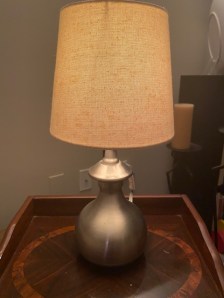
lampI thought of all this last week when my daughter asked me if I’d like a stand to hold my herb pots in the kitchen, she found one on the curb. My first thought was “damn I’m glad that apple didn’t fall far from its tree.” My second thought was to run right over there and get it.

A lot of stuff that people don’t want still has lots of life left. Usually just a little cleaner is all it takes to have them looking good enough for company. Right now I have several kitchen small appliances, a mug holder, a table lamp in the living room, a floor lamp in my office, the stand for my keyboard, a small bookcase, and the office worktable courtesy of several thrift stores, and a roll of sound insulation that I’m working into a podcast booth that I found in front of one of the buildings here marked “free if you want it.” A couple old favorites of mine at the house were an arbor made from an old brass headboard and an end table for the sunroom fashioned out of 4 shutters and some plywood leftover from an old project. When I get tired of these or almost anything else, I make a drop-off trip to the local charity.

Re-recycling may not for everybody. Out and out upcycling is beyond a lot of people’s capabilities, certainly mine. But providing the raw material isn’t. The next time you have a TV cart or a garden hose that you don’t want anymore, donate it to a thrift shop, or put it out with a sign for somebody to take. Don’t jus throw them away. There could be a wet bar out there waiting to happen that just needs a little help from you.

The shot heard around the world -or- Yes, Virginia, there are other vaccines out there

One hundred, thirty-seven years ago this month, Louis Pasteur administered the first rabies vaccine and things haven’t been the same since. That wasn’t the first vaccine developed for an animal. That would have been the chicken cholera vaccine in 1879, also developed by Pasteur. But when he gave that first rabies vaccine five years later he was setting a course for protections from a then universally deadly disease in humans by inoculating the animal. Prevent the disease in the animal and the animal can’t transmit the disease to the human. And thus, today dogs are roaming the streets with rabies tags hanging from their collars indicating they bear no risk to their human companions other than perhaps smothering them with dog kisses. And all is right with the world.

Except it isn’t. Cats and dogs aren’t the only animals who can get rabies. Nor were there in the days of Pasteur’s experiments. Bat, rats, raccoons, even cattle can too. In fact, any mammal can carry and transmit rabies to any other mammal. Could then, can now. In 1885, a year after he developed it for animal use, Pasteur injected the rabies vaccine into nine year old Joseph Meister who had been mauled by a rabid dog. The boy survived the rabies infection, the first ever to do so.

Animal vaccines were new in the 1880s but they weren’t the first time animals had been used in the development of vaccines. That happened 90 years earlier when Edward Jenner injected cowpox into humans to prevent the closely related smallpox virus. Through subsequent studies and experiments, the lives saved from smallpox through vaccination was so significant that by the 1922, primary schools in the United States began requiring smallpox vaccination for admittance. Through the 1930s diphtheria, tetanus, anthrax, cholera, plague, typhoid, and tuberculosis vaccines were developed, and then by mid-century work was completed on vaccines for measles, mumps, and rubella. The latter half of the century brought vaccinations against chicken pox, pneumonia, and hepatitis B. This century saw the successful development of rotovirus, herpes zoster in adults (shingles), and human papilloma virus (HPV) vaccines. And don’t forget SARS-CoV2 aka CoViD-19.

We have been so fixated on COVID for the last 18 months we may have forgotten, or at least not actively considered, all the other vaccines and routine vaccination recommendations for children and adults. This was illustrated last month when this year’s influenza vaccine strains were selected with no notice by the mainstream media and little fanfare even in specialty media circles.

Although we may take a break from thinking of all the horrible things that can happen to us (besides being asked to wear masks, wash hands, and give others some space), viruses don’t take a break from causing potentially horrible things to happen. So, you should probably start worrying about a bad flu season for 2021-2022. It’s not that far away.

Part of the reason we might expect a bad flu season is because we’ve been pretty good with our CoViD mitigation. Masks, handwashing, and social distancing (which I still think should be called personal distancing because there’s nothing social about it), did a fabulous job of keeping influenza airborne rather than allowing it landing zones in our persons. Now those little fellows are mad as anything and will be twice a virulent this year. Well, okay, that would be a great story line for a book or a movie but, viruses aren’t all that vengeful in reality though sometimes it may seem they are.

I’ll give you two reasons why this year’s flu season may be back with a vengeance, and these reasons are valid for any viral infection. One is science based and the other is more social. Science tells us the body’s immune system actually thrives on small, short term exposures (which is why vaccines work) and that the lack of repeated exposure to the flu virus deprived the body of an additional weapon to augment the flu vaccine. The social reason that this year will see a more substantial flu season is that people, having had over a year’s worth of “isolation” will do what people often do and overdo. Without mandated masking and social distancing, people will try to make up for lost time in close social settings and forsake those mitigation practices that added up to making flu season 2020-2021 a non-event.

To reiterate, this covers all viruses. Last year also saw record low incidents of respiratory syncytial virus (RVS) and rotovirus in children, adenovirus and rhinovirus in everybody, and subsequently less non-COVID induced pneumonia.

I know, you are thinking, and possibly saying out loud to your screen, “But it’s too early to think about a flu shot!” You’re right. And I’ll remind you again in September and October to get out there and get your shot. But now is a good time to think about all those other vaccines we’ve spent a year not thinking about. Are you due for a tetanus booster? Did you put off your second shingles or pneumonia shot? Young adults, have you been evaluated for meningococcal vaccination; caregivers, do you need a new hepatitis titre and possible booster? Parents, what is the status of your children’s vaccine regimens? Travelers, are your shots all up to date?

There are so many more vaccines than COVID and now is the time to refresh yourself about them. For years we’ve relied on them to keep us safer and healthier than we were just a single generation ago. But vaccines only work if people are willing to be vaccinated. Go ahead, be willing. Joseph Meister did and lived to talk about it.


Links to US Centers for Disease Control and Prevention immunization schedules for 2021:

For adults age 19 and older
Table 1: By age
Table 2: By indication

For children and adolescents, birth to age 18
Table 1: By age
Table 2: Catch up schedule
Table 3: By indication
Parent Friendly easy-read chart

Resources
Information for adults
Information for parents

VaccinatedFamily

Making Beautiful Music Together

For some reason I was thinking of a time ago when my daughter was a teenager filling her after school day hours with after school activities. Two of those activities, or one with two arms perhaps, were concert band and marching band when she played flute and piccolo respectively. The thing about those particular winds is that, except for perhaps in the fingers of Ian Anderson, they rarely play much that by themselves would be recognizable as good music. While she would practice, I couldn’t be sure she was playing the right notes but during the performances, with the other winds, strings, and percussion, all the individual pieces came together to form true music. Every now and then an instrument might be featured in a solo but for far longer the group played ensemble to make the really good stuff.

In a sappy poetic way, America is like those bands. Alone, we don’t sound like much. We’re single instruments playing random notes that make little sense alone. If you put all the piccolos together, they still don’t make much musical sense, only now they make little sense louder. Likewise, groups of like-thinking individuals spouting the same lines make little sense even when making a lot of noise. No, it’s not the number of people that make the country, it’s the variety. It might not work for other countries and that’s fine, but for America to work, there have to be different voices, playing different parts of the same song.

Lately too many of us have been closing our ears to the other instruments that make up the American band. We’re content hearing only our own part, or worse, playing only solos. Then we question why others are thinking the same thing. Oddly, the others are wondering likewise, everybody convinced their part is the main part, that their idea is the right idea. Why won’t everybody think alike? It really isn’t a matter of why everybody won’t think or say or do the same things. It’s because we can’t. We can’t think the same things because we don’t have the same backgrounds to formulate those thoughts. No matter how hard a piccolo tries, it cannot reach the same notes as a tuba.

You can only listen to a tuba solo – or piccolo or sax or marimba – for so long before you get up and walk out on the concert. The strength of the band, the beauty of the music, is not in the instrument. It is in the players who know when to play their notes, trusting that by allowing the other musicians to play their own notes, they will make beautiful music together.

This Independence Day, take a moment to think about how our differences are what makes us unique as a country. Yes, celebrate those differences, but celebrate the whole also. The music sounds best when all the instruments are playing together. Celebrate this Independence Day and enjoy our rights to life, liberty, and the pursuit of really good harmony.

Happy Birthday America!

Flying in the face of convention

As vaccination totals continue to climb and gathering limits are lifted just in time for the start of summer, people have been commenting on returning to normal. During an interview on a recent local television newscast, a party planner proclaimed, “Now we can get back to planning June weddings and graduations like normal,” and a vacationing couple interviewed at the airport said, “It’s good to be travelling again like normal.” “Like normal” is becoming the latest soundbite fodder, much in contrast to last June’s oft referenced, “Flatten the curve.”

As far as graduations go, June 2020 decidedly was not normal. My friend’s daughter graduated from high school last year in an on-line ceremony that may have truly been the only unprecedented moment during the early months of the pandemic. But was it “not normal,” or was it “not expected?” Years before the pandemic wreaked havoc on graduation schedules, my daughter graduated from college a semester earlier than typical, and her December commencement, although not broadcast on a streaming video platform, was recorded and made available for those who chose not to attend the small, indoor ceremony in contrast to the thousands who would fill the outdoor stadium the following spring. Broadcasting the ceremony was, for the winter graduates, quite “normal.”

In the half-dozen or so weeks that air travel has sort of started its return to normal, I hope its not what we will eventually come to expect whenever we get on a plane. So far this year, the FAA has identified over 400 cases in violation of its Zero Tolerance policy that states any passenger who “assaults, threatens, intimidates, or interferes with airline crew members” can be fined, jailed, or both. For comparison, the FAA recorded 146 violations in all of 2019. The rate of incidents has climbed dramatically since early May when the CDC relaxed mask wearing requirements but maintained the requirement for air and other public transportation.

doc7ckkumm1gsl1lwwcjmuo

The cited incidents do not involve only mask controversies. People have attempted to open aircraft outer doors while on taxiways, refused to surrender open alcohol brought on board, and brawled over who gets to use a shared armrest. Many incidents devolved to violence, at least one resulting in a charge of felony battery, that when a passenger refusing to follow cabin instructions violently attacked a flight attendant caught on video, a video that went viral shortly after the incident. In May, the FAA announced that it was proposing penalties as high as $15,000 against five passengers for violations that included allegedly assaulting and yelling at flight attendants.

In an interview with CNBC, Sara Nelson, International President of the Association of Flight Attendants-CWA, relayed that unruly behavior are more than 20 times higher than what’s normally recorded in an entire year.  I’m not sure this is what we all meant when blithely referring to the new normal. New it may be. Normal? Let’s hope not.


In case you are wondering, Monday’s poll results were 100% in favor of me writing every darned day if I could. There was one write in vote for weekly. That made it a tie! I noticed that the poll was displayed on the post on the full site. For whatever reason, which I’m sure is an absolutely dandy, it was not included on the e-mailed or WordPress Reader versions. (No, me neither.) Anyway, I’ll stick it here one more time. If you really really really want to answer it, make sure to click through the blog site because I just know for sure, that wasn’t a one-time glitch.

Be careful out there

Deaths due to COVID-19 in 2021 already have surpassed the total number of deaths in all of 2020. Let me type that again. Deaths due to COVID-19 in 2021 already have surpassed the total number of deaths in all of 2020. Globally. If you are in the US, Canada, UK, pick a country that last year was locked up tighter than Marley and Scrooge’s backroom safe and you are going out later today without a mask on, that means there are places this year that make what you went through last year look like you were just trying to stay ahead of getting a really bad cold. One more time. Deaths due to COVID-19 in 2021 already have surpassed the total number of deaths in all of 2020. Globally

WorldDeathsAccording to data generated by the Johns Hopkins University, about 1,880,000 deaths from COVID-19 were recorded in 2020. As of the first week of June 2021, less than halfway through this year, about 1,883,000 deaths due to COVID-19 have been reported. Globally.
Globally. That sort of is important because we are a global world. Planes are back in the air with all seats filled, crossing borders. Ships are at sea again stopping at ports not always in the same country as the previous port of call. Students, vacationers, businesspersons are moving to and fro, free as can be. Give or take.

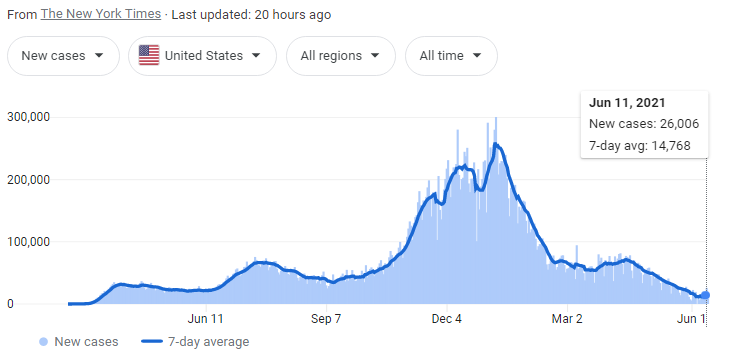
In the United States, the total reported cases, not deaths, for the single day, June 11 (the last full weekday before this was written) was 26,006, the running seven day average cases was 14,768. The last time a seven day average of less than 15,000 was reported at week’s end was on Friday, March 27, 2020 at 12,127. Then, seven day averages were increasing; now, they are declining. Proof that mitigation and vaccination worked and is working. It’s questionable that mitigation without vaccination would have eventually gotten us to the current case load, and certainly not by the end of May. By the end of 2020 with only mitigation, seven day average case totals routinely ran greater than 200,000 and peaked in January 9, 2021 with a single day case total of 300,779 and a seven day average of 259,615 cases. Widespread vaccination and continuing mitigation have since reduced both single day and seven day averages continuously to where we are today. The lowest single day reported cases for 2021 was May 31 at 5,557  with a seven-day average of 17,171. The last time previous to that when a single day case load less than 6,000 was reported was on March 20, 2020, with 5,619 cases.

UScases


Interestingly, since May 31, the daily totals and seven day averages of cases reported in the US have consistently increased. Also, since May 31, have the majority of states relaxed or eliminated mitigation requirements.  It would not be unreasonable to ask if vaccination without mitigation is and will be working. Certainly not wanting to cry wolf, but I will type once more, deaths due to COVID-19 in 2021 already have surpassed the total number of deaths in all of 2020. Globally.

Let’s be careful out there. There’s a lot of virus still out there.


Buddy, can you spare a spare?

Hey everybody!  I have a spare tire. No, not that kind. Sheesh. Out in the car. There’s a tire spare there! What, you don’t think that warrants an exclamation point, let along a blog post? Well, pull up a chair, get a cup of coffee, or tea, or whatever welcomes you to the day, and hear my tale.

Before we begin, you must either recall or take as new information now that I bought a new (to me) vehicle just a few posts ago, or a couple of weeks ago depending on your time reference preference. Another prefatory comment, the previous vehicle was the first “car” vehicle, as in sedan, I bought in this century, Other recent and many older vehicles (with the exception of the “little car” which is the little red roadster than lives 8 months of the year in the garage and doesn’t count for this discussion) have been trucks or SUVs and have always been called “car” though they weren’t, not even the SUVs which were the old truck based SUVs, not station wagons with big wheels we call SUVs (which probably are actually CUVs if you asked a car person) (that’s “car person” as in aficionado, not one who drives a “car” versus a truck, SUV, CUV, or any other V currently roaming the streets). So then, are we ready? Good! I’ll get my coffee and we’ll begin.

Previously I had no need to go looking for a spare tire. While I was driving the now former car of mine, I never had neither a flat nor the desire to lift the car off the ground. Even the existence of a spare tire was merely a curiosity, a conversation starter in very, very, very, very, very slow cocktail parties, or perhaps a discussion topic with my therapist if I had been going to a therapist and he/she/it was one always questioning one’s existence and thus the spare tire could be a tangible example. Or non-tangible as it turned out.

2 + 2 5When I was emptying the trunk of all it’s trunk items I wanted to make certain I had everything and thought I should check under the trunk cover and check to make certain nothing had fallen into the spare tire area. I lifted the carpet, lifted the compartment cover, and found nothing there. Not even a spare tire. Nothing is not true. You see, the spare tire was not missing because somebody had absconded with it. There was in its place a small air pump to be used in the event of a flat tire. (It might also have come in handy when I was blowing up pool toys over the years but not knowing of its existence any more than the non-existence of the tire, that consideration never came up.) After a little head scratching and a silent thank you for not having had to discover that on some dark and stormy night with only three fully inflated tires under the car, I gathered up my boxes of trunk things and brought them indoors awaiting their new residency in the back of the new car which is actually not a car but as previously mentioned they are all called cars.


If I may digress for a moment. If you are wondering if that was a typo, no. I typed and intended to type boxes, the plural. I have since streamlined the car trunk stuff to a amore manageable number of items, not including such things as: two wooden yardsticks, a frying pam, three umbrellas, a license plate frame, a can of wood stain, the pole from a pole lamp, and a dust pan.

(Yeah? Why not?)

So, back to our story. Most people are likely familiar with the space saver, limited use, temporary. “donut” spare tire. That thing has more names than British royalty. They seem to be everywhere but only because about 50% of all the vehicles on the roads have them.  If you consider that none of the buses,  tractor trailers, trailer trailers, full size pick-up trucks, truck based SUVs, motorhomes, and motorcycles and scooters don’t have them, that means a lot of cars and SUVs, CUVs, and other Vs do.

Since the 1980s most cars started carrying space saver spares (the first American vehicle to use a space saver as standard equipment was the 1967 Pontiac Firebird). Probably a big chunk of you reading this weren’t even driving before the 1980s so you might not have even ever seen a full size spare even if you ever even looked for one. I was driving before then, quire a while before then, and even though I rarely ever even looked for them I just made some wild assumption that every car on the road not driven by an “I needed to use my spare but I’m not going to replace it because those things are EX-PEN-SIVE” spare tire user had a spare tire. Even. And that’s how I came to be muttering thanks for not having a need for any kind of spare tire on my previous car when I discovered my previous care did not have any kind of spare tire. (Who gives you just a pump?)

2 + 2 5 (1)

But I am happy to report the new to me new car is fully equipped with not so fully sized space saver, temporary, limited use, “donut,” royal spare tire. I checked.

You may now go about your day. That’s it. We’re done here. That’s the end of the story. There’s nothing else. Good day folks.

(I wonder if I should put the frying pan in the new to me new car. It could come in handy. You never know.)

Now scoot. I have things to do. Bye.

All In

Through thick and through thin, all out or all in
We’re gonna go through it together
With you for me and me for you
We’ll muddle through whatever we do
Together, wherever we go

June 8 is Best Friends Day. I don’t know about the rest of the world but when I think of “best friend” I think of that number. Keen eyed readers with keen ears and keen theater sense will recognize those lyrics from that number don’t go together which is pretty okey dokey. I mixed them up a bit because that’s how I sing them in the shower or wherever I am thinking about best friends and that’s okey dokey too because, all things considered, that musical isn’t about friendship.

The musical in question, of course, is “Gypsy,” the 1959 David Merrick stage production written by Arthur Laurents, and those lyrics came from the pen of Steven Sondheim. In the play, Rose, the prototypical stage mother wants to see her daughters become stars, and so she drags them through the Vaudeville circuit across America. Long story short, outgoing talented daughter sets out on her own, leaving mother and introverted less talented daughter to fail or succeed on their own, Vaudeville dies, the act ends up in burlesque, introvert becomes successful stripper sensation Gypsy Rose Lee, mother confides she always pushed them only so she could live vicariously through them but instead eventually loses them and in the end mother Rose and daughter Louise (Gypsy Rose) sort of, kind of reconcile.

A masterpiece of the theater. Over 700 performances, four Broadway revivals, one London revival, two movies, a Great Masterpieces performance, a triumph indeed, but not the thing of friendships. But that song! “We’ll muddle through.” whatever it takes. Now that’s the thing of friendship – best friends. Not good friends, not close friends, not even canine friends. Best friends. Best, best friends. Bestest friends!

Real best friends aren’t typical friends. They are not the best friends of childhood. You could have had a different best friend every week of summer then. They are not the best friends of a contract like married best friends. You might well be as close as best friends but you’re also there because you’ve formally committed to each other. They are not the best friends of circumstances perhaps of being together in the military, serving or fighting side by side until transfers or separation orders send them apart.

Best, best friends could walk away any time. They could leave or be transferred. They could hide out, remember an important meeting, or realize their tardiness somewhere else when a real need comes up. They could grow tired of each other after so many years together and move on, nothing legally holding them together. But they don’t. Whatever obstacles they face, best friends face together and muddle through, because they want to. Even when it’s hard. Sometimes seemingly especially when it’s hard.

I have a best friend. A best, best friend. A bestest best friend. We greet each other every morning, wish each other a good night at the end of each day. Always we find a way to communicate sometime in between, often many times in between in by texts, or calls, or videos, always there for each other. We know we’ll never move apart. We already live apart, 3,000 miles apart. How much farther apart could we be? Physically. Physically we have been in each other’s company four times in the last ten years, totally maybe 12 days. But we’ve been in each other’s company every day. Together. Wherever we go.

I wish you a best friend like that for Best Friends Day. There aren’t many. Only the bestest. I have mine and I’m all in!

Dedicated to my best friend.

And like I always say, you’re lucky.
Because, you don’t have to take it alone.
Wherever we go, whatever we do, We’re gonna go through it together.

2021-06-06

From Gypsy, the Musical, PBS Great Performances, November 11, 2016


Continuing with my experiment on the WordPress/Anchor partnership, Don’t Believe Everything You Think is available on these platforms.

Anchor   Spotify BreakerLogo PocketcastsLogo RadioPublicLogo

Please let me know what you think. So far I’m still mostly just recording the blog posts but eventually there will be more than that. We might even get into a discussion about how we all got into blogging.

This post will begin to be available on these platforms later today.

Give me a shot and a beer!

I’m usually a day late and dollar short. Several dollars often. This time I’m a couple months late and running short on patience although high enough on admiration for those who are at least coming up with some ideas.

So what’s all this about? Vaccines, don’t you know? Apparently those who have waited have maybe waited their way into a windfall. Like those two Ohioans who each hit their state’s Vax-a-Million lottery. As long a we’re hanging around Ohio, how about that high school freshman (oops, first year student!), who won the first of five 4-year, all expense scholarships to any in-Ohio college.  In Maryland, they are awarding a daily $40,000 prize for 40 days culminating with a $400,000 on July 4. California, Washington, New Mexico, Colorado, Arkansas, and more that I can keep up with are offering cash incentives for getting the vaccine. A number of states are offering full scholarships for resident admissions to in state institutions. Over 30 companies are giving away almost anything you can think of including free flights for a year, free groceries for a year, free Super Bowl tickets, discounts and cash. At least 50 companies are giving cash bonuses or paid time off to employees for being vaccinated. And in a major, vaccine related announcement from earlier this week, Anheuser-Busch will buy America a beer if 70% of us get a vaccine.

You know, that vaccine that protects lives, returns normalcy to normal, and makes it possible for people to live life, lavish liberties, and pursue happiness. The one people in other countries would pay a king’s ransom to get. That vaccine.

I know I said I was a late to the party, suggesting these awards are to get unvaccinated people on the way to the nearest vaccination site. In truth, most of these scholarship and lottery prizes and many of the non-contest incentives are available to anyone vaccinated against COVID-19 regardless of when they were vaccinated, even early birds like me. The beer bash apparently will include everybody, over 21, even the unvaccinated coattail riders. According to an article in The Washington Post, “Adults 21 and older will be able to get a $5 virtual debit card that can be used to buy one Anheuser-Busch product, including beers, seltzers and nonalcoholic products,” when American hits the 70% vaccination mark before July 4. As of June 2, that means another 20 million Americans have to stick out their arms and say “Ahh.”

So where is the sticking point. Hesitancy is still an issue, but so is logistics in some areas. And, there are still a large number of young adults not vaccinated. According the Kaiser Family Foundation Vaccine Tracker, through the end of May, less than 48% of Americans age 18-29 have received at least one shot of COVID-19 vaccine and only 32% of that age group are fully vaccinated. Many colleges have announced they will require students to prove COVID vaccination to attend in person classes starting this fall, not unlike the requirement for other vaccines like mumps and measles. Maybe that will encourage others in this age group to get vaccinated.

Or maybe they would like a beer with their shot.

Not Vaccinated Section (1)

Memorial Day 2021

SoldiersCross

We set aside today to honor the lives of the members of our armed forces who lost their lives to let us live a life of freedom. Freedom of the innocence of what they had to give up so we can live without giving up.

Please spend the literally literal few seconds it takes to say a prayer for their eternal salvation and a toast to their forever memory.