One Hundred Days

If you are “lucky” enough to live in a city, county, state, country, homeowners’ association, etc., that elected a new representative, mayor, commissioner, dog catcher, etc. last fall who was installed in office in January, you are likely seeing stories here and about regarding so-and-so’s first 100 days. That seems to be a fun activity among pundits who have nothing much better to do in mid-April. I’ve never cared much for those types of stories. What can you do in 100 days?

Since the dawn of the Internet Era, hundred day projects although not all the rage, are no longer the sole purview of political hacks and the hacks who follow politics. Everybody can get in on the action. In fact, there is an on-line, on-going, on point 100 Day Project site that claims “thousands of people all around the world commit to 100 days of creating” every year. The ninth annual project period started Feb. 13, but according to their FAQs, any day is a good day to start.

I was glad to hear that because I started a 100 day project on January 9, which means my hundredth day is here! I didn’t put much planning into my activity. To be honest, it wasn’t planned at all! And it certainly began before January 9 but that’s the day I’m going with because that’s the day the official word came to me – I had COVID. I already wrote about the first 30 days I got to participate in this project and I will say the more recent 70 days have been much more fun. Let me tell you what I’ve been doing.

As I said then, I was and am still working the exercises given me to strengthen the muscles that help the lungs do what lungs do, and to increase my stamina and balance. Because the weather has been typical Western Pennsylvania Spring (temperatures ranging from 16⁰F to 72⁰F over 3 days, with wind, rain, sleet and snow often in the same day), I didn’t mind staying inside, far away from the maskless horde. I really needed something to do besides the official physician ordered activity. I tried other exercises, and I can attest that riding a bike to nowhere really is as dull as it sounds. On the occasional day of sun and warmth (at the same time!) I would venture outside to saunter on paved surfaces (of those 100 days, only 4 of them were completely precipitation free making a walk through the woods more like a slog through a bog), but it seemed if I was going to amuse myself, it would be an indoor activity.

They say with 100 days you can reinvent yourself.  I’m not sure who they are and what they started with, but I didn’t think I would be reinventing anything, not even a better mousetrap, in the time I had before “Real Spring” would roll around. So … I decided to revive an old hobby. Art. Actually I revised an old hobby. Once upon a time I was a sketcher. Yes, one of those pretentious twerps who would sit outside with a pad and a soft lead pencil and do more than doodle but less than draw. After I confirmed to myself that I still understood light, shadow, perspective, and representation, I took the plunge and added color. I went full-on painting. With the not quite miraculous miracle of overnight shipping, I had all the supplies I needed to transform a 20 year old drawer into Grandpa Moses.

I’ll never be confused with an old master, and the Tate won’t be keeping a wing open for my work, but I have to say I have enjoyed the last 70 days of my 100 day project and will be continuing it even if the weather ever turns to spring. (It is snowing as I write this. Just FYI. Ugh.)

Don’t think you can develop a talent in a short amount of time in the later years of your life? Please, don’t tell me that. I’m having too much fun. I just really wish I didn’t have to get COVID to figure this out!

66085821713__28E72589-3E88-4A64-8EE8-529861CAAE10    My first piece: “Young woman among trees”

The polarizing of America

At a time when most everybody in America is lining up, taking sides for the next us versus them battle, I read an interesting article last week that posits America is not as divided as some who may be benefiting from division would have you think. Joseph Ratliff, an editor at Allsides.com opened with a critique of a Washington Post article reviewing a recent survey of American priorities for education. (“How Media Bias Makes Polarization Appear Worse Than It Actually Is,” allsides.com, Apr 6, 2022) The gist of Mr. Ratliff’s commentary was although the Post headline “Democrats want to teach kids sex education. Republicans want to teach them patriotism” and lede highlighted significant differences on two education initiatives noted in the survey, it buried the striking agreement on 10 other initiatives, including respect for people of different races, languages besides English, and independent thinking.

Why is the division between the two controversial initiatives emphasized rather than the 10 that the ideological groups agree on? Because conflict sales. It may be healthier for the country and its populace that to note there is more consensus and commonality than discord and disagreement among Americans, but it is healthier for a new outlet’s bottom line to focus on the disparities, People pay more attention to news that can adversely affect them than positive reports. But people also want to know that others are even more adversely affected. This is reinforced in the “us versus them” manner of reporting, establishing clear lines between us and them so the outlet can rely on a consistent audience to present to its advertisers, sponsors, and contributors. By manipulating the importance of datasets and presenting what they feel is of importance to its consumers. outlets can honestly say they are not manipulating the data, only reporting it, although not necessarily all of it or not all of it until after the average reader/listening/surfer has reached his or her attention span limit.

The media has been able to take advantage of the average American to be unaware of much outside his or her own social network. An unawareness that has also been exploited by social media’s algorithms. This unawareness was described in detail in a report of a pair of surveys conducting in January of this year by YouGovAmerica. (“From millionaires to Muslims, small subgroups of the population seem much larger to many Americans,” yougov.com, Mar 15, 2022) When people’s average perceptions of group sizes are compared to actual population estimates, Americans tend to vastly overestimate the size of minority groups, but underestimate the size of majority groups. For example, people surveyed estimated that 19% of Americans make more than $500,000 per year when the actual is 1%, that 24% of Americans are gay, lesbian or bisexual when the actual percentage are 3, 3, and 4% respectively, that 37% of Americans are military veterans and the actual is 6%, and that 52% of Americans own a gun and the actual is 32%. Similar findings were noted for ethnic and religious minorities. However, when groups are clearly in the majority, Americans underestimate. Those surveyed estimated 49% of Americans own their house and the actual is 65%, that 61% of Americans have flown on a plane and the actual is 88%, and they estimated that 68% of Americans have a high school diploma or equivalent when the actual is 89%. It is important to recognize that Americans by and large cannot determine what is and is not prevalent because if the public cannot make that determination, the media can more easily skew reporting and maintain the polarization that benefits them.

they is so wrong (1)

How do we avoid becoming pigeonholed by media influencers. Always read complete articles rather than just the headline or highlight. If you see a blurb on social media, go to the full article cited in the post and if a full article is not cited, consider the information suspect. And know your own susceptibility to misunderstanding. I recommend you review the YouGov survey results and see how you estimate common standards). The survey explored how people estimated groups in family, religion, ethnicity, sexual orientation, politics, income, and education.  Actual percentages were determined based on information from the U.S. Census Bureau, the Bureau of Labor Statistics, and the results of well-established polling firms.

Don’t be stuck on one side of “us versus them” when the middle group is actually where you will likely find most of your neighbors.

They isn’t right

I wish I could find in online so you know I didn’t make this up, but it doesn’t seem to be there. Last week on the local news they had a little throw-away story to fill up 15 seconds. The big news? Grammar mistakes. The line that stuck with me, and a couple of those in the studio also, was that of those surveyed, questioned, interviewed, or whatevered, the most common mistake they encounter is “when to use there, their, and they’re.” Well ain’t no wonder nobody can talk good English no more – that’s not grammar at all. That be spelling, you fools! And while we’re ranting over these three, you really need to be dumber than rocks to not know when to use witch, err, which.

Is it so bad that we now must include the misuse of grammar in our newscasts? Actually, [cue the groans] back when I was in school it would have been news to commit an error in grammar. What happened to the 3-Rs in grammar school. Oops, it’s elementary school now. No grammar required. If you ask me, and I know you didn’t just as well as you know I’m going to tell you anyway, 2+2=4, and you have to be dumber than a rock to not know when to use there, their, or they’re.

I wonder… Do you suppose this started when phones began to automatically correct and/or complete misspelled and partially entered words and phrases? We no longer need to know how to spell there. If we enter t-h-e-e-r, the computer in the phone, which one would think is smarter than your average rock, will correct it. Maybe. It can kind of go either way there. Their? Hmm. More significantly, if you enter t-h-e-r and stop right there, it might even think “hey, this here feller is wanting to type “there” so let me just put in the rest of it in there for you.” There now.

Or maybe… Do you suppose this started when Twitter popped on the scene with its original 140 character limit? (A limit which technically wasn’t a Twitter limit but was the most SMS could transmit which was how the initial Twitter messages were delivered which back then you might have known as twttr which also was an SMS limitation.) (But I digress.) Folks then were busy tryna make everything short. It was like reading vanity license plates. RU w me ther Spelling, grammar, and punctuation were superfluous to the message. Who knew that someday someone would be picky about word choice, spelling, and usage on say, a job application for a company other than twttr or Google.

(By the way, you should see what Word’s spell check and grammar checker are doing to this document. There are more red and blue lines than outside a polling place at election time!) (It was a struggle but I got politics into the discussion.)

Whatever is was to prompt people into thinking a spelling error is their most serious grammar error, it begs the question, how bad is their grammar – their real, actual grammar. How often are their nouns and verbs in agreement? (I’m going with “nouns” and “verbs” here because I’m not sure how they would react to “subject” and “predicate.”)  Have they ever met an infinitive they could not split? Do they know where they misplaced their modifiers? See, these are what I would cite if asked for the most common grammatical errors. Not a spelling issue! (Okay, so every now and then I don’t use a technically complete sentence when I write. Sue me.) And while I’m still thinking about those out there who are as dumb as rocks to be so concerned that they are misusing there, their, and they’re, why did nobody mention its and it’s? If they can grasp its versus it’s, what’s the big deal with there, their, and they’re? Too many to choose? Oh, or should that be two many, or maybe to many?

Rocks, I tell you. Dumb as gravel.

they is so wrong

The envelope please…

And the envelope please…

Ah, Major Movie Award time. The Academy is cracking down in unauthorized used of the gold statuettes’ nickname but you know what Major Movie Award I mean. The Major Movie Award ceremony was last night and I missed it – again. Intentionally. I love movies and this year I actually saw most of the nominees for the Major Movie Award best picture award. But I love old movies a whole lot better and I dislike awards shows even more. Awards shows, awards banquets, recognition ceremonies, even graduations, but especially awards show when anybody who ever got lucky enough to be cast in a good movie demonstrates how valuable screenwriters are. Anyway, I didn’t watch the ceremonies but instead, as is my custom, I watched a couple Major Movie Award winners from 60 years ago.

In general, forty years is my cut off.  If a movie is still entertaining (and relevant, if possible), 40 years after it first hit the theaters, then that’s a good movie. I would say I’ll be re-watching this year’s winner in 40 years but in 40 years I’ll be well ensconced in the centenarian camp, so…that’s a maybe.

So with all this experience of watching long-lasting, significant award winning movies from 40, 50, 60, 100 years ago, you’d  think I could pick out this years winner effortlessly. Yeah, no. A hundred, 90, 60, 50 years ago, significant was defined differently. Right around 40 years ago, it started to be more important to have the right message than to have the right stuff. But that’s okay. That only holds true for the “big” awards.  The true magic in movies, the costumes, sets, music, and cinematography are still awarded on merit so there will always be good old movies to watch. Even forty years from now.

moviefilm

It so happens that I am writing this before the Major Movie Awards ceremony and the announcement of best picture. So, given that I’ve seen them, what movie would I vote for if I were a member of the Major Movie Award voting bloc?  I will say I don’t think the one I would vote for will win, but it should.  I think several of the best picture nominees are definite possibilities for cinematography and costume and would be worthy of those honors. But those same movies have no story, no coherence, or are just not good enough to be “best.” And there are so many this year (10 nominees for best picture), the field is clearly watered down.  But I digress.

What movie would I vote for if I were a member of the Major Movie Award voting bloc? West Side Story. It will have a hard time getting to the podium.  Although remakes dominate moviedom, rarely do remakes get nominated for the best picture award. To win the award, the odds are greater than finder teeth in a hen, but just barely. Only twice has a best picture been a remake. (Ben-Hur in 1959 and The Departed in 2006). To make it an even higher mountain to climb, West Side Story is the first time a remake of a previous best picture winner (1961) has even been nominated for best picture.

So … if I don’t think the. Ivies I would vote for will win for best picture, where would I put my money? Although almost all of the rest of the world thinks, The Power of the Dog will be so honored, I think last night’s winner was CODA. But wouldn’t it be a hoot if Licorice Pizza walk away with it?

We could do this for the other 23 categories too but I have to get dinner on the table.

How did I do?

No muss, no fuss, no parking

The last couple of years have been hard on many people. Contrary to some of the posts you may see on Facebook, everybody was affected, and some good things actually came of these years. This is one I have enjoyed a lot and I hope it doesn’t disappear as we approach the end of the pandemic*.

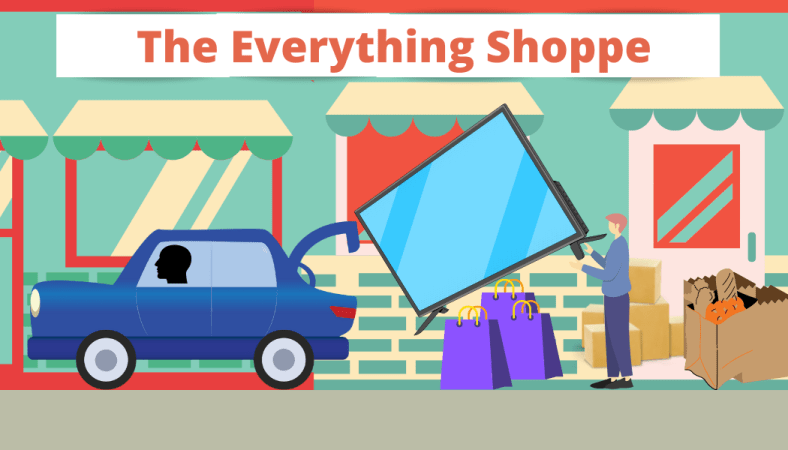
Curbside pick up. CSPU to afficionados. I am loving this concept. Everybody from grocery stores to garden supply sellers to liquor stores to warehouse clubs. Just as Zoom spawned a mini-trend of the meeting mullet (business on top, pajamas on the bottom), curbside shopping has turned shopping into an ultra-casual activity. To be sure, “buy online, pick up in store” has been around for years, decades, stretching back into the last century even, but the process always involved some time spent in the shop. It’s right there in the name – “pick up in store.” Let’s face it. If you’re going into a store, you’re going to have to put pants on. The signs may say “no shoes, no shirt, no service” but they’ll stop you from going in trouser-less too (or skirt-less or dress-less even though we’ve seen how close some people can get in those “People of Walmart” pics and videos). But with curbside pickup, as long as you have an internet connection, a means of electronic payment, and an inside trunk or tailgate release, you can go shopping in a bathrobe if that suits you. It’s not just comfort that has me so enamored of CSPU (and I’ve yet to participate in a pick up in just a bathrobe), but the convenience and the savings. Yes, the savings!

Convenience is obvious. You sit in your favorite chair, put up your feet, and stroll through the aisles. You see that 84 inch OLED smart TV you’ve been waiting to go on sale. It is, and it’s time to buy, and it doesn’t matter that it’s over your doctor-ordered weight limit by 50-some pounds. Someone else will wrestle it off the shelf and into your car. Need a new pair of jeans. No problem. Buy them with confidence because almost everybody has a ‘buy now, try on’ at home policy easing returns for those brands that run small when you get them home. Need to do toilet paper math? You have a calculator, all the time in the world, and nobody trying to get around you while you calculate. So convenience is a given.

How can CSPU be a money-saver? You might think being able to click you way to a full shopping cart would lead to unchecked, indiscriminate buying, but nay I say! You can always stop and check the shopping cart (or the cuter shopping bags and baskets) for your running total, and even at checkout you get the opportunity to delete something. How often have you ever done that in real life? But the true genius to CSPU (and its older cousin OOLPUIS as long as you’re careful) is NO IMPULSE BUYING! No tunnel of candy and cold drinks, magazines and lunch size bags of chips, nail clippers and rolls of mints, key chains and energy drinks to pass through on the way to the final check out. No endcaps filled with unadvertised specials (that never are that much) or overstocks and clearances (that are there for a reason). No electronics counters filled with car chargers, charging cables, and brochures for cell plans, all trying to wrestle away more of your spending dollar (and/or your favorite local currency). Oh some e-tailers have tried to emulate the impulse buy with “people who bought this, often add this” or “don’t forget the…” and “would you like to add…” throughout the shopping experience, but those intrusions are easier to ignore that the constant barrage of political ads that pop into your text messaging app nearing general election time.

Yes, of all the benefits being locked down, quarantined, socially distanced, and generally wanted to stay off the streets, I hope curbside pick up is here to stay.

——

* People keep saying we’re getting close to the end of the pandemic but there is no end to the pandemic, or more accurately, the Covid virus has not waved a white flag, agreed to peace talks or will quietly leave the planet. It is like your favorite Russian autocrat.  There will be a point that we may (may with a capital M and an exclamation mark) not experience worldwide stoppages of life as we know it no even country wide interruptions. But the virus will still be out and about and we will still be susceptible to it and its periodic annoying intrusions on intelligent life on earth, much like your garden variety politician.

Once upon a time they lived happily ever after (4)

Read any good books lately?

There have been a lot of stories this year regarding book banning in America’s schools. Legislature has been presented in seven states and parents have approached dozens of school districts specifically to remove specific volumes or entire categories of books from school libraries. Legislation was introduced in Florida to not limit challenges to school library holdings to parents but allowing any individual to challenge any holding. In Texas, Llano County Commissioners Court forced the closure of the local public library (public library!) so librarians could review all reading material for their younger readers to make sure books are age appropriate. That’s just this year. And it’s only March. That’s following up on a flurry of year end interest around books and children. According to NPR, Texas State Representative Matt Krause put more than 850 books on a watch list, targeting materials he feels “might make students feel discomfort, guilt, anguish, or any other form of psychological distress because of their race or sex.” (npr.org, “A Texas lawmaker is targeting 850 books that he says could make students feel uneasy,” Oct. 28, 2021.) No word on whether he read those books.

Questioning whether the Honorable (Ha!) Krause read all 800+ books on his list isn’t me being ornery as usual. It’s a legitimate question. Not just by me but legitimized by those in the know. Deborah Caldwell-Stone, director for the American Library Association’s Office for Intellectual Freedom said in a recent interview, “We’re now seeing challenges pop up based solely on social media posts. A video gets posted of a parent complaining at a school board meeting, and within days, we see challenges across the country using the same reasons. People are complaining because they saw it on social media, not because they actually engaged with the book.” (Triblive.com, “Book challenges are becoming more frequent, driven in part by social media,” March 14, 2022.)

My concern isn’t about the books being challenged. Book challenges and banning have been going on basically since there were books. It’s the way these challenges are being conducted. Small numbers of individuals uneducated in the library sciences making noisy demands of schools to conform to their (the uneducated small number of individuals’) idea of decorum based on what other uneducated small number of individuals are writing on Facebook, et.al.. In a recent CNN poll, only 12% of Americans believed parents “should have the most sway over which library books are on the shelves” and twice as many felt teachers and school personnel should have more control over library content. (cnn.com, “CNN Poll: Economy and education could shape how Americans vote in 2022,” Feb. 11, 2022.) In the past, challenges were based on the challenger’s personal experience with the book (that means he/she/it actually read the book) and may have actually been able to intelligently debate the content of the book and verbalize why he/she/it felt it (the book) was inappropriate. Now, the majority of challenges are opposing titles simply because they are on some list of ‘controversial’ books. I pointedly use “title” in that sentence because so often the title is all the “concerned” parent knows about the book.

There is no evidence that the current wave of book banning is accomplishing what I think the challengers to the titles are intending, that is a purge of all material contrary to their mores. I’m just not sure they know what their intentions are. Or possibly what mores are. And if anything, the publicity for these books, the classic titles and those barely known to anybody but the most dedicated librarians, has generated increased sales for the books.

We’ve seen when we let anybody with a computer and the ability to cut and paste how America responds to a global pandemic resulting in a death rate twice the rest of the worlds, how we’ve graciously accepted the transfer of power, and how we are politely carrying on primary election campaigns as we run up to the mid-term elections this fall. Perhaps the proposed bans shouldn’t be of books whose only intent is to encourage thought and generate intelligent discussion, we should instead be banning social media whose intent increasingly seems to be to pass off incomprehensible opinion as fact among those who never spent time in their school library back in the day when it was their school library.

Once upon a time they lived happily ever after (3)

I’ll have mine with coffee please

This is the day sweet toothed snackers and pastry enthusiasts wait for every year – Pi Day, or as probably a large percentage of those pie eaters would write it out, and for as much as they care of its significance – Pie Day. Now that opens a whole new line of thought. Exactly what does pi actually do in the real world? And while we’re at it, why pi?

That second question is easier to answer. Everybody, even those insisting on it being Pie Day, knows pi (without the ‘e’) has something to do with math and some of those everybodies might even know it’s most closely associated with circles. Pi is the relationship of a circle’s, any circle’s circumference to its diameter. There’s a great two-minute video here that demonstrates that with a touch of humor and extra pepperoni. Although the concept of pi (again, without the ‘e’) was first demonstrated in the third century B.C., it wasn’t until 1706 on this side of the Common Era dividing line that British mathematician William Jones decided the Greek letter and symbol would make a dandy stand in for 3.14 etc.etc.etc. in calculations. But Leonhard Euler (yes, the is THE Euler) made it popular in his textbooks and justified the Greek Pi, corresponding to P, because pi is all about the perimeter (or circumference) of a circle. (In case you’re wondering, pie (with the ‘e’) has been around since about 6,000 B.C..)

2022-03-13

Now the first question isn’t actually hard to answer. It is hard to pin it down to less than a few hundred dozen applications that are possible only because somebody, sometime, somewhere worked out the calculations to make whatever it is work, using pi. These include radio waves that not only make AM radio possible, but blue tooth that is powering those high priced ear buds you have sitting on your desk.  Not straying too far from there, the GPS function of your phone wouldn’t be possible today if some engineer hadn’t tossed pi into an equation or three. And just that you can talk to your phone or home assistant is possible because voice recognition schemes all use pi to calculate and translate vocal waveforms into computerese. But, you ask, what can you do with it?

If you so wanted to, you could use pi to calculate how much water it takes to fill the kid’s backyard swimming pool, how much stain you need to cover the floor of the gazebo, or how much frosting to make to adequately decorate the surprise party birthday cake. Even more practical is determining what size electrical conduit to buy for that remodel you’re DIY-ing, or how much pie filling you need for the deep dish apple pie the kids are expecting after dinner. Yes, I know, there are charts and recipes for all these things. But now you know you could calculate the answer if all the computers in the world suddenly stopped working or worse, decided to take over and not talk to us anymore. Not too far-fetched you know. Didn’t you ever see “Colossus: The Forbin Project?” (Or one not so evil, like EMARAC from “Desk Set.” If the computers are going to take over, that’s the one I want, as long as Ms. Warriner comes with it.)

So now, go off and eat your pie today, today being Pi Day, or Pie Day if you must. And remember, ask not what pi can do for you, ask if you get whipped cream with it!

2 + 2 5 (6)


The pursuit of clean, filtered air

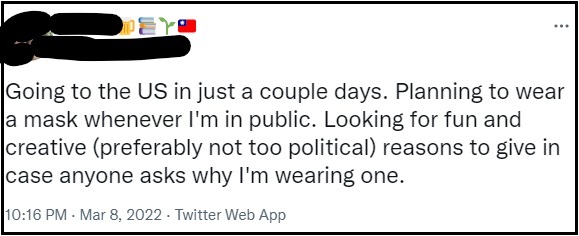
I saw an interesting Tweet yesterday. “Going to the US in just a couple days. Planning to wear a mask whenever I’m in public. Looking for fun and creative (preferably not too political) reasons to give in case anyone asks why I’m wearing one.“

2022-03-09 (1)_LI

The Tweeter(?) obviouslly lives outside the United States and wants to protect herself against a virus that is still raging, even though less actively than a few weeks ago, while visiting a country with a COVID death rate twice the rest of the world’s – and 82 times higher than her country! (WorldOMeter, “COVID Live – Coronavirus Statistics,” March 9, 2022)  According to a New York Times analysis of mortality, since the first Omicron case was reported in the United States in December 2021, Americans have been killed by the coronavirus at a rate at least 63 percent higher than other large, wealthy nations and was averaging about 2,500 deaths per day. (New York Times, “U.S. Has Far Higher Covid Death Rate Than Other Wealthy Countries.” Feb 1, 2022) The report went on to state that the only European countries with higher death rates are Russia, Ukraine, Poland, Greece, and the Czech Republic.

Oddly enough, even though the CDC changed their masking recommendations this month, the federal vaccine mandate was never enforced and now seems to be headed for reversal by the courts, and most limitations on businesses have been removed, people still want to protest them.  Brian Brase, the organizer of the so-called People’s Convoy that just burned countless gallons of gasoline and diesel circling Washington, DC, has called mandates an “infringement on their freedoms” as recently as this week. (Washington Post, “‘People’s Convoy’ organizers meet with GOP lawmakers amid pandemic-related demonstrations,” Mar 8, 2022).

You know that I recently was hospitalized with COVID pneumonia in spite of vaccines and mitigation (TRYing to stay 6 feet away from unmasked miscreants sneezing their offensive germs into public spaces like grocery stores and churches). I empathize with our aforementioned Tweeter because I will be going out in public still masked and standing a safe distance from those who aren’t. What should I say to them? Clearly somebody with more pickup truck parts than brains will come up to me and say, quite politely I’m sure, “What’s the f**k wrong with you, you retard? Act like an American and take that f**king mask off, a$$ho*e!” How do I know? Because it’s already happened, and it happened before the CDC issued new guidance. Months before the recent new guidance was released (which really requires people to have an understanding of the surge of cases in their particularly are and the relative burden placed on the local health care systems (read, too difficult for your average simian to even say, yet understand so let’s just concentrate on the no masks part)), the CDC guidelines recommended that those who were fully vaccinated, may attend small indoor gatherings with other fully vaccinated individuals without masking. This was interpreted as “you don’t need to wear no more masks any more yippee yahoo but let’s keep protesting masks anyway” by the under 65 (as in IQ score) crowd. And yes, I had been approached by inquiring sorts of that ilk, while in public with my mouth and nose stylishly clad in the latest surgical garb as to why I was wearing a mask. “Don’t you believe in science?”

Considering how adamant so many non-maskers were in demanding understanding on their positions and their rights to their freedom to breath the air as it was intended, I hope they will also understand why those of us who are medically challenged, immunocompromised, or just plain leery that a long term accord has been reached between the United States of America and SARS-COV-2, elect to exercise our rights to life, liberty, and the pursuit of breathing clean, filtered air.

And while we at it, it seems to me that those still calling masks, vaccines, and other life-saving measures “infringements on their freedoms,” need to spend some time in the Ukraine right now.

Things I was thinking about when I was thinking about the things I think, I think

It’s that time again when I have to get some things off my mind or I’ll go out of my mind, and that’s the first one. Going out of one’s mind (which admittedly falls trippingly off the tongue) is taken to mean losing it, going nuts, flipping your lip, and a half-bazillion other ways to say gone bonkers. “Don’t pay attention to him, he’s out of his mind.” “I need a day off or I’m going to go out of my mind.” But it’s actually possible to just go half out of one’s mind, “I was half out of my mind with worry” which usually conveys just a temporary inability to deal with a specific occurrence. That’s not to be confused with “having half a mind” which no less an authority than Merriam-Webster defines as “the feeling especially when angry and annoyed that one would like to do something while at the same time not really planning to do it.” It’s just all much too mindless for me.

This one gets a little politically incorrect (and if you ask me, all of politics is a little incorrect lately). Recently, I had the opportunity to read a magazine article that addressed a dispute between a person who wished to be addressed by the pronoun “they” and another person who was addressed as “she.” The columnist, clearly being a woke (and presumably politically correct) person that he/she/it is, honored the request. It was by far the most difficult piece of reporting I have ever read and I used to read military efficiency reports. I could never tell if the author was talking about one or both of the individuals at any given time. In one sentence the word “they” referred to both the individual and both individuals. Please can we stop with using “they” as a singular pronoun. As noted last week, the English language has over 600,000 words. If you don’t like the one people have been using, at least pick one of the more obscure ones. Or make up a new one. Clearly with over 600,000 words, English language users are not shy about doing that!

I don’t know if this is universal among anti-virus programs so maybe you can clear things up for me if you know. I run Norton-360 antivirus program and I swear, sometimes I wish I’d have opted for the virus. I can’t turn on any of my computers without having it pop up and remind me of some extra cost option I haven’t purchased, or pop up usually while I’m in the middle of entering a nice long string of something (data, words, pictures) to let me know it recently did its thing, all is well, and do I know there are extra cost options I haven’t purchased, or pop up while downloading a file, program, video, whatever and assure me that suchandsuch.somethingorother is safe and by the way, do I know there are still some extra cost options I haven’t yet purchased. If one of those options was a pop-up free version I’d write out the check today!

Another thing I don’t know if it is universal is that since I’ve had COVID, I cannot get warm. I can have the furnace on 68, 72, or 76 and I still want a hoodie (or two) on over my sweatshirt (or two). Oddly, or oddlier, it’s only my upper body. Throw an extra blanket on the bed and my legs get hot. I have got to get this in check before next winter because I refuse to be one of those over-testosteroned Neanderthals that walk around in blizzards with their flannel shirts, camo hats, Carhart jackets, and shorts! And I don’t even want a pick-up truck.

I seldom go on Facebook anymore and maybe this is why. On a recent rare excursion to the Land of Odds (odd balls!) I found a post that had great intentions, but, well, really now. You likely saw it or one of its cousins if you still visit there. It was titled(?) “Why Ukraine matters” and then went on for 1,000 words or so listing all of Ukraine’s attributes. How about. “Ukraine matters because Ukrainians live there. Ukrainians matter because they are people.”

Thank you for sticking around to the end. I know it’s a messy process when things just fall out of my head. I should be good for another couple months now.

2 + 2 5 (5)

Change of plans

Remember those best laid plans from a couple weeks ago? Earlier this week I saw a news blurb on one of the local stations about plans. It seems all the rage among the over 30 crowd is to not make plans. In fact, according a majority of 30-somethings interviewed, they are most happy when plans that have been made are cancelled. I know you may find this hard to believe, but I’m going to disagree with that. I remember life in my 30s. I was thrilled when something got cancelled because there was so much else going on, when something fell through, maybe I’d actually be able to do the things I had planned!

Perhaps we should better define “plan.” You likely “planned” to read my blog Thursday morning yet here you are, seeing it for the first time on Friday. Was that really a plan or more an anticipation or expectation (depending on how disappointed you were upon not finding it Thursday morning). I thought you would be reading this Thursday morning. Was that the plan? Or was that an intention? Likely you speak to someone early in the day and may be asked “So, do you have any plans for today?” And perhaps you do but more likely you have aspirations of doing things if other things don’t prevent that from happening. And lastly, if you have a desire to remove yourself from your day to day activities, take a break, perhaps two weeks in a tropical paradise you have never seen and may never see again and you don’t want to miss the plane or would like somewhere to stay besides in the open on the beach, you may request time off, purchase plane tickets, book a hotel room, maybe even make reservations for a local attraction or two for those weeks in the sometime future. This is a plan and one nobody will be “most happy” with if it is cancelled.

2 + 2 5 (1)

I think when the 30-somethings say they don’t make plans, they are speaking of the first three examples noted in the above paragraph. I am sure that somewhere, there is a 35 year old sitting with a couple tickets to Barbados, maybe pre-paid afternoon at the spa and reservations at the Salt Café in his (hers?, its?) phone’s wallet. It may think it a commitment (especially after the first few payments hit the Discover billing cycles) but it started out as a plan. Those other things like anticipating a blog post to hit your email or announcing a day’s probable agenda are possibly considered commitments by that unspecified 35 year old and it might not want to commit to lunch with the brother-in-law and then wash the car this Saturday afternoon and thus would prefer to “not make plans.”

I suppose it’s all in the words you use and even though the English  language gives us a bazillion from which to chose (over 600,000 per the Oxford English Dictionary, 39 for “plan”) we opt to use those that are most familiar to us and cause us to do the least amount of thinking to choose, while saying to everyone else “I know what I mean, figure it out yourself!”

I don’t know who decided that but I plan to look into it.