Oh we are so very close. Just a couple days separate us from Christmas which means it’s well past time for a Christmas movie post.
I didn’t talk about Christmas movies last year. We were too busy praying. Actually, one can never be too busy praying but last year I put the prayer out in public. But this year, let’s talk movies again.
I’ve visited this subject four time before, the most recent from 2019 when I revealed my then current favorite Christmas movie. At the time I said, “I say my current favorite because like children there can be no real favorite among Christmas movies. The favorite is the one making you smile today or remember yesterday, the one encouraging a perfect alternative to an imperfect world and providing an escape from the ordinary.” I stand by that thought still. There can be no favorite among the 873 bazillion holiday film offerings, even if only a handful are truly good movies. If they make you feel good, then they are. Except Die Hard. It isn’t, it never was, it never will be, end of discussion, period. (And it’s not a western either even though the main character does say, “Yippee ki yay.”)
When you get down to it, almost any of our favorite “Christmas movies” can be reworked to be set in some other month, some other season, with some other set decorations, and would play just as well. Maybe we set the bar too low for what we expect of holiday film fare. Maybe we really need those classics that wouldn’t work any other time of the year. Ebeneezer Scrooge would not convey the same sense of repentance in August. A Christmas Carol is a Christmas movie.
My current favorite most likely would work any other time of the year. In fact, the basic story is released dozens of times every year, and I’m surprised Hallmark or Lifetime or whoever churns out a new Christmas story every evening between Thanksgiving and Christmas Eve hasn’t lifted the very plot for one of theirs. My current favorite wasn’t even in the theaters at Christmas, its general release coming in mid-January although it had a Boston release on New Year’s Day. That’s not at all unusual. There are more Christmas movies released in the summer months than any other time. Many studios feel winter releases won’t generate the type of first weekend or first month income their investors demand. One of the greatest Christmas movies of all time, Miracle on 34th Street, was released in June, the classic White Christmas was released in October, and for the younger crowd, it was barely October when Elf arrived. However, you have to give credit to George Minter Productions who managed to get the definitive Christmas Carol starring Alastair Sim as Scrooge released on Thanksgiving Day in the U.S. in 1951. No, release date does not a Christmas movie make.
If you are to go by set decorations and locations, it would be difficult to call my current favorite a very Christmassy Christmas movie. The tree in the Poseidon Adventure gets more screen time and there are few, precious few, presents unwrapped. Most of the action is in a court room and there is one scene where our top credited stars milk a cow. Other than snippets of “Jingle Bells” heard occasionally, there is no Christmas music in a movie featuring a half dozen full songs. Appearances don’t seem to make a Christmas movie either.
So what does make a Christmas movie and why should my current favorite rank so high this year? It has the same unknown last year’s favorite has. Imperfect characters making imperfect plans, and ordinary people doing ordinary things while dealing with ordinary problems. Somehow, among all that mediocrity come glimpses of joy until the end when you find yourself smiling amid the improbability of a happily every after ever happening and the true desire to wish it could.
 My current favorite Christmas movie is the 1940 production of “Remember the Night,” pairing Fred MacMurray and Barbara Stanwyck four years before they team up to become the couple you love to hate in “Double Indemnity.” Here they are the non-couple you want so badly to become the couple you love. All the printed synopses are blah. The story they describe isn’t the movie at all. I saw this movie years ago and promptly forgot about it. Maybe it was where I was in my life. Maybe I wasn’t looking for joy. I saw it in the summer and maybe the joy was there but lost in the stifling heat of July. I saw it again a few years ago at Christmas and fell in love with it. This year I can’t get enough of it. To me, it really is “a perfect alternative to an imperfect world.”
As I was doing some research for this post, I discovered it is #69 on Rotten Tomatoes list of top Christmas movies. There are any number of questionable offerings ranked higher, including their number 2, but at least Die Hard isn’t among them and that my friends, is this year’s true Christmas miracle!
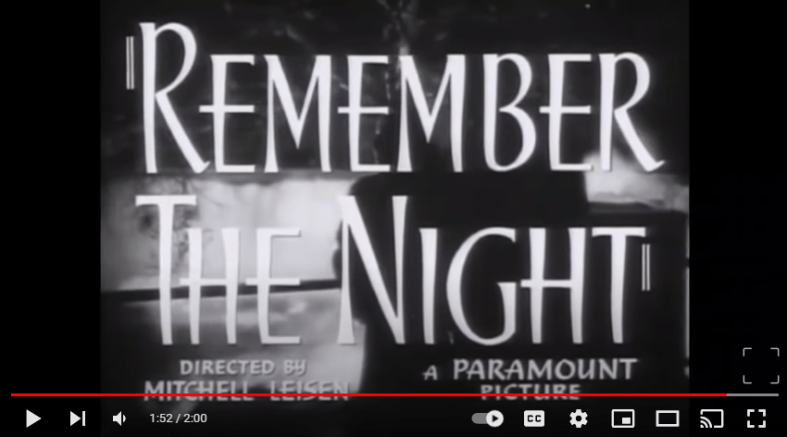
Watch “Remember the Night” trailer
 I published the post below in 2017. The world has changed since but our feelings toward it seem about the same. That no specific events are mentioned may be why I can look at that today and not be surprised that it doesn’t intimate the world’s current events. I wonder if it would have been as appropriate in 1945 or will be relevant in 2067. I wasn’t here yet for the former and don’t expect to make it to the latter so I will concentrate on 2017 and 2021 and find we are still just as clueless. Pity.









 If I had to make a list of the Top Ten People to Ever Walk the Face of the Earth, Pittsburgh native Fred Rogers would be high on that list. He lived for kindness and his type of kindness is returning to vogue, especially now that the generation that mocked him, his quiet, unassuming manner, and his gentleness to everybody, is now having grandkids and their favorite expression is “why can’t you be nicer?” Mr. Rogers didn’t love everybody regardless of race, color, creed, national origin, or gender identity. Mr. Roger loved everybody. Period. His mantra, “I like you just the way you are,” ended every one of his 912 shows. “You’ve made this day a special day, by just your being you. There’s no person in the whole world like you, and I like you, just the way you are.”
 Gene Kranz was the Flight Director for Apollo 11 and Apollo 13. Apollo 11 is known for its success, landing two men on the moon and meeting President John Kennedy’s 1962 challenge to reach the moon before the end of decade. Apollo 13 is known for its inflight disaster, potentially losing another full Apollo crew, when faulty wiring caused a spark and explosion that caused the spacecraft to lose its oxygen supply. Rather than a moon mission it became a survival mission, racing the clock to return the astronauts to earth before their oxygen ran out. Those who read the book or saw the movie know the Flight Control team took accountability for the disaster and used their knowledge and skill to bring the flight crew safely home.

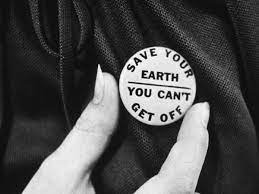 Many posters, PSAs, and other communications will remind us that we have only one earth, we should take care of it. And we are getting better. In 1970, the year of the first Earth Day, there were actually two Earth Days. The first was celebrated on March 21 suggested by newspaper publisher and environmentalist John McConnell to the United Nations Educational, Scientific and Cultural Organization (UNESCO). Mr. McConnell became involved with environmental activities when he began manufacturing plastic and realized how much plastic was being discarded. He presented his vision of a worldwide holiday “to celebrate Earth’s life and beauty and to alert earthlings to the need for preserving and renewing the threatened ecological balances upon which all life on Earth depends,” at the 1969 UNESCO conference in San Francisco. His vision saw the holiday celebrated on the Vernal Equinox (the first day of Spring) symbolic of an equilibrium between man and the planet. Earth Day was first celebrated on March 20, 1970 by proclamation of the city of San Francisco. The following year UN Secretary General U Thant issued a proclamation declaring Earth Day thence to be celebrated on the Vernal Equinox.
 Clean air, clean water, and clean land deserve to be celebrated but not just one day a year. A few miles from my front door there is a county park with a hiking trail labelled on maps as the Rachel Carson Trail. Rachel Carson probably is known best for her 1962 book Silent Spring which questioned the “better living through chemicals” attitude of the time and warned of the dangers from the misuse of chemical pesticides. Many cite her book as the stepping off point for the environmental movement. But Ms. Carson was not an angry activist. She was a noted marine biologist and wrote three earlier books on sea life and marine activity, winning the 1952 National Book Award for nonfiction for The Sea Around Us. In 1935 after graduating from Pennsylvania College for Women (now Chatham University) in 1929 and receiving a Master degree in zoology from Johns Hopkins University in 1932, Ms. Carson was hired as a junior aquatic biologist at the US Bureau of Fisheries (which would later be reorganized as part of the US Fish and Wildlife Service) to write radio programs on marine life. She stayed with service, advancing steadily until she resigned in 1951 to write full time. Despite undergoing multiple operations from 1950 to 1960 for breast cancer, Ms. Carson continue to write and lecture until her death in 1964.

 The Real Reality Show Blog