Today and tomorrow stretch the limits of diseases. Today, as it is every year on the last day of February, is Rare Diseases Day and tomorrow, as does every March 1, begins National Kidney Month one of the most common medical conditions. I am one of the chosen who get to experience both up close and personal.
Rare diseases and kidney diseases share more than just the cusp of the second and third months of the year. What makes a rare disease a rare disease changes a little from country to country. In Europe a disease or condition affecting is considered rare when it affects fewer than 1 in 2,000 people. In the U.S. that consideration is extended to those disorders affecting fewer than 200,000 people in total. Either way, that’s not a lot of people for a disease. There are over 6,000 conditions listed as rare diseases by the National Organization for Rare Diseases (NORD) and Rare Diseases Europe (EURODIS) affecting over 30 million people. Meanwhile, kidney disease affects over 30 million Americans alone. Coincidence? Maybe not.
 If you go back far enough all diseases have been rare at some time. The more common conditions like diseases of the kidneys didn’t become less rare because they affected more people. They became more common as those treating them spoke with others treating similar conditions comparing symptoms, patient histories, disease progression, and constants in presentation. Often when enough data is collected it becomes apparent the rare disease wasn’t as much rare as unrecognized. Treatment options and the responses then get shared, refined, retried, and publicized and the goal shifts from just education and proper diagnosis of the disease so difficult with the rare ones to effective treatment and some day eradication of the disease.
Obviously a disease becoming “common” doesn’t automatically mean we know enough about it to say were well in the way to effectively treating or possibly eradicating it. If it did we’d need far fewer fun runs every weekend. The National Kidney Foundation may not face the recognition challenge like NORD and EURODIS but treatment improvements are still badly needed and 30 million people can attest that eradication is not just around the corner.

Sometimes, whether rare or common, the patient gets lost in the struggle to recognize or combat the disease. The rare disease sufferer often suffers in silence while it’s “clear” to his and her friends and coworkers that it’s all in his head or she just complains a lot. The End Stage Renal Disease patient “fortunate” enough to be able to still work is made to feel guilty that he might be a little slower on the day after dialysis even though he got a whole half day off for it, or that she never wants to take a real vacation, just a weekend here or there when she can work it around her dialysis days.
If you know one of the 30 million people with a rare disease or one of the 30 million people with kidney disease or maybe one of each or one with both take some time today and tomorrow to learn what they go through, what they need, or how you can help. If you feel generous, a donation to one of the hundreds of organizations looking to educate people on, or advance recognition and treatment of one the diseases affecting your friend can’t hurt.
But if you’re feeling really generous, give a call to your friend and say, “Hi, can I do anything for you today?” That could be the rare treat that really makes a day.
 They’ve raised over $157 million. How much more? Add another $10,621,683.76 from this weekend. That’s short of the $13.4 million record from 2013, and far far less than say the $700 million donated to St. Jude’s Hospital last year but Thon’s overhead is probably a little less also. And you can’t argue that is still quite a total for a bunch of kids just helping out another bunch of kids.
 I think everybody in the world (except San Diego) can honestly say “if you don’t like the weather just wait a day, it will change!” but this is ridiculous. It’s also not uncommon. Without trying to annoy the climate change crowd or those who feel climate change is a socialist plot, the world is not made for stable weather patterns. It’s a not quite spherical orb spinning at a not quite constant speed on a tilted axis while revolving around a not consistent heat source on a not quite regular ovoid orbit. If you don’t believe me I give you from prehistory the Sahara Forest, from modem tourism the Great Lakes, and from calendar makers’ nightmares throughout time leap year.
 What happened on July 4, 1776 was like America standing in the middle of the school yard shouting “I am the greatest!” What happened seven and a half years later was everybody else agreeing with them. (Us?) Sort of.
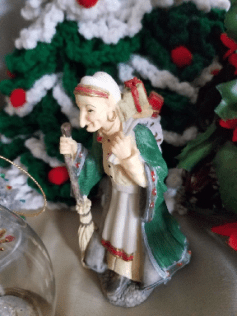 La Befana traditionally is pictured with her broom and a shawl sometimes blackened with soot from cleaning the hearths where she leaves her gifts, sometimes in colorful patches to commemorate the gilded cloths the Wise Men wore. The basket she carries contains sweets and books for the good and coal and garlic for the naughty. She takes up her search every year on January 5, the eve of the Epiphany which then ends the Christmas season.
 Business: Sears is about to become a Jeopardy question. (This former retail giant introduced the Discover Card in 1985.) Sorry. Not news. Sears has been going out of business since the early 1990s. The big business news for 2018 that nobody noticed was that Starbucks opened a store in Jamaica. Jamaica man. In the very shadow of the Blue Mountains. If you are a coffee drinker and you aren’t familiar with Jamaica Blue Mountain Coffee you aren’t a real coffee drinker (or really a coffee drinker) (or really a real coffee drinker). If you aren’t a coffee drinker but your drinking tastes run more to White Russians, you might have experienced Jamaica Blue Mountain Coffee as the main ingredient of Tia Maria liqueur. Yes, Tia Maria in a White Russian, not that Kahlua stuff. Not even Starbucks house blend. That would be too different.

 I’m not sure how I became a glitter magnet but I am. I can’t even drive past a Pat Catan’s or Michael’s without the stuff flying off the shelves, out to parking lot, through the car vent, and forever attached to me. It won’t wipe off, rub off, wash off, or as previously noted loofah off. Typically it wears off 8 to 12 weeks after bonding, so as long as I can stay out of glitter’s way on New Year’s Eve and Ground Hog Day I should be glitter free by St. Patrick’s Day and just in time for green glittered shamrock headbands.
 The Real Reality Show Blog