Tax and Fees Extra

“And of course because this is a foreign check we’ll have to hold it for 5 days.  Which account would you like it held against?”  The question was absolutely serious.  And He of We was absolutely dumbfounded.  “Foreign?  Well yes, it does come all the way from Kentucky.”  And thus he found himself on the receiving end of a lecture, a real honest to gosh lecture, about how the banking industry works to protect our deposits.

She of We got her own lecture two weeks later when her credit union debit card was refused by a merchant because the bank had inactivated it.  It was very good of the bank to do so since it appeared that someone had possibly stolen her card numbers and attempted to buy something out of country.  But nobody told her.  She found out 3 days later.  During that time she attempted two local purchases which were refused and called the credit union.  She spoke with a live operator who suggested she try her card again in an ATM.  After the ATM was no more help than the live telephone version she went to the branch to inquire and was then told that her card had been suspended.

While She of We was waiting at the teller window another patron at the next window was having his own issues with cards and funds.  It seems he stopped at a gas station and “Paid at the Pump” with his debit card.  Forty-five dollars.  But his computer statement told him the account had been debited $70.  Where was the other $25?  And why was it not in his account where it would have stopped a check of his from being returned unpaid for which the institution charged him another fee.

If we remember all the details, a foreign check is one drawn against an account from any bank other than the one to which He of We was attempting to deposit it.  If that check should not clear we will be charged a fee for depositing a check that is not backed by sufficient funds and we’d be charged a fee immediately and thus place our account balance in jeopardy.  So it’s for our safety. 

Purchases against a debit card are transferred to the bank for approval and if it will be paid or not the merchant is apprised of that by electronic message.  Anywhere in the world.  Immediately.  For our safety.

Unspecified cash total purchases, such as a “pre-approval” to buy gasoline sometime in the future (and apparently sometime in the next 30 seconds of the pump reset is “the future”), is transmitted to the gas pump’s mini-computer with a predetermined spending limit.  Eventually, the predetermined already debited amount is re-credited to the account.  Probably for somebody’s safety.

It’s commendable that a bank would want to protect its customers from fraudulent transactions but we have some questions.  What if the debit card number thief had try to make a purchase in Hartford Connecticut rather than Hamburg Germany?  Was somebody ever going to contact She of We that she was walking around with a useless piece of plastic in her wallet?  Why isn’t the card holder made aware of the amount of held funds for pre-approved purchases and for how long they will be held?  And explain again why Kentucky is foreign? 

These are all accepted US banking practices protected by US and individual states’ banking laws.  A bank can hold funds guaranteed by a check for 5, 7, or 10 days until the issuing bank confirms there is money in the account against which the check is written.  That’s only good practice.  Good practice to hold the check until the receiving bank finds out if the issuing bank has the money.  Good practice for it to take 10 days if the receiving bank is planning on sending a representative by stagecoach to the issuing bank to collect the money. 

The rules were written before electronic funds transfers were common, before the average American had 3 phones and 5 e-mail addresses, before people traded in their folding money for a piece of plastic that is easier to carry, and if lost or stolen easier to report, manage and recover.  Why would anybody want to re-write the rules?  They provide the bank with the opportunity to use somebody else’s money for 3, 5, 10 days to collect additional interest for their accounts.  And after all, they protect our accounts.

When the banks can’t get enough by squirrelling away our money for a week or so they charge fees.  ATM fees, teller fees, call center fees, credit card fees, debit card fees, paper statement fees.  We read recently of a bank that tried to establish fees for using their website.  It was a monthly electronic access fee. The banking is free.  The accounts are “service charge free.”  However, if you want to find out how much money you have on deposit you have to pay a fee.

Used to be all banks were worried about was someone holding up the stage coach.  A banks real challenge now is measured by how to creatively phrase the next fee they will charge you and convince you that by paying these small fees translates into large balances later.  If you believe that, we have a bridge we’d like to sell you. 

But you have to pay the closing cost fees.  It’s for your safety.

Now, that’s what we think.  Really.  How ‘bout you?
 

Till Death Do Us Part

She of We asked He of We if he saw the story about the feuding children who were posting competing obituaries.  Oddly enough, He of We who seems invariably to come across only the most bizarre news while trying to find the local weather, sports scores, or lottery numbers, hadn’t.  Since he can’t let much get by him he went in search and found not only that which She of We had referenced, but several other articles decrying bad behavior in the world of remembrances.  Let’s catch you up on what we found.

That which started it all started in of all places, Florida.  The Sunshine State wasn’t sporting very bright people when a seemingly doting son decided he was going to vent his resentments with his siblings in mom’s printed 15 Minutes.  His paid tribute billed himself as the loving son and the other two children as the daughter who betrayed her and the son who broke her heart.  Such a close family.  Word is that the daughter wrote a second obituary but that one seems to be unavailable for viewing to the Internet world.  There was one article that said it contained basically the same information as that of the first without the colorful descriptions of the siblings.  And mom’s age was different.  Maybe they weren’t so close.

It got us to thinking about the etiquette behind obituaries.  We’ve written about workplace etiquette (Fire Them All), shopping etiquette (Clean Up on Aisle Ten), restaurant etiquette (Terms of Appreciation, You want fries with that?), even parking lot etiquette (Parking Wars).  We didn’t think we’d have to ever discuss death etiquette.  Apparently we do.  Not only have we now seen how people can’t keep their pettinesses out of the paper, we’re also aware of viewings, wakes, and services which have been interrupted by arguments, fights, and visits by the police who weren’t there visiting the deceased.

Clearly the best way to approach this issue is proactively.  We plan to write our own obituaries.  And while we’re at it, plan the rest of the party as well.  Who knows us better?   We’ve all read obituaries that just aren’t quite right.  Is the surviving son in Sonoma Sam or Sid?  Didn’t daughter Debbie divorce Dick the dolt?  Since when did he belong to the Loyal Order of the Goose?  It’s understandable.  Obituaries get written in times of extreme stress and grief.  And apparently nobody is checking them too closely for content.  We’ll get the details right.

Some other details about our last hurrah need to be worked out also.  It’s not that we want to celebrate death but we both are of a faith that looks forward to an afterlife with our God and those who have already gone.  You guys left behind have to learn to suck it up and wait your turn.  So no mournful music, no dreary dress, no dull visitations.  We prefer lots of light, pictures, upbeat music, and something spiffy to wear.  We don’t want to look like we’re going to a funeral at our funerals.   We think perhaps a bright blouse, tropical print shirt, and maybe a straw hat at a jaunty angle is a good tone to set for the rest of the crowd.   

Speaking of tone, no organ music at the funeral home.  There are stacks of jazz CDs in both of our cars.  Pick out a couple of handfuls and hustle them over to the mortuary.  If they can’t figure out how to work a CD, find someone under the age of 30.  He or she will be able to download them all onto an MP3 player to make it go on through 2 or 3 visitation sessions without having to change it.  At the church we’d like to hear some upbeat scripture readings.  David chatted about topics plenty more upbeat than “the valley of the shadow of death.”  Fast forward a couple of psalms to “remember your love and kindness…not my sins from when I was younger” for something more chipper and probably a little more accurate where we’re concerned.

Now, getting us around on that last day.  Do we really have to use a hearse?  Dull, dull, dull.  There’s a perfectly good red convertible in He of We’s garage.  Prop up Whichever of We in the passenger seat and let’s go out for a spin.  That just leaves the closing music.  Everybody has passed on by, said “see you later,” and now we need some final travelling music.  She of We thought perhaps, “And now, the end is near, and so I face the final curtain” sung by nobody other than Frank.  It is a terrific send-off for her with the living a full life, tasting it all, and doing it her way.  He of We is leaning more toward keeping the party going and is calling on Irving Berlin to pave the way with Alexander’s Ragtime Band.  We have to wait until halfway through the chorus but there the lyrics say it all, “Come on along, come on along, let me take you by the hand. Up to the man, up to the man, who’s the leader of the band.”  

We know it’s not a terribly original idea.  People have been making their own final arrangements for some time.  You take away a lot of stress at an already stressful time for stressed out people who aren’t always thinking their best.  We figure we’ll pick the mid-price packages all the way around preserving as much of the inheritance as we can and nobody has to feel guilty about taking the cheap way out.  Between the cool clothes, upbeat music, optimistic readings, and cheery bon voyage, nobody will notice we’re going in little more than a high class pine box.  And if they do, nobody can blame anybody but us.  And frankly, we really won’t care.

Now, that’s what we think.  Really.  How ‘bout you?

Paper or Plastic

They say there is an economic crisis.  That we don’t have much disposable income.  That fewer people are in a position to make significant purchases.  That gas will be $4.00 a gallon soon.  Five dollars by summer.  But we can’t get tables at our favorite restaurants; theaters are full; sporting events and concerts where the cheap seats are close to three figures are sold out; there are more Escalades than Smart Cars filling the highways.  How did 2 + 2 get to equal 87?  We think we have it figured out.

If you have the right memories, roll back 30 to 35 years.  Gas was getting close to $2 per gallon and there was real outrage about it.  Tickets for a ball game were for the first time more than $10 for the good seats, more than $5 for the bleachers, and fans were righteously upset.  Ten dollar entrees on a menu meant you were at a restaurant requiring jacket and tie and a very serious relationship or an expense account.  Proportionate to what salaries are, we were actually in better economic shape then.  Yet then we economized, today we spend.  The difference between then and now is the difference between paper and plastic.

No, we aren’t referring to credit cards as plastic.  We mean debit cards.  Thirty years ago we had two choices when it came to making purchases.  Credit cards which nobody used unless planning a vacation and the travel agent needed paid that night or forget about the advanced purchase discount.  Or cash which everybody used but everybody also wanted to keep as much as possible in their pockets or purses.  Cash then meant cash.  When we filled our gas tank and it cost $20, we had to pull a twenty dollar bill out of pocket and watch it disappear into a cash register.  Those tickets for the ball game cost real folding money passed through the iron gated window opening at the ball yard and they were replaced by jingling change.  We even used money, sometimes only coins, at fast food stands.

Today, a sixty dollar gas tab paid with “cash” means swiping a card at the pump and maybe gathering the receipt after filling and really maybe recording it into a checkbook register.  Concert tickets are purchased on line with debit cards.  Even fast food restaurants have card swipers on the counter to eliminate the need to carry cash.  Chances are pretty good the balance gets checked once a week on line and maybe a second look to see that there aren’t more stores listed than actually shopped.  We seriously doubt there is much attention paid to the column with the $ followed by some numbers.

Today money seems to not mean terribly much to many people.  Make your selections.  Swipe a card.  If you happen to swipe more times for more funds than you have money in the bank many bankers have overdraft protection pulling funds from savings accounts or automatically debiting lines of credit.  Yet it’s all “cash” even though none of it folds.  So while mortgage rates stay low because ire was vented over high rates and people refused to buy and thus buy into the inflated charges, bacon costs more per pound than lobster two years ago but nobody is calling for pig boycotts.

Out of sight.  Out of mind.  Never actually seeing cash get handed over person to person has clearly kept rising costs out of sight.  Not recognizing the consequences of this lack of concern has clearly put us out of our minds.

Now, that’s what we think.  Really.  How ‘bout you?


Can you hear me…

The greatest invention of the nineteenth century might well have been the telephone.  From nothing when the first commercial line was strung in 1877 to 48,000 subscribers some ten years later, the telephone may have had the greatest initial impact on American households alongside the regular provision of electricity. 

Some one hundred years later the telephone really hadn’t changed much.  Commercial wireless handsets were becoming more popular in the home and telephone calls no longer meant being tied to the boxes with the dials or buttons where it hung on walls or perched on tables.  Freedom to walk around the house came with only the restriction not to wander too far from the base unit.  It could have be then that telephones started taking on a more positive role among our families.

The phone had always been more positive than negative.  It allowed us to speak with relatives who lived across town, state, and country.  It allowed us to check on our homework answers.  It allowed us to check on friends not feeling well and family who just added another member to the family.  But there were still specific reasons to use the telephone. 

Although relatively economical to maintain local service, local usually meant very local.  Long distance and metropolitan services could be quite expensive.  And phone calls were still often an intrusion into our lives.  They usually came while we were eating, watching TV, playing a board game with our parents and siblings, or out back tossing baseballs, footballs, falling off sleds or pulling weeds depending on the season.  Other than when we were pulling weeds, most of the time the calls came when we really didn’t want to be interrupted. 

Although it might have been more intrusion than necessity, the advances made in the telephone were remarkable.  The twentieth century saw direct dialing, multiple extensions at a single number rather than multiple households on a single line, picture phone, push buttons, memory dialing, built in answering machines, and the first truly portable communication devices – the mobile phone.  Yes, the greatest invention of the twentieth century might well have been the telephone.

Now another thirty years have gone by and we all have a phone attached to our hips or in special pockets in our purses.  We no longer look at the phone as a service or a utility as much as we look at it as an essential that we’d not leave the house without.  We’ve both done it.  Before we leave the house we do our ritual check – wallet, keys, watch, and phone.

We don’t just talk on our phones, we send messages by voice, text, e-mail, Twitter, and Facebook.  We play games on them and with them.  We watch short clip videos on YouTube and streaming videos of live sporting events.  We flip a switch and some satellite finds us and we get turn by turn directions from them.  We maintain our contacts so seamlessly that if someone asks for a phone number for someone we call or text many times a day, we have to look it up.  We don’t know it because we never “dial” it.  We speak the person’s name into the microphone or tap the person’s picture on the screen to be connected.  We no longer have to clip coupons or write shopping lists.  It’s literally at our fingertips.  We aren’t sure but it seems very much like Star Trek.  But if we aren’t sure it’s ok because we can search for and watch episodes of vintage television on our anything by vintage telephones.

Quite an accomplishment for an instrument that at the turn of the century was still fairly impressive to see and use.  When even as portable a phone as it was, it was really just a portable phone.  And in less than a decade it has become as ubiquitous as flies at a picnic.  And as diverse as being able to be the instrument used to look up insect repellant for back yards.  Even though we’re only a little more than a tenth of the way through, the greatest invention of the twenty-first century might well will be the telephone.

Now, that’s what we think.  Really.  How ‘bout you?


Proper Attire Required

Around our parts it’s been a mild winter.  Not much snow, some pretty cold nights but always rebounding during the day.  At then, on February 2, Punxsutawney Phil called for 6 more weeks of winter.  “Six more?” people questioned, “We haven’t seen 6 yet.”

Be careful who you tick off.  Since then we’ve had lows in the teens, wind chills on the other side of zero, and snow enough to break out the snow-blower without fear of ridicule form the neighborhood distributor of testosterone.

There’s something about cold weather that we don’t understand.  It seems to encourage some people to dress as inappropriately as one possibly can.  Everybody in a cold weather climate has managed to run across the one mucho-macho sort who feels that cold weather is no reason for him to deviate from his usual wardrobe of shorts and work boots.  But we’re not talking about him.  Truth be told, we’d prefer not to even think about him.  No, there are others out there who have had the logic portion of their brains suffer from an unexpected frost.

Last Friday night we were waiting for a table at a local restaurant.  Regular readers know we don’t wait long for food.  If we’re told it will be anything longer than a 15 minute wait we consider how much we really want to eat from that menu that evening.  So the fact that we were waiting for a table tells you that we weren’t there long.  Yet in the few minutes that we were standing off to the side of the hostess stand we saw a couple come in that bore watching.  For frostbite.  One-half of the two was wearing a sweatshirt.  The other half, just a shirt shirt.  Did we mention that the outdoor temperature displayed on our dash was 26 degrees, that the snow was wet and cold when it fell, and that where there was not salt there was ice when we parked in the same lot they just came in from? 

The next morning after the temperature dropped another 10 degrees and the sky dropped another 2 inches of snow we were driving through the parking lot of one of the nearby shopping centers and had stopped at a crosswalk while a young man walked by wearing an open hoodie.  Six storefronts down at another crosswalk we paused while another man crossed the other way wearing a football jersey while holding hands with a pre-school version of himself who was wearing a leather jacket bearing the same football team’s logo.  Inside the stores we saw as many wind breakers, sweaters, and an occasional scarf over a light jacket as we did hats, gloves, and toasty wool coats.   This all came after we dropped off She of We’s car for service where a young lady sat in the customer’s lounge wearing only a short raincoat.

Perhaps we unnecessarily marvel at the way some people dress.  Yes, it was only 16 degrees but that was outside.  Inside the stores and restaurants and garages the temperatures were in a well-controlled 68 to 72 degree range.  Yes, outside the snow had fallen and some squalls continued to pass through.  But that was outside.  All of the merchants’ roofs were intact, their insides were dry, and not even fake snow covered any displays. 

And it’s not like we walk to many stores any more.  We don’t ride in open carriages or on run in on horseback.  We get to them in our heated cars with our temperature specific climate systems sitting in our heated seats and holding onto our heated steering wheels.  But boy we still feel bad when we see the abandoned car on the side of the road with its flashers blinking on and off, and hope they didn’t have to wait long for help in this weather.

And if they did, we hope they weren’t cold while they waited.

Now, that’s what we think.  Really.  How ‘bout you?


Drive Through Part Two

January 19, not even a month we noted somewhat shockingly that people are driving through buildings (“Drive Through Service,” January 19, in HUMOR).  It was not quite 3 weeks into the year and we had already heard of local drivers violating stores, banks, restaurants, and various other brick and mortar type stationary objects on the average of once every 3 days.  We implored you to write to building owners to erect safety walls and to petition the US Department of Transportation to promulgate regulations requiring solid object early warning signals in all cars, SUVs, and light trucks.

We don’t think you took us seriously.  Seriously, this is becoming a serious problem.  If 3 weeks into the year the car vs. building rate was one every 3 days, the next 3 weeks has taken an even worse turn (no pun intended).  We’ve heard of 10 more instances of buildings not being able to jump out of the way in time before being attacked by metal, steel, rubber, and presumably licensed drivers.  This round of concrete carnage included a bank, an office building, and the law school offices at one of the local universities. 

So as of today, we are at vehicles 17, calendar 34.  That’s one case of vehicular buildingslaughter every 2.6 days.  That’s increasing from the previous rate of one every 2.7 days.  At this rate we’ll reach the rate of one car/building collision every day by September 28.  (You can check the math but we’re sure that’s right.  He of We was working the calculator.  That’s a sure sign it was checked 47 times for accuracy.)

It is worth noting that this group of poor parkers included a more determined errant driver.   Witnesses at one of the spectacles noted that the vehicle paused at a stop sign, proceeded through the intersection, turned onto the sidewalk, climbed the stairs, and drove into the revolving doors.  Creative.  Most people would have waited until they passed a gas station to look for a public rest room.

These statistics are for our own local metropolitan area.  Although our area is known for some peculiar driving quirks, the steadfast refusal to use sun visors when driving east during shimmering morning rush hours and turning left just before the light turns green are two of them.  Purposely driving into buildings has not been a local drivers’ diversion in the past.  It’s possible we’ve suddenly become the center of brick butchery.  Or it could be a more universal problem.  You should check your local papers to determine if this is becoming a worldwide phenomenon.

Those would be the only choices – local trend or universal bad driving.  On our first post we questioned whether anyone thought it might be because any of those people behind the wheels were also behind their cell phones.  But that couldn’t be.  Almost every state has now passed laws against distracted driving.  Nobody would violate a traffic law like that, would they?  Besides, it’s a silly law, right up there with observing speed limits and wearing seat belts.  What could possibly happen?

We’ll check back with you toward the end of September.

Now, that’s what we think.  Really.  How ‘bout you?

The Road Untraveled

“Do you know there’s an alternate security area? Right through those doors, go to the end of the hall.  You’ll walk a little farther but there won’t be any lines and when you go through you’ll come right out at the tram.”  It was the most He of We ever heard a TSA agent speak at one time.  But who would know better how to beat the crush of early morning flyers?  And that was a real smile on his face and he even wished He of We a good day and a safe flight.  What a pleasant, early start to what was going to be a long, apprehensive day.

And it was early.  Sometime not quite yet 4:30.  In the morning.  How many flyers could there be at the main screening area?  Still, he was right there and the agent seemed earnest in getting people to use the alternate site.  So through the doors He of We pushed, down the hall, over the bridge, around the bend (he was indeed walking farther), down another hall, to the head of the line.  And all by himself.  Not bad.

After a quick run through the scanners, pat down, and carry on inspection, he was down the escalator and onto the people mover. Which was packed!  At still not 4:30.  In the morning.  Apparently a lot of people travel this early.  He of We wasn’t usually one of them.  His preferred travel time was anytime between sun up and sun down.  And his usual companion was She of We and she wasn’t one of the early travelers.  He of We would be navigating three airports, one plane change, 3 time zones, and a “commuter jet” alone this day.

Airport One was turning out to be pretty good thanks to the helpful man from the TSA.  He already knew the landing and departing gates for Airport Two and knew they were a 15-20 minute walk apart and he’d be there for 90 minutes so even the dreaded connection should be ok.  But he had to get from here to there on the dreaded “commuter jet.”  A lifetime of travelling and he’d never flown on one of these compacts of the airplane world.  After getting used to the idea that he was in a plane that could not fit his carry-on of half the size of a standard roll-aboard, and that the emergency card advised in the event of an emergency to step out of the emergency exit (what, no inflatable slide?), he settled his 20 inch bottom into the compact 18 inch seat and enjoyed the hospitality of the single flight attendant while she pushed the compact refreshment cart through the compact aisle.

A bit over an hour later they were at Airport 2 and after another hour He of We was listening to the boarding instructions of the gate attendant.  After pre-boarding the first class passengers, the diamond level frequent flying “partners,” the sapphire and emerald members, the lowly platinum and gold people, and the run of the mill priority flyers, the 40 of us who were left got to climb onto the Boeing 737 for another 4 hours of above cloud commuting.  He was quite thrilled to see an empty seat next to him, flight attendants who smiled, and that he remembered to put a set of ear buds in his carry-on which was now nestled under the seat in front of him.  It was going to be a reasonably pleasant 4 hours.

Those hours went fast enough and soon they were above a body of water that led to Hawaii and points west as they circled to get into position for their approach to (at last!) ground transportation.  To make a short story long, having only to wait 10 minutes for said transportation he was soon standing in front of the desk clerk at the hotel saying “of course you can check in early.” And thus it was that after 10 hours since he pulled in the parking lot of Airport 1 He of We was ready to open the door to his room and close the door on the Trip Not From Hell.

It was one of the first that had gone nearly hitch free for many thousands of miles.  While he thought of that he thought of the smiling TSA agent who wished him a good day.  Perhaps wishes do come true.  Naw, it was just a coincidence.  Of course, if She of We appeared on the other side of that door he was ready to change his mind.  

Now, that’s what we think.  Really.  How ‘bout you?

That Play’s The Thing, That Thing They Do

Have you ever been to a local community theater production of … anything? 

Those of you who answered yes are excused from the remainder of this missive.  You’re welcome to stay but you probably won’t read anything you don’t already know.  Then again, maybe you better stick around.  You never know what’s going to march across this screen.

Those of you who answered no are hereby put on double secret probation and you can’t get off of it until you go.  For Heaven’s sake, go!

Really, we are that taken by the power of the local community theater, from the over-acting to the kitschy program books, to the recorded music, to the cramped theaters.  This is entertainment.

Ok, this is also a little weird.  Grown people reliving their high school spring musical days?  Actually, it’s not so weird.  Grown people honing the talents they discovered in one of the “youth is wasted on the young” activities we’ve all been a part of but few keep alive.

Think of the other activities that made up your younger days and how you felt about them then.  Swimming every weekend at the local pool, knowing for sure that Greg Louganis was no match for your diving skills.  Confidently matching across the football field stepping two, turning left, stepping eight, twice in place, turn right, all while playing the flight song on your clarinet.  Even Benny Goodman couldn’t match your style.  Speeding along on the Schwinn, Day 4 of the Tour de France and your fourth day in the yellow shirt.  Taking the layup to the hoop, your hands above the rim, your signature shoes shimmering in the light of the studio lamps filming the commercial that used to feature that has been, Michael Somebodyorother.  Healthy activities every one.  Healthy imaginations to go with them.  Imagination.  A commodity many fear will never again reach the peak when we were young now that computer games have overtaken recreation as the child’s national pastime.

Now wait a minute, who is to say it has.  Don’t kids still ride bikes, and swim on weekends, and play high school sports, and march in bands?  Maybe we’re being a bit unfair.  Their imagination is still working.  It’s just taking a different turn.  And there are still high school musicals every spring.  (You knew eventually we’d get back to that, didn’t you?)

Those high school musicals.  Who didn’t walk out on to the stage knowing his or her next entrance would be at the Tony Awards?  But while the swimmer and the musician and the sports figure in us have stepped aside so we can fit into our adult life, the actor has found the community theater.  The actor, the director, the stage hand, the producer, the set decorator, the wardrobe and make-up artists all still have a home, a legitimate home where imagination still features raising the silver medallion of the masks comedy and tragedy.  So we applaud the actor, the director, the stage hand, and the others for sharing their imagination and presenting some of the most energetic live theater you’ll ever experience.

Paul Newman said, “To be an actor you have to be a child.”  We agree.  You have to have the wonder that children know and adults crave.  While the professional gets the great opportunity to live that wonder throughout a lifetime most of us only get fleeting moments of it as adults.  Throughout those little theaters tucked away in every neighborhood where lines are tortuously rehearsed, directions are painstakingly prepared, and stages are carefully dressed, the wonder of youth bathes everyone who enters.  Even the audience.

Now, that’s what we think.  Really.  How ‘bout you?


Six Weeks

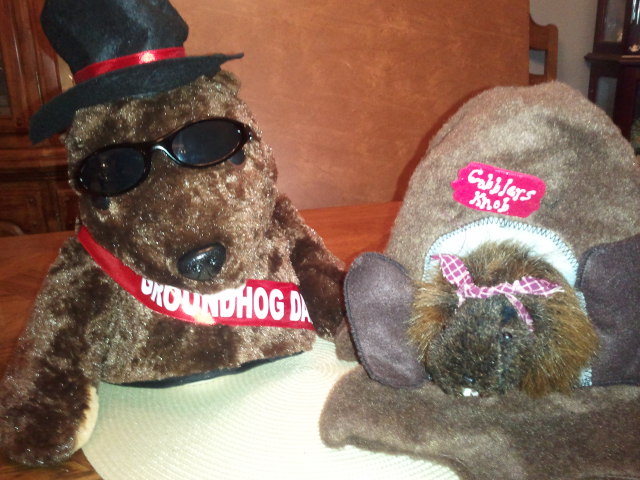
Happy Groundhog Day!  For over 225 years Phil has been the reigning prognosticator of Punxsutawney Pennsylvania perusing his property for signs of his shadow to predict the waning winter’s weather.

What began as an adaptation of Candlemas for the local farmers not too distantly removed from their German homeland now brings an estimated 30,000 people to the Pennsylvania home of Punxsutawney Phil for 4 days of planned events highlighted by the shadow sighting on national news broadcast across our homeland. 

Now here we could tell you all the different things one can do in Phil’s little hamlet.  Who will be playing, singing, dancing, and crafting.  We could guess how many television cameras will be in use.  We could compare the last 2, 5, 10, 25, 100, 150, or 200 predictions and the actual results.  We could talk about the Punxsutawney Groundhog Club or The Inner Circle.  But really, you don’t need to hear from us if last year’s prediction was on the money or how much money the park vendors made. 

Nope, we’re just going to marvel at all that has become of our little rodent friend and all of his friends living in the sunny or shadowy mountains on the edge of the Allegheny National Forest.  Phil has his own official souvenir web-site.  The Inner Circle (those are the guys who pull him from the stump, we mean help him from his hollow) have an annual formal ball.  There are 60 chapters of the Groundhog Club from California to Florida and chapters in Canada, England, and Iraq.  There’s even an Internet chapter.  (The Bluegrass Chapter of Louisville, Kentucky was chartered on Feb. 2 2002, that’s 02-02-02.  There’s a lottery number waiting to be played!)  Other than the iconic “Groundhog Day” movie there isn’t much in the way of multimedia for our little friend but we did find 5 songs celebrating Groundhog Day including “Groundhog Blues” by John Lee Hooker. 

Unlike Candlemas in the 17th century we really don’t need Groundhog Day to tell us if we’re almost done with winter and can breathe a sigh of relief over our dwindling food and firewood supply or if the cold will stay with us for another 6 weeks and challenge our larder.  Groundhog Day in the 21st century is a time when grown men dress in formal attire and play with field animals, when people gather to figure out just how long Phil Conners (Bill Murray’s character in “Groundhog Day”) was stuck in Punxsutawney, when people get married in Phil’s Wedding Chapel  by the mayor of Punxsutawney (weddings on the half-hour, call ahead to get on the schedule), when it’s ok to be seen in public with a hat on your head that looks like a groundhog emerging from a tree stump.

It’s a time when it’s perfectly acceptable not to take yourself too seriously.  And we could probably use six more weeks of that.

Now, that’s what we think.  Really.  How ‘bout you?


Unreal

We’re at a dull time of the month.  We’ve past New Year’s, escaping once again without resolution.  (See “Be It Resolved” posted January 2 under LIFE for why we’ll be making our resolutions sometime in March.)  And we’re not yet up to Groundhog Day, the best holiday of the year throughout the world.  It is a good time to think about what we did last year and will be able to afford those luxuries again this year (insert sound effect of wild laughter).  

What we ended up deciding it that what we really need is for someone to discover us and turn us into a reality show.  Then it wouldn’t matter if we could afford the trip to the edge of the volcano in Hawaii, the edge of the glacier in Alaska, and/or the edge of fashion in Milan. The producers would pick up those tabs while they continued to insist that this is a quite ordinary vacation for a middle class family with 12 kids and one income.

Maybe we aren’t being fair.  Just because we started this blog on an urge to make certain the world knows reality, on average, doesn’t come with hot air balloons, recording contracts, and rehab doesn’t mean every courageous exploration of everyday life on TV is actually scripted fiction casted with diligence and care – or first come first served.  So we took a look at what passes for reality shows today and most recently to make sure we weren’t wrong.  So in no particular order, and not at all a complete review, here is what TV would want you to consider reality.

Gold Rush – Three gold mines in Alaska.  One manned by people who put their real lives with real jobs and real bills and real families on hold while they trek to the Yukon for a few months to play with thousands of dollars of equipment we aren’t sure how any got paid for so they could dig up 8 ounces of gold.  One manned by a guy who was supposed to help out group #1 but instead stole their claim.  One manned by a 17 year old when school is out and a 92 year old when it isn’t.  Just a normal day in the 49th state.

Tabatha Takes Over – A lady hairdresser revamps failing salons while she sports a blonde from a box boy cut, deathly pale complexion, eyelashes the length somewhere between long and you’ve-got-to-be-kidding, and a strong penchant for a black wardrobe.

Jersey Shore – Twenty-somethings try to make complete sentences out of swear words and body parts.

Say Yes to the Dress – Mostly (though not all) brides-to-be start looking at wedding dresses that cost more than Either of We’s current vehicles’ blue book values but talked into spending more because it’s their one special day, including those who are doing it for the third time.

Ice Road Truckers – Even more testosterone than the Deadliest Catch and not as well contained.

Extreme Couponing – People fill 4 shopping carts, hang out at the cash register while management spends several hours on the phone with company computer guru to unfreeze the restrictive software, and then pay with coupons and pocket change.  Except for one shopper who donated all his booty to the local food bank we are left to wonder what these people do with all that stuff.

Finding Bigfoot – Like “Moonshiners,” the title speaks for itself.

Hoarders – People never throw anything away, actually more accurately people who use their houses as garbage cans and throw everything away.

American Pickers – Two guys travel the country making money off the hoarders.

That’s just a small sampling.  There are so many more with equally impossible storylines.   Where did they all come from?  We think we might have figured that out.  It seems nothing is new, just re-worked.  Find something from years ago, clean it up, repackage it, sell it to the unsuspecting, and make a fortune.  Not unlike Pawn Stars.  With that in mind, here is our list of some of today’s more popular shows and their not quite obvious inspirations.

The Bachelor – the Dating Game with sex and hot-tubs over an eight week run.

Dancing with the Stars – American Bandstand with out of work actors and celebrity wannabes.

Celebrity Rehab – Candid Camera with out of work actors and celebrity wannabes.

Storage Wars – Let’s Make a Deal with somebody else’s money.

Man vs. Wild – the American Sportsman got lost on the way to the hunting cabin.

Real Housewives of [Wherever] – To Tell the Truth.  Please.

COPS – Dragnet, still with stories about to heard that are true but with faces blurred rather than names changed to protect the innocent.

American Idol – The Miss America Pageant without the swimsuit competition.

Somehow these and others like them stay on the air.  They are making money for their networks and bringing viewers to their sponsors.  There really are people tuning in every week to see what secret a housewife can dig up on her best friend forever, how often mom and daughter can go into labor together, how many times a 20-something can use the f-word in one sentence.  There really are people who care about them all. 

Or maybe everybody is watching just to see the volcano up close from the edge.  And privately hoping someone, anyone, falls in.

Now, that’s what we think.  Really.  How ‘bout you?