After last week’s mini diatribe (would that be a monotribe?) I started thinking about word usage more than usual. As one who writes and speaks, words are my tools, and usage has to be precise if I expect to be understood. I decided if I could bump off any word, have it struck from all dictionaries, pulled from thesauri, and eliminated from internet searches, the one that stands out more than any other as offensive to my ears, more so than even the inappropriate use of weaponize, practicability, and disenfranchisement that will escalate over the next 15 months, that one word would be “hack” when used as a tip, hint, or suggestion. (A word I’d like you to consider not considering is “run-on” as in sentence.)
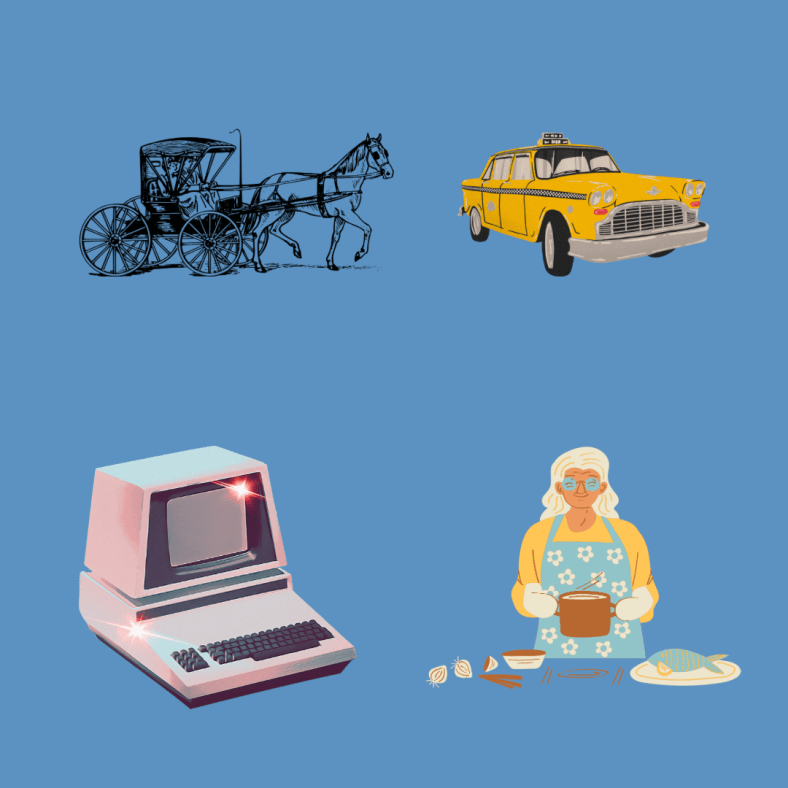
The word hack comes to us from Middle English, hakeney, a horse used for riding. It has been in common use as hackney, a horse of small stature appropriate for riding or pulling a small carriage (versus one used for plowing or pulling wagons) since the 1600s, perhaps earlier. Hack, the obviously shortened version, it along with its adjectival form hackneyed, almost immediately took on more sinister uses.
The hackney pulled carriages became a favorite for rides for hire throughout London, the horse and carriage combination commonly called a hack (which is why we still call taxis, cars for hire, hacks), and anything or anyone offering himself or his property out for hire, also was considered a hack. At this same time, the hackney pulled carriages became so prolific, hackneyed was coined to describe anything commonplace.
Hack continued to grace the pages of English dictionaries as a carriage or vehicle for hire or, in a pejorative way, one of common upbringing, skills, or expectations, and it continued without much controversy as such until Americans got involved. Through the early twentieth century, hacks here were also cabs and commoners but we expanded hack to refer to one who did the bare minimum to earn his pay in almost any field, whether a hack writer or a hack surgeon. And then, just about mid-century, something weird happened. Hack took its turn as a verb in American verbiage, as in, “That’s too much for me, I just can’t hack it anymore.” And that may (MAY) be its entry into computerese.
Mid-century computer programming was a long, difficult, and often trial and error experience. Those who were successful at programming proudly claimed they could hack it. And hack, hacker, and hacking became positive references to those proficient with the inner workings of computers and programming languages. About the time Matthew Broderick was changing grades for him and his high school sweetie, hacking with reference to computers, regained its negative connotation.
None of this explains why today, hack is synonymous with a handy dandy household hint. Etymologically there is no connection. Yet today there will be no less than 48 billion headlines in cyberspace addressing life hacks, kitchen hacks, productivity hacks, dating hacks, health and beauty hacks, and probably hacking hacks. Perhaps 48 billion is a tad hyperbolic. I’ll check for a writing hack on how to get large numbers across in dramatic fashion.
Perhaps it is as one Quorum user suggests, “It sounds edgier. “Tips” are merely interesting and useful. “Hacks” sounds as though you’ve been devious and insightful, perhaps even forbidden. “Hacker” used to be somebody with exceptional skill at computers. “Hacking in” to a computer system was something that required a lot of knowledge and cleverness. “Hacks” carries some of that sense of astuteness, along with some of that sense of having inside information that others don’t have. So it makes people feel important.” He goes on to say, “To me they just sound like a…” but I’ll stop there. This is a family blog. I’d had to get hacked and have my posting privileges revoked.
Etymologically, bias is assuming something. Cognitive biases, nobody listening or discussing, assumes outcomes based on past behavior and can have significant consequences. In the most recent Uplift!, we discuss how with respectful communication we can live, work, and play well together. Take 4 minutes to read it and see if you agree.
 The Real Reality Show Blog
I LOVE THIS~~!~~~! Sorry about the caps. But I felt like some emphasis! 😉
Thank you!! Emphasis appreciated!
GrammarMichael, I love your ability to share worthwhile information with a sense of humor and a plethora of facts. I’ve read enough Old English literature to remember the word “hackney” as the small horse. But the fact that it’s been hijacked by our computer age and helpful hints is a sad reflection that we use words as we choose and don’t give a flying fig about what they really mean. Vocabulary isn’t respected; neither is spelling. Thanks for my morning insights and grins. I so enjoy your thoughts.
Thank you Dayle. Of course you’re spot on that vocabulary, the words we chose to use, is not respected. Nor are the things those words represent. If you don’t respect the word, you aren’t giving to care what words mean. It’s why we now have to spend so much time figuring out what part of what we hear is just a straight up lie, said to make us feel good or connected. Fortunately there are enough like you that are easy to listen to because you do know what you mean when you say something and mean it when you say it.
So many reasons why I enjoy you.
And I you 🙂
Fascinating! I never thought about any of this — but immediately wondered about the family-owned restaurant in our area, “Hackney’s” that’s since closed (they had a few locations for decades, serving Reuben sandwiches, burgers on rye bread and onion rings). We loved the place and purchased an antique wrought-iron doo-dad when they sold one of their old restaurants and the contents. Maybe the family, once upon a time, worked with small horses – ‘hackneys’? 😉
Now I want a Reuben! And yes, it could be the family once worked with those little horses. So many surnames have been derived from what someone did or grew, or from where they came. Or maybe they just liked the word. I already have the name I like picked out and ready to put in lights just in case I hit it big on Broadway when I grow up! 😄
Yay for all of that! Reubens to celebrate! 😎
What an interesting etymological lesson, Michael. My 8-year-old loves to talk about “hacks” and I’d never stopped to wonder where it came from. Thank you!
Th am you, but even after all that I wrote, I’m still wondering where the modern hack came from, but I do love the horse part.
Yes, still a mystery. Maybe a shortcut taken by said horses?
Perhaps so! 🐴