Once again I had a hard time deciding what thoughts to put out to the interworld. I had what I thought an absolutely timely and terrific piece and then all sorts of things came up from politically correcting toys that have no business being the subject of political correctness to speeches espousing incorrectness by people who have no business in politics. Wedged in between were musings on the Golden Globes, the Grammy Awards, and long wait for this year’s Oscars. Then if that wasn’t enough, I’ve been without a phone for the entire weekend which demonstrated how little difference it made in my life but also gave me a brief respite from the onslaught of what has become the extended car warranty spam/scam/abomination.
In the end I decided to go with my first thought even though I had to think so many times before I got there. That first thought was to join the world in celebrating March as Women in History month. There are so many women in history we can make note of, your location, profession, career, passion, and cultural background undoubtedly coloring your idea of the most significant women in history. Marie Curie, Marie Antoinette, Clara Barton, Clara Bow, Cleopatra, Cleo Wade, Sandra Day O’Connor, Doris Day, Sandra Oh; Eve, Sarah, Esther, and Mary. From Lucy to Siri women are history.
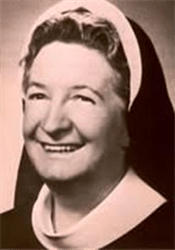 The women in our own histories will always be the most important women in our lives. Our mothers and grandmothers, aunts and honorary aunts, teachers, coaches, students, and teammates. And for almost everybody, there is that one person you did not even realize would become a part of your history yet found a way to be part of much of your life without actually being there. For me that woman is Mary Gonzales Duffy, RSM.
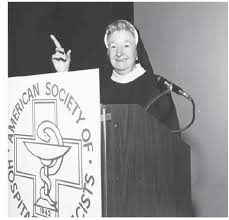
Sister Gonzales was a Religious Sister of Mercy. She was already a force in hospital pharmacist when I opened the mail and dug out my pharmacy intern certificate in 1975. If you have ever been a patient in a hospital and received a drug while you were there you benefited from some contribution of Sister. Sister Gonzales was one of those women who did not contribute to the history of pharmacy, she is the history of pharmacy, particularly hospital pharmacy. In 1962 working with the Mercy Hospital of Pittsburgh and Duquesne University School of Pharmacy she established the first postgraduate, academic residency in Hospital Pharmacy. She formalized drug information services, unit dose distribution methods, and pharmacy consultation services. In 1978 she was elected the first woman president of the American Society of Hospital Pharmacists (now American Society of Health System Pharmacists). That same year she was honored by Duquesne University at their centennial celebration as one of the top 100 alumni.
More than just a collection of her accomplishments in hospital pharmacy, Sister’s legacy reflects her gentleness and respect for those she served, as a pharmacist, as a nun, as a complete person. Sister was still working during my undergraduate years at Duquesne. Even when she received the Harvey A. K. Whitney Award, what is considered hospital pharmacy’s most prestigious award, in 1971, she was just Sister in the pharmacy moving it from a “service of things to a service of people.” Important women in hospital pharmacy are not uncommon, nor is acknowledging them. By the time Sister received her honor in 1971 she was in a long list of women so recognized going to 1953 in an award established just 3 years earlier. Still, she is the one I remember, the one who taught at the school where I learned, who lead the first hospital pharmacy I saw from inside its walls, the one who encouraged me and other young white coated future pharmacists to serve from the outside those walls.
Sister Gonzales closed her Whitney lecture with, “There are some in our modern society who claim we live in an age of insensitivity. Perhaps we do, but I hope not. There should be no taboo on tenderness. … May we be mindful of the fact that our Creator, who has placed us here on earth to do a work, touches the world mainly through the ministration of human services. We labor in an atmosphere where frequently good must battle evil, where some must suffer and die. May it be our happy task to ease the ways of all those for whom we care. May we be brought to the realization that true happiness is found in the knowledge that a job assigned to us here and at this point in time has been a job well done.”
Hers was a job done well, her job as a pharmacist, as a teacher, as a religious, as a part of history.
 The Real Reality Show Blog
I love that thought–there is no taboo on tenderness. Sister Gonzales was a force to be reckoned with because she was embraced herself by a Force of love. Thanks for sharing this, Michael. Celebrating the unsung heroes of life is a worthy cause.
She was a force. We all have one, we might even be one to somebody. We should celebrate them often and. It wait for some special month to remind us of that.
A fitting tribute.
Thank you…she was one fitting of a tribute!